Recognition: unknown
Light Deflection and Greybody Bound Around a BTZ-ModMax Black Hole in Plasma Medium
Pith reviewed 2026-05-08 16:39 UTC · model grok-4.3
The pith
The deflection angle of light in plasma around a BTZ-ModMax black hole is modified by plasma dispersion and the nonlinear electrodynamics parameter, as derived using the Gauss-Bonnet theorem.
A machine-rendered reading of the paper's core claim, the machinery that carries it, and where it could break.
Core claim
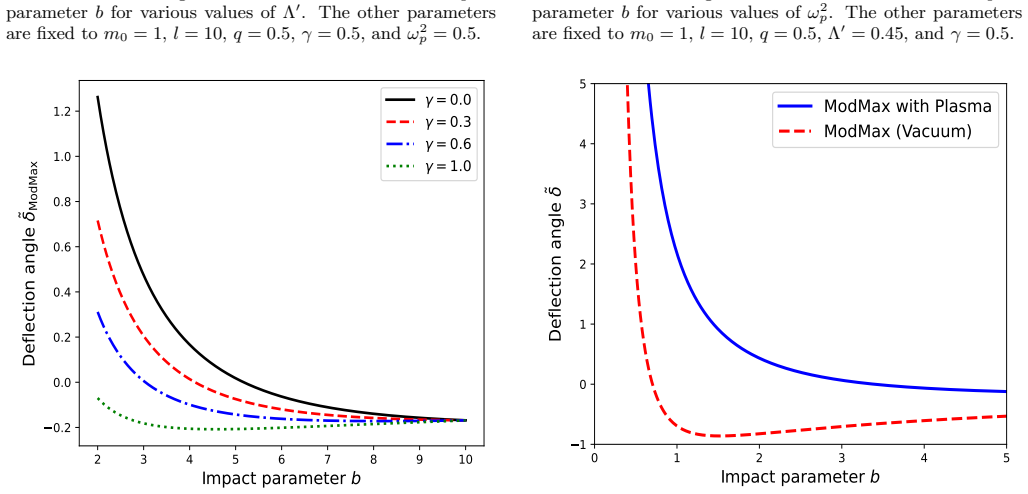
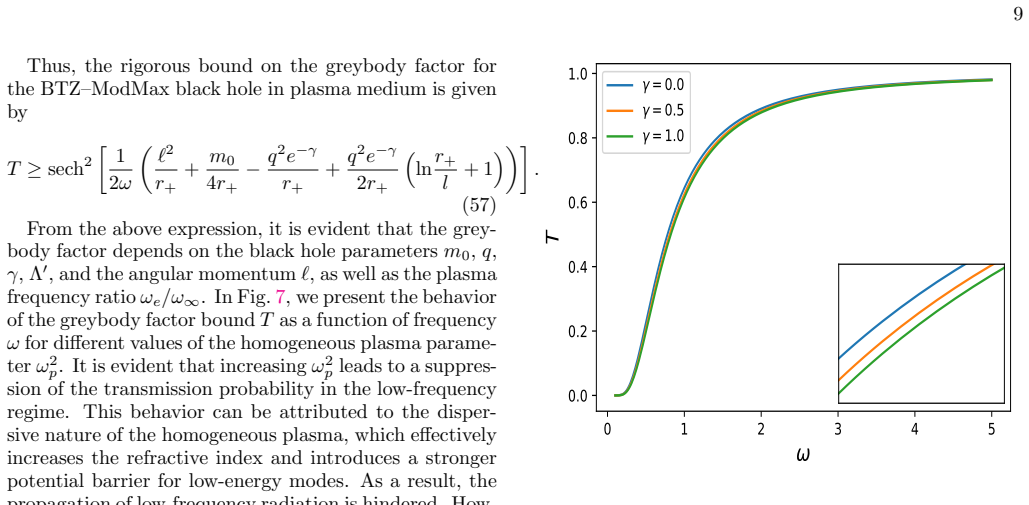
The central claim is that applying the Gauss-Bonnet theorem to the optical geometry in homogeneous plasma yields a modified deflection angle for the BTZ-ModMax black hole that depends on the plasma frequency, the ModMax parameter, and the cosmological constant. This angle differs from its vacuum counterpart and from that of charged static BTZ black holes. Additionally, the greybody factor is modified by the combined presence of plasma and the ModMax parameter, which in turn affects the transmission probabilities and the black hole's energy emission spectrum.
What carries the argument
The optical metric in homogeneous plasma constructed from the BTZ-ModMax black hole geometry, allowing use of the Gauss-Bonnet theorem to calculate light deflection.
If this is right
- Plasma effects and the ModMax parameter produce distinct changes in the gravitational lensing behavior.
- Compared to vacuum, the deflection angle shows the influence of nonlinear electrodynamics in plasma.
- Greybody factors are altered, changing wave transmission probabilities.
- Energy emission rates are influenced, providing insight into observational signatures.
Where Pith is reading between the lines
- These results suggest that plasma environments could be used to test nonlinear electrodynamics models around black holes.
- Similar optical geometry methods could apply to other black hole metrics in plasma.
- The findings might connect to studies of wave propagation in curved spacetimes with media.
Load-bearing premise
The assumption that the optical geometry for light in homogeneous plasma around the BTZ-ModMax black hole can have the Gauss-Bonnet theorem applied directly without extra corrections.
What would settle it
An independent calculation of the deflection angle by solving the geodesic equation in the metric with plasma refractive index and finding disagreement with the derived expression.
Figures



read the original abstract
We study the deflection of light in a homogeneous plasma medium around a BTZ-ModMax black hole, focusing on the effects of the ModMax nonlinear electrodynamics parameter and the cosmological constant. Using the Gauss-Bonnet theorem applied to the corresponding optical geometry in plasma, we derive a modified expression for the deflection angle and examine how plasma dispersion alters the gravitational lensing behavior. The influence of the ModMax parameter in the presence of homogeneous plasma is compared with its vacuum counterpart, as well as with the charged and static BTZ black hole cases, revealing distinct signatures arising from nonlinear electrodynamics. This work highlights the combined impact of homogeneous plasma, spacetime curvature, and nonlinear field dynamics on light deflection in lower-dimensional black hole geometries. We further study the greybody factor and analyze how the presence of homogeneous plasma and the ModMax parameter modifies the energy emission spectrum of the black hole. Our results demonstrate that both plasma effects and nonlinear electrodynamics significantly influence the transmission probabilities and emission rates, providing deeper insight into wave propagation and observational signatures in lower-dimensional black hole geometries.
Editorial analysis
A structured set of objections, weighed in public.
Referee Report
Summary. The manuscript derives a modified deflection angle for light in a homogeneous plasma medium around a BTZ black hole modified by ModMax nonlinear electrodynamics, by constructing an optical metric and applying the Gauss-Bonnet theorem. It compares the results to the vacuum and charged BTZ cases, and further computes greybody factors to analyze modifications to the energy emission spectrum due to plasma and the ModMax parameter, concluding that both effects significantly alter transmission probabilities and emission rates in lower-dimensional geometries.
Significance. If the central derivations are placed on a sound footing, the work would offer concrete expressions for lensing and greybody modifications in 3D AdS black holes with plasma and nonlinear electrodynamics, allowing direct comparison across parameter choices and potentially informing analog models. The explicit contrasts with static and charged BTZ solutions provide a useful baseline for isolating the ModMax and plasma signatures.
major comments (2)
- [Abstract] Abstract and the deflection-angle derivation: the optical metric is obtained by rescaling the BTZ-ModMax line element with the homogeneous-plasma refractive index and the Gauss-Bonnet theorem is then invoked directly; because the spacetime is asymptotically AdS, the optical metric does not approach Minkowski at large r, so the standard domain integral receives additional boundary contributions at the AdS boundary that are absent in the asymptotically flat derivations cited in the literature. No indication is given that these terms have been evaluated or that an alternative limiting procedure has been adopted.
- [Greybody analysis] Greybody-factor section: plasma enters the wave equation through an ad-hoc refractive-index modification whose relation to the optical metric employed for the null geodesics is not demonstrated; without this consistency check the combined treatment of deflection and greybody bounds rests on two distinct effective descriptions of the same plasma that may not be compatible.
minor comments (1)
- The abstract states that results are compared with the charged and static BTZ cases but does not specify which limiting values of the ModMax parameter recover those geometries; adding an explicit statement would clarify the scope of the claimed distinct signatures.
Simulated Author's Rebuttal
We thank the referee for their careful reading of our manuscript and for providing constructive feedback. We have addressed each of the major comments below and will incorporate the necessary revisions to improve the clarity and rigor of our derivations.
read point-by-point responses
-
Referee: [Abstract] Abstract and the deflection-angle derivation: the optical metric is obtained by rescaling the BTZ-ModMax line element with the homogeneous-plasma refractive index and the Gauss-Bonnet theorem is then invoked directly; because the spacetime is asymptotically AdS, the optical metric does not approach Minkowski at large r, so the standard domain integral receives additional boundary contributions at the AdS boundary that are absent in the asymptotically flat derivations cited in the literature. No indication is given that these terms have been evaluated or that an alternative limiting procedure has been adopted.
Authors: We thank the referee for pointing out this subtlety. The application of the Gauss-Bonnet theorem to the optical metric in asymptotically AdS spacetimes indeed requires careful consideration of the boundary terms at infinity. In the revised version of the manuscript, we will include an explicit calculation of these boundary contributions at the AdS boundary. We will demonstrate that they can be properly accounted for by adopting a suitable limiting procedure, thereby justifying the deflection angle expression used in our work. revision: yes
-
Referee: [Greybody analysis] Greybody-factor section: plasma enters the wave equation through an ad-hoc refractive-index modification whose relation to the optical metric employed for the null geodesics is not demonstrated; without this consistency check the combined treatment of deflection and greybody bounds rests on two distinct effective descriptions of the same plasma that may not be compatible.
Authors: We acknowledge the need to establish consistency between the two treatments of the plasma. The refractive index modification is derived from the same plasma dispersion relation in both cases. In the revision, we will add a discussion showing how the optical metric corresponds to the high-frequency limit of the wave equation with the plasma term, ensuring compatibility. This will include a brief derivation linking the effective potential in the greybody calculation to the optical geometry. revision: yes
Circularity Check
No significant circularity; standard GB application to plasma optical metric is independent of inputs
full rationale
The derivation applies the Gauss-Bonnet theorem directly to an optical metric obtained by rescaling the given BTZ-ModMax line element with the homogeneous plasma refractive index. This is a standard external technique (not derived within the paper) and produces a deflection angle expression that depends on the metric parameters and plasma frequency without reducing to a self-definition or fitted quantity. Greybody factors are obtained from the wave equation in the same background with plasma modification; the transmission probabilities are computed outputs rather than predictions forced by construction. No self-citations are invoked to justify uniqueness of the method or to smuggle ansatze, and the AdS asymptotics are handled via the explicit metric without boundary-term redefinitions that collapse to inputs. The chain remains self-contained against external mathematical tools and the provided spacetime.
Axiom & Free-Parameter Ledger
free parameters (2)
- ModMax nonlinear electrodynamics parameter
- Plasma density or frequency parameter
axioms (1)
- standard math Gauss-Bonnet theorem applies directly to the optical geometry constructed from the plasma-modified metric
Reference graph
Works this paper leans on
-
[1]
Einstein, Relat
A. Einstein, Relat. Theory Ann. Phys49, 769 (1916)
1916
-
[2]
Chandrasekhar, The mathematical theory of black holes, Vol
S. Chandrasekhar, The mathematical theory of black holes, Vol. 69 (Oxford university press, 1998)
1998
-
[3]
J. M. Bardeen, Nature226, 64 (1970)
1970
-
[4]
Witten, Nuclear Physics B323, 113 (1989)
E. Witten, Nuclear Physics B323, 113 (1989)
1989
-
[5]
Cardenas, O
M. Cardenas, O. Fuentealba, and C. Martinez, Physical Review D90, 124072 (2014)
2014
-
[6]
Kruglov, Physics Letters B822, 136633 (2021)
S. Kruglov, Physics Letters B822, 136633 (2021)
2021
-
[7]
S. M. Kuzenko and E. S. Raptakis, Physical Review D 104, 125003 (2021)
2021
-
[8]
Avetisyan, O
Z. Avetisyan, O. Evnin, and K. Mkrtchyan, Physical Re- view Letters127, 271601 (2021)
2021
-
[9]
S. H. Hendi, B. E. Panah, S. Panahiyan, and M. Hassaine, Physical Review D98, 084006 (2018)
2018
-
[10]
G. G. L. Nashed and S. Capozziello, International Jour- nal of Modern Physics A33, 1850076 (2018)
2018
-
[11]
B. Mu, J. Tao, and P. Wang, Physics Letters B800, 135098 (2020)
2020
-
[12]
Canate, D
P. Canate, D. Magos, and N. Breton, Physical Review D 101, 064010 (2020)
2020
-
[13]
B. E. Panah, Fortschritte der Physik71, 2300012 (2023)
2023
-
[14]
Karakasis, G
T. Karakasis, G. Koutsoumbas, and E. Papantonopoulos, Physical Review D107, 124047 (2023)
2023
-
[15]
B. E. Panah, M. Khorasani, and J. Sedaghat, European Physical Journal Plus138, 728 (2023)
2023
-
[16]
S. L. Jaki, Foundations of Physics8, 927 (1978)
1978
-
[17]
C. G. Darwin, Proceedings of the Royal Society of Lon- don. Series A. Mathematical and Physical Sciences249, 180 (1959)
1959
-
[18]
F. Quan, Z.-W. Xia, R. Ding, Q. Pan, and J. Jing, Quasi- normal modes and AdS/CFT correspondence of a rotat- ing BTZ-like black hole in the Einstein-bumblebee grav- ity (2026), arXiv:2603.25470 [gr-qc]
-
[19]
S. Upadhyay, S. Mandal, Y. Myrzakulov, and K. Myrzakulov, Annals Phys.450, 169242 (2023), arXiv:2303.02132 [gr-qc]
-
[20]
Kala, International Journal of Geometric Methods in Modern Physics , 2650100 (2025)
S. Kala, International Journal of Geometric Methods in Modern Physics , 2650100 (2025)
2025
-
[21]
Eslam Panah, Contributions of Science and Technol- ogy for Engineering1, 25 (2024)
B. Eslam Panah, Contributions of Science and Technol- ogy for Engineering1, 25 (2024)
2024
-
[22]
Javed, A
F. Javed, A. Waseem, S. Sadiq, and G. Mustafa, Eur. Phys. J. C85, 93 (2025)
2025
-
[23]
de la Fuente and R
A. de la Fuente and R. Sundrum, Journal of High Energy Physics2014, 1 (2014)
2014
-
[24]
S. V. Iyer and A. O. Petters, General Relativity and Gravitation39, 1563 (2007). 11
2007
-
[25]
P. V. P. Cunha and C. A. R. Herdeiro, General Relativity and Gravitation50, 42 (2018)
2018
-
[26]
G. Mustafa, F. Atamurotov, I. Hussain, S. Shayma- tov, and A. ¨Ovg¨ un, Chin. Phys. C46, 125107 (2022), arXiv:2207.07608 [gr-qc]
-
[27]
Atamurotov, O
F. Atamurotov, O. Yunusov, A. Abdujabbarov, and G. Mustafa, New Astron.105, 102098 (2024)
2024
-
[28]
S. Kala, H. Nandan, and P. Sharma, Modern Physics Letters A35, 2050323 (2020)
2020
-
[29]
S. Kala, H. Nandan, and P. Sharma, European Physical Journal Plus137, 457 (2022)
2022
-
[30]
S. Kala, H. Nandan, A. Abebe, and S. Roy, European Physical Journal C84, 1089 (2024)
2024
- [31]
-
[32]
S. V. Iyer and A. O. Petters, General Relativity and Gravitation39, 1563 (2007)
2007
-
[33]
Broderick and R
A. Broderick and R. Blandford, Monthly Notices of the Royal Astronomical Society342, 1208 (2003)
2003
-
[34]
Biˇ c´ ak and P
J. Biˇ c´ ak and P. Hadrava, Astronomy and Astrophysics 44, 389 (1975)
1975
-
[35]
Kichenassamy and R
S. Kichenassamy and R. A. Krikorian, Physical Review D32, 1866 (1985)
1985
-
[36]
R. A. Krikorian, Astrophysics42, 338 (1999)
1999
-
[37]
J. L. Synge, Relativity: The General Theory (North- Holland Publishing Company, Amsterdam, 1960)
1960
- [39]
- [40]
-
[41]
V. Perlick and O. Y. Tsupko, Phys. Rev. D95, 104003 (2017), arXiv:1702.08768 [gr-qc]
-
[42]
S. Kala and J. Singh, Eur. Phys. J. C85, 1047 (2025), arXiv:2507.17280 [gr-qc]
-
[43]
S. Roy, S. Kala, S. Modak, H. Nandan, and A. Abebe, Gravitational lensing around a Kerr-Sen black hole in plasma background (2026), arXiv:2604.11860 [gr-qc]
work page internal anchor Pith review Pith/arXiv arXiv 2026
- [44]
-
[45]
Y. Pahlavon, F. Atamurotov, K. Jusufi, M. Jamil, and A. Abdujabbarov, Phys. Dark Univ.45, 101543 (2024), arXiv:2406.09431 [gr-qc]
-
[46]
Gibbons and M
G. Gibbons and M. Werner, Classical and Quantum Gravity25, 235009 (2008)
2008
-
[47]
A. ¨Ovg¨ un, Phys. Rev. D98, 044033 (2018), arXiv:1805.06296 [gr-qc]
-
[48]
D. N. Page, Physical Review D14, 3260 (1976)
1976
-
[49]
Boonserm and M
P. Boonserm and M. Visser, Physical Review D78, 101502 (2008)
2008
-
[50]
Dai and D
D.-C. Dai and D. Stojkovic, Journal of High Energy Physics2010, 016 (2010)
2010
-
[51]
Fernando, General Relativity and Gravitation37, 461 (2005)
S. Fernando, General Relativity and Gravitation37, 461 (2005)
2005
-
[52]
Mistry, S
R. Mistry, S. Upadhyay, A. F. Ali, and M. Faizal, Nuclear Physics B923, 378 (2017)
2017
-
[53]
Kanti and J
P. Kanti and J. March-Russell, Physical Review D66, 024023 (2002)
2002
-
[54]
Kanti, J
P. Kanti, J. Grain, and A. Barrau, Physical Review D 71, 104002 (2005)
2005
- [55]
-
[56]
Javed, M
W. Javed, M. Aqib, and A. ¨Ovg¨ un, Physics Letters B 829, 137114 (2022)
2022
-
[57]
A nonlinear duality-invariant conformal extension of Maxwell’s equations,
I. Bandos, K. Lechner, D. Sorokin, and P. K. Townsend, Phys. Rev. D102, 121703 (2020), arXiv:2007.09092 [hep- th]
- [58]
- [59]
- [60]
-
[61]
R. M. Corless, G. H. Gonnet, D. E. Hare, D. J. Jeffrey, and D. E. Knuth, Advances in Computational mathe- matics5, 329 (1996)
1996
-
[62]
Influence of a plasma on the shadow of a spherically symmetric black hole
V. Perlick, O. Y. Tsupko, and G. S. Bisnovatyi-Kogan, arXiv preprint arXiv:1507.04217 (2015)
work page Pith review arXiv 2015
- [63]
-
[64]
S. Kukreti, S. Kala, H. Nandan, F. Ahmed, and S. Roy, Nucl. Phys. B1019, 117124 (2025), arXiv:2507.15298 [gr-qc]
-
[65]
Gravitational bending angle of light for finite distance and the Gauss-Bonnet theorem,
A. Ishihara, Y. Suzuki, T. Ono, T. Kitamura, and H. Asada, Phys. Rev. D94, 084015 (2016), arXiv:1604.08308 [gr-qc]
-
[66]
R. A. Konoplya and A. Zhidenko, Rev. Mod. Phys.83, 793 (2011), arXiv:1102.4014 [gr-qc]
work page internal anchor Pith review arXiv 2011
-
[67]
P. Boonserm, S. Phalungsongsathit, K. Sansuk, and P. Wongjun, Eur. Phys. J. C83, 657 (2023), arXiv:2305.00459 [gr-qc]
-
[68]
Regge and J
T. Regge and J. A. Wheeler, Physical Review108, 1063 (1957)
1957
discussion (0)
Sign in with ORCID, Apple, or X to comment. Anyone can read and Pith papers without signing in.