Recognition: unknown
Beyond the Cosmological Constant: Breaking the Geometric Degeneracy of f(Q) cosmology via Redshift-Space Distortions
Pith reviewed 2026-05-10 15:40 UTC · model grok-4.3
The pith
The Hybrid f(Q) model matches LambdaCDM background expansion exactly but produces distinguishable signatures in structure growth via redshift-space distortions.
A machine-rendered reading of the paper's core claim, the machinery that carries it, and where it could break.
Core claim
By requiring the linear coupling to be unity to preserve early-universe structure formation, the Hybrid f(Q) model is fixed into geometric degeneracy with LambdaCDM at the background level. The geometric coupling in the perturbation sector then suppresses the effective gravitational constant at late times. When redshift-space distortion data is incorporated, an amplitude compensation mechanism occurs in which the clustering amplitude inflates to match the f sigma8 signature under weaker gravity. Statistical comparison yields a moderate to weak preference for the Hybrid model, providing a physically bounded alternative to LambdaCDM with a falsifiable large-scale structure signature.
What carries the argument
The Hybrid f(Q) model with its late-time 1/Q term, which enforces background degeneracy with LambdaCDM while inducing late-time suppression of the effective gravitational constant in the perturbation equations, thereby producing the amplitude compensation when RSD data is included.
If this is right
- Background probes alone leave the Hybrid model indistinguishable from LambdaCDM.
- Late-time suppression of effective gravity alters the rate of cosmic structure growth.
- Matching observed f sigma8 with RSD data forces an increase in the clustering amplitude sigma8.
- Incorporating growth data produces moderate to weak statistical preference for the Hybrid model via AIC and DIC.
- The setup yields a specific, falsifiable signature in large-scale structure for testing by upcoming surveys.
Where Pith is reading between the lines
- Future surveys could test the compensation mechanism by checking whether observed pairs of sigma8 and f sigma8 values follow the exact relation predicted under suppressed gravity.
- The same background-fixing strategy might be applied to other modified gravity models that match expansion history but differ in perturbations.
- Observational campaigns should prioritize precise growth-rate measurements over expansion history alone to distinguish such alternatives from the cosmological constant.
- The bounded parameter space in this model reduces the freedom compared to more general f(Q) variants, making its predictions more sharply testable.
Load-bearing premise
Early-universe structure formation must proceed exactly as in standard cosmology, which requires setting the linear coupling parameter to exactly unity before any perturbation analysis or data fitting.
What would settle it
A measurement from next-generation galaxy surveys that finds no inflation in the clustering amplitude sigma8 when the growth rate signature f sigma8 matches observations under conditions of suppressed effective gravity.
Figures



read the original abstract
We present a rigorous theoretical and observational analysis of the Hybrid $ f(Q) $ class of models by including the late-time modifying $ 1/Q $ term. After deriving strict viability conditions from the analytical expansion history, we show that preserving early-universe structure formation dictates that the linear coupling be exactly unity. This fixes the background of the Hybrid model into a geometric degeneracy with $ \Lambda $CDM which is confirmed explicitly through MCMC analysis with the latest background-only probes. The physical novelty of this model is manifest in the perturbation sector, where the geometric coupling breaks the background degeneracy and induces a late-time suppression of the effective gravitational constant $ G_{eff} < G_N $. Consequently, the inclusion of RSD data reveals an amplitude compensation mechanism, by which the matching of the signature $ f\sigma_8 $ of the data causes the clustering amplitude $ \sigma_8 $ to inflate under weaker gravity. Statistical model comparison through AIC/DIC demonstrates that incorporating growth data yields a moderate to weak preference for the Hybrid model keeping the background cosmology intact. This provides a physically bounded alternative to $ \Lambda $CDM with a falsifiable signature in the large scale structure, directly testable by the next generation of galaxy surveys.
Editorial analysis
A structured set of objections, weighed in public.
Referee Report
Summary. The manuscript analyzes a Hybrid f(Q) cosmological model incorporating a late-time 1/Q term. Analytical viability conditions derived from the expansion history require the linear coupling constant to be fixed exactly to unity in order to preserve early-universe structure formation. This choice enforces a geometric degeneracy with ΛCDM at the background level, which is then confirmed via MCMC sampling using background-only cosmological probes. In the perturbation sector the model produces a late-time suppression of the effective gravitational constant G_eff < G_N. Confrontation with redshift-space distortion (RSD) data reveals an amplitude-compensation mechanism in which the clustering amplitude σ8 increases to match the observed fσ8 signature under weaker gravity. Information-criterion comparison (AIC/DIC) indicates a moderate-to-weak statistical preference for the Hybrid model over ΛCDM once growth data are included, while the background cosmology remains unchanged. The work positions the model as a physically bounded, falsifiable alternative testable by forthcoming large-scale structure surveys.
Significance. If substantiated, the result supplies a concrete route to breaking the background-level geometric degeneracy that plagues many f(Q) extensions by exploiting the perturbation sector and RSD observables. The amplitude-compensation effect is a noteworthy physical feature that illustrates how modified gravity can remain consistent with certain growth signatures while altering the underlying clustering amplitude. The combination of analytical viability conditions, explicit MCMC verification of degeneracy, and conservative AIC/DIC reporting constitutes a strength; the model thereby offers a falsifiable signature for next-generation surveys without spoiling the background expansion history.
major comments (1)
- The fixing of the linear coupling constant to exactly unity (invoked to enforce early-universe consistency and background degeneracy) is load-bearing for the subsequent RSD analysis and the reported model preference. The manuscript should supply the explicit analytical derivation or viability equations demonstrating that any deviation from unity would violate early-universe constraints; without this step the conditional nature of the RSD fit and the AIC/DIC preference cannot be fully assessed.
minor comments (2)
- Ensure that the explicit functional form of G_eff in the Hybrid model, the predicted fσ8 evolution, and the full posterior corner plots from both background-only and RSD-inclusive MCMC runs are presented in the main text or supplementary material so that the amplitude-compensation claim and the information-criterion results can be directly verified.
- Clarify the precise data sets and covariance assumptions entering the AIC/DIC calculation; a brief table listing the ΔAIC and ΔDIC values together with the number of additional parameters would improve transparency of the moderate-to-weak preference statement.
Simulated Author's Rebuttal
We thank the referee for the careful and constructive review of our manuscript. We appreciate the positive assessment of the model's physical novelty in breaking the background degeneracy via the perturbation sector and RSD observables. We address the single major comment below.
read point-by-point responses
-
Referee: The fixing of the linear coupling constant to exactly unity (invoked to enforce early-universe consistency and background degeneracy) is load-bearing for the subsequent RSD analysis and the reported model preference. The manuscript should supply the explicit analytical derivation or viability equations demonstrating that any deviation from unity would violate early-universe constraints; without this step the conditional nature of the RSD fit and the AIC/DIC preference cannot be fully assessed.
Authors: We agree that the explicit step-by-step derivation is essential for transparency. Section 3 of the manuscript already derives the viability conditions from the analytical expansion history and demonstrates that the linear coupling must be fixed to unity to preserve early-universe structure formation. To fully address the referee's request, we will revise the manuscript by expanding this section with the complete analytical derivation, including all intermediate viability equations and the explicit demonstration that any deviation from unity leads to inconsistencies with early-universe constraints. This will clarify the conditional nature of the subsequent RSD analysis and statistical preference. revision: yes
Circularity Check
Amplitude compensation follows from fσ8 definition; background degeneracy imposed by construction before fitting
specific steps
-
self definitional
[Abstract]
"the inclusion of RSD data reveals an amplitude compensation mechanism, by which the matching of the signature fσ8 of the data causes the clustering amplitude σ8 to inflate under weaker gravity"
fσ8 is defined as the product of the growth rate f (suppressed when G_eff < G_N) and σ8. Fitting the model to observed fσ8 values therefore requires σ8 to rise whenever G_eff falls in order to keep the product fixed. The 'mechanism' is an algebraic identity of the observable rather than an independent result derived from the dynamics or data.
full rationale
The derivation sets the linear coupling exactly to unity via early-universe viability to enforce background degeneracy with ΛCDM, then confirms this degeneracy via MCMC on background data (expected by construction). The central novelty claim—that RSD data 'reveals' an amplitude compensation mechanism—is a direct algebraic consequence of the observable definition fσ8 ≡ f × σ8 together with G_eff suppression in the perturbation equations. No load-bearing self-citation or ansatz smuggling is present, and the AIC/DIC preference retains some independent content from the actual data fits. This produces moderate but not dominant circularity.
Axiom & Free-Parameter Ledger
free parameters (1)
- linear coupling constant
axioms (2)
- domain assumption Viability conditions derived from analytical expansion history must be satisfied for the model to be physically acceptable.
- domain assumption Linear perturbation theory and standard RSD modeling remain valid for the redshifts and scales used.
invented entities (1)
-
Hybrid f(Q) model with late-time 1/Q term
no independent evidence
Reference graph
Works this paper leans on
-
[1]
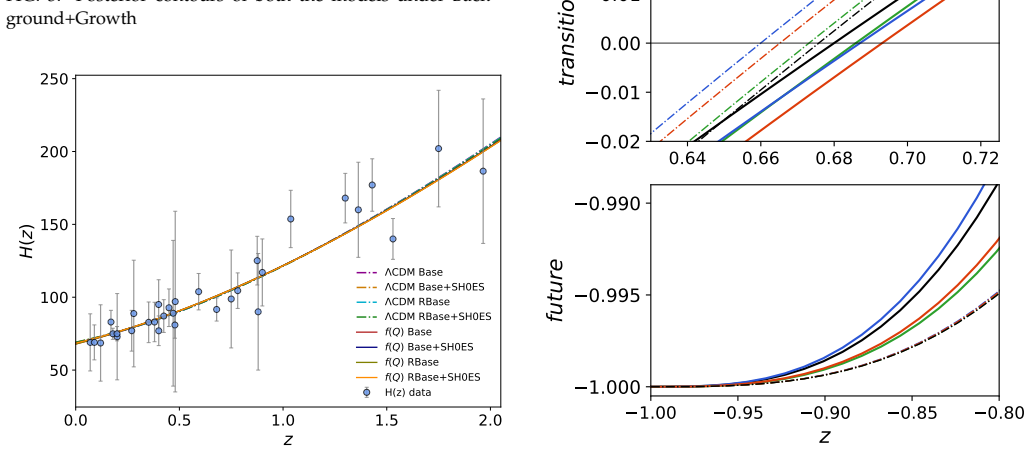
Background only probes This category employs two combinations - Base ( CC + SN + BAO) and Base + SH0ES. • Cosmic Chronometers - CC : We use 32 points of the Cosmic Chronometer H(z) measurements with 15 correlated and 17 uncorrelated data points 4 /uni00000014/uni00000013/uni00000013 /uni00000014/uni00000013/uni00000014 /uni00000014/uni00000013/uni00000015...
-
[2]
• Redshift-Space Distortion - RSD : In order to ex- plore the linear perturbation sector, we employ a compilation of growth data constraining f σ8 present in Table II of [45]
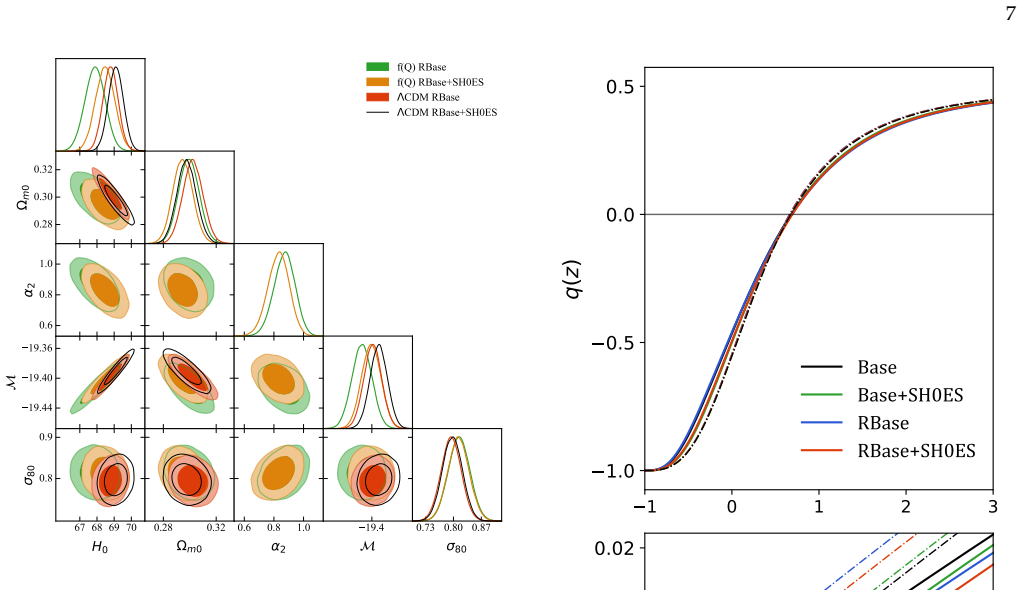
Growth data This category also employs two dataset combinations - RBase and RBase + SH0ES where RBase is Base + RSD. • Redshift-Space Distortion - RSD : In order to ex- plore the linear perturbation sector, we employ a compilation of growth data constraining f σ8 present in Table II of [45]. Both the growth rate f (a) = dln δm dlna and the clustering ampl...
-
[3]
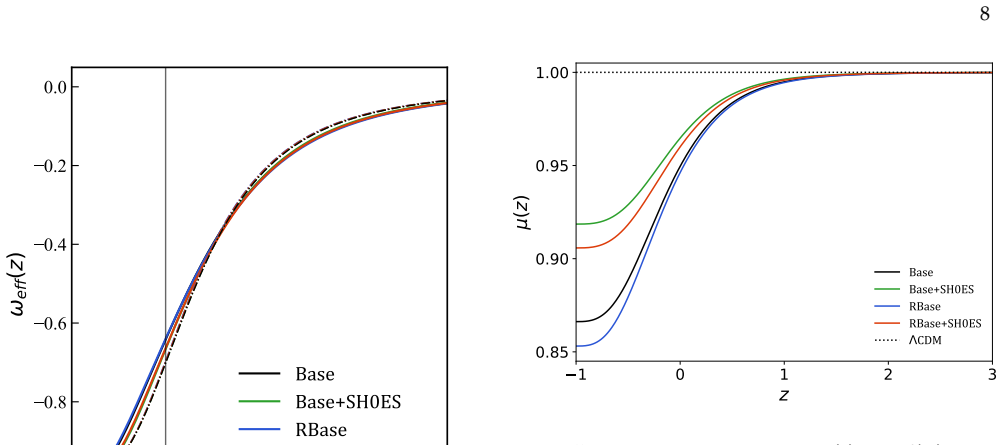
The suppressed gravity gives way to an immedi- ate consequence: the amplitude compensation mech- anism. Since structure formation takes longer under weaker gravity, the Hybrid model now compensates for this by inflating the late-time clustering amplitude σ80 /uni00000019/uni00000019/uni00000019/uni0000001b/uni0000001a/uni00000013 H0 /uni00000014/uni000000...
-
[4]
R. H. Cyburt, B. D. Fields, K. A. Olive, and T.-H. Yeh, Big Bang Nucleosynthesis: 2015, Rev. Mod. Phys. 88, 015004 (2016), arXiv:1505.01076 [astro-ph.CO]
work page Pith review arXiv 2015
-
[5]
Planck 2018 results. VI. Cosmological parameters
N. Aghanim et al. (Planck), Planck 2018 results. VI. Cosmological parameters, Astron. Astrophys. 641, A6 (2020), [Erratum: Astron.Astrophys. 652, C4 (2021)], arXiv:1807.06209 [astro-ph.CO]
work page internal anchor Pith review Pith/arXiv arXiv 2018
-
[6]
S. Alam et al. (eBOSS), Completed SDSS-IV extended Baryon Oscillation Spectroscopic Survey: Cosmological implications from two decades of spectroscopic surveys at the Apache Point Observatory, Phys. Rev. D103, 083533 (2021), arXiv:2007.08991 [astro-ph.CO]
-
[7]
A. G. Riess et al. (Supernova Search Team), Observational evidence from supernovae for an accelerating universe and a cosmological constant, Astron. J. 116, 1009 (1998), arXiv:astro-ph/9805201
work page internal anchor Pith review arXiv 1998
-
[8]
S. Perlmutter et al. (Supernova Cosmology Project), Mea- surements of Ω and Λ from 42 High Redshift Supernovae, Astrophys. J. 517, 565 (1999), arXiv:astro-ph/9812133
work page internal anchor Pith review arXiv 1999
-
[9]
Weinberg, The Cosmological Constant Problem, Rev
S. Weinberg, The Cosmological Constant Problem, Rev. Mod. Phys. 61, 1 (1989)
1989
- [10]
-
[11]
Coincident general relativity,
J. Beltr ´an Jim ´enez, L. Heisenberg, and T. Koivisto, Coin- cident General Relativity, Phys. Rev. D 98, 044048 (2018), arXiv:1710.03116 [gr-qc]
-
[12]
The geometrical trinity of gravity,
J. Beltr ´an Jim´enez, L. Heisenberg, and T. S. Koivisto, The Geometrical Trinity of Gravity, Universe 5, 173 (2019), arXiv:1903.06830 [hep-th]
-
[13]
J. Beltr ´an Jim ´enez, L. Heisenberg, T. S. Koivisto, and S. Pekar, Cosmology in f (Q) geometry, Phys. Rev. D 101, 103507 (2020), arXiv:1906.10027 [gr-qc]
-
[14]
L. Heisenberg, Review on f(Q) gravity, Phys. Rept. 1066, 1 (2024), arXiv:2309.15958 [gr-qc]
-
[15]
J. Beltr ´an Jim ´enez, L. Heisenberg, and T. S. Koivisto, Teleparallel Palatini theories, JCAP 08, 039, arXiv:1803.10185 [gr-qc]
- [16]
- [17]
- [18]
- [19]
-
[20]
R.-H. Lin and X.-H. Zhai, Spherically symmetric con- figuration in f (Q) gravity, Phys. Rev. D 103, 124001 (2021), [Erratum: Phys.Rev.D 106, 069902 (2022)], arXiv:2105.01484 [gr-qc]
-
[21]
N. Dimakis, A. Paliathanasis, and T. Christodoulakis, Quantum cosmology in f(Q) theory, Class. Quant. Grav. 38, 225003 (2021), arXiv:2108.01970 [gr-qc]
- [22]
-
[23]
L. Atayde and N. Frusciante, Can f (Q) gravity chal- lenge ΛCDM?, Phys. Rev. D 104, 064052 (2021), arXiv:2108.10832 [astro-ph.CO]
-
[24]
Signatures off(Q)gravity in cosmology,
N. Frusciante, Signatures of f (Q)-gravity in cosmology, Phys. Rev. D 103, 044021 (2021), arXiv:2101.09242 [astro- ph.CO]
- [25]
-
[26]
On the impact off(Q)gravity on the large scale structure,
O. Sokoliuk, S. Arora, S. Praharaj, A. Baransky, and P . K. Sahoo, On the impact of f(Q) gravity on the large scale structure, Mon. Not. Roy. Astron. Soc. 522, 252 (2023), arXiv:2303.17341 [astro-ph.CO]
- [27]
-
[28]
L. Atayde and N. Frusciante, f(Q) gravity and neutrino physics, Phys. Rev. D107, 124048 (2023), arXiv:2306.03015 [astro-ph.CO]
- [29]
-
[30]
S. Capozziello, M. Capriolo, and S. Nojiri, Gravitational waves in f(Q) non-metric gravity via geodesic deviation, Phys. Lett. B 850, 138510 (2024), arXiv:2401.06424 [gr-qc]
-
[31]
S. Capozziello and M. Capriolo, Gravitational waves in f(Q) non-metric gravity without gauge fixing, Phys. Dark Univ. 45, 101548 (2024), arXiv:2405.16163 [gr-qc]
- [32]
- [33]
-
[34]
Kolhatkar, S
A. Kolhatkar, S. S. Mishra, and P . K. Sahoo, Implications of cosmological perturbations of √Q in STEGR, Eur. Phys. J. C 85, 656 (2025)
2025
-
[35]
S. Capozziello, S. Cesare, and C. Ferrara, Extended ge- ometric trinity of gravity, Eur. Phys. J. C 85, 932 (2025), arXiv:2503.08167 [gr-qc]
-
[36]
N. S. Kavya, S. Swagat Mishra, and P . K. Sahoo, f(Q) grav- ity as a possible resolution of the H0 and S8 tensions with DESI DR2, Sci. Rep. 15, 36504 (2025)
2025
- [37]
-
[38]
Kolhatkar, P
A. Kolhatkar, P . Dalal, and P . K. Sahoo, Structural con- straints on interacting dark sector in ΛCDM-mimicking f(Q) gravity, Phys. Lett. B 876, 140397 (2026)
2026
- [39]
-
[40]
A. Kolhatkar, S. S. Mishra, and P . K. Sahoo, Investigating early and late-time epochs in f(Q) gravity, Eur. Phys. J. C 84, 888 (2024), arXiv:2409.01538 [gr-qc]
- [41]
-
[42]
Ortin, Gravity and Strings , 2nd ed., Cambridge Mono- graphs on Mathematical Physics (Cambridge University Press, 2015)
T. Ortin, Gravity and Strings , 2nd ed., Cambridge Mono- graphs on Mathematical Physics (Cambridge University Press, 2015)
2015
-
[43]
J. de Cruz Perez, C.-G. Park, and B. Ratra, Updated observational constraints on spatially flat and nonflat ΛCDM and XCDM cosmological models, Phys. Rev. D 110, 023506 (2024), arXiv:2404.19194 [astro-ph.CO]
-
[44]
The Pantheon+ Analysis: Cosmological Constraints
D. Brout et al. , The Pantheon+ Analysis: Cosmo- logical Constraints, Astrophys. J. 938, 110 (2022), arXiv:2202.04077 [astro-ph.CO]
work page internal anchor Pith review arXiv 2022
-
[45]
The Pantheon+ Analysis: The Full Dataset and Light-Curve Release
D. Scolnic et al., The Pantheon+ Analysis: The Full Data Set and Light-curve Release, Astrophys. J. 938, 113 (2022), arXiv:2112.03863 [astro-ph.CO]
work page internal anchor Pith review arXiv 2022
-
[46]
DESI DR2 Results II: Measurements of Baryon Acoustic Oscillations and Cosmological Constraints
M. Abdul Karim et al. (DESI), DESI DR2 Results II: Measurements of Baryon Acoustic Oscillations and Cos- mological Constraints, (2025), arXiv:2503.14738 [astro- ph.CO]
work page internal anchor Pith review arXiv 2025
-
[47]
A. G. Riess, S. Casertano, W. Yuan, L. M. Macri, and D. Scolnic, Large Magellanic Cloud Cepheid Stan- dards Provide a 1% Foundation for the Determina- tion of the Hubble Constant and Stronger Evidence for Physics beyond ΛCDM, Astrophys. J. 876, 85 (2019), arXiv:1903.07603 [astro-ph.CO]
-
[48]
G. Alestas, L. Kazantzidis, and S. Nesseris, Machine learning constraints on deviations from general relativity from the large scale structure of the Universe, Phys. Rev. D 106, 103519 (2022), arXiv:2209.12799 [astro-ph.CO]
-
[49]
Foreman-Mackey, D
D. Foreman-Mackey, D. W. Hogg, D. Lang, and J. Good- man, emcee: The mcmc hammer, Publications of the As- tronomical Society of the Pacific 125, 306–312 (2013)
2013
-
[50]
GetDist: a Python package for analysing Monte Carlo samples,
A. Lewis, GetDist: a Python package for analysing Monte Carlo samples, JCAP 08, 025, arXiv:1910.13970 [astro- ph.IM]
discussion (0)
Sign in with ORCID, Apple, or X to comment. Anyone can read and Pith papers without signing in.