Recognition: unknown
Sensitivities of Black Hole Images from GRMHD Simulations
Pith reviewed 2026-05-10 16:29 UTC · model grok-4.3
The pith
Automatic differentiation-computed gradients of GRMHD black hole images can guide parameter exploration even in the presence of noise.
A machine-rendered reading of the paper's core claim, the machinery that carries it, and where it could break.
Core claim
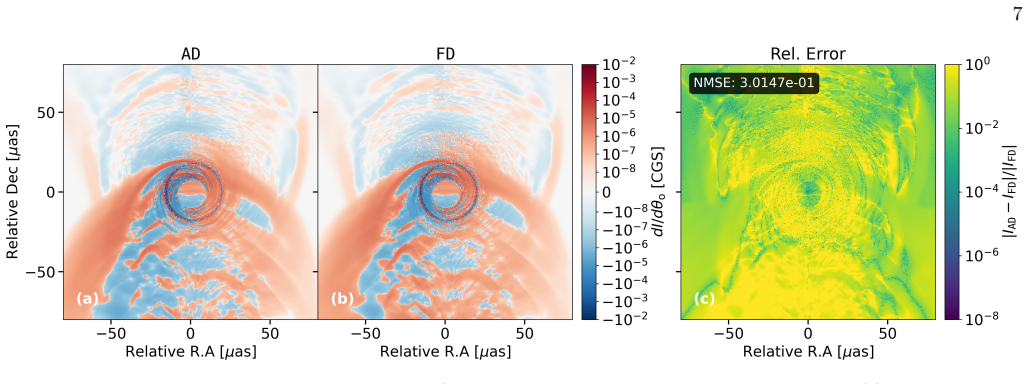
The authors compute image sensitivities, which are the pixel-wise derivatives of the intensity with respect to model parameters from GRMHD simulations. These sensitivities form the Jacobian of the forward model and define a local map from parameter space to image space. In a mock data analysis, GRMHD-based images generate a structured error landscape for parameter fitting with anisotropies and local minima. This makes parameter exploration nontrivial but tractable when guided by the gradient information from automatic differentiation, even under idealized, blurred, and noisy conditions.
What carries the argument
The Jacobian matrix of pixel intensities with respect to GRMHD parameters, obtained through automatic differentiation of the radiative transfer calculation, serving as a local map between parameter changes and image variations.
If this is right
- Parameter recovery remains feasible in the presence of noise when using gradient information from the image sensitivities.
- The error landscape exhibits anisotropies and local minima that gradient-based methods can help overcome.
- These sensitivities establish a basis for efficient high-precision comparisons between models and black hole images.
- Integration of such sensitivities into inference frameworks becomes feasible for black hole imaging studies.
Where Pith is reading between the lines
- Real-world application to telescope data may require accounting for additional systematics not included in the mocks.
- Similar sensitivity calculations could be applied to other types of astrophysical imaging problems involving complex simulations.
- The approach might help identify which parameters are most degenerate in current GRMHD models of black holes.
Load-bearing premise
Simplified models of blurring and added noise in the mock data are sufficient to represent the main challenges of real observations of black holes.
What would settle it
A case where gradient-based optimization fails to recover the input parameters when applied to images with more complex noise or unaccounted physical effects would demonstrate that the guidance is not effective as described.
Figures




read the original abstract
The advent of high-fidelity imaging of supermassive black holes calls for efficient and robust data-analysis methods. In this work, we use $\texttt{Jipole}$, a differentiable, $\texttt{ipole}$-based radiative transfer code, to enable gradient-based analyses of images generated from state-of-the-art general relativistic magnetohydrodynamic (GRMHD) simulations. We compute image sensitivities, i.e., pixel-wise derivatives of the intensity with respect to model parameters, which form the Jacobian of the forward model and define a local map from parameter space to image space. Using these sensitivities in a mock data analysis, we find that GRMHD-based images generate a structured error landscape for parameter fitting, with anisotropies and local minima, making parameter exploration nontrivial but still tractable when guided by gradient information. We characterize this landscape through the Jacobian and assess the feasibility of gradient-based recovery under idealized, blurred, and noisy conditions. Our results show that automatic differentiation-computed image gradients can guide parameter exploration effectively even in the presence of noise. These findings establish a basis for efficient, high-precision model--data comparisons in black hole imaging and motivate the integration of these sensitivities into advanced inference frameworks.
Editorial analysis
A structured set of objections, weighed in public.
Referee Report
Summary. The paper introduces Jipole, a differentiable radiative transfer code based on ipole, to compute pixel-wise image sensitivities (the Jacobian of the forward model) from GRMHD simulations with respect to model parameters. These sensitivities are applied in a mock data analysis under idealized blurring and noise to show that automatic differentiation-computed gradients can guide parameter exploration effectively despite anisotropies and local minima in the error landscape.
Significance. If the central claim holds, the work provides a technical foundation for gradient-based inference frameworks in black hole imaging, which could improve efficiency and precision when comparing state-of-the-art GRMHD models to EHT data. The explicit computation of the Jacobian and characterization of the structured error landscape are useful contributions.
major comments (3)
- [Abstract] Abstract: the description of the mock data analysis results provides no quantitative metrics (e.g., parameter recovery accuracy, posterior widths, or chi-squared values), error bars, or direct validation against known GRMHD degeneracies (spin, magnetic flux, electron distribution), leaving the effectiveness claim unsubstantiated.
- [Mock data analysis] Mock data analysis section: the chosen blurring kernel and additive Gaussian noise model are not shown to reproduce the error landscape anisotropies induced by real EHT systematics (station-based gains, time-dependent effects, non-Gaussian closure quantities), which directly affects whether the reported tractability of gradient guidance transfers beyond the idealized case.
- [Methods] Methods: full implementation details of Jipole, including how automatic differentiation is applied through the radiative transfer solver and any approximations in the Jacobian computation, are absent, preventing assessment of numerical stability and reproducibility.
minor comments (2)
- Notation for the Jacobian matrix and parameter vector should be defined explicitly at first use to improve readability.
- Figure captions for the sensitivity maps and error landscapes should include the specific parameter values and noise levels used.
Simulated Author's Rebuttal
We thank the referee for their constructive and detailed comments on our manuscript. We address each major comment below and describe the revisions we will make to improve the paper.
read point-by-point responses
-
Referee: [Abstract] Abstract: the description of the mock data analysis results provides no quantitative metrics (e.g., parameter recovery accuracy, posterior widths, or chi-squared values), error bars, or direct validation against known GRMHD degeneracies (spin, magnetic flux, electron distribution), leaving the effectiveness claim unsubstantiated.
Authors: We agree that the abstract would be strengthened by quantitative metrics. In the revised version we will add specific results from the mock analysis, including parameter recovery accuracy (e.g., spin recovered within stated tolerances), chi-squared improvements, and explicit comparison to known GRMHD degeneracies. These numbers are already present in the main text and will be summarized concisely in the abstract. revision: yes
-
Referee: [Mock data analysis] Mock data analysis section: the chosen blurring kernel and additive Gaussian noise model are not shown to reproduce the error landscape anisotropies induced by real EHT systematics (station-based gains, time-dependent effects, non-Gaussian closure quantities), which directly affects whether the reported tractability of gradient guidance transfers beyond the idealized case.
Authors: We acknowledge that the mock uses idealized blurring and Gaussian noise and does not replicate full EHT systematics. The section is deliberately controlled to isolate the effect of the differentiable Jacobian on the error landscape. We will add a new paragraph explicitly stating the idealized assumptions, discussing how the observed anisotropies and local minima relate to real EHT effects, and noting that transfer to full systematics is left for future work. revision: partial
-
Referee: [Methods] Methods: full implementation details of Jipole, including how automatic differentiation is applied through the radiative transfer solver and any approximations in the Jacobian computation, are absent, preventing assessment of numerical stability and reproducibility.
Authors: We agree that the current Methods section lacks sufficient implementation detail. We will expand it to describe (i) how automatic differentiation is threaded through the radiative transfer solver in Jipole, (ii) any approximations used when forming the Jacobian, (iii) numerical stability safeguards, and (iv) reproducibility steps. Key code fragments or a supplementary notebook will be referenced. revision: yes
Circularity Check
No circularity: new AD-based Jacobian computation demonstrated on independent mocks
full rationale
The paper introduces Jipole as a differentiable extension of the existing ipole radiative transfer code and uses automatic differentiation to compute pixel-wise image sensitivities forming the Jacobian of the forward model. These sensitivities are then applied in a separate mock-data analysis on GRMHD images to characterize the resulting error landscape under idealized blurring and noise. The central claim that gradient information makes parameter exploration tractable is obtained directly from these numerical experiments rather than by re-using fitted parameters, renaming prior results, or relying on self-citation chains that would reduce the derivation to its own inputs. No self-definitional steps, fitted-input predictions, or load-bearing self-citations appear in the provided derivation chain; the work is therefore self-contained against external benchmarks.
Axiom & Free-Parameter Ledger
axioms (1)
- domain assumption GRMHD simulations plus standard radiative transfer produce images whose parameter dependence can be accurately captured by first-order sensitivities.
Reference graph
Works this paper leans on
-
[1]
2018, A&A, 613, A2, doi: 10.1051/0004-6361/201732149
Bronzwaer, T., Davelaar, J., Younsi, Z., et al. 2018, A&A, 613, A2, doi: 10.1051/0004-6361/201732149
-
[2]
2013, The Astrophysical Journal, 777, 13, doi: 10.1088/0004-637X/777/1/13
Chan, C.-k., Psaltis, D., & ¨Ozel, F. 2013, The Astrophysical Journal, 777, 13, doi: 10.1088/0004-637X/777/1/13
-
[3]
, archivePrefix = "arXiv", eprint =
Chan, C.-K., Psaltis, D., ¨Ozel, F., Narayan, R., & Sa¸dowski, A. 2015, The Astrophysical Journal, 799, 1, doi: 10.1088/0004-637x/799/1/1
-
[4]
Dhruv, V., Prather, B., Wong, G. N., & Gammie, C. F. 2025, The Astrophysical Journal Supplement Series, 277, 16, doi: 10.3847/1538-4365/adaea6
-
[5]
Dolence, J. C., Gammie, C. F., Mo´ scibrodzka, M., & Leung, P. K. 2009, The Astrophysical Journal Supplement Series, 184, 387, doi: 10.1088/0067-0049/184/2/387 Event Horizon Telescope Collaboration, Akiyama, K.,
-
[6]
2019a, 875, L5, doi: 10.3847/2041-8213/ab0f43 Event Horizon Telescope Collaboration, Akiyama, K.,
Alberdi, A., et al. 2019a, 875, L5, doi: 10.3847/2041-8213/ab0f43 Event Horizon Telescope Collaboration, Akiyama, K.,
-
[7]
2019, The Astrophysical Journal Letters, 875, L6, doi: 10.3847/2041-8213/ab1141
Alberdi, A., et al. 2019b, ApJL, 875, L6, doi: 10.3847/2041-8213/ab1141 Event Horizon Telescope Collaboration, Akiyama, K.,
-
[8]
Algaba, J. C., et al. 2021, The Astrophysical Journal Letters, 910, L13, doi: 10.3847/2041-8213/abe4de Event Horizon Telescope Collaboration, Akiyama, K.,
-
[9]
First Sagittarius A* Event Horizon Telescope Results
Alberdi, A., et al. 2022, 930, L16, doi: 10.3847/2041-8213/ac6672
-
[10]
Georgiev, B., Pesce, D. W., Broderick, A. E., et al. 2022, The Astrophysical Journal Letters, 930, L20, doi: 10.3847/2041-8213/ac65eb
-
[11]
D., Akiyama, K., Blackburn, L., et al
Johnson, M. D., Akiyama, K., Blackburn, L., et al. 2023, Galaxies, 11, 61, doi: 10.3390/galaxies11030061
-
[12]
2024, in Space Telescopes and Instrumentation 2024: Optical, Infrared, and Millimeter Wave, ed
Johnson, M. D., Akiyama, K., Baturin, R., et al. 2024, in Society of Photo-Optical Instrumentation Engineers (SPIE) Conference Series, Vol. 13092, Space Telescopes and Instrumentation 2024: Optical, Infrared, and Millimeter Wave, ed. L. E. Coyle, S. Matsuura, & M. D. Perrin, 130922D, doi: 10.1117/12.3019835
-
[13]
Leung, P. K., Gammie, C. F., & Noble, S. C. 2011, ApJ, 737, 21, doi: 10.1088/0004-637X/737/1/21
-
[14]
2022, Universe, 8, doi: 10.3390/universe8020085 Mo´ scibrodzka, M., & Gammie, C
Mizuno, Y. 2022, Universe, 8, doi: 10.3390/universe8020085 Mo´ scibrodzka, M., & Gammie, C. F. 2018, MNRAS, 475, 43, doi: 10.1093/mnras/stx3162
-
[15]
$\texttt{GPUmonty}$: A GPU-accelerated relativistic Monte Carlo radiative transfer code
Moscibrodzka, M. A., & Yfantis, A. I. 2023, The Astrophysical Journal Supplement Series, 265, 22, doi: 10.3847/1538-4365/acb6f9 Mo´ scibrodzka, M., Falcke, H., & Shiokawa, H. 2016, Astronomy & Astrophysics, 586, A38, doi: 10.1051/0004-6361/201526630 Naethe Motta, P., Nemmen, R., & Joshi, A. V. 2026, GPUmonty: A GPU-accelerated relativistic Monte Carlo...
work page internal anchor Pith review Pith/arXiv arXiv doi:10.3847/1538-4365/acb6f9 2023
-
[16]
2021, The Journal of Open Source Software, 6, 3336, doi: 10.21105/joss.03336
Prather, B., Wong, G., Dhruv, V., et al. 2021, The Journal of Open Source Software, 6, 3336, doi: 10.21105/joss.03336
-
[17]
S., Dexter, J., Moscibrodzka, M., et al
Prather, B. S., Dexter, J., Moscibrodzka, M., et al. 2023, The Astrophysical Journal, 950, 35, doi: 10.3847/1538-4357/acc586
-
[18]
2016, ApJ, 820, 105, doi: 10.3847/0004-637X/820/2/105 16
Pu, H.-Y., Yun, K., Younsi, Z., & Yoon, S.-J. 2016, ApJ, 820, 105, doi: 10.3847/0004-637X/820/2/105 16
-
[19]
Revels, J., Lubin, M., & Papamarkou, T. 2016, arXiv:1607.07892 [cs.MS]. https://arxiv.org/abs/1607.07892
-
[20]
Sharma, A., Medeiros, L., Wong, G. N., et al. 2025, Astrophys. J., 985, 40, doi: 10.3847/1538-4357/adc104
-
[21]
Tchekhovskoy, A., Narayan, R., & McKinney, J. C. 2011, Monthly Notices of the Royal Astronomical Society: Letters, 418, L79–L83, doi: 10.1111/j.1745-3933.2011.01147.x
-
[22]
2022, Journal of Open Source Software, 7, 4457, doi: 10.21105/joss.04457
Tiede, P. 2022, Journal of Open Source Software, 7, 4457, doi: 10.21105/joss.04457
-
[23]
2018, Automatic differentiation of ODE integration
Willkomm, J. 2018, Automatic differentiation of ODE integration. https://arxiv.org/abs/1802.02247
-
[24]
Wong, G. N., et al. 2022, Astrophys. J. Supp., 259, 64, doi: 10.3847/1538-4365/ac582e
-
[25]
Yoon, D., Chatterjee, K., Markoff, S. B., et al. 2020, MNRAS, 499, 3178, doi: 10.1093/mnras/staa3031
discussion (0)
Sign in with ORCID, Apple, or X to comment. Anyone can read and Pith papers without signing in.