Recognition: no theorem link
JWST Observations of Starbursts: Dust Processing in the M82 Superwind
Pith reviewed 2026-05-11 01:58 UTC · model grok-4.3
The pith
PAH abundance holds steady at ~1% in the M82 superwind out to 5 kpc from the disk
A machine-rendered reading of the paper's core claim, the machinery that carries it, and where it could break.
Core claim
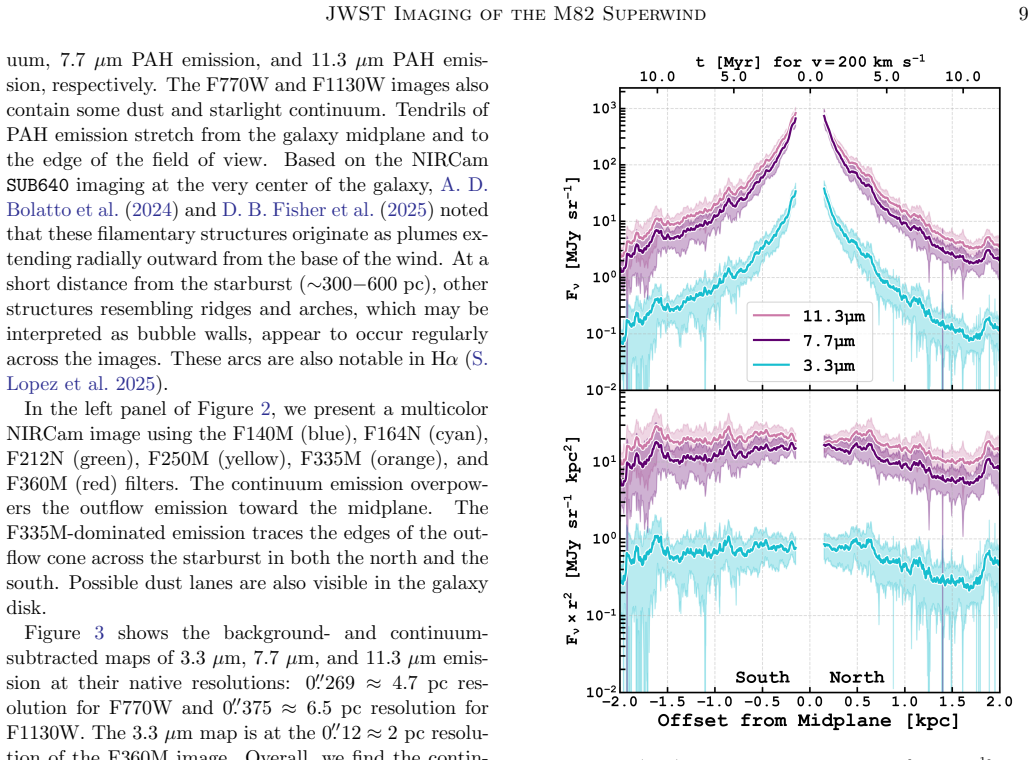
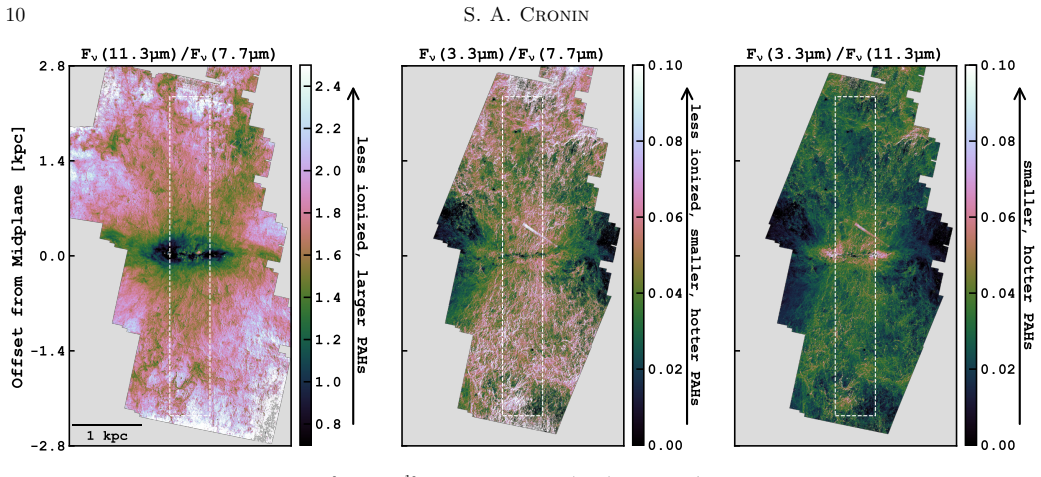
The central claim is that PAH abundance (qPAH) is set at approximately 1 percent in the starburst and remains constant out to 5 kpc off the disk. This flat profile is derived from JWST PAH band imaging combined with Spitzer and Herschel data. The 3.3/11.3 and 3.3/7.7 ratios show uniformity with distance, with a modest shift toward larger PAHs, while 11.3/7.7 rises moderately, indicating PAHs become more neutral as they move into a weaker radiation field. PAH surface brightness declines with the inverse square of distance to the midplane, consistent with illumination by the central starburst. The observations imply that PAHs are shielded from the hot wind, likely in the surface layers of cool
What carries the argument
The qPAH parameter (PAH mass fraction), extracted from mid-infrared band ratios (3.3/7.7, 3.3/11.3, 11.3/7.7) and multi-wavelength continuum data, which stays constant with distance in the wind.
If this is right
- PAH intensity is driven by the starburst radiation field out to at least 2.5 kpc.
- PAHs shift to more neutral states with distance due to the declining ionization parameter.
- PAHs remain consistent with standard-to-large sizes and standard-to-high ionization throughout the wind.
- Cool clouds survive transit through the hot wind for at least 20 Myr via radiative cooling and mixing.
- The galactic halo receives PAH enrichment from material processed in prior starburst episodes.
Where Pith is reading between the lines
- Similar shielding may allow PAHs to reach the circumgalactic medium in other starburst systems.
- Galactic wind models should treat PAHs as protected tracers rather than rapidly destroyed grains.
- PAHs delivered this way could contribute to dust budgets in the intergalactic medium on longer timescales.
- Higher-resolution spectroscopy could directly test whether PAHs sit on cloud surfaces.
Load-bearing premise
Band ratios interpreted through standard dust models accurately capture PAH size and ionization without significant contamination, and the flat radial profile arises from shielding in cool clouds rather than ongoing production or selection biases.
What would settle it
A clear decline in qPAH with increasing distance in deeper JWST maps of M82 or in another starburst wind would contradict the shielding interpretation.
Figures



read the original abstract
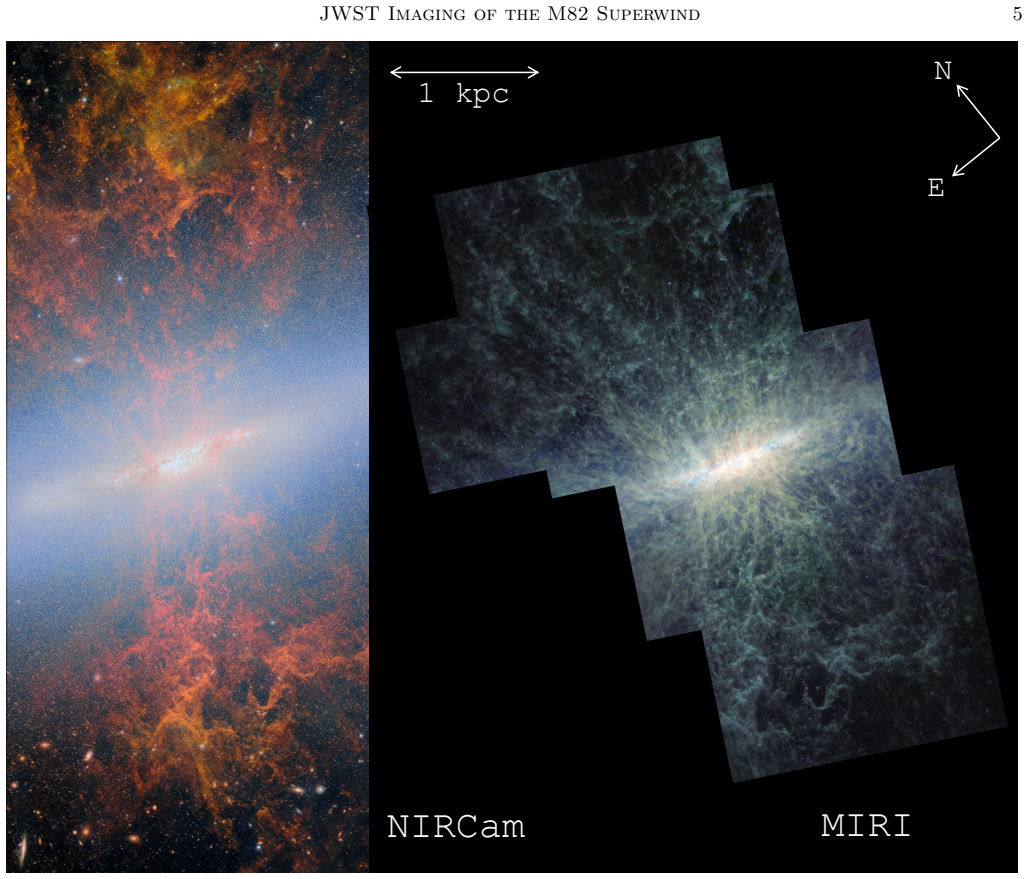
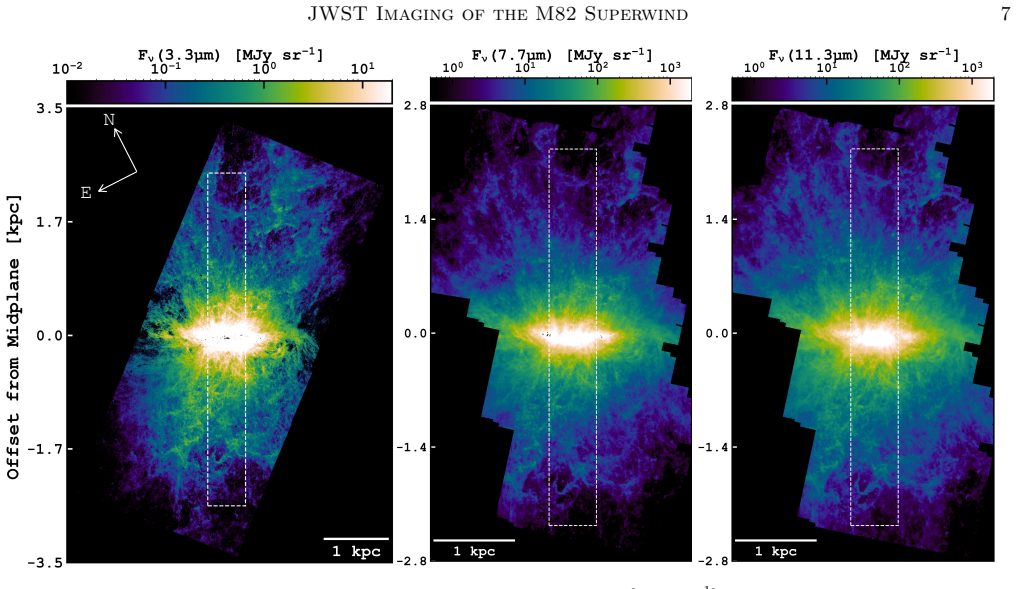
We present JWST MIRI and NIRCam imaging of the inner ~5 kpc of the M82 superwind at 0.05-0.375'' (~0.9-6.5 pc) resolution. Targeted filters probe emission from polycyclic aromatic hydrocarbons (PAHs; F335M, F360M, F770W, F1130W) and continuum (F250M, F360M). The images reveal a network of cool wind filaments traced by PAHs. PAH surface brightness declines with the inverse square of distance to the midplane, suggesting that the incident radiation field from the starburst drives the observed PAH intensity out to 2.5 kpc. The 3.3/11.3 and 3.3/7.7 band ratios show uniformity with distance from the starburst, though comparisons with mid-IR dust emission models indicate a modest shift toward larger PAHs. Outside the disk, 11.3/7.7 increases moderately, reflecting that PAHs become more neutral with distance from the starburst as they are exposed to a declining radiation field and ionization parameter. Overall, PAHs in the wind are consistent with standard-to-large sizes and standard-to-high ionization states. Including Spitzer and Herschel data, PAH abundance (qPAH) is set at ~1% in the starburst and remains unchanging out to 5 kpc off the disk. This flat qPAH profile suggests that PAHs are shielded from the hot wind, perhaps residing in the surface layers of cool clouds, with possible replenishment from cloud interiors and enrichment of the halo from previous bursts. In this picture, clouds are not dense enough to promote PAH growth, and they likely undergo radiative cooling and mixing with the hot phase to survive the gauntlet for at least ~20 Myr.
Editorial analysis
A structured set of objections, weighed in public.
Referee Report
Summary. The manuscript presents JWST MIRI and NIRCam imaging of the inner ~5 kpc of the M82 superwind at 0.05–0.375 arcsec resolution. It reports that PAH surface brightness declines as the inverse square of distance from the midplane out to 2.5 kpc, with 3.3/11.3 and 3.3/7.7 band ratios remaining largely uniform (indicating standard-to-large PAH sizes) while 11.3/7.7 increases with radius (suggesting more neutral PAHs). Combining the JWST data with existing Spitzer and Herschel photometry yields a constant PAH mass fraction qPAH ≈ 1% from the starburst out to 5 kpc, interpreted as evidence that PAHs are shielded within cool cloud surfaces, with possible replenishment and halo enrichment from prior bursts.
Significance. If the reported constancy of qPAH holds after resolution corrections, the work supplies direct high-resolution constraints on PAH survival and transport in galactic superwinds. This strengthens multiphase wind models by showing that PAHs can persist without rapid destruction, with implications for dust enrichment of the circumgalactic medium and the role of cool filaments in feedback. The filamentary structures mapped by JWST add observational detail to wind morphology that was previously limited by lower-resolution data.
major comments (2)
- [Abstract and PAH abundance derivation section] The central claim of a flat qPAH profile at ~1% out to 5 kpc (Abstract and the section deriving PAH abundance from multi-wavelength SEDs) is obtained by folding JWST photometry into fits that also use Spitzer and Herschel data to constrain total dust mass. The manuscript does not describe convolution of the JWST maps to the coarser Spitzer/Herschel beams or a joint multi-resolution fitting procedure prior to radial extraction. Because beam sizes differ by factors of several to tens, unresolved structures and background levels are sampled differently at large radii; this mismatch could produce an artificially flat qPAH(r) even if the true profile varies.
- [Band-ratio analysis section] The interpretation that the observed 3.3/11.3 and 3.3/7.7 band ratios directly trace PAH size and ionization distributions (band-ratio analysis section) assumes negligible contamination from other mid-IR sources and accurate filter calibration. The paper notes a modest shift toward larger PAHs but does not quantify the impact of possible line or continuum contaminants or calibration uncertainties on the inferred size/ionization trends; this step is load-bearing for the conclusion that PAHs remain in standard-to-large sizes and standard-to-high ionization states throughout the wind.
minor comments (2)
- [Figure captions] Figure captions should explicitly state the radial binning method and any aperture corrections applied when combining datasets of differing resolution.
- [Introduction or methods] The first use of the symbol qPAH should be accompanied by its explicit definition (PAH mass fraction) rather than assuming reader familiarity with the Draine & Li notation.
Simulated Author's Rebuttal
We thank the referee for their thoughtful and constructive report, which highlights important aspects of our data analysis and interpretation. We address each major comment point by point below. Where the manuscript was incomplete in its description, we will revise accordingly to improve clarity and robustness without altering the core scientific conclusions.
read point-by-point responses
-
Referee: [Abstract and PAH abundance derivation section] The central claim of a flat qPAH profile at ~1% out to 5 kpc (Abstract and the section deriving PAH abundance from multi-wavelength SEDs) is obtained by folding JWST photometry into fits that also use Spitzer and Herschel data to constrain total dust mass. The manuscript does not describe convolution of the JWST maps to the coarser Spitzer/Herschel beams or a joint multi-resolution fitting procedure prior to radial extraction. Because beam sizes differ by factors of several to tens, unresolved structures and background levels are sampled differently at large radii; this mismatch could produce an artificially flat qPAH(r) even if the true profile varies.
Authors: We acknowledge that the original manuscript did not explicitly describe the convolution of JWST maps to match the coarser Spitzer and Herschel beams. This was an oversight in the methods presentation. In the revised manuscript, we will add a dedicated paragraph in the data analysis section detailing the procedure: JWST images were convolved using the Aniano et al. (2011) kernels to the respective beam sizes (e.g., ~6 arcsec for Spitzer 24 μm and ~18 arcsec for Herschel 70 μm) prior to radial profile extraction and joint SED fitting. Background subtraction was performed consistently on the matched-resolution maps. After these corrections, the qPAH profile remains flat at ~1% out to 5 kpc, as verified through re-extraction of the photometry. We will include a supplementary figure comparing the original and convolved radial profiles to demonstrate that the flatness is not an artifact of resolution mismatch. revision: yes
-
Referee: [Band-ratio analysis section] The interpretation that the observed 3.3/11.3 and 3.3/7.7 band ratios directly trace PAH size and ionization distributions (band-ratio analysis section) assumes negligible contamination from other mid-IR sources and accurate filter calibration. The paper notes a modest shift toward larger PAHs but does not quantify the impact of possible line or continuum contaminants or calibration uncertainties on the inferred size/ionization trends; this step is load-bearing for the conclusion that PAHs remain in standard-to-large sizes and standard-to-high ionization states throughout the wind.
Authors: We agree that quantifying the effects of potential contaminants and calibration uncertainties is necessary to strengthen the band-ratio interpretation. The revised manuscript will expand the relevant section to include a quantitative assessment: we estimate line contamination (e.g., [Ne II] 12.8 μm in F1130W and possible continuum from hot dust) using archival Spitzer IRS spectra of M82, finding contributions <10% to the broadband fluxes. Calibration uncertainties are taken as ±5-10% for JWST MIRI/NIRCam filters; propagating these through the ratios shows changes of <0.1 in 3.3/11.3 and <0.2 in 11.3/7.7, insufficient to reverse the observed trends of increasing neutrality and modest size shift with radius. These tests will be described with error bars on the radial band-ratio plots, confirming that PAHs remain consistent with standard-to-large sizes and standard-to-high ionization states. revision: yes
Circularity Check
No significant circularity; qPAH profile is measured from multi-wavelength SED fits to observed data
full rationale
The paper measures PAH band ratios directly from JWST filter photometry and derives qPAH values by fitting observed fluxes (including Spitzer/Herschel photometry) to standard mid-IR dust emission models. The reported ~1% value and flat radial profile out to 5 kpc are outputs of this fitting process applied to the data at different radii, not quantities defined in terms of themselves or forced by construction. The shielding interpretation is presented as a physical inference from the observed flatness rather than a definitional step. No load-bearing self-citations, uniqueness theorems, or ansatzes from prior author work are invoked to justify the central measurements. The derivation chain is self-contained and relies on external model grids and independent datasets.
Axiom & Free-Parameter Ledger
axioms (1)
- domain assumption Standard mid-IR dust emission models accurately map observed PAH band ratios to grain size and ionization distributions.
Reference graph
Works this paper leans on
-
[1]
Abruzzo, M. W., Bryan, G. L., & Fielding, D. B. 2022, ApJ, 925, 199, doi: 10.3847/1538-4357/ac3c48
-
[2]
Andrews, H., Boersma, C., Werner, M. W., et al. 2015, ApJ, 807, 99, doi: 10.1088/0004-637X/807/1/99
-
[3]
Aniano, G., Draine, B. T., Gordon, K. D., & Sandstrom, K. 2011, PASP, 123, 1218, doi: 10.1086/662219
-
[4]
Aniano, G., Draine, B. T., Hunt, L. K., et al. 2020, ApJ, 889, 150, doi: 10.3847/1538-4357/ab5fdb
-
[5]
Armillotta, L., Ostriker, E. C., Kim, C.-G., & Jiang, Y.-F. 2024, ApJ, 964, 99, doi: 10.3847/1538-4357/ad1e5c
-
[6]
Asano, R. S., Takeuchi, T. T., Hirashita, H., & Inoue, A. K. 2013, Earth, Planets and Space, 65, 213, doi: 10.5047/eps.2012.04.014 Astropy Collaboration, Robitaille, T. P., Tollerud, E. J., et al. 2013, A&A, 558, A33, doi: 10.1051/0004-6361/201322068 Astropy Collaboration, Price-Whelan, A. M., Sip˝ ocz, B. M., et al. 2018, AJ, 156, 123, doi: 10.3847/1538-...
-
[7]
Bakes, E. L. O., & Tielens, A. G. G. M. 1994, ApJ, 427, 822, doi: 10.1086/174188
-
[8]
Bakes, E. L. O., & Tielens, A. G. G. M. 1998, ApJ, 499, 258, doi: 10.1086/305625
-
[9]
Baron, D., Sandstrom, K. M., Rosolowsky, E., et al. 2024, ApJ, 968, 24, doi: 10.3847/1538-4357/ad39e5
-
[10]
Baron, D., Sandstrom, K. M., Sutter, J., et al. 2025, ApJ, 978, 135, doi: 10.3847/1538-4357/ad972a Beir˜ ao, P., Brandl, B. R., Appleton, P. N., et al. 2008, ApJ, 676, 304, doi: 10.1086/527343 Beir˜ ao, P., Armus, L., Lehnert, M. D., et al. 2015, MNRAS, 451, 2640, doi: 10.1093/mnras/stv1101 Bern´ e, O., Habart,´E., Peeters, E., et al. 2022, PASP, 134, 054...
-
[11]
Bolatto, A. D., Warren, S. R., Leroy, A. K., et al. 2013, Nature, 499, 450, doi: 10.1038/nature12351
-
[12]
Bolatto, A. D., Levy, R. C., Tarantino, E., et al. 2024, ApJ, 967, 63, doi: 10.3847/1538-4357/ad33c8
-
[13]
2016, A&A, 596, A63, doi: 10.1051/0004-6361/201629080
Boucaud, A., Bocchio, M., Abergel, A., et al. 2016, A&A, 596, A63, doi: 10.1051/0004-6361/201629080
-
[14]
Bruzual, G., & Charlot, S. 2003, MNRAS, 344, 1000, doi: 10.1046/j.1365-8711.2003.06897.x
-
[15]
2023, JWST Calibration Pipeline, 1.9.5 Zenodo, doi: 10.5281/zenodo.7692609
Bushouse, H., Eisenhamer, J., Dencheva, N., et al. 2023, JWST Calibration Pipeline, 1.9.5 Zenodo, doi: 10.5281/zenodo.7692609
-
[16]
2024, JWST Calibration Pipeline, 1.15.1 Zenodo, doi: 10.5281/zenodo.12692459
Bushouse, H., Eisenhamer, J., Dencheva, N., et al. 2024, JWST Calibration Pipeline, 1.15.1 Zenodo, doi: 10.5281/zenodo.12692459
-
[17]
2019, ApJ, 876, 62, doi: 10.3847/1538-4357/ab16cf
Chastenet, J., Sandstrom, K., Chiang, I.-D., et al. 2019, ApJ, 876, 62, doi: 10.3847/1538-4357/ab16cf
-
[18]
2023, ApJL, 944, L11, doi: 10.3847/2041-8213/acadd7
Chastenet, J., Sutter, J., Sandstrom, K., et al. 2023, ApJL, 944, L11, doi: 10.3847/2041-8213/acadd7
-
[19]
Chastenet, J., Sandstrom, K., Leroy, A. K., et al. 2025, ApJS, 276, 2, doi: 10.3847/1538-4365/ad8a5c
-
[20]
Chen, Z., & Oh, S. P. 2024, MNRAS, 530, 4032, doi: 10.1093/mnras/stae1113
-
[21]
2024, A&A, 685, A75, doi: 10.1051/0004-6361/202346662
Chown, R., Sidhu, A., Peeters, E., et al. 2024, A&A, 685, A75, doi: 10.1051/0004-6361/202346662
-
[22]
2025, A&A, 698, A86, doi: 10.1051/0004-6361/202452940
Chown, R., Okada, Y., Peeters, E., et al. 2025, A&A, 698, A86, doi: 10.1051/0004-6361/202452940
-
[23]
Y., Sandstrom, K., Wolfire, M., et al
Clark, I. Y., Sandstrom, K., Wolfire, M., et al. 2025, ApJ, 990, 209, doi: 10.3847/1538-4357/adef38
-
[24]
Coker, C. T., Thompson, T. A., & Martini, P. 2013, ApJ, 778, 79, doi: 10.1088/0004-637X/778/1/79
-
[25]
Cronin, S. A., Bolatto, A. D., Congiu, E., et al. 2025, ApJ, 987, 92, doi: 10.3847/1538-4357/add738
-
[26]
Dalcanton, J. J., Williams, B. F., Seth, A. C., et al. 2009, ApJS, 183, 67, doi: 10.1088/0067-0049/183/1/67
-
[27]
Dale, D. A., Boquien, M., Barnes, A. T., et al. 2023, ApJL, 944, L23, doi: 10.3847/2041-8213/aca769
-
[28]
Dale, D. A., Graham, G. B., Barnes, A. T., et al. 2025, AJ, 169, 133, doi: 10.3847/1538-3881/ada89f
-
[29]
2016, DOLPHOT: Stellar photometry,, Astrophysics Source Code Library, record ascl:1608.013
Dolphin, A. 2016, DOLPHOT: Stellar photometry,, Astrophysics Source Code Library, record ascl:1608.013
work page 2016
-
[30]
Dolphin, A. E. 2000, PASP, 112, 1383, doi: 10.1086/316630
-
[31]
SIMLA: The Spitzer Infrared Spectrograph Mapping Legacy Archive
Donnelly, G. P., Whitcomb, C. M., Hands, L., et al. 2025a, arXiv e-prints, arXiv:2512.12434. https://arxiv.org/abs/2512.12434
work page internal anchor Pith review Pith/arXiv arXiv
-
[32]
Donnelly, G. P., Lai, T. S.-Y., Armus, L., et al. 2025b, ApJ, 983, 79, doi: 10.3847/1538-4357/adb97f
-
[33]
Draine, B. T. 2011, Physics of the Interstellar and Intergalactic Medium
work page 2011
-
[34]
Draine, B. T., & Li, A. 2001, ApJ, 551, 807, doi: 10.1086/320227
-
[35]
Draine, B. T., & Li, A. 2007, ApJ, 657, 810, doi: 10.1086/511055
-
[36]
Draine, B. T., Li, A., Hensley, B. S., et al. 2021, ApJ, 917, 3, doi: 10.3847/1538-4357/abff51
-
[37]
Draine, B. T., & Salpeter, E. E. 1979a, ApJ, 231, 438, doi: 10.1086/157206 JWST Imaging of the M82 Superwind29
-
[38]
Draine, B. T., & Salpeter, E. E. 1979b, ApJ, 231, 77, doi: 10.1086/157165
-
[39]
Draine, B. T., Dale, D. A., Bendo, G., et al. 2007, ApJ, 663, 866, doi: 10.1086/518306
-
[40]
and Kreckel, Kathryn and Sandstrom, Karin M
Egorov, O. V., Kreckel, K., Sandstrom, K. M., et al. 2023, ApJL, 944, L16, doi: 10.3847/2041-8213/acac92
-
[41]
Egorov, O. V., Leroy, A. K., Sandstrom, K., et al. 2025, A&A, 703, A103, doi: 10.1051/0004-6361/202556427
-
[42]
Engelbracht, C. W., Kundurthy, P., Gordon, K. D., et al. 2006, ApJL, 642, L127, doi: 10.1086/504590
-
[43]
Farber, R. J., & Gronke, M. 2022, MNRAS, 510, 551, doi: 10.1093/mnras/stab3412
-
[44]
Fielding, D. B., & Bryan, G. L. 2022, ApJ, 924, 82, doi: 10.3847/1538-4357/ac2f41
-
[45]
Fischer, T. C., Cothard, N. F., Nayak, O., et al. 2025, ApJ, 993, 153, doi: 10.3847/1538-4357/adfb62
-
[46]
Fisher, D. B., Bolatto, A. D., Chisholm, J., et al. 2025, MNRAS, doi: 10.1093/mnras/staf363
-
[47]
Fleming, B., France, K., Lupu, R. E., & McCandliss, S. R. 2010, ApJ, 725, 159, doi: 10.1088/0004-637X/725/1/159 F¨ orster Schreiber, N. M., Genzel, R., Lutz, D., Kunze, D., & Sternberg, A. 2001, ApJ, 552, 544, doi: 10.1086/320546 F¨ orster Schreiber, N. M., Genzel, R., Lutz, D., &
-
[48]
2003, ApJ, 599, 193, doi: 10.1086/379097
Sternberg, A. 2003, ApJ, 599, 193, doi: 10.1086/379097
-
[49]
2017, in Astrophysics and Space Science
Fraternali, F. 2017, in Astrophysics and Space Science
work page 2017
-
[50]
430, Gas Accretion onto Galaxies, ed
Library, Vol. 430, Gas Accretion onto Galaxies, ed. A. Fox & R. Dav´ e, 323, doi: 10.1007/978-3-319-52512-9 14
-
[51]
Freedman, W. L., Hughes, S. M., Madore, B. F., et al. 1994, ApJ, 427, 628, doi: 10.1086/174172
-
[52]
Galametz, M., Kennicutt, R. C., Calzetti, D., et al. 2013, MNRAS, 431, 1956, doi: 10.1093/mnras/stt313
-
[53]
Glasse, A., Rieke, G. H., Bauwens, E., et al. 2015, PASP, 127, 686, doi: 10.1086/682259
-
[54]
Gordon, K. D., Bohlin, R., Sloan, G. C., et al. 2022, AJ, 163, 267, doi: 10.3847/1538-3881/ac66dc
-
[55]
P., Martini, P., & Thompson, T
Greco, J. P., Martini, P., & Thompson, T. A. 2012, ApJ, 757, 24, doi: 10.1088/0004-637X/757/1/24
-
[56]
Gronke, M., & Oh, S. P. 2018, MNRAS, 480, L111, doi: 10.1093/mnrasl/sly131
-
[57]
Hammonds, M., Mori, T., Usui, F., & Onaka, T. 2015, Planet. Space Sci., 116, 73, doi: 10.1016/j.pss.2015.05.010
-
[58]
Harris, C. R., Millman, K. J., van der Walt, S. J., et al. 2020, Nature, 585, 357, doi: 10.1038/s41586-020-2649-2
-
[59]
Heckman, T. M., Armus, L., & Miley, G. K. 1990, ApJS, 74, 833, doi: 10.1086/191522
-
[60]
Heitsch, F., & Putman, M. E. 2009, ApJ, 698, 1485, doi: 10.1088/0004-637X/698/2/1485
-
[61]
Hensley, B. S., & Draine, B. T. 2017, ApJ, 834, 134, doi: 10.3847/1538-4357/834/2/134
-
[62]
Hensley, B. S., & Draine, B. T. 2023, ApJ, 948, 55, doi: 10.3847/1538-4357/acc4c2
-
[63]
2020, A&A, 635, A47, doi: 10.1051/0004-6361/201936434
Herrera-Camus, R., Janssen, A., Sturm, E., et al. 2020, A&A, 635, A47, doi: 10.1051/0004-6361/201936434
-
[64]
Hoopes, C. G., Heckman, T. M., Strickland, D. K., et al. 2005, ApJL, 619, L99, doi: 10.1086/423032
-
[65]
Hunter, J. D. 2007, Computing in Science & Engineering, 9, 90, doi: 10.1109/MCSE.2007.55
-
[66]
Huo, Y., Cangahuala, M. K. E., Zamudio-Bayer, V., et al. 2023a, European Physical Journal D, 77, 181, doi: 10.1140/epjd/s10053-023-00763-w
-
[67]
Huo, Y., Espinoza Cangahuala, M. K., Zamudio-Bayer, V., et al. 2023b, MNRAS, 523, 865, doi: 10.1093/mnras/stad1341
-
[68]
Klein, R. I., McKee, C. F., & Colella, P. 1994, ApJ, 420, 213, doi: 10.1086/173554
-
[69]
2016, in ELPUB, 87–90, doi: 10.3233/978-1-61499-649-1-87
Kluyver, T., Ragan-Kelley, B., P´ erez, F., et al. 2016, in ELPUB, 87–90, doi: 10.3233/978-1-61499-649-1-87
-
[70]
1986, Highlights of Astronomy, 7, 833
Turnshek, D. 1986, Highlights of Astronomy, 7, 833
work page 1986
-
[71]
Krieger, N., Walter, F., Bolatto, A. D., et al. 2021, ApJL, 915, L3, doi: 10.3847/2041-8213/ac01e9
-
[72]
2020, ApJ, 905, 55, doi: 10.3847/1538-4357/abc002
Lai, T. S.-Y., Smith, J. D. T., Baba, S., Spoon, H. W. W., & Imanishi, M. 2020, ApJ, 905, 55, doi: 10.3847/1538-4357/abc002
-
[73]
Lai, T. S.-Y., Smith, J. D. T., Peeters, E., et al. 2024, ApJ, 967, 83, doi: 10.3847/1538-4357/ad354b
-
[74]
S.-Y., Armus, L., Bianchin, M., et al
Lai, T. S.-Y., Armus, L., Bianchin, M., et al. 2023, ApJL, 957, L26, doi: 10.3847/2041-8213/ad0387
-
[75]
Lange, K., Dominik, C., & Tielens, A. G. G. M. 2025, A&A, 702, A14, doi: 10.1051/0004-6361/202347722 Le Page, V., Snow, T. P., & Bierbaum, V. M. 2001, ApJS, 132, 233, doi: 10.1086/318952
-
[76]
Leger, A., & Puget, J. L. 1984, A&A, 137, L5
work page 1984
-
[77]
Faraday Discussions , year = 2023, month = sep, volume =
Lemmens, A. K., Mackie, C. J., Candian, A., et al. 2023, Faraday Discussions, 245, 380, doi: 10.1039/D2FD00180B
-
[78]
K., Walter, F., Martini, P., et al
Leroy, A. K., Walter, F., Martini, P., et al. 2015, ApJ, 814, 83, doi: 10.1088/0004-637X/814/2/83
-
[79]
Levy, R. C., Bolatto, A. D., Tarantino, E., et al. 2023, ApJ, 958, 109, doi: 10.3847/1538-4357/acff6e
-
[80]
Levy, R. C., Bolatto, A. D., Mayya, D., et al. 2024, ApJL, 973, L55, doi: 10.3847/2041-8213/ad7af3
discussion (0)
Sign in with ORCID, Apple, or X to comment. Anyone can read and Pith papers without signing in.