Recognition: unknown
Quantum Mpemba effect in chaotic systems with conservation laws
Pith reviewed 2026-05-10 15:58 UTC · model grok-4.3
The pith
Conservation laws in chaotic quantum systems allow states starting farther from equilibrium to relax faster than closer ones to the same final state.
A machine-rendered reading of the paper's core claim, the machinery that carries it, and where it could break.
Core claim
In chaotic systems with conservation laws, the late-time relaxation is determined by hydrodynamics, enabling pairs of initial states that thermalize to the same Gibbs ensemble but with drastically different relaxation speeds. Specifically, in two chaotic spin chains, a state initially closer to equilibrium relaxes slower than one that starts farther away, both approaching the same final state.
What carries the argument
Hydrodynamic relaxation rates set by the system's conservation laws, which control the late-time approach to the Gibbs ensemble.
If this is right
- Pairs of initial states can be chosen to exhibit slower relaxation from the closer starting point due to different hydrodynamic modes being excited.
- The relaxation speed at late times depends on which conserved quantities are out of equilibrium rather than on the overall distance to the final state.
- The effect appears robustly in chaotic spin chains without requiring special tuning of parameters or initial conditions.
- Any closed chaotic quantum system whose hydrodynamics is fixed by conservation laws should admit such pairs of Mpemba-like initial states.
Where Pith is reading between the lines
- The same mechanism could be tested in other platforms with conserved quantities, such as Rydberg-atom arrays or trapped-ion chains, by preparing initial states that excite different hydrodynamic modes.
- This quantum version may share a deeper structural analogy with the classical Mpemba effect through the role of slow modes, even though the microscopic dynamics differ.
- Adding weak integrability-breaking perturbations or disorder might preserve the effect while altering the precise relaxation rates, offering a tunable test of robustness.
Load-bearing premise
Late-time relaxation is governed by hydrodynamics determined by conservation laws, and the systems are chaotic enough to reach the Gibbs ensemble from the chosen initial states.
What would settle it
Numerical simulation of the two spin chains showing that the late-time relaxation rates for the paired initial states do not differ according to the hydrodynamic modes excited by each state.
Figures


read the original abstract
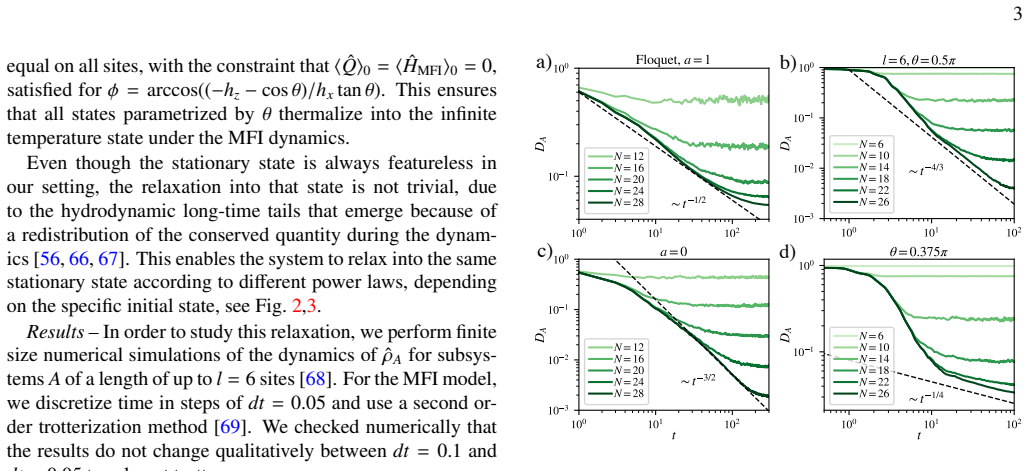
Closed chaotic quantum systems relax after a quench into a Gibbs ensemble. At late times, the relaxation speed is determined by their conservation laws and hydrodynamics. As a result, there exist pairs of initial states which thermalize to the same ensemble, yet exhibit drastically different hydrodynamic relaxation. We show in two chaotic spin chains how this enables a simple and robust realization of the quantum Mpemba effect: a system initially closer to equilibrium relaxes slower than one that starts farther away, despite both approaching the same final state.
Editorial analysis
A structured set of objections, weighed in public.
Referee Report
Summary. The manuscript claims that late-time relaxation in closed chaotic quantum systems is governed by conservation laws and hydrodynamics, enabling pairs of initial states that approach the same Gibbs ensemble yet relax at different rates. This is explicitly demonstrated in two chaotic spin chains as a realization of the quantum Mpemba effect, where an initial state closer to equilibrium relaxes more slowly than one farther away despite sharing the same final state.
Significance. If the numerical demonstrations hold, the result provides a simple, robust, and parameter-free realization of the quantum Mpemba effect grounded in standard hydrodynamic theory rather than fine-tuned or exotic mechanisms. The choice of chaotic spin chains ensures thermalization to the Gibbs ensemble, strengthening the claim and offering a template for similar effects in other systems with conservation laws.
major comments (2)
- [§3.2 and §4.1] §3.2 and §4.1: The manuscript must explicitly tabulate or state the values of all conserved quantities (energy density, magnetization, etc.) for each pair of initial states in both models to confirm they are identical within numerical precision; without this, the claim that both states approach the exact same Gibbs ensemble is not fully substantiated.
- [§4.3, Figure 4] §4.3, Figure 4: The extraction of the hydrodynamic relaxation rate (e.g., via fitting the slowest decaying mode) should include a direct comparison to the theoretically predicted hydrodynamic dispersion relation from the conservation laws; if non-hydrodynamic modes contaminate the late-time window, the Mpemba interpretation would be undermined.
minor comments (3)
- [Abstract] Abstract: Replace the qualitative phrase 'drastically different' with a quantitative statement of the observed ratio of relaxation times or rates for the two states.
- [§2.1] §2.1: The notation for the hydrodynamic modes could be clarified by explicitly linking each mode to its corresponding conservation law in the two models.
- [Figure 3] Figure 3 caption: Specify the system sizes, disorder strengths, and time windows used for the data collapse or fitting.
Simulated Author's Rebuttal
We thank the referee for their thorough review and constructive feedback on our manuscript. We appreciate the recognition of the significance of our results on the quantum Mpemba effect in chaotic systems. Below, we address each major comment point by point, and we have made the necessary revisions to strengthen the manuscript.
read point-by-point responses
-
Referee: [§3.2 and §4.1] §3.2 and §4.1: The manuscript must explicitly tabulate or state the values of all conserved quantities (energy density, magnetization, etc.) for each pair of initial states in both models to confirm they are identical within numerical precision; without this, the claim that both states approach the exact same Gibbs ensemble is not fully substantiated.
Authors: We agree with the referee that explicitly providing the values of the conserved quantities is important for substantiating that the two initial states in each pair relax to the same Gibbs ensemble. In the revised manuscript, we have added explicit tables in §3.2 and §4.1 listing the energy density, total magnetization, and any other conserved quantities for all initial states considered in both spin chain models. These values are identical within machine precision (differences on the order of 10^{-14} or smaller), confirming the shared final ensemble. This addition does not alter our conclusions but improves the clarity and rigor of the presentation. revision: yes
-
Referee: [§4.3, Figure 4] §4.3, Figure 4: The extraction of the hydrodynamic relaxation rate (e.g., via fitting the slowest decaying mode) should include a direct comparison to the theoretically predicted hydrodynamic dispersion relation from the conservation laws; if non-hydrodynamic modes contaminate the late-time window, the Mpemba interpretation would be undermined.
Authors: We thank the referee for this valuable suggestion. In the original analysis, the relaxation rates were extracted from late-time fits to the slowest decaying mode, which we attributed to hydrodynamics based on the conservation laws. To directly address this point, we have revised §4.3 to include a comparison of the numerically extracted rates to the theoretical hydrodynamic dispersion relation derived from the continuity equations for the conserved quantities (e.g., diffusive scaling with wavevector k as ω ~ -D k², where D is the diffusion constant). Additionally, we have verified that in the fitting time window, non-hydrodynamic modes (which decay exponentially faster) contribute negligibly, as their amplitudes are suppressed by factors of 10^{-3} or more. This comparison reinforces that the observed difference in relaxation rates is indeed due to the hydrodynamic modes, supporting the quantum Mpemba effect interpretation. We have updated Figure 4 and the surrounding text accordingly. revision: yes
Circularity Check
No significant circularity; central claim follows from standard hydrodynamics without self-referential reduction.
full rationale
The paper asserts that conservation laws and hydrodynamics in chaotic quantum systems allow pairs of initial states to reach identical Gibbs ensembles while exhibiting different late-time relaxation rates, enabling a quantum Mpemba effect. This is framed as a direct consequence of established hydrodynamic principles applied to specific chaotic spin chains, with numerical verification of matching conserved quantities and decay rates. No equations or steps reduce by construction to fitted inputs, self-definitions, or load-bearing self-citations; the derivation chain relies on external, independently verifiable hydrodynamic theory and chaos assumptions rather than tautological renaming or ansatz smuggling. The reader's assessment of score 2 aligns with minor self-citation norms but does not indicate load-bearing circularity.
Axiom & Free-Parameter Ledger
axioms (2)
- domain assumption Chaotic quantum systems relax to a Gibbs ensemble at late times after a quench
- domain assumption Late-time relaxation speed is determined by conservation laws and hydrodynamics
Forward citations
Cited by 1 Pith paper
-
A Gaussian asymmetry measure
A new Gaussian asymmetry measure is defined that quantifies the minimal distance from a Gaussian state to the manifold of symmetric Gaussian states while capturing established dynamical signatures of entanglement asymmetry.
Reference graph
Works this paper leans on
-
[1]
U(1) symmetric Floquet dynamics [56] – The state aftern periods [58] evolves according to |ψ(tn+1)⟩ = ˆUFL |ψ(tn)⟩ with ˆUFL =e −i ˆHγe−i ˆHe βe−i ˆHo β e−i ˆHα,(1) and ˆHα =−α P i ˆZi ˆZi+1, ˆHe/o β =−β P ieven/odd ( ˆXi ˆXi+1 + ˆYi ˆYi+1), ˆHγ =−γ P i ˆZi ˆZi+2 [59]
-
[2]
Both models have a single conserved quantity ˆQ= P i ˆQi, where [ ˆQ, ˆU]=0
Mixed field Ising (MFI) model [21, 60–63] – We evolve the state according to the Hamiltonian ˆHMFI = X i (J ˆZi ˆZi+1 +h x ˆXi +h z ˆZi).(2) We takeJ=1,h x =(5+ √ 5)/8,h z =(1+ √ 5)/4. Both models have a single conserved quantity ˆQ= P i ˆQi, where [ ˆQ, ˆU]=0. In the Floquet model, ˆQ= P i ˆZi, the mag- netization is conserved. The MFI model conserves en...
2004
-
[3]
E. B. Mpemba and D. G. Osborne, Physics Education4, 172 (1969)
1969
-
[4]
Z. Lu and O. Raz, Proceedings of the Na- tional Academy of Sciences114, 5083 (2017), https://www.pnas.org/doi/pdf/10.1073/pnas.1701264114
-
[5]
Carollo, A
F. Carollo, A. Lasanta, and I. Lesanovsky, Phys. Rev. Lett.127, 060401 (2021)
2021
-
[6]
F. Ares, S. Murciano, and P. Calabrese, Nature Communica- tions14(2023), 10.1038/s41467-023-37747-8
- [7]
-
[8]
F. Ares, P. Calabrese, and S. Murciano, Nature Reviews Physics7, 451–460 (2025)
2025
-
[9]
H. Yu, S. Liu, and S.-X. Zhang, AAPPS Bulletin35(2025), 10.1007/s43673-025-00157-7
-
[10]
Murciano, F
S. Murciano, F. Ares, I. Klich, and P. Calabrese, Journal of Statistical Mechanics: Theory and Experiment2024, 013103 (2024)
2024
-
[11]
S. Yamashika, F. Ares, and P. Calabrese, Physical Review B 110(2024), 10.1103/physrevb.110.085126
-
[12]
Rylands, K
C. Rylands, K. Klobas, F. Ares, P. Calabrese, S. Murciano, and B. Bertini, Phys. Rev. Lett.133, 010401 (2024)
2024
-
[13]
F. Ares, V . Vitale, and S. Murciano, Phys. Rev. B111, 104312 (2025)
2025
-
[14]
F. Ares, C. Rylands, and P. Calabrese, Journal of Physics A: Mathematical and Theoretical58, 445302 (2025)
2025
-
[15]
Caceffo, S
F. Caceffo, S. Murciano, and V . Alba, Journal of Statistical Mechanics: Theory and Experiment2024, 063103 (2024)
2024
-
[16]
Chalas, F
K. Chalas, F. Ares, C. Rylands, and P. Calabrese, Journal of Statistical Mechanics: Theory and Experiment2024, 103101 (2024)
2024
-
[17]
Yamashika, P
S. Yamashika, P. Calabrese, and F. Ares, Phys. Rev. A111, 043304 (2025)
2025
-
[18]
Calabrese, Journal of Statistical Mechanics: Theory and Ex- periment2026, 034002 (2026)
P. Calabrese, Journal of Statistical Mechanics: Theory and Ex- periment2026, 034002 (2026)
2026
-
[19]
Turkeshi, P
X. Turkeshi, P. Calabrese, and A. De Luca, Phys. Rev. Lett. 135, 040403 (2025)
2025
-
[20]
D. Qian, H. Wang, and J. Wang, Phys. Rev. B111, L220304 (2025)
2025
-
[21]
Y . Li, W. Li, and X. Li, Phys. Rev. A112, 032209 (2025)
2025
- [22]
-
[23]
Bhore, L
T. Bhore, L. Su, I. Martin, A. A. Clerk, and Z. Papi ´c, Phys. Rev. B112, L121109 (2025)
2025
-
[24]
Yu, T.-R
Y .-H. Yu, T.-R. Jin, L. Zhang, K. Xu, and H. Fan, Phys. Rev. B 112, 094315 (2025)
2025
-
[25]
Alishahiha and M
M. Alishahiha and M. J. Vasli, Phys. Rev. D113, 045004 6 (2026)
2026
- [26]
-
[27]
Yamashika and F
S. Yamashika and F. Ares, Phys. Rev. Lett.136, 090402 (2026)
2026
-
[28]
Con- served quantities enable the quantum mpemba effect in weakly open systems,
I. Ul ˇcakar, R. Sharipov, G. Lagnese, and Z. Lenar ˇciˇc, “Con- served quantities enable the quantum mpemba effect in weakly open systems,” (2025), arXiv:2511.16739 [quant-ph]
-
[29]
S. Yamashika and R. Hamazaki, “Quantum many-body mpemba effect through resonances,” (2026), arXiv:2603.11788 [cond-mat.stat-mech]
-
[30]
Liu, H.-K
S. Liu, H.-K. Zhang, S. Yin, and S.-X. Zhang, Phys. Rev. Lett. 133, 140405 (2024)
2024
-
[31]
Quantum mpemba effect in long-ranged u(1)-symmetric ran- dom circuits,
H.-Z. Li, C. H. Lee, S. Liu, S.-X. Zhang, and J.-X. Zhong, “Quantum mpemba effect in long-ranged u(1)-symmetric ran- dom circuits,” (2025), arXiv:2512.06775 [quant-ph]
-
[32]
Liu, H.-K
S. Liu, H.-K. Zhang, S. Yin, S.-X. Zhang, and H. Yao, Science Bulletin70, 3991 (2025)
2025
-
[33]
A. Nava and R. Egger, Physical Review Letters133(2024), 10.1103/physrevlett.133.136302
-
[34]
Nava and R
A. Nava and R. Egger, Phys. Rev. Lett.135, 140404 (2025)
2025
-
[35]
Zatsarynna, A
K. Zatsarynna, A. Nava, R. Egger, and A. Zazunov, Phys. Rev. B111, 104506 (2025)
2025
-
[36]
A. K. Chatterjee, S. Takada, and H. Hayakawa, Phys. Rev. Lett. 131, 080402 (2023)
2023
-
[37]
A. K. Chatterjee, S. Takada, and H. Hayakawa, Phys. Rev. A 110, 022213 (2024)
2024
-
[38]
Direct experimental observation of quantum mpemba effect without bath engineering,
A. Chatterjee, S. Khan, S. Jain, and T. S. Mahesh, “Direct ex- perimental observation of quantum mpemba effect without bath engineering,” (2025), arXiv:2509.13451 [quant-ph]
-
[39]
Moroder, O
M. Moroder, O. Culhane, K. Zawadzki, and J. Goold, Phys. Rev. Lett.133, 140404 (2024)
2024
-
[40]
Medina, O
I. Medina, O. Culhane, F. C. Binder, G. T. Landi, and J. Goold, Phys. Rev. Lett.134, 220402 (2025)
2025
-
[41]
J. W. Dong, H. F. Mu, M. Qin, and H. T. Cui, Phys. Rev. A111, 022215 (2025)
2025
-
[42]
Furtado and A
J. Furtado and A. C. Santos, Annals of Physics480, 170135 (2025)
2025
-
[43]
Longhi, APL Quantum2(2025), 10.1063/5.0266143
S. Longhi, APL Quantum2(2025), 10.1063/5.0266143
-
[44]
D. Liu, J. Yuan, H. Ruan, Y . Xu, S. Luo, J. He, X. He, Y . Ma, and J. Wang, Phys. Rev. A110, 042218 (2024)
2024
-
[45]
Noise-induced quantum mpemba effect,
M. Zhao and Z. Hou, “Noise-induced quantum mpemba effect,” (2025), arXiv:2507.11915 [quant-ph]
-
[46]
D. J. Strachan, A. Purkayastha, and S. R. Clark, Phys. Rev. Lett.134, 220403 (2025)
2025
-
[47]
Quantum mpemba effect in dissipative spin chains at criticality,
Z. Wei, M. Xu, X.-P. Jiang, H. Hu, and L. Pan, “Quantum mpemba effect in dissipative spin chains at criticality,” (2025), arXiv:2508.18906 [quant-ph]
-
[48]
Anomaly to resource: The mpemba effect in quantum thermome- try,
P. Chattopadhyay, J. F. G. Santos, and A. Misra, “Anomaly to resource: The mpemba effect in quantum thermometry,” (2026), arXiv:2601.05046 [quant-ph]
-
[49]
Role reversal in quantum mpemba effect,
A. Das, P. Chaki, P. Ghosh, and U. Sen, “Role reversal in quan- tum mpemba effect,” (2025), arXiv:2512.24839 [quant-ph]
-
[50]
Bao, Phys
R. Bao, Phys. Rev. Lett.136, 070402 (2026)
2026
-
[51]
Di Giulio, X
G. Di Giulio, X. Turkeshi, and S. Murciano, Entropy27, 407 (2025)
2025
-
[52]
L. K. Joshi, J. Franke, A. Rath, F. Ares, S. Murciano, F. Kranzl, R. Blatt, P. Zoller, B. Vermersch, P. Calabrese, C. F. Roos, and M. K. Joshi, Phys. Rev. Lett.133, 010402 (2024)
2024
-
[53]
J. Zhang, G. Xia, C.-W. Wu, T. Chen, Q. Zhang, Y . Xie, W.-B. Su, W. Wu, C.-W. Qiu, P.-X. Chen, W. Li, H. Jing, and Y .- L. Zhou, Nature Communications16(2025), 10.1038/s41467- 024-54303-0
-
[54]
Y . Xu, C.-P. Fang, B.-J. Chen, M.-C. Wang, Z.-Y . Ge, Y .- H. Shi, Y . Liu, C.-L. Deng, K. Zhao, Z.-H. Liu, T.-M. Li, H. Li, Z. Wang, G.-H. Liang, D. Feng, X. Guo, X.-Y . Gu, Y . He, H.-T. Liu, Z.-Y . Mei, Y . Xiao, Y . Yan, Y .-H. Yu, W.- P. Yuan, J.-C. Zhang, Z.-A. Wang, G. Liu, X. Song, Y . Tian, Y .-R. Zhang, S.-X. Zhang, K. Huang, Z. Xiang, D. Zheng...
-
[55]
S. Mukerjee, V . Oganesyan, and D. Huse, Physical Review B 73(2006), 10.1103/physrevb.73.035113
-
[56]
J. Lux, J. M ¨uller, A. Mitra, and A. Rosch, Physical Review A 89(2014), 10.1103/physreva.89.053608
-
[57]
L. V . Delacretaz, SciPost Phys.9, 034 (2020)
2020
-
[58]
Matthies, N
A. Matthies, N. Dannenfeld, S. Pappalardi, and A. Rosch, Phys. Rev. B113, 024305 (2026)
2026
-
[59]
M. A. Nielsen and I. L. Chuang,Quantum Computation and Quantum Information: 10th Anniversary Edition(Cambridge University Press, 2010)
2010
-
[60]
We identify the discretized time ast=t n =n
-
[61]
We choose the parametersα=2, β=0.25, γ=1 [56]
-
[62]
Kim and D
H. Kim and D. A. Huse, Phys. Rev. Lett.111, 127205 (2013)
2013
-
[63]
Quantum ising model in trans- verse and longitudinal fields: chaotic wave functions,
Y . Y . Atas and E. Bogomolny, “Quantum ising model in trans- verse and longitudinal fields: chaotic wave functions,” (2015), arXiv:1503.04508 [math-ph]
-
[64]
M. C. Ba ˜nuls, J. I. Cirac, and M. B. Hastings, Phys. Rev. Lett. 106, 050405 (2011)
2011
-
[65]
I. A. Maceira and A. M. L ¨auchli, “Thermalization dynamics in closed quantum many body systems: a precision large scale ex- act diagonalization study,” (2025), arXiv:2409.18863 [quant- ph]
-
[66]
J. M. Deutsch, Reports on Progress in Physics81, 082001 (2018)
2018
-
[67]
|ψ(t)⟩ =⟨
We introduce the notation ⟨ψ(t)| . . . |ψ(t)⟩ =⟨. . .⟩ t
-
[68]
Eigenstate thermalization hypothesis correlations via non-linear hydrodynamics,
J. Wang, R. Mishra, T.-H. Yang, L. V . Delacr´etaz, and S. Pap- palardi, “Eigenstate thermalization hypothesis correlations via non-linear hydrodynamics,” (2025), arXiv:2505.06869 [cond- mat.stat-mech]
-
[69]
Capizzi, J
L. Capizzi, J. Wang, X. Xu, L. Mazza, and D. Poletti, Phys. Rev. X15, 011059 (2025)
2025
-
[70]
Cirq Developers, “Cirq,” (2025)
2025
-
[71]
Finding exponential product formu- las of higher orders,
N. Hatano and M. Suzuki, “Finding exponential product formu- las of higher orders,” inQuantum Annealing and Other Opti- mization Methods(Springer Berlin Heidelberg, 2005) p. 37–68
2005
-
[72]
Spohn,Large Scale Dynamics of Interacting Particles (Springer, 1991)
H. Spohn,Large Scale Dynamics of Interacting Particles (Springer, 1991)
1991
-
[73]
H. Fujimura and S. Shimamori, “Entanglement asymmetry and quantum mpemba effect for non-abelian global symmetry,” (2025), arXiv:2509.05597 [hep-th]
-
[74]
Banerjee, S
T. Banerjee, S. Das, and K. Sengupta, SciPost Phys.19, 051 (2025)
2025
-
[75]
Kormos, M
M. Kormos, M. Collura, G. Tak ´acs, and P. Calabrese, Nature Physics13, 246–249 (2016)
2016
-
[76]
P. P. Mazza, G. Perfetto, A. Lerose, M. Collura, and A. Gam- bassi, Phys. Rev. B99, 180302 (2019)
2019
-
[77]
Jiang, J
X. Jiang, J. C. Halimeh, and N. S. Srivatsa, Phys. Rev. D113, L031503 (2026)
2026
-
[78]
C. J. Turner, A. A. Michailidis, D. A. Abanin, M. Serbyn, and Z. Papi´c, Nature Physics14, 745–749 (2018)
2018
-
[79]
Data underpinning
T. M. M ¨uller, S. Pappalardi, and R. Fazio, “Data underpinning ”quantum mpemba effect in chaotic systems with conservation laws”,” (2026)
2026
discussion (0)
Sign in with ORCID, Apple, or X to comment. Anyone can read and Pith papers without signing in.