Recognition: unknown
The Shocking Origin of the Flat EE/BB Ratio
Pith reviewed 2026-05-10 16:34 UTC · model grok-4.3
The pith
MHD shocks flatten the EE/BB ratio of galactic polarized emission to match observations.
A machine-rendered reading of the paper's core claim, the machinery that carries it, and where it could break.
Core claim
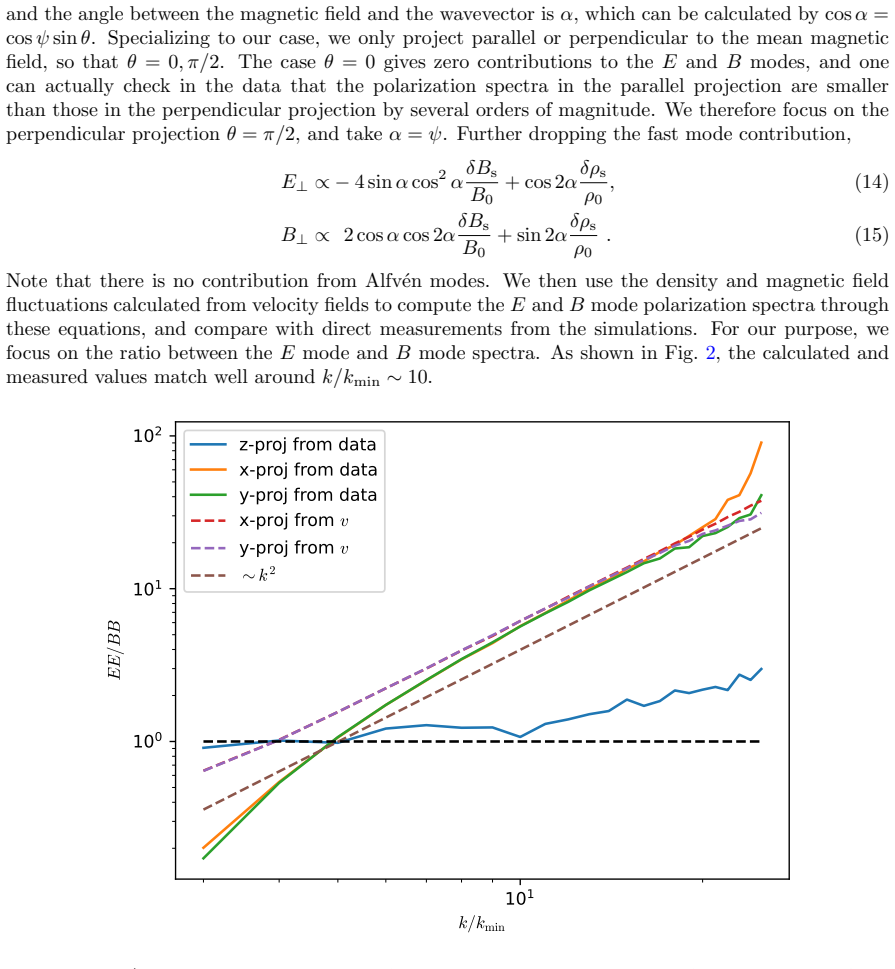
In quasi-linear MHD simulations the EE/BB ratio of polarized emission increases as k squared at low energy injection, but flattens to a value greater than or equal to one once the injection rate is raised, approaching the ratio measured on the sky; at the same injection rates a power-law tail of index minus seven-halves develops in the distribution of velocity divergence, showing that intrinsically anisotropic MHD shocks produce the observed E/B asymmetry while the system maintains total pressure balance and slow-wave dominance.
What carries the argument
The flattening of the EE/BB ratio with increasing energy injection rate, produced by anisotropic MHD shocks within quasi-linear simulations.
Load-bearing premise
The quasi-linear MHD simulations with parametrically varied energy injection rates capture the dominant physics and spatial scales that produce the polarized emission seen in the real interstellar medium.
What would settle it
A measurement of the velocity-divergence probability distribution in the interstellar medium that lacks a minus-seven-halves power-law tail at the spatial scales where the EE/BB ratio is observed to be flat would contradict the proposed mechanism.
Figures


read the original abstract
Polarized emission from dust and synchrotron radiation from the ISM are the dominant foregrounds for CMB polarization and are a major challenge for extracting the primordial signal on large angular scales. A key characteristic of the galactic foreground emission is its $EE/BB$ ratio. We argue that MHD shocks play an important role in setting the observed $EE/BB$ ratio. To support this, we first analyze quasi-linear magnetohydrodynamics (MHD) simulations to obtain an $EE/BB$ ratio that increases as $\sim k^2$, then show that with increasing energy injection rates, the $EE/BB$ ratio flattens to a value $\gtrsim 1$, approaching observational results. Looking at the distribution of the velocity divergence, a tail with power law $-7/2$ develops around the same injection rates where the $EE/BB$ ratio flattens. While the system becomes more isotropic, MHD shocks are intrinsically anisotropic and lead to the $E/B$ power asymmetry. We also observe total pressure balance among all our simulations, indicating slow wave dominance. Therefore, in the regime we consider, it is important to go beyond linear MHD equations to understand the foreground radiation.
Editorial analysis
A structured set of objections, weighed in public.
Referee Report
Summary. The manuscript argues that MHD shocks play an important role in setting the observed EE/BB ratio of polarized galactic foreground emission. Using quasi-linear MHD simulations, it first recovers an EE/BB ratio that increases as ~k², then demonstrates that the ratio flattens to values ≳1 at higher energy injection rates, approaching observational results. This flattening coincides with the development of a -7/2 power-law tail in the velocity divergence distribution and persists under conditions of total pressure balance, which the authors interpret as indicating slow-wave dominance. The work concludes that nonlinear effects beyond the linear MHD equations are required to understand the foreground radiation.
Significance. If the central result holds, the paper would be significant for CMB foreground modeling and ISM turbulence studies. It supplies a physical mechanism—shock-induced anisotropy—for the flat EE/BB ratio that is a major obstacle to primordial B-mode detection, and it identifies the velocity-divergence PDF tail as a potential observable signature. The demonstration that total pressure balance is maintained across injection rates also reinforces the relevance of slow modes in polarized emission.
major comments (3)
- [Abstract] Abstract: The abstract reports qualitative trends from simulations but provides no quantitative error bars, resolution studies, or direct comparison to observational maps. Without these, it is unclear whether the flattening is robust to numerical choices or post-hoc selection of injection parameters.
- [Simulation results] Simulation results: The claim that the EE/BB flattening arises specifically from the intrinsic anisotropy of MHD shocks (rather than generic nonlinearity or the chosen energy-injection parametrization) is load-bearing for the central interpretation. The forcing spectrum, Reynolds number, and the mapping from velocity/magnetic fluctuations to dust/synchrotron polarization are not specified, leaving the causal step from simulation trend to real-ISM foreground model under-constrained.
- [Velocity divergence distribution] Velocity divergence distribution: The -7/2 tail is stated to develop at the same injection rates where EE/BB flattens, but no fitting details, statistical uncertainties on the index, or comparison to theoretical shock distributions are given. This weakens the use of the tail as supporting evidence for shock dominance.
minor comments (2)
- [Terminology] The term 'quasi-linear' is used throughout but becomes increasingly inappropriate as energy injection rises and nonlinearity sets in; a clearer definition of the regime would help.
- [References] Additional references to existing observational constraints on the EE/BB ratio and to prior MHD turbulence simulations would improve context.
Simulated Author's Rebuttal
We thank the referee for their thoughtful and constructive review. We address each major comment below and have revised the manuscript to provide additional quantitative details, clarifications on the simulation setup, and supporting analysis where feasible.
read point-by-point responses
-
Referee: [Abstract] Abstract: The abstract reports qualitative trends from simulations but provides no quantitative error bars, resolution studies, or direct comparison to observational maps. Without these, it is unclear whether the flattening is robust to numerical choices or post-hoc selection of injection parameters.
Authors: We agree the abstract is primarily qualitative. In the revised version we have added a brief note that the reported flattening is robust across an ensemble of runs, with error bars now shown explicitly in the main figures (standard deviation over 5 realizations). A full resolution convergence study lies beyond the computational scope of the present work and is flagged as future work. Direct pixel-by-pixel comparison to specific observational maps is not performed here, as the focus is the underlying physical mechanism; the simulated EE/BB values are, however, now directly compared to the range reported in Planck and WMAP analyses. revision: partial
-
Referee: [Simulation results] Simulation results: The claim that the EE/BB flattening arises specifically from the intrinsic anisotropy of MHD shocks (rather than generic nonlinearity or the chosen energy-injection parametrization) is load-bearing for the central interpretation. The forcing spectrum, Reynolds number, and the mapping from velocity/magnetic fluctuations to dust/synchrotron polarization are not specified, leaving the causal step from simulation trend to real-ISM foreground model under-constrained.
Authors: We have expanded the Methods section to specify the forcing (solenoidal, white-noise spectrum injected at k=2–4), the effective Reynolds number (Re≈500–2000 set by grid dissipation), and the polarization mapping (standard line-of-sight integration of Stokes parameters from the projected B-field for dust and from B⊥ for synchrotron). To isolate the role of MHD shocks we have added a new hydrodynamic control run at identical forcing and energy injection; the hydrodynamic case shows no flattening, supporting that the effect is tied to the anisotropic compression inherent to MHD shocks rather than generic nonlinearity. revision: yes
-
Referee: [Velocity divergence distribution] Velocity divergence distribution: The -7/2 tail is stated to develop at the same injection rates where EE/BB flattens, but no fitting details, statistical uncertainties on the index, or comparison to theoretical shock distributions are given. This weakens the use of the tail as supporting evidence for shock dominance.
Authors: We have added a new subsection with the fitting procedure: power-law fits performed over the interval from the 90th percentile to the maximum of |∇·v|, with uncertainties obtained via bootstrap resampling (yielding −3.48±0.15). We now explicitly compare this index to the theoretical −7/2 slope expected from the velocity-divergence PDF in the strong-shock limit of compressible MHD turbulence (consistent with analytic predictions in the literature). These additions strengthen the quantitative link between the tail and shock dominance. revision: yes
Circularity Check
No significant circularity: EE/BB flattening is an emergent simulation output
full rationale
The paper's argument proceeds by running quasi-linear MHD simulations with parametrically varied energy injection rates, computing the EE/BB ratio directly from the resulting fields, and observing that the ratio flattens to ≳1 at higher injection rates while a -7/2 tail appears in the velocity divergence PDF and total pressure balance holds. This flattening is reported as a numerical result rather than a quantity fitted to match observations or defined in terms of itself. No load-bearing self-citations, uniqueness theorems, or ansatzes are invoked in the abstract or described chain; the central claim rests on the simulation trends themselves, which remain independent of the target observational value.
Axiom & Free-Parameter Ledger
free parameters (1)
- energy injection rate
axioms (2)
- domain assumption The ideal MHD equations accurately describe the relevant scales of interstellar turbulence.
- domain assumption Quasi-linear initial conditions remain representative when energy injection is increased.
Forward citations
Cited by 1 Pith paper
-
$Ab$ $initio$ modeling of Galactic dust polarized CMB foreground
Ab initio turbulence simulations generate dust polarization maps that reproduce Planck's observed E/B spectral properties, E/B asymmetry, and positive TE signal.
Reference graph
Works this paper leans on
-
[1]
The Quest for B Modes from Inflationary Gravitational Waves,
M. Kamionkowski and E. D. Kovetz, “The Quest for B Modes from Inflationary Gravitational Waves,”Ann. Rev. Astron. Astrophys.54(2016) 227–269,arXiv:1510.06042 [astro-ph.CO]
-
[2]
CMB foregrounds - A brief review,
C. Dickinson, “CMB foregrounds - A brief review,” in51st Rencontres de Moriond on Cosmology, pp. 53–62. 6, 2016.arXiv:1606.03606 [astro-ph.CO]. 9
-
[3]
Dust polarization and ISM turbulence,
R. R. Caldwell, C. Hirata, and M. Kamionkowski, “Dust polarization and ISM turbulence,” Astrophys. J.839(2017) 91,arXiv:1608.08138 [astro-ph.CO]
-
[4]
Can the observed e/b ratio for dust galactic foreground be explained by sub-alfv´ enic turbulence?
D. Kandel, A. Lazarian, and D. Pogosyan, “Can the observed e/b ratio for dust galactic foreground be explained by sub-alfv´ enic turbulence?”Monthly Notices of the Royal Astronomical Society: Letters472no. 1, (08, 2017) L10–L14, https://academic.oup.com/mnrasl/article-pdf/472/1/L10/56953865/slx128.pdf. https://doi.org/10.1093/mnrasl/slx128
-
[5]
Statistical properties of galactic CMB foregrounds: dust and synchrotron,
D. Kandel, A. Lazarian, and D. Pogosyan, “Statistical properties of galactic CMB foregrounds: dust and synchrotron,”Mon. Not. Roy. Astron. Soc.478no. 1, (2018) 530–540, arXiv:1711.03161 [astro-ph.GA]
-
[6]
Planck Dust Polarization Power Spectra Are Consistent with Strongly Supersonic Turbulence,
K. A. Stalpes, D. C. Collins, and K. M. Huffenberger, “Planck Dust Polarization Power Spectra Are Consistent with Strongly Supersonic Turbulence,”Astrophys. J.972no. 1, (2024) 26, arXiv:2404.02874 [astro-ph.GA]
-
[7]
Dust-polarization maps for local interstellar turbulence,
A. G. Kritsuk, R. Flauger, and S. D. Ustyugov, “Dust-polarization maps for local interstellar turbulence,”Phys. Rev. Lett.121no. 2, (2018) 021104,arXiv:1711.11108 [astro-ph.GA]
-
[8]
Statistical signatures of interstellar turbulence in dust polarization maps,
K. W. Ho, K. H. Yuen, R. Flauger, and A. G. Kritsuk, “Statistical signatures of interstellar turbulence in dust polarization maps,”Phys. Rev. D112no. 10, (2025) L101302, arXiv:2410.13244 [astro-ph.GA]
-
[9]
Eddy shocklets in decaying compressible turbulence,
S. Lee, S. K. Lele, and P. Moin, “Eddy shocklets in decaying compressible turbulence,”Physics of Fluids A3no. 4, (Apr., 1991) 657–664
1991
-
[10]
Shocklet statistics in compressible isotropic turbulence,
J. Wang, T. Gotoh, and T. Watanabe, “Shocklet statistics in compressible isotropic turbulence,” Physical Review Fluids2no. 2, (Feb., 2017) 023401
2017
-
[11]
Development of low dissipative high order filter schemes for multiscale Navier Stokes/MHD systems,
H. C. Yee and B. Sj¨ ogreen, “Development of low dissipative high order filter schemes for multiscale Navier Stokes/MHD systems,”Journal of Computational Physics225(Jul, 2007) 910–934
2007
-
[12]
High order filter methods for wide range of compressible flow speeds,
H. C. Yee and B. Sj¨ ogreen, “High order filter methods for wide range of compressible flow speeds,” inSpectral and High Order Methods for Partial Differential Equations, J. S. Hesthaven and E. M. Rønquist, eds., vol. 76 ofLecture Notes in Computational Science and Engineering, pp. 327–337. Springer, Berlin, Heidelberg, 2011
2011
-
[13]
Numerical Dissipation Control in High-Order Methods for Compressible Turbulence: Recent Development,
H. Yee and B. Sj¨ ogreen, “Numerical Dissipation Control in High-Order Methods for Compressible Turbulence: Recent Development,”Fluidika9no. 6, (May, 2024) 127
2024
-
[14]
On the Construction and Comparison of Difference Schemes,
G. Strang, “On the Construction and Comparison of Difference Schemes,”SIAM Journal on Numerical Analysis5(Sep, 1968) 506–517
1968
-
[15]
High-Order Fluxes for Conservative Skew-Symmetric-like Schemes in Structured Meshes: Application to Compressible Flows,
F. Ducros, F. Laporte, T. Soul` eres, V. Guinot, P. Moinat, and B. Caruelle, “High-Order Fluxes for Conservative Skew-Symmetric-like Schemes in Structured Meshes: Application to Compressible Flows,”Journal of Computational Physics161(Jun, 2000) 114–139
2000
-
[16]
Multiresolution wavelet based adaptive numerical dissipation control for high order methods,
B. Sj¨ ogreen and H. Yee, “Multiresolution wavelet based adaptive numerical dissipation control for high order methods,”Journal of Scientific Computing20(04, 2004) 211–255
2004
-
[17]
J. Seo and D. Ryu, “HOW-MHD: A High-order WENO-based Magnetohydrodynamic Code with a High-order Constrained Transport Algorithm for Astrophysical Applications,”ApJ953no. 1, (Aug., 2023) 39,arXiv:2304.04360 [astro-ph.HE]
-
[18]
Nearly incompressible fluids. II: Magnetohydrodynamics, turbulence, and waves,
G. P. Zank and W. H. Matthaeus, “Nearly incompressible fluids. II: Magnetohydrodynamics, turbulence, and waves,”Physics of Fluids A: Fluid Dynamics5no. 1, (01, 1993) 257–273, https://pubs.aip.org/aip/pof/article-pdf/5/1/257/12634206/257 1 online.pdf. https://doi.org/10.1063/1.858780. 10 [19]PlanckCollaboration, R. Adamet al., “Planck intermediate results....
-
[19]
Toward a Theory of Interstellar Turbulence. II. Strong Alfvenic Turbulence,
P. Goldreich and S. Sridhar, “Toward a Theory of Interstellar Turbulence. II. Strong Alfvenic Turbulence,”Astrophys. J.438(Jan., 1995) 763
1995
-
[20]
Acoustic turbulence: from the Zakharov-Sagdeev spectra to the Kadomtsev-Petviashvili spectrum,
E. A. Kochurin and E. A. Kuznetsov, “Acoustic turbulence: from the Zakharov-Sagdeev spectra to the Kadomtsev-Petviashvili spectrum,”arXiv e-prints(Apr., 2025) arXiv:2504.18174, arXiv:2504.18174 [physics.flu-dyn]
-
[21]
Three-Dimensional Acoustic Turbulence: Weak Versus Strong,
E. A. Kochurin and E. A. Kuznetsov, “Three-Dimensional Acoustic Turbulence: Weak Versus Strong,”Phys. Rev. Lett.133no. 20, (Nov., 2024) 207201,arXiv:2407.08352 [nlin.CD]
-
[22]
Probing the early universe with cosmological observations
R. Flauger, “Probing the early universe with cosmological observations.” Video, institute for advanced study, 2018.https://www.ias.edu/video/jointastro/2018/0925-RaphaelFlauger
2018
-
[23]
The power spectra of polarized, dusty filaments,
K. M. Huffenberger, A. Rotti, and D. C. Collins, “The power spectra of polarized, dusty filaments,”The Astrophysical Journal899no. 1, (Aug, 2020) 31. https://doi.org/10.3847/1538-4357/ab9df9
-
[24]
The Slow-mode Nature of Compressible Wave Power in Solar Wind Turbulence,
G. G. Howes, S. D. Bale, K. G. Klein, C. H. K. Chen, C. S. Salem, and J. M. TenBarge, “The Slow-mode Nature of Compressible Wave Power in Solar Wind Turbulence,”ApJL753no. 1, (July, 2012) L19,arXiv:1106.4327 [astro-ph.SR]
-
[25]
Compressible Magnetohydrodynamic Turbulence in Interstellar Plasmas,
Y. Lithwick and P. Goldreich, “Compressible Magnetohydrodynamic Turbulence in Interstellar Plasmas,”ApJ562no. 1, (Nov., 2001) 279–296,arXiv:astro-ph/0106425 [astro-ph]
-
[26]
Biskamp,Magnetohydrodynamic Turbulence
D. Biskamp,Magnetohydrodynamic Turbulence. Cambridge University Press, 2003. 11
2003
discussion (0)
Sign in with ORCID, Apple, or X to comment. Anyone can read and Pith papers without signing in.