Network Nonlocality with Separable Measurements
Pith reviewed 2026-05-10 15:47 UTC · model grok-4.3
The pith
Separable measurements plus bidirectional classical feedforward can produce correlations that certify full network nonlocality without any entangled detectors.
A machine-rendered reading of the paper's core claim, the machinery that carries it, and where it could break.
Core claim
The central claim is that an explicit strategy based on separable measurements augmented with bidirectional classical feedforward achieves full network nonlocality for networks with independent sources, certifying the nonclassicality of every source without relying on entangled measurements at the central node.
What carries the argument
Separable measurements augmented with bidirectional classical feedforward, which let the central node exchange classical information with peripheral nodes to produce correlations that certify every source as nonclassical.
If this is right
- Full network nonlocality can be demonstrated without performing entangled measurements.
- The same class of measurements also certifies minimal network nonclassicality.
- Device-independent randomness can be extracted and quantified from full network nonlocal correlations under separable measurement strategies.
- Experimental tests of network nonlocality become feasible with simpler, non-entangled detectors.
Where Pith is reading between the lines
- The approach may generalize to other network shapes where entangled measurements were previously required.
- Classical communication can substitute for some quantum resources in certifying network nonlocality, which could simplify resource accounting in quantum networks.
- Larger or more complex networks might now be testable in the lab because detector entanglement is no longer needed.
Load-bearing premise
The correlations generated by this separable-plus-feedforward strategy cannot be reproduced by any classical model with independent sources.
What would settle it
Deriving a classical local hidden-variable model that exactly matches the output statistics of the proposed separable measurements with bidirectional feedforward would show that full network nonlocality has not been achieved.
Figures


read the original abstract
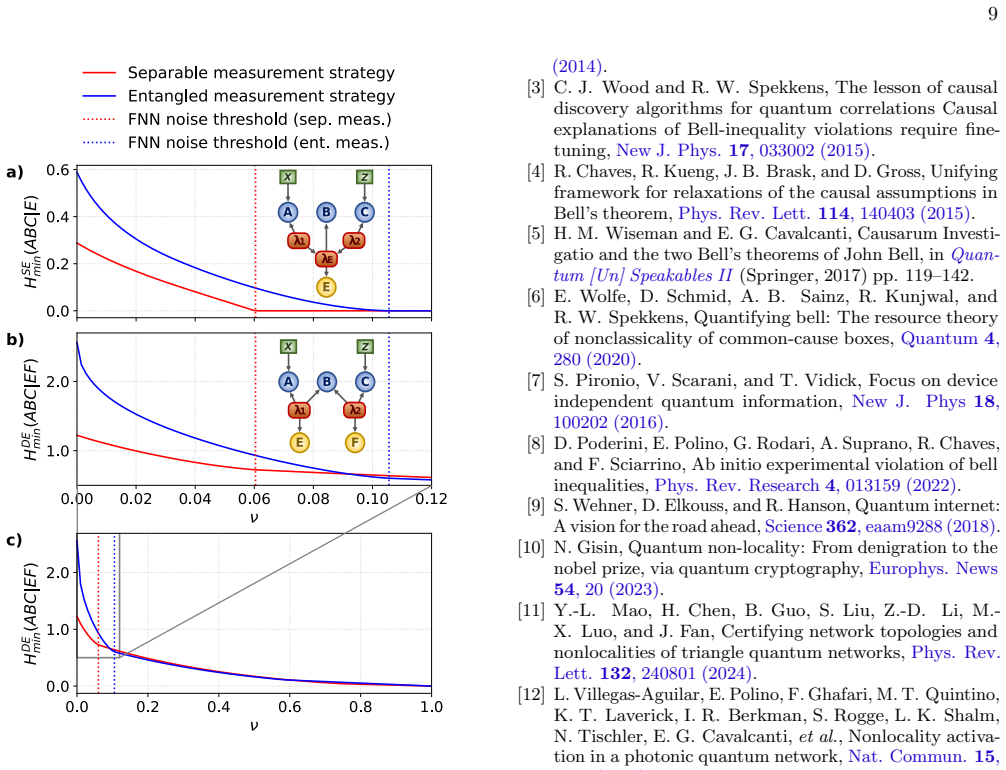
Quantum correlations in networks with independent sources have revealed novel forms of nonclassical behavior. While entanglement in the sources is a necessary ingredient, the role played by entanglement in the measurements remains largely unexplored. In particular, all existing demonstrations of full network nonlocality, certifying the nonclassicality of every source in the network, have relied on entangled measurements performed at a central node with no inputs. In this work, we construct an explicit strategy that does not rely on entangled measurements, yet still achieves full network nonlocality. Our approach is based on separable measurements augmented with bidirectional classical feedforward. We further show that this same class of measurements can give rise to another recently proposed form of network nonlocality, the minimal network nonclassicality, which ensures that the observed correlations cannot be attributed to any fixed subset of nonclassical sources within the network. Finally, building on a recently developed certification framework, we quantify the amount of device-independent randomness that can be extracted from full network nonlocal correlations under different measurement strategies. Beyond their foundational significance, our results also offer a practically attractive route toward experimental implementations of network nonlocality, as they remove the need for entangled measurements.
Editorial analysis
A structured set of objections, weighed in public.
Referee Report
Summary. The manuscript constructs an explicit strategy using separable measurements augmented with bidirectional classical feedforward that achieves full network nonlocality (certifying nonclassicality of every independent source) without entangled measurements at the central node. It further shows that the same class of measurements can produce minimal network nonclassicality and applies an existing certification framework to quantify the device-independent randomness extractable from the resulting correlations.
Significance. If the explicit construction holds, the result is significant for both foundational and practical reasons: it removes the requirement for entangled measurements in demonstrations of full network nonlocality, thereby offering a more experimentally accessible route, while the extension to minimal network nonclassicality and the randomness quantification strengthen device-independent protocols in networks with independent sources. The explicit, parameter-free nature of the strategy (as asserted) is a notable strength.
major comments (2)
- [§3] §3 (the explicit construction): the central claim that separable measurements plus bidirectional feedforward suffice to violate all classical bounds for full network nonlocality is load-bearing; the manuscript must supply the concrete POVM elements, the precise feedforward rules, and the resulting correlation expressions so that the violation can be verified directly against the classical polytope for the assumed network topology.
- [§5] §5 (randomness quantification): the application of the existing certification framework to the separable-measurement case must explicitly state how the feedforward affects the min-entropy bound and whether the bound remains tight relative to the entangled-measurement case; without this, the comparative claim cannot be assessed.
minor comments (2)
- [Abstract/Introduction] The abstract and introduction should briefly specify the network topology (number of sources, parties, and inputs) used for the construction to improve readability.
- [§3] Notation for the bidirectional classical feedforward should be defined once at first use and used consistently; a small diagram would clarify the information flow.
Simulated Author's Rebuttal
We thank the referee for their careful reading, positive assessment of the work, and recommendation for minor revision. We address each major comment below, indicating the revisions that will be made to strengthen the manuscript.
read point-by-point responses
-
Referee: [§3] §3 (the explicit construction): the central claim that separable measurements plus bidirectional feedforward suffice to violate all classical bounds for full network nonlocality is load-bearing; the manuscript must supply the concrete POVM elements, the precise feedforward rules, and the resulting correlation expressions so that the violation can be verified directly against the classical polytope for the assumed network topology.
Authors: We agree that explicit, verifiable details are essential for the central claim in §3. While the manuscript already outlines the separable measurement strategy and bidirectional feedforward protocol in sufficient detail to define the correlations, we will add a new appendix in the revised version. This appendix will provide the concrete POVM elements (as product operators on the local Hilbert spaces), the precise rules for what classical information is communicated in each direction based on local outcomes, and the full analytic expressions for the resulting tripartite correlations p(a,b,c|x,y,z). These expressions will be directly compared to the relevant facets of the classical polytope for the network with independent sources, allowing immediate numerical verification of the violation. We believe this addition will fully address the concern without altering the main text. revision: yes
-
Referee: [§5] §5 (randomness quantification): the application of the existing certification framework to the separable-measurement case must explicitly state how the feedforward affects the min-entropy bound and whether the bound remains tight relative to the entangled-measurement case; without this, the comparative claim cannot be assessed.
Authors: We agree that the impact of feedforward on the min-entropy bound requires explicit clarification. In the revised §5 we will add a dedicated paragraph explaining that bidirectional classical feedforward is incorporated into the certification framework by treating the communicated messages as additional classical inputs that define the effective local response functions at each node. The min-entropy is then lower-bounded directly from the observed correlations (which already include all feedforward effects) using the same semidefinite programming relaxation as in the entangled-measurement case. Because the framework depends only on the network structure and the observed joint distribution, the resulting bound is identical for any implementation that produces the same correlations; we will include a side-by-side numerical comparison confirming that the extractable randomness is the same (and remains tight) relative to the entangled-measurement strategy. revision: yes
Circularity Check
No significant circularity
full rationale
The paper presents an explicit construction of a separable measurement strategy augmented with bidirectional classical feedforward to achieve full network nonlocality, without relying on entangled measurements. This is a direct existence proof via construction rather than any reduction to fitted inputs, self-definitional loops, or load-bearing self-citations. The abstract and provided description show the central claim stands independently as a strategy that certifies nonclassicality for all sources, with no evidence of the enumerated circular patterns such as renaming known results or smuggling ansatzes via prior self-work. The derivation is self-contained against the network topology and measurement assumptions stated.
Axiom & Free-Parameter Ledger
axioms (1)
- domain assumption Standard quantum mechanics governs the network with independent sources and local operations
Reference graph
Works this paper leans on
-
[1]
J. S. Bell, On the einstein podolsky rosen paradox, Physics 1, 195 (1964)
work page 1964
-
[2]
N. Brunner, D. Cavalcanti, S. Pironio, V. Scarani, and S. Wehner, Bell nonlocality, Rev. Mod. Phys.86, 419 (2014)
work page 2014
-
[3]
C. J. Wood and R. W. Spekkens, The lesson of causal discovery algorithms for quantum correlations Causal explanations of Bell-inequality violations require fine- tuning, New J. Phys.17, 033002 (2015)
work page 2015
- [4]
-
[5]
H. M. Wiseman and E. G. Cavalcanti, Causarum Investi- gatio and the two Bell’s theorems of John Bell, inQuan- tum [Un] Speakables II(Springer, 2017) pp. 119–142
work page 2017
- [6]
-
[7]
S. Pironio, V. Scarani, and T. Vidick, Focus on device independent quantum information, New J. Phys18, 100202 (2016)
work page 2016
-
[8]
D. Poderini, E. Polino, G. Rodari, A. Suprano, R. Chaves, and F. Sciarrino, Ab initio experimental violation of bell inequalities, Phys. Rev. Research4, 013159 (2022)
work page 2022
- [9]
-
[10]
Gisin, Quantum non-locality: From denigration to the nobel prize, via quantum cryptography, Europhys
N. Gisin, Quantum non-locality: From denigration to the nobel prize, via quantum cryptography, Europhys. News 54, 20 (2023)
work page 2023
-
[11]
Y.-L. Mao, H. Chen, B. Guo, S. Liu, Z.-D. Li, M.- X. Luo, and J. Fan, Certifying network topologies and nonlocalities of triangle quantum networks, Phys. Rev. Lett.132, 240801 (2024)
work page 2024
-
[12]
L. Villegas-Aguilar, E. Polino, F. Ghafari, M. T. Quintino, K. T. Laverick, I. R. Berkman, S. Rogge, L. K. Shalm, N. Tischler, E. G. Cavalcanti,et al., Nonlocality activa- tion in a photonic quantum network, Nat. Commun.15, 3112 (2024)
work page 2024
- [13]
-
[14]
A. Pepper, T. J. Baker, Y. Wang, Q.-C. Song, L. K. Shalm, V. B. Verma, S. W. Nam, N. Tischler, S. Slus- sarenko, H. M. Wiseman,et al., Scalable multiparty steer- ing using a single entangled photon pair, AVS Quantum Sci.6, https://doi.org/10.1116/5.0197186 (2024)
-
[15]
J. W. Webb, J. Ho, F. Grasselli, G. Murta, A. Pickston, A. Ulibarrena, and A. Fedrizzi, Experimental anonymous quantum conferencing, Optica11, 872 (2024)
work page 2024
-
[16]
L. T. Weinbrenner, N. Prasannan, K. Hansenne, S. Denker, J. Sperling, B. Brecht, C. Silberhorn, and O. G¨ uhne, Certifying the topology of quantum networks: Theory and experiment, Phys. Rev. Lett.132, 240802 (2024)
work page 2024
- [17]
-
[18]
A. Tavakoli, A. Pozas-Kerstjens, M.-X. Luo, and M.-O. Renou, Bell nonlocality in networks, Reports on Progress in Physics85, 056001 (2022)
work page 2022
-
[19]
D. J. Saunders, A. J. Bennet, C. Branciard, and G. J. Pryde, Experimental demonstration of nonbilocal quan- tum correlations, Science Advances3, e1602743 (2017). 10
work page 2017
-
[20]
G. Carvacho, F. Andreoli, L. Santodonato, M. Bentivegna, R. Chaves, and F. Sciarrino, Experimental violation of local causality in a quantum network, Nat. Commun.8, 1 (2017)
work page 2017
- [21]
-
[22]
D. Poderini, I. Agresti, G. Marchese, E. Polino, T. Gior- dani, A. Suprano, M. Valeri, G. Milani, N. Spagnolo, G. Carvacho,et al., Experimental violation of n-locality in a star quantum network, Nat. Commun.11, 1 (2020)
work page 2020
- [23]
-
[24]
D. Wu, Y.-F. Jiang, X.-M. Gu, L. Huang, B. Bai, Q.- C. Sun, X. Zhang, S.-Q. Gong, Y. Mao, H.-S. Zhong, M.-C. Chen, J. Zhang, Q. Zhang, C.-Y. Lu, and J.- W. Pan, Experimental refutation of real-valued quantum mechanics under strict locality conditions, Phys. Rev. Lett.129, 140401 (2022)
work page 2022
-
[25]
G. Carvacho, E. Roccia, M. Valeri, F. B. Basset, D. Poderini, C. Pardo, E. Polino, L. Carosini, M. B. Rota, J. Neuwirth,et al., Quantum violation of local causality in an urban network using hybrid photonic technologies, Optica9, 572 (2022)
work page 2022
-
[26]
I. Agresti, B. Polacchi, D. Poderini, E. Polino, A. Suprano, I. ˇSupi´ c, J. Bowles, G. Carvacho, D. Cavalcanti, and F. Sciarrino, Experimental robust self-testing of the state generated by a quantum network, PRX Quantum2, 020346 (2021)
work page 2021
-
[27]
A. Suprano, D. Poderini, E. Polino, I. Agresti, G. Carva- cho, A. Canabarro, E. Wolfe, R. Chaves, and F. Sciarrino, Experimental genuine tripartite nonlocality in a quantum triangle network, PRX Quantum3, 030342 (2022)
work page 2022
-
[28]
N. D’Alessandro, B. Polacchi, G. Moreno, E. Polino, R. Chaves, I. Agresti, and F. Sciarrino, Machine-learning- based device-independent certification of quantum net- works, Phys. Rev. Res.5, 023016 (2023)
work page 2023
- [29]
-
[30]
N.-N. Wang, C. Zhang, H. Cao, K. Xu, B.-H. Liu, Y.- F. Huang, C.-F. Li, G.-C. Guo, N. Gisin, T. Kriv´ achy, et al., Experimental genuine quantum nonlocality in the triangle network, arXiv preprint arXiv:2401.15428 https://doi.org/10.48550/arXiv.2401.15428 (2024)
-
[31]
N.-N. Wang, A. Pozas-Kerstjens, C. Zhang, B.-H. Liu, Y.- F. Huang, C.-F. Li, G.-C. Guo, N. Gisin, and A. Tavakoli, Certification of non-classicality in all links of a photonic star network without assuming quantum mechanics, Nat. Commun.14, 2153 (2023)
work page 2023
-
[32]
N.-N. Wang, X. Yang, Y.-H. Yang, C. Zhang, M.-X. Luo, B.-H. Liu, Y.-F. Huang, C.-F. Li, and G.-C. Guo, Si- multaneous verification of genuine multipartite nonlocal- ity and full network nonlocality, Phys. Rev. Lett.134, 080202 (2025)
work page 2025
-
[33]
M. Zukowski, A. Zeilinger, M. A. Horne, and A. K. Ek- ert, Event-ready-detectors Bell experiment via entangle- ment swapping., Phys. Rev. Lett.71, 10.1103/Phys- RevLett.71.4287 (1993)
- [34]
- [35]
- [36]
-
[37]
M. O. Renou, J. Kaniewski, and N. Brunner, Self-testing entangled measurements in quantum networks, Phys. Rev. Lett.121, 250507 (2018)
work page 2018
-
[38]
I. ˇSupi´ c, J. Bowles, M.-O. Renou, A. Ac´ ın, and M. J. Hoban, Quantum networks self-test all entangled states, Nature Physics19, 670 (2023)
work page 2023
-
[39]
P. Sekatski, S. Boreiri, and N. Brunner, Partial self-testing and randomness certification in the triangle network, Phys. Rev. Lett.131, 100201 (2023)
work page 2023
- [40]
- [41]
-
[42]
C. Branciard, D. Rosset, N. Gisin, and S. Pironio, Bilocal versus nonbilocal correlations in entanglement-swapping experiments, Phys. Rev. A85, 032119 (2012)
work page 2012
-
[43]
Fritz, Beyond Bell’s theorem: correlation scenarios, New J
T. Fritz, Beyond Bell’s theorem: correlation scenarios, New J. Phys.14, 103001 (2012)
work page 2012
- [44]
- [45]
-
[46]
A. Pozas-Kerstjens, N. Gisin, and M.-O. Renou, Proofs of network quantum nonlocality in continuous families of distributions, Phys. Rev. Lett.130, 090201 (2023)
work page 2023
-
[47]
E. B¨ aumer, V. Gitton, T. Kriv´ achy, N. Gisin, and R. Ren- ner, Exploring the local landscape in the triangle network, Phys. Rev.111, 052453 (2025)
work page 2025
- [48]
- [49]
-
[50]
M.-C. Chen, C. Wang, F.-M. Liu, J.-W. Wang, C. Ying, Z.-X. Shang, Y. Wu, M. Gong, H. Deng, F.-T. Liang, et al., Ruling out real-valued standard formalism of quan- tum theory, Phys. Rev. Lett.128, 040403 (2022)
work page 2022
-
[51]
R. Jozsa, M. Koashi, N. Linden, S. Popescu, S. Presnell, D. Shepherd, and A. Winter, Entanglement cost of gener- alised measurements, arXiv preprint quant-ph/0303167 https://doi.org/10.48550/arXiv.quant-ph/0303167 (2003)
-
[52]
C. H. Bennett, G. Brassard, C. Cr´ epeau, R. Jozsa, A. Peres, and W. K. Wootters, Teleporting an unknown 11 quantum state via dual classical and einstein-podolsky- rosen channels, Phys. Rev. Lett.70, 1895 (1993)
work page 1993
-
[53]
X.-M. Hu, Y. Guo, B.-H. Liu, C.-F. Li, and G.-C. Guo, Progress in quantum teleportation, Nat. Rev. Phys.5, 339 (2023)
work page 2023
-
[54]
N. Gisin, Entanglement 25 years after quantum telepor- tation testing joint measurements in quantum networks, Entropy21, 325 (2019)
work page 2019
-
[55]
A. Tavakoli, N. Gisin, and C. Branciard, Bilocal bell in- equalities violated by the quantum elegant joint measure- ment, Phys. Rev. Lett.126, 220401 (2021)
work page 2021
-
[56]
I. ˇSupi´ c, J.-D. Bancal, Y. Cai, and N. Brunner, Genuine network quantum nonlocality and self-testing, Phys. Rev. A105, 022206 (2022)
work page 2022
-
[57]
C.-X. Huang, X.-M. Hu, Y. Guo, C. Zhang, B.-H. Liu, Y.- F. Huang, C.-F. Li, G.-C. Guo, N. Gisin, C. Branciard, et al., Entanglement swapping and quantum correlations via symmetric joint measurements, Phys. Rev. Lett.129, 030502 (2022)
work page 2022
-
[58]
A. Pozas-Kerstjens, N. Gisin, and A. Tavakoli, Full net- work nonlocality, Phys. Rev. Lett.128, 010403 (2022)
work page 2022
-
[59]
X.-M. Gu, L. Huang, A. Pozas-Kerstjens, Y.-F. Jiang, D. Wu, B. Bai, Q.-C. Sun, M.-C. Chen, J. Zhang, S. Yu, et al., Experimental full network nonlocality with inde- pendent sources and strict locality constraints, Phys. Rev. Lett.130, 190201 (2023)
work page 2023
-
[60]
F. Del Santo, J. Czartowski, K. ˙Zyczkowski, and N. Gisin, Iso-entangled bases and joint measurements, Physical Review Research6, 023085 (2024)
work page 2024
-
[61]
J. Pauwels, A. Pozas-Kerstjens, F. Del Santo, and N. Gisin, Classification of joint quantum measurements based on entanglement cost of localization, Physical Review X15, 021013 (2025)
work page 2025
-
[62]
A. Wei, G. Cobucci, and A. Tavakoli, Nonprojective bell- state measurements, Phys. Rev. A110, 042206 (2024)
work page 2024
-
[63]
D. Ding, Y.-Q. He, T. Gao, and F.-L. Yan, Symmetric quantum joint measurements on multiple qubits, Phys. Rev.111, 052450 (2025)
work page 2025
-
[64]
J. Pauwels, C. Branciard, A. Pozas-Kerstjens, and N. Gisin, Symmetric localizable multi- partite quantum measurements from pauli orbits, arXiv preprint arXiv:2509.01851 https://doi.org/10.48550/arXiv.2509.01851 (2025)
work page internal anchor Pith review doi:10.48550/arxiv.2509.01851 2025
-
[65]
J. Pauwels and N. Gisin, The multiqubit elegant joint measurement, arXiv preprint arXiv:2509.01852 https://doi.org/10.48550/arxiv.2509.01852 (2025)
work page internal anchor Pith review doi:10.48550/arxiv.2509.01852 2025
-
[66]
G. ¨Ust¨ un, E. G. Rieffel, S. J. Devitt, and J. Saied, Fusion for high-dimensional linear-optical quantum computing with improved success probability, Phys. Rev. Applied 24, 044024 (2025)
work page 2025
-
[67]
C. Branciard, N. Gisin, and S. Pironio, Characterizing the nonlocal correlations created via entanglement swapping, Phys. Rev. Lett.104, 170401 (2010)
work page 2010
-
[68]
A. Tavakoli, P. Skrzypczyk, D. Cavalcanti, and A. Ac´ ın, Nonlocal correlations in the star-network configuration, Phys. Rev. A90, 062109 (2014)
work page 2014
-
[69]
F. Andreoli, G. Carvacho, L. Santodonato, R. Chaves, and F. Sciarrino, Maximal qubit violation of n-locality inequalities in a star-shaped quantum network, New J. Phys.19, 113020 (2017)
work page 2017
-
[70]
E. G. Cavalcanti, R. Chaves, F. Giacomini, and Y.-C. Liang, Fresh perspectives on the foundations of quantum physics, Nature Reviews Physics5, 323 (2023)
work page 2023
-
[71]
Calsamiglia, Generalized measurements by linear ele- ments, Phys
J. Calsamiglia, Generalized measurements by linear ele- ments, Phys. Rev. A65, 030301 (2002)
work page 2002
-
[72]
Bell state measurements in quantum optics: a review of recent progress and open challenges
L. Bianchi, C. Marconi, and D. Bacco, Bell state mea- surements in quantum optics: A review of recent progress and open challenges, arXiv preprint 2509.18756 (2025), 2509.18756 [quant-ph]
work page internal anchor Pith review Pith/arXiv arXiv 2025
-
[73]
M. Ciudad-Ala˜ n´ on, E.-C. Boghiu, P. Abiuso, and E. Wolfe, Escaping the shadow of bell’s theorem in network nonlocality, arXiv preprint arXiv:2406.15587 https://arxiv.org/abs/2406.15587 (2024)
-
[74]
M.-X. Luo, X. Yang, and A. Pozas-Kerstjens, Hierarchical certification of nonclassical network correlations, Phys. Rev. A110, 022617 (2024)
work page 2024
-
[75]
E. H˚ akansson, A. Piveteau, S. Muhammad, and M. Bourennane, Experimental demonstration of full net- work nonlocality in the bilocal scenario, arXiv preprint (2022), arXiv:2201.06361 [quant-ph]
-
[76]
S. Munshi and A. K. Pan, Device-independent full net- work nonlocality for arbitrary-party and unbounded-input scenario, Phys. Rev. Lett.134, 210203 (2025)
work page 2025
-
[77]
K. Mukherjee, Full network nonlocal- ity based security in quantum key distri- bution, arXiv preprint arXiv:2603.20035 https://doi.org/10.48550/arXiv.2603.20035 (2026)
-
[78]
F. Andreoli, G. Carvacho, L. Santodonato, M. Bentivegna, R. Chaves, and F. Sciarrino, Experimental bilocality vio- lation without shared reference frames, Phys. Rev. A95, 062315 (2017)
work page 2017
- [79]
-
[80]
N. Gisin, The elegant joint quantum measurement and some conjectures about n-locality in the triangle and other configurations, arXiv preprint arXiv:1708.05556 (2017)
discussion (0)
Sign in with ORCID, Apple, or X to comment. Anyone can read and Pith papers without signing in.