Bell state measurements in quantum optics: a review of recent progress and open challenges
Pith reviewed 2026-05-18 15:02 UTC · model grok-4.3
The pith
Linear optical elements impose fundamental efficiency limits on photonic Bell state measurements, with reviewed proposals and high-dimensional extensions offering paths forward.
A machine-rendered reading of the paper's core claim, the machinery that carries it, and where it could break.
Core claim
Bell state measurements project bipartite qubit systems onto the maximally entangled Bell basis and are central to quantum information tasks, yet in photonic platforms constrained to linear optical elements their realization remains inefficient; the review surveys all major proposals, identifies their inherent limitations, outlines strategies developed to mitigate those limits, and covers recent advances for high-dimensional systems relevant to scalable networks and high-capacity communication.
What carries the argument
Linear-optical Bell state measurement, a projection of two photonic qubits onto one of the four Bell states using only beam splitters, phase shifters, and detectors, whose success probability is bounded by the absence of photon-photon interactions.
If this is right
- Higher-efficiency linear-optical Bell state measurements would make quantum teleportation of photonic states more reliable and less resource-intensive.
- Improved entanglement swapping would enable longer-distance quantum repeaters without requiring nonlinear optical gates.
- Fusion gates based on these measurements would become viable building blocks for measurement-based photonic quantum computation.
- High-dimensional Bell state measurements would increase the information capacity per photon in quantum communication links.
- Practical strategies reviewed would reduce the overhead needed for error-corrected photonic quantum networks.
Where Pith is reading between the lines
- Overcoming the linear-optics bottleneck could allow hybrid photonic systems to interface more cleanly with other quantum platforms such as trapped ions or superconducting circuits.
- The high-dimensional extensions surveyed may connect to ongoing work on qudit-based quantum error correction codes that tolerate higher noise rates.
- If the reviewed strategies scale experimentally, they could inform concrete hardware requirements for a photonic quantum internet backbone.
- Testing the high-dimensional proposals in real fiber or free-space channels would reveal whether the theoretical gains survive realistic loss and noise.
Load-bearing premise
Photonic quantum information processing remains restricted to linear optical elements without access to strong nonlinear interactions.
What would settle it
An experiment that achieves deterministic, near-unit-efficiency discrimination of all four Bell states on photonic qubits using only linear optics would directly contradict the fundamental limitations surveyed in the review.
Figures


read the original abstract
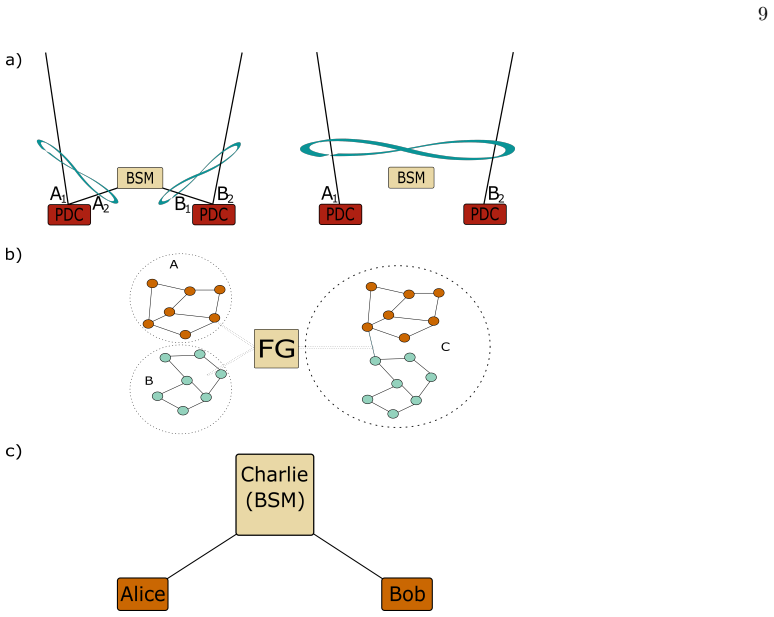
Bell state measurements, which project bipartite qubit systems onto the maximally entangled Bell basis, are central to a wide range of quantum information processing tasks, including quantum teleportation, entanglement swapping, and fusion-gate quantum computation. In photonic quantum platforms, where information is encoded in optical degrees of freedom, the realization of efficient Bell state measurements is particularly challenging, especially when constrained to linear optical elements. In this review, we provide a comprehensive examination of existing proposals for implementing Bell state measurements, highlighting their fundamental limitations and the strategies developed to overcome them. Additionally, we survey recent advances in Bell state measurements for high-dimensional systems, an area of growing interest due to its relevance in scalable quantum networks and high-capacity quantum communication.
Editorial analysis
A structured set of objections, weighed in public.
Referee Report
Summary. The manuscript is a review that examines Bell state measurements (BSMs) in photonic quantum platforms. It describes the central role of BSMs in tasks such as quantum teleportation, entanglement swapping, and fusion-gate computation; surveys proposals for their implementation under the constraint of linear optical elements and the associated fundamental limitations; and covers recent progress in high-dimensional encodings relevant to scalable quantum networks and high-capacity communication.
Significance. If the coverage is balanced and citations accurate, the review would provide a useful consolidation of the literature on a key primitive for photonic quantum information processing. Highlighting both the no-go results for linear optics and the strategies developed to circumvent them, together with the survey of high-dimensional approaches, could help researchers identify open directions without needing to assemble the material from many primary sources.
minor comments (3)
- The abstract states that the review provides a 'comprehensive examination' of proposals and limitations. Adding an explicit scope paragraph early in the introduction that lists the main classes of proposals considered (e.g., linear-optics-only, auxiliary-photon, nonlinear, high-dimensional) and the time window of literature covered would help readers judge completeness.
- When summarizing the linear-optics no-go theorems, include a brief reference to the key mathematical argument (e.g., the requirement that the measurement operators commute with the total photon-number operator) so that the review remains accessible to readers who have not consulted the original papers.
- For the high-dimensional section, ensure that tables or figures comparing success probabilities, resource overhead, and experimental demonstrations across different dimensions (d=2, d=3, d=4, etc.) are included to make quantitative progress easier to assess.
Simulated Author's Rebuttal
We thank the referee for the positive assessment of our review manuscript on Bell state measurements in quantum optics. We appreciate the recognition of its potential utility in consolidating the literature on this key primitive, including the discussion of linear-optical limitations and high-dimensional approaches. We will ensure the revised version maintains balanced coverage and accurate citations.
Circularity Check
No significant circularity in this review paper
full rationale
This is a review paper that aggregates and cites prior literature on Bell state measurements in photonic systems without performing any new derivations, theorems, or parameter fittings. No load-bearing steps reduce by construction to self-definitions, fitted inputs renamed as predictions, or self-citation chains. The content consists of descriptive summaries of existing proposals and their limitations under linear optics, so the argument rests on accurate representation of external work rather than internal reductions. This is self-contained against external benchmarks and receives the default non-finding for reviews.
Axiom & Free-Parameter Ledger
Lean theorems connected to this paper
-
IndisputableMonolith/Foundation/RealityFromDistinction.leanreality_from_one_distinction unclear?
unclearRelation between the paper passage and the cited Recognition theorem.
Bell state measurements... constrained to linear optical elements... fundamental limitations... high-dimensional systems
-
IndisputableMonolith/Cost/FunctionalEquation.leanwashburn_uniqueness_aczel unclear?
unclearRelation between the paper passage and the cited Recognition theorem.
success probability... bounded from above by 50 %... auxiliary photons, nonlinear interactions
What do these tags mean?
- matches
- The paper's claim is directly supported by a theorem in the formal canon.
- supports
- The theorem supports part of the paper's argument, but the paper may add assumptions or extra steps.
- extends
- The paper goes beyond the formal theorem; the theorem is a base layer rather than the whole result.
- uses
- The paper appears to rely on the theorem as machinery.
- contradicts
- The paper's claim conflicts with a theorem or certificate in the canon.
- unclear
- Pith found a possible connection, but the passage is too broad, indirect, or ambiguous to say the theorem truly supports the claim.
Forward citations
Cited by 3 Pith papers
-
Imaginarity-generating power of unitaries: A resource-theoretic approach
Unitaries have an exactly quantifiable purity-constrained imaginarity-generating power that depends on intrinsic unitary properties and concentrates near its maximum for typical Haar-random dynamics in high dimensions.
-
On-demand generation of all four Bell states using a single PPKTP entangled photon source
A single PPKTP source in a polarization Sagnac interferometer generates any of the four Bell states on demand via motorized crystal translation and HWP switching, with fidelity verified by tomography and Bell tests.
-
Network Nonlocality with Separable Measurements
Separable measurements augmented with classical feedforward suffice to certify full network nonlocality and minimal network nonclassicality while enabling device-independent randomness quantification.
Reference graph
Works this paper leans on
-
[1]
C. H. Bennett, G. Brassard, C. Cr´ epeau, R. Jozsa, A. Peres, and W. K. Wootters, Teleporting an unknown quantum state via dual classical and einstein-podolsky-rosen channels, Physical review letters70, 1895 (1993)
work page 1993
-
[2]
S. Pirandola, J. Eisert, C. Weedbrook, A. Furusawa, and S. L. Braunstein, Advances in quantum teleportation, Nature photonics9, 641 (2015)
work page 2015
-
[3]
C. H. Bennett and S. J. Wiesner, Communication via one-and two-particle operators on einstein-podolsky-rosen states, Physical review letters69, 2881 (1992)
work page 1992
- [4]
-
[5]
C. H. Bennett and G. Brassard, Quantum cryptography: Public key distribution and coin tossing, Theoretical computer science560, 7 (2014)
work page 2014
-
[6]
S. Pirandola, U. L. Andersen, L. Banchi, M. Berta, D. Bunandar, R. Colbeck, D. Englund, T. Gehring, C. Lupo, C. Ottaviani,et al., Advances in quantum cryptography, Advances in optics and photonics12, 1012 (2020)
work page 2020
-
[7]
F. Xu, X. Ma, Q. Zhang, H.-K. Lo, and J.-W. Pan, Secure quantum key distribution with realistic devices, Reviews of modern physics92, 025002 (2020)
work page 2020
-
[8]
M. B. Plenio and S. S. Virmani, An introduction to entanglement theory, inQuantum information and coherence(Springer,
- [9]
- [10]
-
[11]
Vidal, Entanglement monotones, Journal of Modern Optics47, 355 (2000)
G. Vidal, Entanglement monotones, Journal of Modern Optics47, 355 (2000)
work page 2000
-
[12]
M. A. Nielsen and I. L. Chuang,Quantum computation and quantum information, Vol. 2 (Cambridge university press Cambridge, 2001)
work page 2001
-
[13]
R. A. Bertlmann and A. Zeilinger,Bell’s theorem, information and quantum physics(Springer, 2002)
work page 2002
- [14]
-
[15]
M. ˙Zukowski, A. Zeilinger, M. A. Horne, and A. K. Ekert, “event-ready-detectors”bell experiment via entanglement swapping, Physical Review Letters71, 4287 (1993)
work page 1993
-
[16]
J.-W. Pan, D. Bouwmeester, H. Weinfurter, and A. Zeilinger, Experimental entanglement swapping: entangling photons that never interacted, Physical review letters80, 3891 (1998)
work page 1998
-
[17]
T. C. Ralph, N. K. Langford, T. Bell, and A. White, Linear optical controlled-not gate in the coincidence basis, Physical Review A65, 062324 (2002)
work page 2002
-
[18]
S. Bartolucci, P. Birchall, H. Bombin, H. Cable, C. Dawson, M. Gimeno-Segovia, E. Johnston, K. Kieling, N. Nickerson, M. Pant,et al., Fusion-based quantum computation, Nature Communications14, 912 (2023)
work page 2023
-
[19]
H.-K. Lo, M. Curty, and B. Qi, Measurement-device-independent quantum key distribution, Physical review letters108, 130503 (2012)
work page 2012
-
[20]
A. Furusawa and P. Van Loock,Quantum teleportation and entanglement: a hybrid approach to optical quantum infor- mation processing(John Wiley & Sons, 2011)
work page 2011
-
[21]
S. L. Braunstein and A. Mann, Measurement of the bell operator and quantum teleportation, Physical Review A51, R1727 (1995)
work page 1995
-
[22]
Weinfurter, Experimental bell-state analysis, Europhysics Letters25, 559 (1994)
H. Weinfurter, Experimental bell-state analysis, Europhysics Letters25, 559 (1994)
work page 1994
-
[23]
D. Bouwmeester, J.-W. Pan, K. Mattle, M. Eibl, H. Weinfurter, and A. Zeilinger, Experimental quantum teleportation, Nature390, 575 (1997)
work page 1997
-
[24]
C.-K. Hong, Z.-Y. Ou, and L. Mandel, Measurement of subpicosecond time intervals between two photons by interference, Physical review letters59, 2044 (1987)
work page 2044
-
[25]
N. L¨ utkenhaus, J. Calsamiglia, and K.-A. Suominen, Bell measurements for teleportation, Physical Review A59, 3295 (1999)
work page 1999
-
[26]
L. Vaidman and N. Yoran, Methods for reliable teleportation, Physical Review A59, 116 (1999)
work page 1999
-
[27]
J. Calsamiglia and N. L¨ utkenhaus, Maximum efficiency of a linear-optical bell-state analyzer, Applied Physics B72, 67 (2001)
work page 2001
-
[28]
W. P. Grice, Arbitrarily complete bell-state measurement using only linear optical elements, Physical Review A—Atomic, Molecular, and Optical Physics84, 042331 (2011)
work page 2011
-
[29]
S. Wein, K. Heshami, C. A. Fuchs, H. Krovi, Z. Dutton, W. Tittel, and C. Simon, Efficiency of an enhanced linear optical bell-state measurement scheme with realistic imperfections, Physical Review A94, 032332 (2016)
work page 2016
-
[30]
F. Ewert and P. van Loock, 3/4-efficient bell measurement with passive linear optics and unentangled ancillae, Physical review letters113, 140403 (2014)
work page 2014
-
[31]
M. J. Bayerbach, S. E. D’Aurelio, P. Van Loock, and S. Barz, Bell-state measurement exceeding 50% success probability with linear optics, Science Advances9, eadf4080 (2023)
work page 2023
-
[32]
S. E. D’Aurelio, M. J. Bayerbach, and S. Barz, Boosted quantum teleportation, npj Quantum Information11, 37 (2025)
work page 2025
-
[33]
Investigating the optimality of ancilla-assisted linear optical Bell measurements
A. Olivo and F. Grosshans, Investigating the optimality of ancilla-assisted linear optical bell measurements, arXiv preprint arXiv:1806.01243 https://doi.org/10.1103/PhysRevA.98.042323 (2018). 13
work page internal anchor Pith review Pith/arXiv arXiv doi:10.1103/physreva.98.042323 2018
-
[34]
D. E. Browne and T. Rudolph, Resource-efficient linear optical quantum computation, Physical Review Letters95, 010501 (2005)
work page 2005
-
[35]
T. Yamazaki and K. Azuma, Linear-optical fusion boosted by high-dimensional entanglement, arXiv preprint arXiv:2407.10893 https://doi.org/10.48550/arXiv.2407.10893 (2024)
- [36]
-
[37]
S. D. Barrett, P. Kok, K. Nemoto, R. G. Beausoleil, W. J. Munro, and T. P. Spiller, Symmetry analyzer for nondestructive bell-state detection using weak nonlinearities, Physical Review A—Atomic, Molecular, and Optical Physics71, 060302 (2005)
work page 2005
-
[38]
H. A. Zaidi and P. van Loock, Beating the one-half limit of ancilla-free linear optics bell measurements, Physical review letters110, 260501 (2013)
work page 2013
-
[39]
T. Kilmer and S. Guha, Boosting linear-optical bell measurement success probability with predetection squeezing and imperfect photon-number-resolving detectors, Physical Review A99, 032302 (2019)
work page 2019
- [40]
- [41]
-
[42]
Y.-H. Kim, S. P. Kulik, and Y. Shih, Quantum teleportation of a polarization state with a complete bell state measurement, Physical Review Letters86, 1370 (2001)
work page 2001
-
[43]
N. Sangouard, B. Sanguinetti, N. Curtz, N. Gisin, R. Thew, and H. Zbinden, Faithful entanglement swapping based on sum-frequency generation, Physical review letters106, 120403 (2011)
work page 2011
-
[44]
J. E. d. S. C´ esar, A. Coelho, K. N. Cassemiro, A. d. S. Villar, M. Lassen, P. Nussenzveig, and M. Martinelli, Extra phase noise from thermal fluctuations in nonlinear optical crystals, Physical Review A—Atomic, Molecular, and Optical Physics 79, 063816 (2009)
work page 2009
-
[45]
Q. Xie, H. Zhong, M. T. Batchelor, and C. Lee, The quantum rabi model: solution and dynamics, Journal of Physics A: Mathematical and Theoretical50, 113001 (2017)
work page 2017
-
[46]
A. D. Greentree, J. Koch, and J. Larson, Fifty years of jaynes–cummings physics, Journal of Physics B: Atomic, Molecular and Optical Physics46, 220201 (2013)
work page 2013
-
[47]
H. Walther, B. T. Varcoe, B.-G. Englert, and T. Becker, Cavity quantum electrodynamics, Reports on Progress in Physics 69, 1325 (2006)
work page 2006
- [48]
-
[49]
H. P. Specht, C. N¨ olleke, A. Reiserer, M. Uphoff, E. Figueroa, S. Ritter, and G. Rempe, A single-atom quantum memory, Nature473, 190 (2011)
work page 2011
-
[50]
L.-M. Duan and H. Kimble, Scalable photonic quantum computation through cavity-assisted interactions, Physical review letters92, 127902 (2004)
work page 2004
-
[51]
A. Reiserer and G. Rempe, Cavity-based quantum networks with single atoms and optical photons, Reviews of Modern Physics87, 1379 (2015)
work page 2015
-
[52]
C. N¨ olleke, A. Neuzner, A. Reiserer, C. Hahn, G. Rempe, and S. Ritter, Efficient teleportation between remote single-atom quantum memories, Physical review letters110, 140403 (2013)
work page 2013
- [53]
-
[54]
A. Kamimaki, K. Wakamatsu, K. Mikata, Y. Sekiguchi, and H. Kosaka, Deterministic bell state measurement with a single quantum memory, npj Quantum Information9, 101 (2023)
work page 2023
-
[55]
P. G. Kwiat and H. Weinfurter, Embedded bell-state analysis, Physical Review A58, R2623 (1998)
work page 1998
-
[56]
S. Walborn, S. P´ adua, and C. Monken, Hyperentanglement-assisted bell-state analysis, Physical Review A68, 042313 (2003)
work page 2003
- [57]
-
[58]
M. Barbieri, G. Vallone, P. Mataloni, and F. De Martini, Complete and deterministic discrimination of polarization bell states assisted by momentum entanglement, Physical Review A—Atomic, Molecular, and Optical Physics75, 042317 (2007)
work page 2007
-
[59]
T.-C. Wei, J. T. Barreiro, and P. G. Kwiat, Hyperentangled bell-state analysis, Physical Review A—Atomic, Molecular, and Optical Physics75, 060305 (2007)
work page 2007
-
[60]
N. Pisenti, C. Gaebler, and T. Lynn, Distinguishability of hyperentangled bell states by linear evolution and local pro- jective measurement, Physical Review A—Atomic, Molecular, and Optical Physics84, 022340 (2011)
work page 2011
-
[61]
Y.-B. Sheng, F.-G. Deng, and G. L. Long, Complete hyperentangled-bell-state analysis for quantum communication, Physical Review A—Atomic, Molecular, and Optical Physics82, 032318 (2010)
work page 2010
-
[62]
T.-J. Wang and C. Wang, Complete hyperentangled-bell-state analysis for photonic qubits assisted by a three-levelλ-type system, Scientific reports6, 19497 (2016)
work page 2016
-
[63]
F.-G. Deng, B.-C. Ren, and X.-H. Li, Quantum hyperentanglement and its applications in quantum information process- ing, Science bulletin62, 46 (2017)
work page 2017
- [64]
-
[65]
M. Kar´ acsony, L. Oroszl´ any, and Z. Zimboras, Efficient qudit based scheme for photonic quantum computing, SciPost Physics Core7, 032 (2024)
work page 2024
-
[66]
Y. Wang, Z. Hu, B. C. Sanders, and S. Kais, Qudits and high-dimensional quantum computing, Frontiers in Physics8, 589504 (2020)
work page 2020
- [67]
- [68]
- [69]
-
[70]
L. Sheridan and V. Scarani, Security proof for quantum key distribution using qudit systems, Physical Review A—Atomic, Molecular, and Optical Physics82, 030301 (2010)
work page 2010
-
[71]
H. Bechmann-Pasquinucci and W. Tittel, Quantum cryptography using larger alphabets, Physical Review A61, 062308 (2000)
work page 2000
-
[72]
N. J. Cerf, M. Bourennane, A. Karlsson, and N. Gisin, Security of quantum key distribution using d-level systems, Physical review letters88, 127902 (2002)
work page 2002
-
[73]
A. K. Ekert, Quantum cryptography based on bell’s theorem, Physical review letters67, 661 (1991)
work page 1991
- [74]
-
[75]
P. Navez and N. J. Cerf, Cloning a real d-dimensional quantum state on the edge of the no-signaling condition, Physical Review A68, 032313 (2003)
work page 2003
-
[76]
D. Bruß and C. Macchiavello, Optimal state estimation for d-dimensional quantum systems, Physics Letters A253, 249 (1999)
work page 1999
-
[77]
J. L. O’brien, A. Furusawa, and J. Vuˇ ckovi´ c, Photonic quantum technologies, Nature photonics3, 687 (2009)
work page 2009
-
[78]
F. Bouchard, A. Sit, F. Hufnagel, A. Abbas, Y. Zhang, K. Heshami, R. Fickler, C. Marquardt, G. Leuchs, R. w. Boyd, et al., Quantum cryptography with twisted photons through an outdoor underwater channel, Optics express26, 22563 (2018)
work page 2018
-
[79]
Y. Ren, G. Xie, H. Huang, N. Ahmed, Y. Yan, L. Li, C. Bao, M. P. Lavery, M. Tur, M. A. Neifeld,et al., Adaptive-optics- based simultaneous pre-and post-turbulence compensation of multiple orbital-angular-momentum beams in a bidirectional free-space optical link, Optica1, 376 (2014)
work page 2014
- [80]
discussion (0)
Sign in with ORCID, Apple, or X to comment. Anyone can read and Pith papers without signing in.