Recognition: unknown
Critical transverse compressive stresses of straight and bent CORC^circledR wires with and without impregnation
Pith reviewed 2026-05-10 15:36 UTC · model grok-4.3
The pith
Transverse pressures causing 3% and 5% critical current reductions are measured for straight and bent CORC wires with and without impregnation.
A machine-rendered reading of the paper's core claim, the machinery that carries it, and where it could break.
Core claim
The transverse pressures corresponding to 3% and 5% reductions in the critical current are reported for five configurations: (1) straight wires without impregnation, (2) bent wires without impregnation, (3) straight wires with Stycast 2850 FT impregnation, (4) bent wires with Stycast 2850 FT impregnation, and (5) bent wires impregnated with paraffin wax. The effects of wire bending and impregnation on the critical transverse pressure are analyzed, and the implications for transverse stress levels in accelerator magnet conductors are discussed.
What carries the argument
The custom experimental system that applies transverse compression to straight or bent wire samples in liquid nitrogen, with and without impregnation.
If this is right
- The reported pressures provide benchmarks for safe transverse stress in magnet designs using CORC wires.
- Bending the wire before compression alters the pressure at which critical current begins to drop.
- Impregnation with Stycast 2850 FT or paraffin wax changes the critical transverse pressure relative to non-impregnated wires.
- These measurements allow direct comparison of stress tolerance across the tested configurations.
- The results indicate the transverse stress levels that accelerator magnet conductors can sustain while retaining most of their critical current.
Where Pith is reading between the lines
- Designers could use the lowest reported pressure across configurations as a conservative limit to avoid current loss in wound coils.
- Further experiments might test whether the impregnation effect persists at the higher pressures or larger bend radii found in full-scale magnets.
- Selecting impregnation materials based on these data could improve the compression tolerance of bent sections without changing the wire itself.
Load-bearing premise
The custom test apparatus and impregnation procedures accurately reproduce the combined bending-plus-transverse-compression environment inside a real accelerator magnet coil.
What would settle it
Observing critical current degradation at markedly different transverse pressures in an actual wound accelerator magnet coil would show the lab conditions do not match operational stresses.
Figures
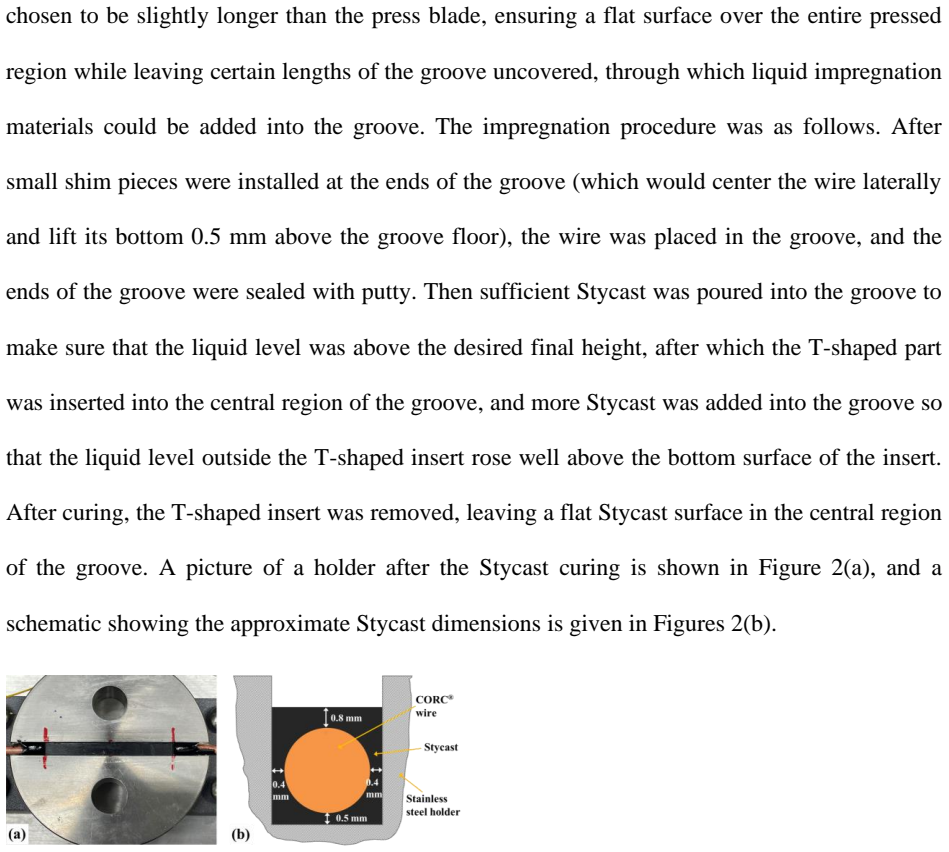

read the original abstract
CORC$^\circledR$ wires are a promising superconductor for accelerator magnet applications. While their excellent uniaxial tensile properties have been well established, potential degradation under transverse compression remains a significant concern for accelerator magnets, in which transverse compression is a primary stress experienced by superconductors. To evaluate the critical transverse compressive stresses of ReBCO conductors, we developed an experimental system that enables testing of samples both with and without impregnation in liquid nitrogen. Furthermore, because bending strain induced during coil winding may influence the critical compressive response of CORC$^\circledR$ wires, the apparatus was also modified to allow testing under the bending condition. In this study tests were conducted for five configurations: (1) straight wires without impregnation, (2) bent wires without impregnation, (3) straight wires with Stycast 2850 FT impregnation, (4) bent wires with Stycast 2850 FT impregnation, and (5) bent wires impregnated with paraffin wax. The transverse pressures corresponding to 3% and 5% reductions in the critical current are reported. The effects of wire bending and impregnation on the critical transverse pressure are analyzed, and the implications for transverse stress levels in accelerator magnet conductors are discussed.
Editorial analysis
A structured set of objections, weighed in public.
Referee Report
Summary. The paper describes the development of a custom experimental system to measure critical transverse compressive stresses in CORC® wires for accelerator magnet applications. Tests were performed on five configurations—straight and bent wires, with and without impregnation (Stycast 2850 FT or paraffin wax)—and the transverse pressures causing 3% and 5% reductions in critical current are reported, along with analysis of bending and impregnation effects.
Significance. If validated, the results would provide practical guidance on allowable transverse stress levels in wound, impregnated CORC conductors, addressing a key mechanical limit for high-field accelerator magnets. The inclusion of bending strain and multiple impregnants is relevant to real coil environments, but the absence of apparatus validation and statistical reporting reduces the immediate utility of the headline thresholds.
major comments (2)
- [Experimental Methods] Experimental Methods (apparatus description): The modified fixture for bent samples and the impregnation procedures are outlined, but no FEA, contact-pressure mapping, or comparison to coil-winding stress models is provided to confirm that the applied stress state reproduces the multi-axial, non-uniform loading inside a real accelerator magnet coil; this directly affects the translatability of the reported 3 %/5 % Ic thresholds to design limits.
- [Results] Results section (pressure values): The transverse pressures at 3 % and 5 % Ic reduction are stated for the five configurations without error bars, number of samples, or any description of how critical current was measured under load; this omission makes the quantitative claims difficult to assess for reproducibility or statistical significance.
minor comments (2)
- [Discussion] The discussion of implications for accelerator magnets would be strengthened by explicit numerical comparison of the measured thresholds to typical transverse stresses calculated for common coil geometries.
- [Figures] Figure captions and axis labels should explicitly state the impregnant used and whether the sample is straight or bent to improve readability.
Simulated Author's Rebuttal
We thank the referee for the constructive comments and the opportunity to improve the manuscript. We address each major point below and will make revisions where the concerns are valid.
read point-by-point responses
-
Referee: [Experimental Methods] Experimental Methods (apparatus description): The modified fixture for bent samples and the impregnation procedures are outlined, but no FEA, contact-pressure mapping, or comparison to coil-winding stress models is provided to confirm that the applied stress state reproduces the multi-axial, non-uniform loading inside a real accelerator magnet coil; this directly affects the translatability of the reported 3 %/5 % Ic thresholds to design limits.
Authors: We acknowledge that the experimental fixture applies a simplified, primarily uniaxial transverse compression rather than the full multi-axial and non-uniform stress distribution present in a wound and impregnated coil. The apparatus was intentionally designed to isolate transverse compressive effects, which are the dominant stress component in accelerator magnets, following approaches used in prior HTS conductor studies. No FEA, contact-pressure mapping, or direct comparison to coil-winding models was included in the original work. In the revised manuscript we will add a dedicated paragraph in the Discussion section that explicitly states this limitation, explains why the reported thresholds should be treated as conservative guidance for design, and outlines how more complex modeling could be used in future work to bridge the gap. revision: partial
-
Referee: [Results] Results section (pressure values): The transverse pressures at 3 % and 5 % Ic reduction are stated for the five configurations without error bars, number of samples, or any description of how critical current was measured under load; this omission makes the quantitative claims difficult to assess for reproducibility or statistical significance.
Authors: We agree that these details are essential for assessing the results. Critical current was measured in situ under applied load using the standard four-probe method with a 1 μV/cm criterion while the sample remained immersed in liquid nitrogen. However, only one sample was tested per configuration owing to limited material availability and the time-intensive nature of the setup. We will revise the Methods and Results sections to include a clear description of the Ic measurement protocol and to state explicitly that the reported 3 % and 5 % thresholds are single-sample values. We will also add a note on this limitation and recommend replicate testing in follow-on studies. revision: yes
Circularity Check
No circularity; purely experimental reporting of measured pressures with no derivations or self-referential steps.
full rationale
The paper presents an experimental apparatus and reports direct measurements of transverse pressures causing 3% and 5% Ic reductions across five wire configurations (straight/bent, impregnated or not). No equations, fitted parameters, predictions, ansatzes, or uniqueness theorems appear in the provided text or abstract. Results are obtained from physical tests rather than any chain that reduces to the paper's own inputs by construction, so the work is self-contained with no load-bearing self-citations or definitional loops.
Axiom & Free-Parameter Ledger
Reference graph
Works this paper leans on
-
[1]
[1]. Durante M, Borgnolutti F, Bouziat D, Fazilleau P, Gheller J-M, Molinié F and Antoni P D 2018 Realization and first test results of the EuCARD 5.4-T REBCO dipole magnet IEEE Trans. Appl. Supercond. 28 4203805 [2]. Wang X, Caspi S, Dietderich D R, Ghiorso W B, Gourlay S A, Higley H C, Lin A, Prestemon S O, van der Laan D and Weiss J D 2018 A viable dip...
discussion (0)
Sign in with ORCID, Apple, or X to comment. Anyone can read and Pith papers without signing in.