Recognition: unknown
Relativistic Effects on Circumbinary Orbit Stability
Pith reviewed 2026-05-10 15:19 UTC · model grok-4.3
The pith
General relativity drives instability for circumbinary particles out to eight times the binary separation.
A machine-rendered reading of the paper's core claim, the machinery that carries it, and where it could break.
Core claim
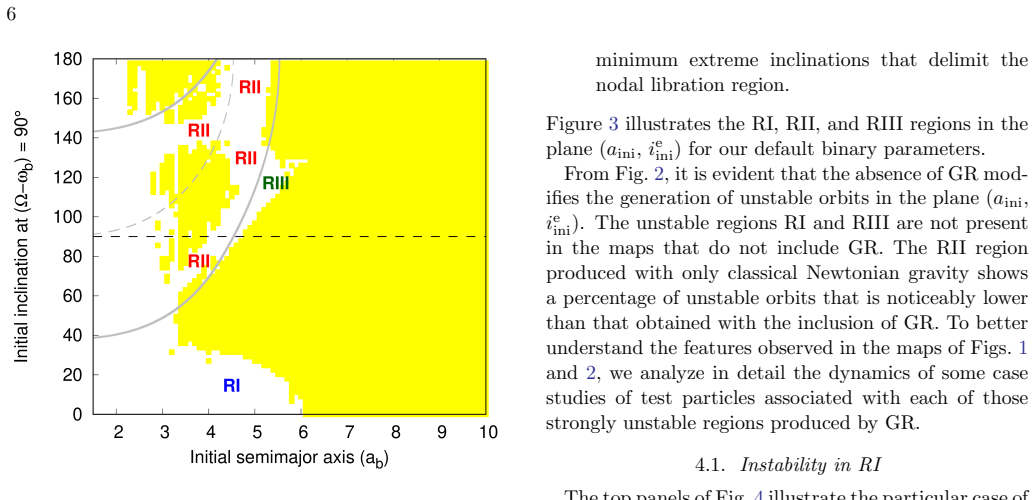
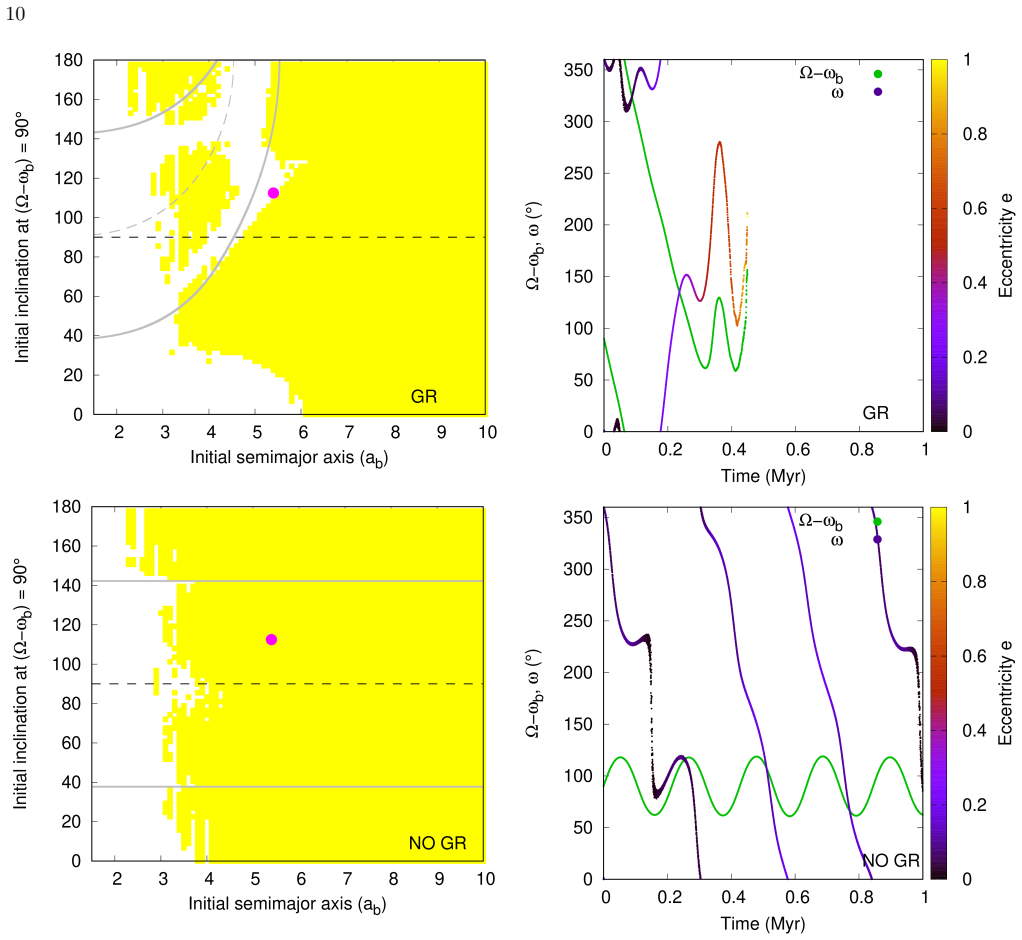
With n-body simulations and analytic approximations the dynamics and stability of low eccentricity misaligned test particles around binary systems with varying mass fraction and eccentricity are studied. General relativity plays a primary role in determining the motion of an outer particle since it drives apsidal precession of the binary orbit. The effects of GR can drive particle instability close to the binary orbit, up to a semimajor axis of about 8 ab. In particular, three different regions of instability that are driven by GR are identified and analysed in the phase plane of the initial semimajor axis and the initial inclination of the particle.
What carries the argument
GR-driven apsidal precession of the binary orbit, which interacts with the outer particle's orbital motion to produce instability
If this is right
- Instability can occur up to a semimajor axis of about 8 ab depending on binary parameters and particle inclination.
- Three distinct regions of instability appear in the phase plane of initial semimajor axis and initial inclination.
- The results apply to circumbinary orbits and disks on all scales, especially around supermassive black hole binaries where GR effects are strong.
Where Pith is reading between the lines
- The inner boundary of stable circumbinary material may lie farther out in strongly relativistic binaries than Newtonian models predict.
- These GR-driven zones could shape the inner edges of circumbinary disks and affect the survival of any embedded planets or gas.
- Similar precession-driven instabilities may appear in other hierarchical systems once relativistic corrections are included.
Load-bearing premise
The outer bodies are treated as massless test particles whose back-reaction on the binary is negligible, and that GR apsidal precession dominates over other effects such as tides or higher-order post-Newtonian terms for the chosen binary parameters.
What would settle it
Running the same n-body simulations of binary systems and test particles but turning off the GR precession term and checking whether the three identified instability regions in the semimajor-axis and inclination plane disappear.
Figures






read the original abstract
With n-body simulations and analytic approximations we study the dynamics and stability of low eccentricity misaligned test particles around binary systems with varying mass fraction and eccentricity. General relativity (GR) plays a primary role in determining the motion of an outer particle since it drives apsidal precession of the binary orbit. The effects of GR can drive particle instability close to the binary orbit, depending upon the binary parameters and the initial inclination of the particle. For the binary parameters we consider, we find instability up to a semimajor axis of about 8 ab, where ab is the binary semimajor axis. In particular, we identify and analyse three different regions of instability that are driven by GR in the phase plane of the initial semimajor axis and the initial inclination of the particle. The results have implications for circumbinary orbits and circumbinary disks on all scales, but are particularly important around supermassive black hole binaries where the effects of GR can be strong.
Editorial analysis
A structured set of objections, weighed in public.
Referee Report
Summary. The manuscript uses n-body simulations and analytic approximations to examine the stability of low-eccentricity, misaligned test particles orbiting binary systems with varying mass ratios and eccentricities. It argues that general relativistic apsidal precession of the inner binary is the primary driver of particle motion, producing three distinct instability regions in the (semimajor axis, inclination) phase plane and extending instability out to approximately 8 binary semimajor axes for the chosen parameters, with implications for circumbinary orbits and disks around supermassive black hole binaries.
Significance. If the GR-driven mechanism is robustly isolated, the work would provide a concrete link between post-Newtonian precession and circumbinary test-particle instability, offering testable predictions for relativistic regimes that Newtonian treatments miss. The dual use of simulations and analytic approximations is a methodological strength that could allow falsifiable comparisons with observations of circumbinary disks or exoplanets.
major comments (3)
- The central claim that the three identified instability regions are 'driven by GR' (abstract and results) requires explicit Newtonian control runs with identical initial conditions, binary parameters, and integration settings to demonstrate that the regions vanish when the GR term is omitted. No such differential comparison is described or shown, leaving the causal attribution unverified.
- Simulation setup details (integration method, timestep criterion, number of particles or realizations, convergence tests, and error bars on the instability boundaries) are not provided, preventing assessment of whether the reported instability up to ~8 ab is numerically robust or an artifact of the chosen parameters.
- The test-particle assumption and the specific binary mass fractions/eccentricities used to reach the 8 ab limit are load-bearing for the quantitative extent of the instability regions; without tabulated values or a sensitivity study, it is unclear how general the three-region structure is.
minor comments (2)
- Notation for binary semimajor axis (ab) and particle semimajor axis should be defined consistently in the text and figures to avoid ambiguity.
- The abstract states 'we identify and analyse three different regions' but does not preview the analytic approximations used to interpret them; a brief statement of the approximation method would improve clarity.
Simulated Author's Rebuttal
We thank the referee for their constructive and detailed comments, which have helped us identify areas where the manuscript can be strengthened. We address each major comment below and have revised the manuscript accordingly to provide the requested controls, details, and analysis.
read point-by-point responses
-
Referee: The central claim that the three identified instability regions are 'driven by GR' (abstract and results) requires explicit Newtonian control runs with identical initial conditions, binary parameters, and integration settings to demonstrate that the regions vanish when the GR term is omitted. No such differential comparison is described or shown, leaving the causal attribution unverified.
Authors: We agree that explicit Newtonian control runs are required to rigorously isolate the role of GR. In the revised manuscript we will add a new subsection presenting Newtonian simulations performed with identical initial conditions, binary parameters, and integration settings but with the GR term omitted. These runs will show that the three instability regions are absent or substantially suppressed, thereby confirming the causal attribution to GR apsidal precession. revision: yes
-
Referee: Simulation setup details (integration method, timestep criterion, number of particles or realizations, convergence tests, and error bars on the instability boundaries) are not provided, preventing assessment of whether the reported instability up to ~8 ab is numerically robust or an artifact of the chosen parameters.
Authors: We acknowledge the omission of these essential numerical details. The revised manuscript will include a dedicated methods subsection that specifies the N-body integrator, the adaptive timestep criterion, the number of particles and independent realizations, the results of convergence tests with respect to timestep and particle number, and quantitative uncertainty estimates on the locations of the instability boundaries. revision: yes
-
Referee: The test-particle assumption and the specific binary mass fractions/eccentricities used to reach the 8 ab limit are load-bearing for the quantitative extent of the instability regions; without tabulated values or a sensitivity study, it is unclear how general the three-region structure is.
Authors: The test-particle limit is appropriate for the low-mass outer bodies under consideration, but we agree that the dependence on binary parameters must be made explicit. The revised manuscript will contain a table listing the exact mass fractions and eccentricities employed, together with a new sensitivity study that varies these parameters and demonstrates how the three-region structure and the outer extent of instability respond. This will clarify the generality of the reported features. revision: yes
Circularity Check
No circularity; claims rest on independent n-body simulations and analytic approximations.
full rationale
The paper derives its results on GR-driven instability regions through direct n-body simulations incorporating GR apsidal precession and separate analytic approximations. No load-bearing step reduces by construction to a fitted parameter, self-definition, or self-citation chain. The abstract explicitly separates the GR term as an input to the dynamics, with instability regions identified via simulation outputs rather than by renaming or reparameterizing the inputs themselves. This is the standard non-circular case for numerical astrophysics papers.
Axiom & Free-Parameter Ledger
axioms (1)
- domain assumption General relativity produces apsidal precession of the binary orbit that dominates the dynamics of nearby test particles
Reference graph
Works this paper leans on
-
[1]
P., Chen, C., Smallwood, J., et al
Abod, C. P., Chen, C., Smallwood, J., et al. 2022, MNRAS, 517, 732, doi: 10.1093/mnras/stac2601
-
[2]
Agazie, G., Anumarlapudi, A., Archibald, A. M., et al. 2023, ApJL, 951, L50, doi: 10.3847/2041-8213/ace18a
-
[3]
2015, MNRAS, 449, 65, doi: 10.1093/mnras/stv128
Aly, H., Dehnen, W., Nixon, C., & King, A. 2015, MNRAS, 449, 65, doi: 10.1093/mnras/stv128
-
[4]
Artymowicz, P., & Lubow, S. H. 1994, ApJ, 421, 651, doi: 10.1086/173679
-
[5]
Begelman, M. C., Blandford, R. D., & Rees, M. J. 1980, Nature, 287, 307, doi: 10.1038/287307a0
-
[6]
Brinch, C., Jørgensen, J. K., Hogerheijde, M. R., Nelson, R. P., & Gressel, O. 2016, ApJL, 830, L16, doi: 10.3847/2041-8205/830/1/L16
-
[7]
Capelo, H. L., Herbst, W., Leggett, S. K., Hamilton, C. M., & Johnson, J. A. 2012, ApJL, 757, L18, doi: 10.1088/2041-8205/757/1/L18
-
[8]
2024, A&A, 682, A104, doi: 10.1051/0004-6361/202348375
Ceppi, S., Cuello, N., Lodato, G., et al. 2024, A&A, 682, A104, doi: 10.1051/0004-6361/202348375
-
[9]
Chen, C., Franchini, A., Lubow, S. H., & Martin, R. G. 2019, MNRAS, 490, 5634, doi: 10.1093/mnras/stz2948
-
[10]
Chen, C., Iglesias, D. P., Miley, J. M., & Nixon, C. J. 2026, arXiv e-prints, arXiv:2603.19983, doi: 10.48550/arXiv.2603.19983
-
[11]
Chen, C., Lubow, S. H., & Martin, R. G. 2020, MNRAS, 494, 4645, doi: 10.1093/mnras/staa1037
-
[12]
Chiang, E. I., & Murray-Clay, R. A. 2004, ApJ, 607, 913, doi: 10.1086/383522
-
[13]
Childs, A. C., & Martin, R. G. 2021, ApJL, 920, L8, doi: 10.3847/2041-8213/ac2957
-
[14]
Geller, A. M. 2023, ApJL, 945, L11, doi: 10.3847/2041-8213/acbcc9
-
[15]
Childs, A. C., Martin, R. G., Nixon, C. J., et al. 2024, ApJ, 962, 77, doi: 10.3847/1538-4357/ad1a11 De Rosa, A., Vignali, C., Bogdanovi´ c, T., et al. 2019, NewAR, 86, 101525, doi: 10.1016/j.newar.2020.101525
-
[16]
Deck, K. M., Payne, M., & Holman, M. J. 2013, ApJ, 774, 129, doi: 10.1088/0004-637X/774/2/129
-
[17]
Doolin, S., & Blundell, K. M. 2011, MNRAS, 418, 2656, doi: 10.1111/j.1365-2966.2011.19657.x
-
[18]
Doyle, L. R., Carter, J. A., Fabrycky, D. C., et al. 2011, Science, 333, 1602, doi: 10.1126/science.1210923
-
[19]
1915, Sitzungsberichte der Königlich Preussischen Akademie der Wissenschaften, 831
Einstein, A. 1915, Sitzungsberichte der Königlich Preussischen Akademie der Wissenschaften, 831
1915
-
[20]
1918, Sitzungsberichte der K¨ oniglich Preussischen Akademie der Wissenschaften, 154
Einstein, A. 1918, Sitzungsberichte der K¨ oniglich Preussischen Akademie der Wissenschaften, 154
1918
-
[21]
2010, MNRAS, 401, 791, doi: 10.1111/j.1365-2966.2009.15715.x
Farago, F., & Laskar, J. 2010, MNRAS, 401, 1189, doi: 10.1111/j.1365-2966.2009.15711.x
-
[22]
Franchini, A., Lubow, S. H., & Martin, R. G. 2019, ApJL, 880, L18, doi: 10.3847/2041-8213/ab2fd8
-
[23]
2024, AJ, 168, 224, doi: 10.3847/1538-3881/ad7a78
Georgakarakos, N., Eggl, S., Ali-Dib, M., & Dobbs-Dixon, I. 2024, AJ, 168, 224, doi: 10.3847/1538-3881/ad7a78
-
[24]
Gualandris, A., Khan, F. M., Bortolas, E., et al. 2022, MNRAS, 511, 4753, doi: 10.1093/mnras/stac241
-
[25]
2018, AJ, 156, 95, doi: 10.3847/1538-3881/aad32c
Hadden, S., & Lithwick, Y. 2018, AJ, 156, 95, doi: 10.3847/1538-3881/aad32c
-
[26]
Heath, R. M., & Nixon, C. J. 2020, A&A, 641, A64, doi: 10.1051/0004-6361/202038548
-
[27]
Holman, M. J., & Wiegert, P. A. 1999, AJ, 117, 621, doi: 10.1086/300695
-
[28]
Hong, Z., Quarles, B., Li, G., & Orosz, J. A. 2019, AJ, 158, 8, doi: 10.3847/1538-3881/ab2127
-
[29]
2022, arXiv e-prints, arXiv:2201.11633, doi: 10.48550/arXiv.2201.11633
Jiang, N., Yang, H., Wang, T., et al. 2022, arXiv e-prints, arXiv:2201.11633, doi: 10.48550/arXiv.2201.11633
-
[30]
Johnson, T. M., Martin, R. G., Lepp, S., & Lubow, S. H. 2025, AJ, 170, 77, doi: 10.3847/1538-3881/adde5d
-
[31]
King, A. R., & Pringle, J. E. 2006, Monthly Notices of the Royal Astronomical Society: Letters, 373, L90, doi: 10.1111/j.1745-3933.2006.00249.x
-
[32]
1996, MNRAS, 282, 597, doi: 10.1093/mnras/282.2.597
Terquem, C. 1996, MNRAS, 282, 597, doi: 10.1093/mnras/282.2.597
-
[33]
Lepp, S., Martin, R. G., & Childs, A. C. 2022, ApJL, 929, L5, doi: 10.3847/2041-8213/ac61e1
-
[34]
Lepp, S., Martin, R. G., & Zhang, B. 2023, ApJL, 958, L23, doi: 10.3847/2041-8213/ad0bd8
-
[35]
2022, MNRAS, 517, 1602, doi: 10.1093/mnras/stac2577
Li, R., & Lai, D. 2022, MNRAS, 517, 1602, doi: 10.1093/mnras/stac2577
-
[36]
Martin, D. V., & Fitzmaurice, E. 2022, MNRAS, 512, 602, doi: 10.1093/mnras/stac090
-
[37]
Martin, R. G., & Lubow, S. H. 2017, ApJL, 835, L28, doi: 10.3847/2041-8213/835/2/L28
-
[38]
Martin, R. G., & Lubow, S. H. 2018, MNRAS, 479, 1297, doi: 10.1093/mnras/sty1648
-
[39]
G., Nixon, C., Xie, F.-G., & King, A
Martin, R. G., Nixon, C., Xie, F.-G., & King, A. 2018, MNRAS, 480, 4732, doi: 10.1093/mnras/sty2178
-
[40]
2015, MNRAS, 452, 2396, doi: 10.1093/mnras/stv1450
Miranda, R., & Lai, D. 2015, MNRAS, 452, 2396, doi: 10.1093/mnras/stv1450
-
[41]
Mudryk, L. R., & Wu, Y. 2006, ApJ, 639, 423, doi: 10.1086/499347
-
[42]
Naoz, S., Li, G., Zanardi, M., de El´ ıa, G. C., & Di Sisto, R. P. 2017, AJ, 154, 18, doi: 10.3847/1538-3881/aa6fb0
-
[43]
2012, ApJL, 757, L24, doi: 10.1088/2041-8205/757/2/L24
Nixon, C., King, A., Price, D., & Frank, J. 2012, ApJL, 757, L24, doi: 10.1088/2041-8205/757/2/L24
-
[44]
Nixon, C. J., King, A. R., & Pringle, J. E. 2011, MNRAS, 417, L66, doi: 10.1111/j.1745-3933.2011.01121.x 16
-
[45]
Peters, P. C. 1964, Phys. Rev., 136, B1224, doi: 10.1103/PhysRev.136.B1224
-
[46]
Peters, P. C., & Mathews, J. 1963, Physical Review, 131, 435, doi: 10.1103/PhysRev.131.435
-
[47]
2020, AJ, 159, 80, doi: 10.3847/1538-3881/ab64fa
Quarles, B., Li, G., Kostov, V., & Haghighipour, N. 2020, AJ, 159, 80, doi: 10.3847/1538-3881/ab64fa
-
[48]
Quarles, B., & Lissauer, J. J. 2016, AJ, 151, 111, doi: 10.3847/0004-6256/151/5/111
-
[49]
Ramos, X. S., Correa-Otto, J. A., & Beaug´ e, C. 2015, Celestial Mechanics and Dynamical Astronomy, 123, 453, doi: 10.1007/s10569-015-9646-z
-
[50]
Rein, H., & Spiegel, D. S. 2015, MNRAS, 446, 1424, doi: 10.1093/mnras/stu2164
-
[51]
Rein, H., & Tamayo, D. 2015, MNRAS, 452, 376, doi: 10.1093/mnras/stv1257
-
[52]
Sutherland, A. P., & Fabrycky, D. C. 2016, ApJ, 818, 6, doi: 10.3847/0004-637X/818/1/6
-
[53]
Tamayo, D., Rein, H., Shi, P., & Hernandez, D. M. 2020, MNRAS, 491, 2885, doi: 10.1093/mnras/stz2870
-
[54]
2006, The Three-Body Problem
Valtonen, M., & Karttunen, H. 2006, The Three-Body Problem
2006
-
[55]
2010, MNRAS, 401, 791, doi: 10.1111/j.1365-2966.2009.15715.x
Verrier, P. E., & Evans, N. W. 2009, MNRAS, 394, 1721, doi: 10.1111/j.1365-2966.2009.14446.x
-
[56]
Welsh, W. F., Orosz, J. A., Carter, J. A., et al. 2012, Nature, 481, 475, doi: 10.1038/nature10768
-
[57]
1980, AJ, 85, 1122, doi: 10.1086/112778
Wisdom, J. 1980, AJ, 85, 1122, doi: 10.1086/112778
-
[58]
Youdin, A. N., Kratter, K. M., & Kenyon, S. J. 2012, ApJ, 755, 17, doi: 10.1088/0004-637X/755/1/17
-
[59]
Zanardi, M., de El´ ıa, G. C., Di Sisto, R. P., & Naoz, S. 2018, A&A, 615, A21, doi: 10.1051/0004-6361/201732127
-
[60]
Zanardi, M., de El´ ıa, G. C., Di Sisto, R. P., et al. 2017, A&A, 605, A64, doi: 10.1051/0004-6361/201730411
-
[61]
Zanardi, M., de El´ ıa, G. C., Dugaro, A., & Coronel, C. F. 2023, MNRAS, 525, 2125, doi: 10.1093/mnras/stad2345
-
[62]
Zheng, Z.-Y., Butler, N. R., Shen, Y., et al. 2016, ApJ, 827, 56, doi: 10.3847/0004-637X/827/1/56
-
[63]
Ziglin, S. L. 1975, Soviet Astronomy Letters, 1, 194
1975
discussion (0)
Sign in with ORCID, Apple, or X to comment. Anyone can read and Pith papers without signing in.