Recognition: unknown
MMS Insights into CME Driven Sub-Alfv\'enic Solar Wind at 1 AU
Pith reviewed 2026-05-10 16:06 UTC · model grok-4.3
The pith
Sub-Alfvénic solar wind inside a CME magnetic cloud shows hotter electrons and weak MHD turbulence with steeper spectral slopes.
A machine-rendered reading of the paper's core claim, the machinery that carries it, and where it could break.
Core claim
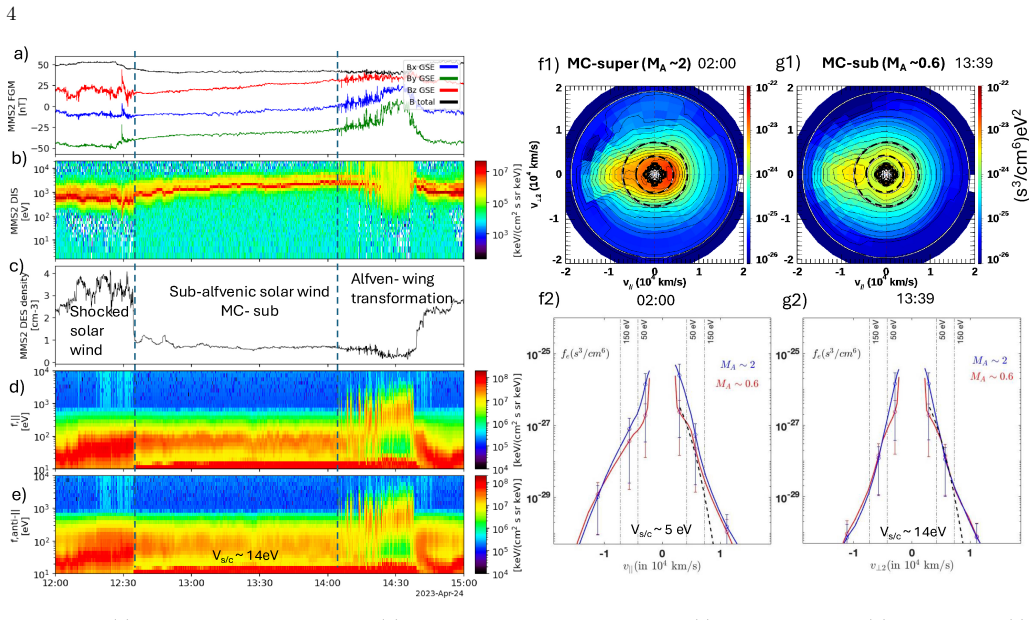
Within the sub-Alfvénic interval of the magnetic cloud, electron temperatures are higher, with one-dimensional distributions revealing super-thermal tails and depletion between 15-50 eV; isolated electron heating occurs in the sheath. Magnetic field fluctuations exhibit negligible cross helicity, steeper-than-Kolmogorov scaling in the inertial range with no spectral break, reduced intermittency at ion and sub-ion scales, emerging intermittency at electron scales, and weak magnetic compressibility. These features indicate the presence of weak magnetohydrodynamic turbulence in the sub-Alfvénic magnetic cloud, resembling conditions in planetary magnetospheres.
What carries the argument
Comparison of electron velocity distributions and magnetic field fluctuation spectra between the two-hour sub-Alfvénic interval inside the magnetic cloud and the surrounding super-Alfvénic MC and sheath regions.
Load-bearing premise
That the two-hour sub-Alfvénic interval and chosen comparison regions are representative enough to attribute the electron and turbulence differences specifically to the sub-Alfvénic regime rather than other CME-specific or instrumental factors.
What would settle it
Detection of a different sub-Alfvénic magnetic cloud interval that displays strong cross-helicity and Kolmogorov-like spectral scaling in magnetic fluctuations would challenge the link between these properties and sub-Alfvénic conditions.
Figures



read the original abstract
We report the properties of electron distributions and turbulence during a Coronal Mass Ejection (CME) in April 2023 observed by Magnetospheric Multiscale (MMS). The CME exhibits a clear sheath and magnetic cloud (MC), and within the MC, the solar wind becomes sub-Alfv\'enic for two hours. We investigate plasma and turbulence properties of the sub-Alfv\'enic CME wind and compare them with those in the super-Alfv\'enic solar wind in the MC and CME sheath. Electrons within the sub-Alfv\'enic MC show significantly higher temperatures than those in the CME sheath and the super-Alfv\'enic MC, with their one-dimensional distributions revealing super-thermal tail and a depletion in electron populations between 15-50 eV. Within the CME sheath, isolated regions of electron heating are observed, where parallel energy flux is enhanced up to ~1 keV. Magnetic field fluctuations within the sub-Alfv\'enic MC interval exhibit negligible cross helicity and steeper-than-Kolmogorov scaling in the inertial range, with no clear spectral break. These fluctuations also show reduced intermittency at ion and sub-ion scales, emerging intermittency at electron scales, and weak magnetic compressibility. Together, these observations point to the presence of weak magnetohydrodynamic (MHD) turbulence within the sub-Alfv\'enic MC, resembling conditions commonly observed in planetary magnetospheres such as Jupiter's.
Editorial analysis
A structured set of objections, weighed in public.
Referee Report
Summary. The manuscript presents in-situ MMS observations of electron distributions and magnetic field turbulence during a CME event in April 2023. It identifies a two-hour sub-Alfvénic interval inside the magnetic cloud and contrasts its properties with the super-Alfvénic portion of the MC and the CME sheath, concluding that the sub-Alfvénic region hosts weak MHD turbulence with characteristics similar to those in planetary magnetospheres.
Significance. The observations provide direct measurements of plasma conditions in an uncommon sub-Alfvénic solar wind environment at 1 AU using high-resolution MMS instrumentation. This could be significant for understanding turbulence transitions across the Alfvén critical surface and analogies to magnetospheric plasmas, though the single-event scope restricts its immediate impact on broader theory.
major comments (3)
- [Abstract and Results] The turbulence diagnostics (negligible cross helicity, steeper-than-Kolmogorov scaling, no spectral break, scale-dependent intermittency, weak compressibility) are presented for only one 2-hour interval. Without quantitative spectral index values, error bars, or details on how the inertial range was identified, the distinction from Kolmogorov scaling and the 'weak turbulence' interpretation cannot be fully assessed.
- [Methods or Data Selection] No information is provided on the criteria for selecting the sub-Alfvénic interval, the comparison intervals, or any statistical tests used to establish differences in electron temperatures or turbulence properties between regions.
- [Discussion] The inference that these features indicate 'weak MHD turbulence within the sub-Alfvénic MC, resembling conditions commonly observed in planetary magnetospheres' is weakened by the lack of multi-event analysis; all data come from the same CME, so CME-specific effects cannot be ruled out as the source of the observed differences.
minor comments (2)
- [Abstract] The abstract states 'significantly higher temperatures' without providing the actual temperature values or the basis for significance.
- [Figure captions] Ensure figure captions explicitly describe what each panel shows regarding the different solar wind regions (sub-Alfvénic, super-Alfvénic, sheath).
Simulated Author's Rebuttal
We thank the referee for their constructive comments on our manuscript. We have prepared point-by-point responses below and will revise the manuscript to address the concerns where possible, improving clarity on methods, quantitative results, and limitations.
read point-by-point responses
-
Referee: [Abstract and Results] The turbulence diagnostics (negligible cross helicity, steeper-than-Kolmogorov scaling, no spectral break, scale-dependent intermittency, weak compressibility) are presented for only one 2-hour interval. Without quantitative spectral index values, error bars, or details on how the inertial range was identified, the distinction from Kolmogorov scaling and the 'weak turbulence' interpretation cannot be fully assessed.
Authors: We agree that quantitative details are needed for full assessment. The full manuscript contains the underlying spectral analysis; in revision we will explicitly report the fitted spectral indices with uncertainties (e.g., for the inertial-range power-law fits), describe the precise frequency/wavenumber bounds used to identify the inertial range, and note the fitting procedure. These additions will allow readers to evaluate the steeper-than-Kolmogorov claim and the weak-turbulence interpretation directly. revision: yes
-
Referee: [Methods or Data Selection] No information is provided on the criteria for selecting the sub-Alfvénic interval, the comparison intervals, or any statistical tests used to establish differences in electron temperatures or turbulence properties between regions.
Authors: We will expand the Methods section to detail the selection criteria: the sub-Alfvénic interval is defined where the Alfvén Mach number remains below 1 for the full two-hour period inside the magnetic cloud, with explicit start/end times and the plasma parameters used to compute M_A. The super-Alfvénic MC and sheath comparison intervals will be defined by their temporal boundaries relative to the MC leading edge. We will also report the quantitative temperature differences (means and standard deviations) and any statistical comparisons performed. revision: yes
-
Referee: [Discussion] The inference that these features indicate 'weak MHD turbulence within the sub-Alfvénic MC, resembling conditions commonly observed in planetary magnetospheres' is weakened by the lack of multi-event analysis; all data come from the same CME, so CME-specific effects cannot be ruled out as the source of the observed differences.
Authors: We acknowledge this is a single-event case study, which inherently limits the ability to separate CME-specific effects from general sub-Alfvénic behavior. In revision we will explicitly frame the conclusions as applying to this rare observed interval, add a statement that additional events would be required to test generality, and soften the analogy to magnetospheric turbulence to reflect the single-CME scope. No further events are available in the present MMS dataset for this CME. revision: partial
- The single-event nature of the study prevents multi-event statistical analysis or ruling out CME-specific effects without additional data.
Circularity Check
No significant circularity: purely observational data analysis
full rationale
The paper reports direct MMS observations of electron distributions and magnetic field fluctuations during one April 2023 CME event, comparing a 2-hour sub-Alfvénic MC interval against super-Alfvénic MC and sheath regions from the same event. No derivations, equations, fitted parameters, or predictions are present; all reported properties (temperatures, spectral slopes, cross-helicity, intermittency, compressibility) are measured quantities. The analysis contains no self-referential definitions, load-bearing self-citations, or reductions of results to inputs by construction, rendering the derivation chain empty and the findings self-contained.
Axiom & Free-Parameter Ledger
axioms (1)
- standard math Standard plasma physics assumptions for interpreting electron velocity distributions and magnetic fluctuation spectra from spacecraft data
Reference graph
Works this paper leans on
-
[1]
1991, Journal of Geophysical Research: Space Physics, 96, 5847, doi: https://doi.org/10.1029/91JA00087
-
[2]
2026, The Astrophysical Journal, 997, 259, doi: 10.3847/1538-4357/ae2c78
Adhikari, S., Bandyopadhyay, R., Goodwill, J., et al. 2026, The Astrophysical Journal, 997, 259, doi: 10.3847/1538-4357/ae2c78
-
[3]
2022, Universe, 8, 338, doi: 10.3390/universe8070338
Alberti, T., Benella, S., Carbone, V., et al. 2022, Universe, 8, 338, doi: 10.3390/universe8070338
-
[4]
2009, Physical Review Letters, 103, doi: 10.1103/physrevlett.103.165003
Alexandrova, O., Saur, J., Lacombe, C., et al. 2009, Physical Review Letters, 103, doi: 10.1103/physrevlett.103.165003
-
[5]
R., Chen, L.-J., Lugaz, N., et al
Argall, M. R., Chen, L.-J., Lugaz, N., et al. 2025, https://arxiv.org/abs/2505.13645
-
[6]
Badman, S. T., Stevens, M. L., Bale, S. D., et al. 2025, arXiv e-prints. https://arxiv.org/abs/2509.17149
-
[7]
Bandyopadhyay, R., McComas, D. J., Szalay, J. R., et al. 2021, Geophysical Research Letters, 48, e2021GL095006, doi: https://doi.org/10.1029/2021GL095006
-
[8]
Bandyopadhyay, R., Matthaeus, W. H., McComas, D. J., et al. 2022, ApJL, 926, L1, doi: 10.3847/2041-8213/ac4a5c Berˇ ciˇ c, L., Larson, D., Whittlesey, P., et al. 2020, The Astrophysical Journal, 892, 88, doi: 10.3847/1538-4357/ab7b7a
-
[9]
2006, PhRvL, 96, 115002, doi: 10.1103/PhysRevLett.96.115002
Boldyrev, S. 2006, Phys. Rev. Lett., 96, 115002, doi: 10.1103/PhysRevLett.96.115002
-
[10]
Borovsky, J. E. 2021, Frontiers in Astronomy and Space Sciences, 8, doi: 10.3389/fspas.2021.646443
-
[11]
Bowen, T. A., Bale, S. D., Bonnell, J. W., et al. 2018, The Astrophysical Journal. https://arxiv.org/abs/1805.02739
-
[12]
Bowers, C. F., Jackman, C. M., Jia, X., et al. 2025, Journal of Geophysical Research: Space Physics, doi: 10.1029/2024JA033619
-
[13]
2017, MNRAS, 472, 1052, doi: 10.1093/mnras/stx2008
Bruno, R., Telloni, D., DeIure, D., & Pietropaolo, E. 2017, MNRAS, 472, 1052, doi: 10.1093/mnras/stx2008
-
[14]
Burch, J. L., Torbert, R. B., Phan, T. D., et al. 2016, Science, 352, aaf2939, doi: 10.1126/science.aaf2939
-
[15]
L., Chen, L.-J., Sarantos, M., et al
Burkholder, B. L., Chen, L.-J., Sarantos, M., et al. 2024, Geophysical Research Letters, 51, e2024GL108311, doi: 10.1029/2024GL108311
-
[16]
F., Sittler, E., Mariani, F., & Schwenn, R
Burlaga, L. F., Sittler, E., Mariani, F., & Schwenn, R. 1981, Journal of Geophysical Research: Space Physics, 86, 6673, doi: 10.1029/JA086iA08p06673
-
[17]
2024, Geophysical Research Letters, 51, e2024GL108894, doi: https://doi.org/10.1029/2024GL108894
Chen, L.-J., Gershman, D., Burkholder, B., et al. 2024, Geophysical Research Letters, 51, e2024GL108894, doi: https://doi.org/10.1029/2024GL108894
-
[18]
Burkholder, B. L. 2025, Geophysical Research Letters, 52, e2024GL113416, doi: https://doi.org/10.1029/2024GL113416
-
[19]
2025, The Astrophysical Journal Letters, 992, L11, doi: 10.3847/2041-8213/ae0b56
Ervin, T., Mallet, A., Eriksson, S., et al. 2025, The Astrophysical Journal Letters, 992, L11, doi: 10.3847/2041-8213/ae0b56
-
[20]
2021, Monthly Notices of the Royal Astronomical Society, 502, 5821, doi: 10.1093/mnras/stab387
Grasso, D. 2021, Monthly Notices of the Royal Astronomical Society, 502, 5821, doi: 10.1093/mnras/stab387
-
[21]
Galtier, S., Nazarenko, S. V., Newell, A. C., & Pouquet, A. 2000, Journal of Plasma Physics, 63, 447, doi: 10.1017/S0022377899008284
-
[22]
Gershman, D. J., Pfaff, R. F., Khotyaintsev, Y. V., Burch, J. L., et al. 2019, Journal of Geophysical Research: Space Physics, 124, e2019JA026980, doi: 10.1029/2019JA026980
-
[23]
Gershman, D. J., Avanov, L. A., Boardsen, S. A., et al. 2017, Journal of Geophysical Research: Space Physics, 122, 11,548, doi: https://doi.org/10.1002/2017JA024518
-
[24]
Goldreich, P., & Sridhar, S. 1995, ApJ, 438, 763, doi: 10.1086/175121
-
[25]
1997, The Astrophysical Journal, 485, 680, doi: 10.1086/304442
Goldreich, P., & Sridhar, S. 1997, The Astrophysical Journal, 485, 680, doi: 10.1086/304442
-
[26]
W., Ala-Lahti, M., Palmerio, E., Kilpua, E
Good, S. W., Ala-Lahti, M., Palmerio, E., Kilpua, E. K. J., & Osmane, A. 2020, The Astrophysical Journal, 893, 110, doi: 10.3847/1538-4357/ab7fa2
-
[27]
Gosling, J. T. 1993, J. Geophys. Res., 98, 18937, doi: 10.1029/93JA01896
-
[28]
Gurram, H., Shuster, J. R., Chen, L.-J., et al. 2025, Geophysical Research Letters, 52, e2024GL111931, doi: https://doi.org/10.1029/2024GL111931
-
[29]
Hajra, R., & Tsurutani, B. T. 2022, The Astrophysical Journal, 926, 186, doi: 10.3847/1538-4357/ac4471
-
[30]
Horbury, T. S., Forman, M., & Oughton, S. 2008, PhRvL, 101, 175005, doi: 10.1103/PhysRevLett.101.175005
-
[31]
2025, The Astrophysical Journal, 989, 133, doi: 10.3847/1538-4357/ada3d3
Vourlidas, A. 2025, The Astrophysical Journal, 989, 133, doi: 10.3847/1538-4357/ada3d3
-
[32]
Janser, S., Saur, J., Clark, G., Sulaiman, A. H., & Szalay, J. R. 2022, Journal of Geophysical Research: Space Physics, 127, e2022JA030675, doi: https://doi.org/10.1029/2022JA030675
-
[33]
Jiao, Y., Liu, Y. D., Ran, H., & Cheng, W. 2023, The Astrophysical Journal, 960, 42, doi: 10.3847/1538-4357/ad0dfe
-
[34]
Jokipii, J. R. 1973, ARA&A, 11, 1, doi: 10.1146/annurev.aa.11.090173.000245
-
[35]
Kilpua, E. K. J., Good, S. W., Ala-Lahti, M., et al. 2021, Frontiers in Astronomy and Space Sciences, 7, 109, doi: 10.3389/fspas.2020.610278 12
-
[36]
Kilpua, E. K. J., Koskinen, H. E. J., & Pulkkinen, T. I. 2017, Living Reviews in Solar Physics, 14, 5, doi: 10.1007/s41116-017-0009-6
-
[37]
Kilpua, E. K. J., Fontaine, D., Good, S. W., et al. 2020, Annales Geophysicae, 38, 999, doi: 10.5194/angeo-38-999-2020
-
[38]
Klein, L. W., & Burlaga, L. F. 1982, Journal of Geophysical Research: Space Physics, 87, 613, doi: 10.1029/JA087iA02p00613
-
[39]
2003, The Astrophysical Journal, 582, 1220, doi: 10.1086/344676
Lithwick, Y., & Goldreich, P. 2003, The Astrophysical Journal, 582, 1220, doi: 10.1086/344676
-
[40]
Marsch, E., & Tu, C. Y. 1994, Annales Geophysicae, 12, 1127, doi: 10.1007/s00585-994-1127-8
-
[41]
Matthaeus, W. H., & Goldstein, M. L. 1982, Journal of Geophysical Research: Space Physics, 87, 6011, doi: https://doi.org/10.1029/JA087iA08p06011
-
[42]
1996, The Astrophysical Journal, 465, 845, doi: 10.1086/177472
Ng, C.-S., & Bhattacharjee, A. 1996, The Astrophysical Journal, 465, 845, doi: 10.1086/177472
-
[43]
Pagel, C., & Balogh, A. 2002, Journal of Geophysical Research: Space Physics, 107, SSH 6, doi: https://doi.org/10.1029/2002JA009331
-
[44]
N., Chasapis, A., Bandyopadhyay, R., et al
Parashar, T. N., Chasapis, A., Bandyopadhyay, R., et al. 2018, PhRvL, 121, 265101, doi: 10.1103/PhysRevLett.121.265101
-
[45]
Perez, J. C., & Boldyrev, S. 2009, Phys. Rev. Lett., 102, 025003, doi: 10.1103/PhysRevLett.102.025003
-
[46]
Perez, J. C., Bourouaine, S., Chen, C. H. K., & Raouafi, N. E. 2021, A&A, 650, A22, doi: 10.1051/0004-6361/202039879
-
[47]
2010, ApJ, 714, 937, doi: 10.1088/0004-637X/714/1/937
Perri, S., & Balogh, A. 2010, ApJ, 714, 937, doi: 10.1088/0004-637X/714/1/937
-
[48]
Podesta, J. J. 2009, The Astrophysical Journal, 698, 986, doi: 10.1088/0004-637X/698/2/986
-
[49]
Podesta, J. J., & Borovsky, J. E. 2010, Physics of Plasmas, 17, 112905, doi: 10.1063/1.3505092
-
[50]
2016, Space Science Reviews, 199, 331, doi: 10.1007/s11214-016-0245-4
Pollock, C., Moore, T., Jacques, A., et al. 2016, Space Science Reviews, 199, 331, doi: 10.1007/s11214-016-0245-4
-
[51]
Russell, C. T., Anderson, B. J., Baumjohann, W., et al. 2016, SSRv, 199, 189, doi: 10.1007/s11214-014-0057-3
-
[52]
Samson, J. C., & Olson, J. V. 1980, Geophysical Journal of the Royal Astronomical Society, 61, 115, doi: 10.1111/j.1365-246X.1980.tb04308.x
-
[53]
2021, Frontiers in Astronomy and Space Sciences, 8, 56, doi: 10.3389/fspas.2021.624602
Saur, J. 2021, Frontiers in Astronomy and Space Sciences, 8, 56, doi: 10.3389/fspas.2021.624602
-
[54]
Saur, J., Politano, H., Pouquet, A., & Matthaeus, W. H. 2002, A&A, 386, 699, doi: 10.1051/0004-6361:20020305
-
[55]
Servidio, S., Matthaeus, W. H., & Dmitruk, P. 2008, Physical Review Letters, 100, 095005, doi: 10.1103/PhysRevLett.100.095005
-
[56]
Smith, C. W., Stawarz, J. E., Vasquez, B. J., Forman, M. A., & MacBride, B. T. 2009, Phys. Rev. Lett., 103, 201101, doi: 10.1103/PhysRevLett.103.201101
-
[57]
Sridhar, S., & Goldreich, P. 1994, ApJ, 432, 612, doi: 10.1086/174600
-
[58]
Stix, T. H. 1992, Waves in plasmas
1992
-
[59]
Taylor, G. I. 1938, Proceedings of the Royal Society of London Series A, 164, 476, doi: 10.1098/rspa.1938.0032
-
[60]
Vasquez, B. J., Forman, M. A., Coburn, J. T., Smith, C. W., & Stawarz, J. E. 2018, The Astrophysical Journal, 867, 156, doi: 10.3847/1538-4357/aae6c6
-
[61]
2021, in Astrophysics and Space Science Library, Vol
Vocks, C. 2021, in Astrophysics and Space Science Library, Vol. 464, Kappa Distributions; From Observational Evidences via Controversial Predictions to a Consistent Theory of Nonequilibrium Plasmas, ed. M. Lazar & H. Fichtner, 125–143, doi: 10.1007/978-3-030-82623-9 7
-
[62]
2003, ApJ, 593, 1134, doi: 10.1086/376682
Vocks, C., & Mann, G. 2003, ApJ, 593, 1134, doi: 10.1086/376682
-
[63]
Vocks, C., Mann, G., & Rausche, G. 2008, A&A, 480, 527, doi: 10.1051/0004-6361:20078826 ˇStver´ ak,ˇS., Maksimovic, M., Tr´ avn´ ıˇ cek, P. M., et al. 2009, Journal of Geophysical Research (Space Physics), 114, A05104, doi: 10.1029/2008JA013883
-
[64]
Webb, D. F., & Howard, T. A. 2012, Living Reviews in Solar Physics, 9, 3, doi: 10.12942/lrsp-2012-3
-
[65]
2009, Journal of Geophysical Research: Space Physics, 114, doi: https://doi.org/10.1029/2009JA014067
Yordanova, E., Balogh, A., Noullez, A., & von Steiger, R. 2009, Journal of Geophysical Research: Space Physics, 114, doi: https://doi.org/10.1029/2009JA014067
-
[66]
Zank, G. P., Zhao, L. L., Adhikari, L., et al. 2022, ApJL, 926, L16, doi: 10.3847/2041-8213/ac51da
-
[67]
Zhang, J., Huang, S. Y., Yuan, Z. G., et al. 2022, ApJ, 937, 70, doi: 10.3847/1538-4357/ac8c34
-
[68]
Zhao, L. L., Zank, G. P., Adhikari, L., et al. 2022, ApJL, 934, L36, doi: 10.3847/2041-8213/ac8353
discussion (0)
Sign in with ORCID, Apple, or X to comment. Anyone can read and Pith papers without signing in.