Recognition: 2 theorem links
· Lean TheoremTwisted Edges: A Unified Framework for Designing Linked Knot (LK) Structures Using Labeled Non-Manifold Surface Meshes
Pith reviewed 2026-05-10 15:29 UTC · model grok-4.3
The pith
Integer twist labels on non-manifold mesh edges enable design of linked knot structures as immersions of 4D knotted surfaces.
A machine-rendered reading of the paper's core claim, the machinery that carries it, and where it could break.
Core claim
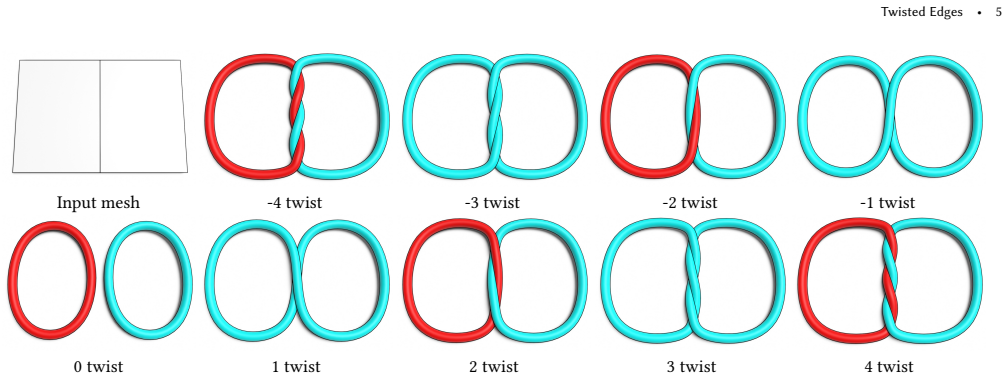
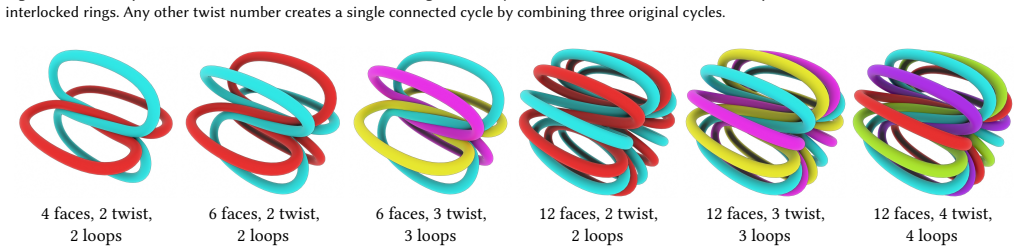
By generalizing twist formulations to support arbitrary integer labels, integer-twisted meshes on 2-manifolds preserve connectivity through even twists to form chainmail-like structures with consistently linked face cycles, and non-manifold extensions with specific assignments prevent cycle merging to enable partial connectivity and hinges. These structures correspond to knotted surfaces in four dimensions, with the linked knot structures arising as their immersions into R^3.
What carries the argument
Labeled non-manifold surface meshes with arbitrary integer twist labels on edges, which control linking and connectivity to produce linked knot structures.
If this is right
- Even twists applied to 2-manifold meshes create fully connected structures resembling chainmail where faces form linked cycles.
- Specific integer twist assignments on non-manifold meshes allow partial linking without unintended mergers, supporting dynamic folding and articulation.
- The framework unifies the exploration of woven and articulated structures by removing the binary restriction on twists.
- Integer-twisted meshes represent knotted surfaces in four dimensions immersed in three-dimensional space.
Where Pith is reading between the lines
- This approach may enable computational tools for generating complex articulated mechanisms or metamaterials with knot-based topology.
- Exploring dynamic simulations of these structures could reveal new folding behaviors or stability properties not addressed in the static framework.
- Applications in fields like architecture or robotics might arise from the ability to design hinged, partially connected surfaces systematically.
Load-bearing premise
That arbitrary integer twist labels can be assigned consistently to edges of non-manifold meshes without causing unintended disconnections or cycle mergers.
What would settle it
Demonstrating a specific non-manifold mesh with integer twist labels that results in disconnected components or merged cycles contrary to the predicted behavior, or showing that the 4D knotted surface correspondence does not hold for a constructed example.
Figures





read the original abstract
We present Twisted Edges, a unified framework for designing Linked Knot (LK) structures using labeled non-manifold surface meshes. While the concept of edge twists, originating in topological graph theory, is foundational to these designs, prior approaches have been strictly limited to binary states. We identify this restriction as a critical barrier; binary twisting fails to capture the full spectrum of topological possibilities, rendering a vast class of structural and dynamic behaviors inaccessible. To overcome this limitation, we generalize the twist formulation to support arbitrary integer twist labels. This expansion reveals that while zero twists may introduce disconnections, applying even twists to 2-manifold meshes robustly preserves connectivity, transforming surfaces into fully connected, chainmail-like structures where faces form consistently linked cycles. Furthermore, we extend this framework to non-manifold meshes, where specific integer assignments prevent cycle merging. This capability, unattainable with binary methods, enables the design of partial connectivity and functional hinges, supporting dynamic folding and articulation. Theoretically, we show that these integer-twisted meshes correspond to knotted surfaces in four dimensions, with LK structures arising as their immersions into $\mathbb{R}^3$. By breaking the binary constraint, this work establishes a coherent paradigm for the systematic exploration of previously unstudied woven and articulated structures.
Editorial analysis
A structured set of objections, weighed in public.
Referee Report
Summary. The paper presents Twisted Edges, a unified framework for designing Linked Knot (LK) structures via non-manifold surface meshes whose edges carry arbitrary integer twist labels. It generalizes prior binary-twist methods, argues that even twists preserve connectivity on 2-manifolds while selected integer assignments on non-manifolds enable partial linking and hinges without mergers, and claims a theoretical correspondence in which the labeled meshes lift to knotted surfaces in four dimensions whose generic immersions into R^3 recover the observed LK structures.
Significance. If the integer-twist assignment rules and the 4D lifting are made rigorous, the framework could open systematic exploration of articulated and partially linked woven structures beyond binary limits, with potential applications in graphics modeling of dynamic meshes. The manuscript currently supplies no derivations, coordinate constructions, examples, or invariant checks, so the significance remains prospective.
major comments (2)
- [Abstract] Abstract: the central claim that 'these integer-twisted meshes correspond to knotted surfaces in four dimensions, with LK structures arising as their immersions into R^3' is stated without an explicit lifting map, without a rule that places the fourth coordinate from each integer twist label, and without verification that the resulting 4-manifold remains embedded or immersed without extra intersections or topology changes.
- [Abstract] Abstract: the assertion that arbitrary integer assignments on non-manifold meshes 'prevent cycle merging' and 'enable partial connectivity and functional hinges' without 'unintended disconnections or mergers' is presented as a capability unattainable with binary methods, yet no construction, consistency proof, or counter-example check is supplied, leaving the weakest assumption unverified.
minor comments (2)
- [Abstract] Abstract: the statement that 'prior approaches have been strictly limited to binary states' would benefit from one or two specific citations to the topological-graph-theory literature on binary twists.
- [Abstract] Abstract: terms such as 'chainmail-like structures' and 'functional hinges' are introduced without reference to existing graphics or topology usage, which could improve clarity for readers outside the immediate sub-area.
Simulated Author's Rebuttal
We thank the referee for the careful reading and constructive feedback. The comments correctly identify places where the presentation of the theoretical claims can be made more explicit. We respond to each major comment below and commit to revisions that strengthen the manuscript without altering its core contributions.
read point-by-point responses
-
Referee: [Abstract] Abstract: the central claim that 'these integer-twisted meshes correspond to knotted surfaces in four dimensions, with LK structures arising as their immersions into R^3' is stated without an explicit lifting map, without a rule that places the fourth coordinate from each integer twist label, and without verification that the resulting 4-manifold remains embedded or immersed without extra intersections or topology changes.
Authors: We agree that the abstract states the 4D correspondence at a high level. The manuscript motivates the idea through the topological effect of integer twists but does not supply an explicit lifting construction or coordinate rule in the provided sections. In the revised version we will add a concise description of the lifting map to the abstract and a short subsection in the theory portion: the fourth coordinate is obtained by integrating the integer twist label as a signed offset along the surface normal in R^4, with the immersion into R^3 recovered by projection. We will also include a brief general-position argument showing that generic choices of the labels avoid extraneous intersections and preserve the intended topology. revision: yes
-
Referee: [Abstract] Abstract: the assertion that arbitrary integer assignments on non-manifold meshes 'prevent cycle merging' and 'enable partial connectivity and functional hinges' without 'unintended disconnections or mergers' is presented as a capability unattainable with binary methods, yet no construction, consistency proof, or counter-example check is supplied, leaving the weakest assumption unverified.
Authors: The manuscript demonstrates the effect via concrete non-manifold examples (e.g., integer labels of +2 and +1 at junctions) that produce hinges without full cycle merger, contrasting with binary twists. Nevertheless, we acknowledge that no formal combinatorial construction or consistency argument is given. We will revise by adding a short proposition that states the parity conditions under which selected integer assignments on non-manifold edges prevent merging, together with a brief combinatorial proof and one additional counter-example check for an odd-integer case that would otherwise disconnect. revision: yes
Circularity Check
No significant circularity in the derivation chain
full rationale
The paper generalizes binary edge twists to arbitrary integer labels on non-manifold meshes and claims that the resulting structures correspond to knotted surfaces in 4D whose immersions into R^3 produce LK structures. This is presented as a theoretical result resting on topological generalizations rather than any self-referential definition, fitted parameter renamed as prediction, or load-bearing self-citation. No equations or steps reduce the claimed correspondence to its inputs by construction; the framework introduces independent capabilities for partial connectivity and hinges. The derivation is self-contained against external topological benchmarks.
Axiom & Free-Parameter Ledger
axioms (1)
- domain assumption Integer twist labels can be assigned to edges of manifold and non-manifold meshes to control connectivity and produce linked cycles or hinges.
Lean theorems connected to this paper
-
IndisputableMonolith/Foundation/AlexanderDuality.leanalexander_duality_circle_linking unclear?
unclearRelation between the paper passage and the cited Recognition theorem.
We generalize the twist formulation to support arbitrary integer twist labels... the number of independent cycles created by a twist is equal to the greatest common divisor of the twist-label and K
-
IndisputableMonolith/Foundation/AlexanderDuality.leanD3_admits_circle_linking echoes?
echoesECHOES: this paper passage has the same mathematical shape or conceptual pattern as the Recognition theorem, but is not a direct formal dependency.
Theoretically, we show that these integer-twisted meshes correspond to knotted surfaces in four dimensions, with LK structures arising as their immersions into R^3
What do these tags mean?
- matches
- The paper's claim is directly supported by a theorem in the formal canon.
- supports
- The theorem supports part of the paper's argument, but the paper may add assumptions or extra steps.
- extends
- The paper goes beyond the formal theorem; the theorem is a base layer rather than the whole result.
- uses
- The paper appears to rely on the theorem as machinery.
- contradicts
- The paper's claim conflicts with a theorem or certificate in the canon.
- unclear
- Pith found a possible connection, but the passage is too broad, indirect, or ambiguous to say the theorem truly supports the claim.
Reference graph
Works this paper leans on
-
[1]
Colin C. Adams. 1994.The Knot Book. W. H. Freeman and Company, New York
1994
-
[2]
Akleman and J
E. Akleman and J. Chen. 1999. Guaranteeing the 2-manifold property for meshes with doubly linked face list.International Journal of Shape Modeling5, 2 (1999), 149–177
1999
-
[3]
Ergun Akleman, Jianer Chen, YenLin Chen, Qing Xing, and Jonathan L Gross
-
[4]
Cyclic twill-woven objects.Computers & Graphics35, 3 (2011), 623–631
2011
-
[5]
Ergun Akleman, Jianer Chen, and Jonathan L Gross. 2015. Block meshes: Topolog- ically robust shape modeling with graphs embedded on 3-manifolds.Computers & Graphics46 (2015), 306–326
2015
-
[6]
Ergun Akleman, Jianer Chen, and Jonathan L Gross. 2015. Extended graph rotation systems as a model for cyclic weaving on orientable surfaces.Discrete Applied Mathematics193 (2015), 61–79
2015
-
[7]
Ergun Akleman, Jianer Chen, Jonathan L Gross, and Shiyu Hu. 2020. A topologi- cally complete theory of weaving.SIAM Journal on Discrete Mathematics34, 4 (2020), 2457–2480
2020
-
[8]
Ergun Akleman, Jianer Chen, Qing Xing, and Jonathan L Gross. 2009. Cyclic plain-weaving on polygonal mesh surfaces with graph rotation systems.ACM Transactions on Graphics (TOG)28, 3 (2009), 1–8
2009
-
[9]
B. J. Baumgart. 1972.Winged-edge polyhedron representation. Master’s thesis. Technical Report CS-320, Stanford University
1972
-
[10]
RL Berry and GV Raynor. 1953. The crystal chemistry of the Laves phases.Acta Crystallographica6, 2 (1953), 178–186
1953
-
[11]
Borhani and N
A. Borhani and N. Kalantar. 2016. Material active geometry—constituting pro- grammable materials for responsive building skins. InComplexity & Simplicity: Proceedings of the 34th eCAADe Conference, Vol. 1. eCAADe (Education and Re- search in Computer Aided Architectural Design in Europe) and Oulu School of Architecture, University of Oulu, Oulu, Finland, 639–648
2016
-
[12]
Alireza Borhani, Negar Kalantar, et al. 2016. The emergence of a new material cul- ture: forging unprecedented alliances between design and engineering. InDS 83: Proceedings of the 18th International Conference on Engineering and Product Design Education (E&PDE16), Design Education: Collaboration and Cross-Disciplinarity, Aalborg, Denmark, 8th–9th Septemb...
2016
-
[13]
John H. Conway. 1970. An enumeration of knots and links, and some of their algebraic properties. InComputational Problems in Abstract Algebra, John Leech (Ed.). Elsevier, New York, USA, 329–358
1970
-
[14]
HSM Coxeter. 1955. On Laves’ graph of girth ten.Canadian Journal of Mathematics 7 (1955), 18–23
1955
-
[15]
David J Craik, Norelle L Daly, and Clement Waine. 2001. The cystine knot motif in toxins and implications for drug design.Toxicon39, 1 (2001), 43–60
2001
-
[16]
Edmonds, John Robert
Jr. Edmonds, John Robert. 1960.A Combinatorial Representation for Ori- ented Polyhedral Surfaces. Ph.D. thesis. University of Maryland, College Park. https://api.drum.lib.umd.edu/server/api/core/bitstreams/68532bbd-8dee- 41a9-97cc-d1d72e133b85/content Department of Mathematics
1960
-
[17]
Evans, Vanessa Robins, and Stephen T
Myfanwy E. Evans, Vanessa Robins, and Stephen T. Hyde. 2013. Periodic entan- glement i: networks from hyperbolic reticulations.Acta crystallographica section a69, 3 (May 2013), 241–261. https://doi.org/10.1107/S0108767313001670
-
[18]
Evans, Vanessa Robins, and Stephen T
Myfanwy E. Evans, Vanessa Robins, and Stephen T. Hyde. 2013. Periodic entan- glement ii: weavings from hyperbolic line patterns.Acta crystallographica section a69, 3 (May 2013), 262–275. https://doi.org/10.1107/S0108767313001682
-
[19]
Stephen DP Fielden, David A Leigh, and Steffen L Woltering. 2017. Molecular knots.Angewandte Chemie International Edition56, 37 (2017), 11166–11194
2017
-
[20]
Ross S Forgan, Jean-Pierre Sauvage, and J Fraser Stoddart. 2011. Chemical topol- ogy: complex molecular knots, links, and entanglements.Chemical Reviews111, 9 (2011), 5434–5464
2011
-
[21]
Frederickson
Greg N. Frederickson. 2002.Hinged Dissections: Swinging and Twisting. Cambridge University Press, Cambridge, United Kingdom
2002
-
[22]
Freedman and Frank Quinn
Michael H. Freedman and Frank Quinn. 1990.Topology of 4-Manifolds. Princeton University Press, Princeton, New Jersey, USA
1990
-
[23]
Paul Gailiunas. 2022. Triply Periodic Links. InProceedings of Bridges 2022: Mathematics, Art, Music, Architecture, Culture, David Reimann, Douglas Nor- ton, and Eve Torrence (Eds.). Tessellations Publishing, Phoenix, Arizona, 191–198. http://archive.bridgesmathart.org/2022/bridges2022-191.html
2022
-
[24]
Gupta, and David M
Martin Glaser, Sourav Deb, Florian Seier, Amay Agrawal, Tim Liedl, Shawn Douglas, Manish K. Gupta, and David M. Smith. 2021. The Art of Designing DNA Nanostructures with CAD Software.Molecules26, 8 (2021), 2287. https: //www.mdpi.com/1420-3049/26/8/2287
2021
-
[25]
Gross and Thomas W
Jonathan L. Gross and Thomas W. Tucker. 2001.Topological Graph Theory. Courier Corporation, Mineola, New York, USA
2001
-
[26]
Grunbaum and G
B. Grunbaum and G. Shephard. 1980. Satins and twills: an introduction to the geometry of fabrics.Mathematics Magazine53 (1980), 139–161
1980
-
[27]
Grunbaum and G
B. Grunbaum and G. Shephard. 1985. A catalogue of isonemal fabrics.Annals of the New York Academy of Sciences440 (1985), 279–298
1985
-
[28]
B. Grunbaum and G. Shephard. 1986. An extension to the catalogue of isonemal fabrics.Discrete Mathematics60 (1986), 155–192. http://portal.acm.org/citation. cfm?id=10139.10148
-
[29]
Branko Grünbaum and Geoffrey C Shephard. 1988. Isonemal fabrics.The American Mathematical Monthly95, 1 (1988), 5–30
1988
-
[30]
Leonidas Guibas and Jorge Stolfi. 1985. Primitives for the manipulation of general subdivisions and the computation of Voronoi.ACM transactions on graphics (TOG) 4, 2 (1985), 74–123
1985
-
[31]
1974.Differential Topology
Victor Guillemin and Alan Pollack. 1974.Differential Topology. Prentice-Hall, Englewood Cliffs, New Jersey, USA
1974
-
[32]
Hoffmann
Claude M. Hoffmann. 1989.Geometric & Solid Modeling: An Introduction. Morgan Kaufmann Publishers, San Mateo, California, USA
1989
-
[33]
Joshua Holden and Lana Holden. 2016. Modeling Braids, Cables, and Weaves with Stranded Cellular Automata. InProceedings of Bridges 2016: Mathematics, Music, Art, Architecture, Education, Culture, Eve Torrence, Bruce Torrence, Carlo Séquin, Douglas McKenna, Kristóf Fenyvesi, and Reza Sarhangi (Eds.). Tessellations Publishing, Phoenix, Arizona, 127–134. htt...
2016
-
[34]
Kate E Horner, Mark A Miller, Jonathan W Steed, and Paul M Sutcliffe. 2016. Knot theory in modern chemistry.Chemical Society Reviews45, 23 (2016), 6432–6448
2016
-
[35]
Stephen T. Hyde and Myfanwy E. Evans. 2022. Symmetric tangled Platonic poly- hedra.Proceedings of the National Academy of Sciences119, 1 (2022), e2110345118. arXiv:https://www.pnas.org/doi/pdf/10.1073/pnas.2110345118 https://www.pnas. org/doi/abs/10.1073/pnas.2110345118
-
[36]
Hyde, Michael O’Keeffe, Davide M
Stephen T. Hyde, Michael O’Keeffe, Davide M. Proserpio, and Ram Seshadri. 1997. The Language of Shape. Elsevier, Amsterdam, Netherlands
1997
-
[37]
Clode, Martin Saunders, Myfanwy E
Anna-Lee Jessop, Peta L. Clode, Martin Saunders, Myfanwy E. Evans, Stephen T. Hyde, James N. McPherson, Kasper S. Pedersen, Jacob J. K. Kirkensgaard, Nipam H. Patel, Kyle A. DeMarr, W. Owen McMillan, Bodo D. Wilts, and Gerd E. Schröder- Turk. 2025. Hierarchical woven fibrillar structures in developing single gyroids 22•Yildiz, et al. in butterflies.Procee...
-
[38]
2002.Surfaces in 4-Space
Seiichi Kamada. 2002.Surfaces in 4-Space. Springer, Berlin, Germany
2002
-
[39]
1987.On Knots
LH Kauffman. 1987.On Knots. Princeton University Press, Princeton Nj
1987
-
[40]
Alexander R Klotz, Caleb J Anderson, and Michael S Dimitriyev. 2024. Chirality effects in molecular chainmail.Soft Matter20, 35 (2024), 7044–7058
2024
-
[41]
Chelsea E Knittel, Michael Tanis, Amy L Stoltzfus, Toen Castle, Randall D Kamien, and Genevieve Dion. 2020. Modelling textile structures using bicontinuous surfaces.Journal of Mathematics and the Arts14, 4 (2020), 331–344
2020
-
[42]
Dmitri Kozlov. 2013. Structures of periodical knots and links as geometric models of complex surfaces for designing.Nexus Network Journal15, 2 (2013), 241–255
2013
-
[43]
Dmitri Kozlov. 2018. Knots as a Principle of Form in Modern Art and Architecture. In2nd International Conference on Art Studies: Science, Experience, Education (ICASSEE 2018). Atlantis Press, Paris, France, 367–372
2018
-
[44]
Henriette Lipschütz, Martin Skrodzki, Ulrich Reitebuch, and Konrad Polthier
-
[45]
InProceedings of Bridges 2022: Mathematics, Art, Music, Architecture, Culture, David Reimann, Douglas Norton, and Eve Torrence (Eds.)
Linked Knots from thegyroOperation on the Dodecahedron. InProceedings of Bridges 2022: Mathematics, Art, Music, Architecture, Culture, David Reimann, Douglas Norton, and Eve Torrence (Eds.). Tessellations Publishing, Phoenix, Arizona, 175–182. http://archive.bridgesmathart.org/2022/bridges2022-175.html
2022
-
[46]
Yuanpeng Liu, Seiichi Suzuki, Florin Isvoranu, and Mark Pauly. 2025. Double- Layered Elastic Gridshells with Locally Deployable Rotational-Surface Compo- nents. InAdvances in Architectural Geometry (AAG 2025). AAG, Vienna, Austria, 35–46. Presented at Advances in Architectural Geometry (AAG 2025), Cambridge, MA, USA. Paper available on EPFL Infoscience repository
2025
-
[47]
1988.An Introduction to Solid Modeling
Martti Mäntylä. 1988.An Introduction to Solid Modeling. Computer Science Press, Rockville, Maryland, USA
1988
-
[48]
1965.Topology from the Differentiable Viewpoint
John Milnor. 1965.Topology from the Differentiable Viewpoint. University of Virginia Press, Charlottesville, Virginia, USA
1965
-
[49]
Widianto P Moestopo, Sammy Shaker, Weiting Deng, and Julia R Greer. 2023. Knots are not for naught: Design, properties, and topology of hierarchical inter- twined microarchitected materials.Science Advances9, 10 (2023), eade6725
2023
-
[50]
Lee Neuwirth. 1979. The theory of knots.Scientific American240, 6 (1979), 110–125
1979
-
[51]
Lauren Niu, Geneviève Dion, and Randall D Kamien. 2025. Geometric modeling of knitted fabrics.Proceedings of the National Academy of Sciences122, 7 (2025), e2416536122
2025
-
[52]
Yingying Ren, Julian Panetta, Tian Chen, Florin Isvoranu, Samuel Poincloux, Christopher Brandt, Alison Martin, and Mark Pauly. 2021. 3D weaving with curved ribbons.ACM Trans. Graph.40, 4, Article 127 (July 2021), 15 pages
2021
-
[53]
Rinus Roelofs. 2007. Entwined Circular Rings. InBridges Donostia: Mathemat- ics, Music, Art, Architecture, Culture, Reza Sarhangi and Javier Barrallo (Eds.). Tarquin Publications, London, 81–90. http://archive.bridgesmathart.org/2007/ bridges2007-81.html
2007
-
[54]
1976.Knots and Links
Dale Rolfsen. 1976.Knots and Links. Publish or Perish, Berkeley, CA
1976
-
[55]
1995.Blender
Ton Roosendaal and Blender Foundation. 1995.Blender. https://www.blender.org Open-source 3D creation suite
1995
-
[56]
Doris Schattschneider and Wallace Walker. 1987.M. C. Escher Kaleidocycles. Ballantine Books, New York, NY, USA
1987
-
[57]
Carlo H. Séquin. 2021. Polyhedral-Edge Knots. InProceedings of Bridges 2021: Mathematics, Art, Music, Architecture, Culture, David Swart, Frank Farris, and Eve Torrence (Eds.). Tessellations Publishing, Phoenix, Arizona, 63–70. http: //archive.bridgesmathart.org/2021/bridges2021-63.html
2021
-
[58]
1994.The Flexagon Book
Joseph Sherman and Paul Stewart. 1994.The Flexagon Book. Cambridge University Press, Cambridge, United Kingdom
1994
-
[59]
Krishma Singal, Michael S Dimitriyev, Sarah E Gonzalez, A Patrick Cachine, Sam Quinn, and Elisabetta A Matsumoto. 2024. Programming mechanics in knitted materials, stitch by stitch.Nature Communications15, 1 (2024), 2622
2024
-
[60]
Bryant Tuckerman Stone. 1942. Flexagons.Scientific American167, 6 (1942), 246–250
1942
-
[62]
Peter G. Tait. 1877. On Links.Transactions of the Royal Society of Edinburgh28, 9 (1877), 321–332. doi:10.1017/S0080456800090633
-
[63]
Tom Verhoeff and Koos Verhoeff. 2011. From Chain-link Fence to Space-Spanning Mathematical Structures. InProceedings of Bridges 2011: Mathematics, Music, Art, Architecture, Culture, Reza Sarhangi and Carlo H. Séquin (Eds.). Tessellations Publishing, Phoenix, Arizona, 73–80. http://archive.bridgesmathart.org/2011/ bridges2011-73.html
2011
-
[64]
1999.The Physics of Foams
Denis Weaire and Robert Phelan. 1999.The Physics of Foams. Oxford University Press, Oxford, UK
1999
-
[65]
Kevin J. Weiler. 1986.Topological structures for geometric modeling (boundary representation, manifold, radial edge structure). Ph. D. Dissertation. Rensse- laer Polytechnic Institute. http://proxy.library.tamu.edu/login?url=https: //www.proquest.com/dissertations-theses/topological-structures-geometric- modeling/docview/303506577/se-2 Copyright - Databas...
-
[66]
Wikipedia contributors. 2025. Medial graph — Wikipedia, The Free Encyclopedia. https://en.wikipedia.org/wiki/Medial_graph. [Online; accessed 17-January-2026]
2025
-
[67]
Qing Xing, Ergun Akleman, Jianer Chen, and Jonathan L. Gross. 2010. Single- cycle Plain-Woven Objects. In2010 Shape Modeling International Conference. IEEE, Piscataway, New Jersey, USA, 90–99
2010
-
[68]
Hong-Bin Yang, Seiichi Suzuki, and Mark Pauly. 2025. Topological generation of woven nodes for double-layered elastic gridshells built from deployable cylindrical components. InAdvances in Architectural Geometry (AAG 2025). AAG, Vienna, Austria, 47–58. Presented at Advances in Architectural Geometry (AAG 2025), Cambridge, MA, USA. Paper available on EPFL ...
2025
-
[69]
Tolga Yildiz and Ergun Akleman. 2024. Volumetric nonwoven structures: An algebraic framework for systematic design of infinite polyhedral frames using nonwoven fabric patterns.Computers & Graphics4, 8 (2024), 103979
2024
-
[70]
Tolga Yildiz and Ergun Akleman. 2025. Triply periodic mesh-based linked- structures: Design and construction of a family of periodic links based on Bravais lattices and corresponding Wigner-Seitz cells.Computers & Graphics132 (2025), 104369. https://www.sciencedirect.com/science/article/pii/S0097849325002109
2025
-
[71]
Tolga T Yildiz, Alice C Niemeyer, Vinayak R Krishnamurthy, and Er- gun Akleman. 2025. A constructive framework for discovery, design, and classification of volumetric Bravais weaves.PNAS Nexus4, 8 (07 2025), pgaf219. arXiv:https://academic.oup.com/pnasnexus/article- pdf/4/8/pgaf219/63794488/pgaf219.pdf https://doi.org/10.1093/pnasnexus/ pgaf219
-
[72]
Akira Yoshimoto. 1971. An Amusing Cube.Mathematics Magazine44, 2 (1971), 87–89
1971
-
[73]
Yuwen Zhang and Nadrian C. Seeman. 1994. Construction of a DNA-Truncated Octahedron.Journal of the American Chemical Society116, 5 (1994), 1661–1669. arXiv:https://doi.org/10.1021/ja00084a006 doi:10.1021/ja00084a006 Received 20 February 2007; revised 12 March 2009; accepted 5 June 2009
discussion (0)
Sign in with ORCID, Apple, or X to comment. Anyone can read and Pith papers without signing in.