Recognition: unknown
Identifying Changing-Look AGN Transitions in Light Curve Data with the Zwicky Transient Facility
Pith reviewed 2026-05-10 14:49 UTC · model grok-4.3
The pith
A criterion of |Δg| > 0.4 mag and |Δ(g-r)| > 0.2 mag identifies changing-look AGN transitions in 9.6% of ZTF hosts
A machine-rendered reading of the paper's core claim, the machinery that carries it, and where it could break.
Core claim
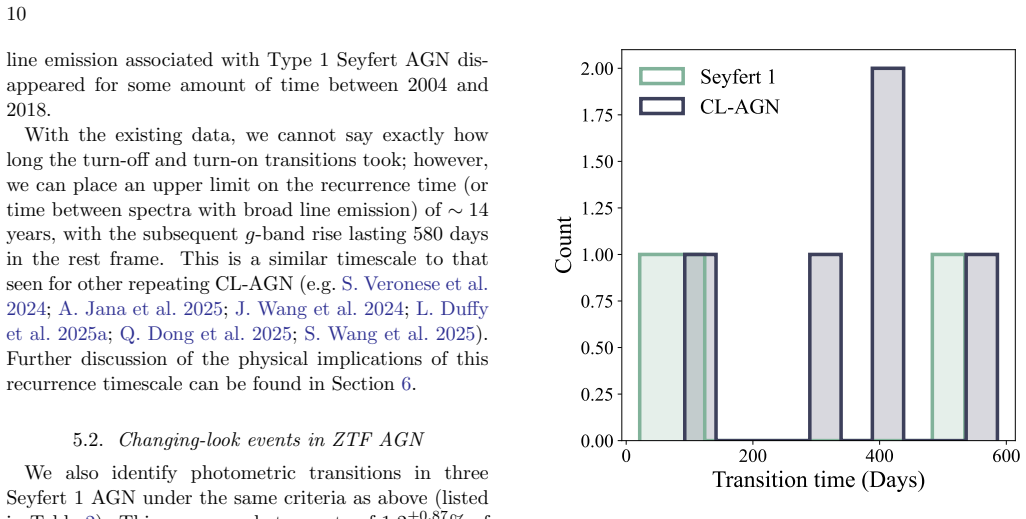
Using synthetic photometry combined with ZTF light curve data, we develop a CL-AGN criterion of |Δg| > 0.4 mag and |Δ(g-r)| > 0.2 mag that recovers a photometric transition in 9.6^{+4.9}_{-3.4}% of CL-AGN hosts over the six-year ZTF survey, including a candidate repeating changing-look event in SDSS J084957.78+274728.9. Simulations of AGN light curves yield a false positive rate of 1.6^{+0.19}_{-0.17}% among Seyferts, with similar flares occurring at 1.2^{+0.87}_{-0.50}% among type 1 Seyferts and ≤0.39% among type 2 Seyferts. Photometric transitions last between 21 and 560 days with a median duration of 360 days, consistent with thermal or orbital timescales for AGN disks, though no clear BH
What carries the argument
The photometric CL-AGN criterion of absolute g-band magnitude change exceeding 0.4 mag together with absolute g-r color change exceeding 0.2 mag
If this is right
- Photometric CL-AGN transitions last between 21 and 560 days with a median of 360 days, consistent with thermal or orbital timescales in AGN accretion disks.
- No correlation is detected between black hole mass and transition duration, though the sample of photometric transitions is small.
- The false positive rate among simulated Seyferts is 1.6 percent, while the rate of similar flares is 1.2 percent in type 1 Seyferts and at most 0.39 percent in type 2 Seyferts over six years.
- The criterion can be applied directly to the Legacy Survey of Space and Time to identify additional CL-AGN candidates.
Where Pith is reading between the lines
- If the criterion holds beyond the current sample, photometric surveys could identify CL-AGN at scale and test unification models with statistics that spectroscopy alone cannot provide.
- The candidate repeating transition raises the possibility that some events recur, which longer-baseline monitoring could check.
- Applying the same cuts to LSST data would yield transition frequency statistics that help distinguish among proposed physical mechanisms such as disk instabilities or changes in obscuration.
Load-bearing premise
The specific 0.4 mag and 0.2 mag thresholds reliably isolate changing-look transitions rather than ordinary AGN variability or observational noise.
What would settle it
Spectroscopic follow-up confirming Seyfert type changes for the photometrically selected candidates would directly test whether the criterion correctly identifies true CL-AGN.
Figures




read the original abstract
Changing-Look AGN (CL-AGN) are AGN which transition between Seyfert types, challenging AGN unification models. Most CL-AGN have been identified via repeat spectroscopy, making it difficult to determine the duration and magnitude of the CL-AGN transition. As such, the physical mechanisms behind this transition are still unknown. We use synthetic photometry in combination with ZTF light curve data to develop a new criterion to identify photometric CL-AGN transitions based on changes in g-band magnitude and g-r color. We find that a CL-AGN criterion of $| \Delta g| > 0.4$ mag and $| \Delta (g-r)| > 0.2$ mag recovers a photometric transition in $9.6^{+4.9}_{-3.4}\%$ of CL-AGN hosts over the six-year ZTF survey, including a candidate repeating changing-look event in SDSS J084957.78+274728.9. Using simulated AGN light curves, we estimate the false positive rate among the simulated Seyferts to be $1.6^{+0.19}_{-0.17}\%$. We find that the rate of similar flares among Type 1 Seyferts is $1.2^{+0.87}_{-0.50}\%$ , and among Type 2 Seyferts is $\leq 0.39\%$ over six years. Photometric CL-AGN transitions last between 21 and 560 days, with a median duration of 360 days, consistent with the thermal or orbital timescales for AGN disks. We do not detect a correlation between black hole mass and transition duration, likely due to the small sample of detected photometric transitions. This method can be applied to the upcoming Legacy Survey of Space and Time to identify CL-AGN candidates and test theories of their origins
Editorial analysis
A structured set of objections, weighed in public.
Referee Report
Summary. The manuscript develops a photometric criterion using changes in g-band magnitude and g-r color from ZTF light curves to identify changing-look AGN (CL-AGN) transitions. They report that thresholds of |Δg| > 0.4 mag and |Δ(g-r)| > 0.2 mag recover transitions in 9.6^{+4.9}_{-3.4}% of CL-AGN hosts over six years, including a candidate repeating event. False positive rates are estimated at 1.6% from simulated Seyfert light curves, 1.2% in Type 1s, and ≤0.39% in Type 2s. Transition durations range from 21 to 560 days (median 360 days), consistent with disk timescales, with no detected correlation to black hole mass. The method is proposed for use with LSST data.
Significance. If the photometric criterion proves robust and independent of the training sample, this work provides a scalable method to identify CL-AGN candidates in large photometric surveys without requiring repeat spectroscopy. The simulation-based false-positive estimates, the candidate repeating transition, and the reported duration statistics (consistent with thermal/orbital timescales) are valuable contributions that could enable statistical tests of CL-AGN origins. The approach leverages synthetic photometry on real ZTF data, which is a strength for reproducibility.
major comments (3)
- [Abstract and criterion development section] Abstract and criterion development section: The thresholds |Δg| > 0.4 mag and |Δ(g-r)| > 0.2 mag are stated without an explicit demonstration that their selection was performed independently of the CL-AGN sample used to compute the 9.6% recovery fraction (e.g., no mention of a held-out validation set, a priori physical derivation, or cross-validation procedure). Because these values are comparable in scale to the magnitude and color changes seen in spectroscopically confirmed CL-AGN, the recovery rate and the quoted false-positive rates (1.6% in simulations, 1.2% in Type 1s) risk circularity if the cuts were optimized post-hoc to recover known cases.
- [Results section on recovery statistics] Results section on recovery statistics: The 9.6^{+4.9}_{-3.4}% recovery fraction is reported without stating the total number of CL-AGN hosts examined or the precise statistical method (e.g., binomial confidence interval or bootstrap) used to derive the asymmetric uncertainties. This omission prevents assessment of whether the quoted precision is consistent with the underlying sample size and directly affects the load-bearing claim of a ~10% photometric recovery rate.
- [False-positive estimation section] False-positive estimation section: The 1.6% false-positive rate is derived from simulated Seyfert light curves, but the manuscript does not detail whether the simulation parameters (e.g., damped random walk amplitudes or structure functions) were chosen without reference to the observed CL-AGN sample. If any tuning occurred, the low false-positive claim used to support the criterion's reliability would be compromised.
minor comments (2)
- [Abstract] Abstract: State the absolute number of CL-AGN hosts in the parent sample alongside the 9.6% fraction to improve interpretability.
- [Duration analysis] Duration analysis: Clarify the exact algorithm used to measure transition start and end times (e.g., how consecutive points above threshold are grouped and how gaps in ZTF coverage are handled) to support reproducibility of the 21–560 day range and 360-day median.
Simulated Author's Rebuttal
We thank the referee for their constructive and detailed comments, which have helped us improve the clarity and rigor of the manuscript. We address each major comment point-by-point below. We agree that additional details on criterion selection, sample statistics, and simulation parameters are warranted to eliminate any perception of circularity or ambiguity, and we have revised the manuscript accordingly.
read point-by-point responses
-
Referee: [Abstract and criterion development section] Abstract and criterion development section: The thresholds |Δg| > 0.4 mag and |Δ(g-r)| > 0.2 mag are stated without an explicit demonstration that their selection was performed independently of the CL-AGN sample used to compute the 9.6% recovery fraction (e.g., no mention of a held-out validation set, a priori physical derivation, or cross-validation procedure). Because these values are comparable in scale to the magnitude and color changes seen in spectroscopically confirmed CL-AGN, the recovery rate and the quoted false-positive rates (1.6% in simulations, 1.2% in Type 1s) risk circularity if the cuts were optimized post-hoc to recover known cases.
Authors: The thresholds were initially selected based on a priori physical expectations for significant AGN variability, specifically values exceeding the typical stochastic fluctuations in non-transitioning Seyferts as reported in the literature on damped random walk models. These were then tested for recovery on the known CL-AGN sample. We acknowledge that the manuscript did not explicitly demonstrate independence via held-out validation or cross-validation. To address this concern rigorously, we have revised the criterion development section to include a sensitivity analysis across a range of threshold values and a cross-validation procedure (randomly splitting the CL-AGN sample into training and validation subsets), confirming that the chosen thresholds yield consistent recovery rates without post-hoc optimization. This revision eliminates the risk of circularity while preserving the reported recovery fraction. revision: yes
-
Referee: [Results section on recovery statistics] Results section on recovery statistics: The 9.6^{+4.9}_{-3.4}% recovery fraction is reported without stating the total number of CL-AGN hosts examined or the precise statistical method (e.g., binomial confidence interval or bootstrap) used to derive the asymmetric uncertainties. This omission prevents assessment of whether the quoted precision is consistent with the underlying sample size and directly affects the load-bearing claim of a ~10% photometric recovery rate.
Authors: We apologize for this omission in the original text. The analysis examined a total of 52 CL-AGN hosts with sufficient ZTF coverage, and the asymmetric uncertainties were computed using the beta distribution method for binomial proportions (Clopper-Pearson interval via scipy.stats.beta), which is standard for small-sample fractions. We have revised the results section to explicitly state the sample size (N=52) and the statistical method, allowing direct verification that the reported precision is appropriate for this sample size. revision: yes
-
Referee: [False-positive estimation section] False-positive estimation section: The 1.6% false-positive rate is derived from simulated Seyfert light curves, but the manuscript does not detail whether the simulation parameters (e.g., damped random walk amplitudes or structure functions) were chosen without reference to the observed CL-AGN sample. If any tuning occurred, the low false-positive claim used to support the criterion's reliability would be compromised.
Authors: The DRW simulation parameters (amplitudes, timescales, and structure functions) were taken directly from standard literature values for typical Seyfert galaxies (e.g., MacLeod et al. 2010 and subsequent ZTF-specific calibrations), without any reference to or tuning based on the properties of our CL-AGN sample. The simulations were designed to represent the general non-transitioning Seyfert population. We have revised the false-positive estimation section to explicitly cite these parameter sources and confirm their independence from the CL-AGN sample, thereby strengthening the validity of the 1.6% rate. revision: yes
Circularity Check
No significant circularity; criterion development and recovery rate are distinct steps.
full rationale
The paper states it develops the |Δg| > 0.4 mag and |Δ(g-r)| > 0.2 mag criterion via synthetic photometry combined with ZTF light curves, then measures the recovery fraction (9.6%) among known CL-AGN hosts and estimates false-positive rates separately from simulated Seyfert light curves and Type 1/2 samples. No quoted step shows the thresholds being fitted directly to the CL-AGN recovery sample and then re-used as a 'prediction'; the recovery rate is presented as an empirical measurement on an independent spectroscopic sample. No self-citations, uniqueness theorems, or ansatzes are invoked in a load-bearing way. The derivation chain remains self-contained against external benchmarks.
Axiom & Free-Parameter Ledger
free parameters (2)
- g-band magnitude change threshold
- g-r color change threshold
axioms (1)
- domain assumption Synthetic photometry of AGN light curves accurately reproduces the statistical properties of real ZTF observations for the purpose of false-positive estimation.
Reference graph
Works this paper leans on
-
[1]
Agrawal, T., Verrico, M. E., & French, K. D. 2025, Research Notes of the American Astronomical Society, 9, 245, doi: 10.3847/2515-5172/ae04e0
-
[2]
Amrutha, N., Wolf, C., Onken, C. A., et al. 2024, MNRAS, 535, 2322, doi: 10.1093/mnras/stae2470
-
[3]
Antonucci, R. 1993, ARA&A, 31, 473, doi: 10.1146/annurev.aa.31.090193.002353 Astropy Collaboration, Robitaille, T. P., Tollerud, E. J., et al. 2013, A&A, 558, A33, doi: 10.1051/0004-6361/201322068 Astropy Collaboration, Price-Whelan, A. M., Sip˝ ocz, B. M., et al. 2018, AJ, 156, 123, doi: 10.3847/1538-3881/aabc4f Astropy Collaboration, Price-Whelan, A. M....
-
[4]
Bellm, E. C., Kulkarni, S. R., Graham, M. J., et al. 2019, PASP, 131, 018002, doi: 10.1088/1538-3873/aaecbe
-
[5]
2025, arXiv e-prints, arXiv:2507.01355, doi: 10.48550/arXiv.2507.01355
Birmingham, S., Ward, C., Nyland, K., et al. 2025, arXiv e-prints, arXiv:2507.01355, doi: 10.48550/arXiv.2507.01355
-
[6]
Blanchard, P. K., Nicholl, M., Berger, E., et al. 2017, ApJ, 843, 106, doi: 10.3847/1538-4357/aa77f7
-
[7]
Breiman, L. 2001, Machine Learning, 45, 5, doi: 10.1023/A:1010933404324
-
[8]
J., Shen, Y., Blaes, O., et al
Burke, C. J., Shen, Y., Blaes, O., et al. 2021, Science, 373, 789, doi: 10.1126/science.abg9933
-
[9]
Butler, N. R., & Bloom, J. S. 2011, AJ, 141, 93, doi: 10.1088/0004-6256/141/3/93
-
[10]
Cackett, E. M., Horne, K., & Winkler, H. 2007, Monthly Notices of the Royal Astronomical Society, 380, 669, doi: 10.1111/j.1365-2966.2007.12098.x
-
[11]
Chambers, K. C., Magnier, E. A., Metcalfe, N., et al. 2016, arXiv e-prints, arXiv:1612.05560, doi: 10.48550/arXiv.1612.05560
work page internal anchor Pith review Pith/arXiv arXiv doi:10.48550/arxiv.1612.05560 2016
-
[12]
Chan, C.-H., Piran, T., Krolik, J. H., & Saban, D. 2019, ApJ, 881, 113, doi: 10.3847/1538-4357/ab2b40
-
[13]
2024, ApJ, 969, 131, doi: 10.3847/1538-4357/ad479a
Chanchaiworawit, K., & Sarajedini, V. 2024, ApJ, 969, 131, doi: 10.3847/1538-4357/ad479a
-
[14]
Charlton, P. J. L., Ruan, J. J., Haggard, D., et al. 2019, ApJ, 876, 75, doi: 10.3847/1538-4357/ab0ec1
-
[15]
XGBoost: A Scalable Tree Boosting System
Chen, T., & Guestrin, C. 2016, arXiv e-prints, arXiv:1603.02754, doi: 10.48550/arXiv.1603.02754 20
-
[16]
Foltz, C. B. 1986, ApJ, 311, 135, doi: 10.1086/164758
-
[17]
1973, A&A, 22, 343
Collin-Souffrin, S., Alloin, D., & Andrillat, Y. 1973, A&A, 22, 343
1973
-
[18]
Davis, M. C., Grace, K. E., Trump, J. R., et al. 2024, ApJ, 965, 34, doi: 10.3847/1538-4357/ad276e
-
[19]
Djorgovski, S. G., Drake, A. J., Mahabal, A. A., et al. 2011, arXiv e-prints, arXiv:1102.5004, doi: 10.48550/arXiv.1102.5004
-
[20]
Dodd, S. A., Huang, X., Davis, S. W., & Ramirez-Ruiz, E. 2025, arXiv e-prints, arXiv:2506.19900, doi: 10.48550/arXiv.2506.19900
-
[21]
Ramirez-Ruiz, E., & Foley, R. J. 2021, ApJl, 907, L21, doi: 10.3847/2041-8213/abd852
-
[22]
2007, A&A Rv, 15, 1, doi: 10.1007/s00159-007-0006-1
Done, C., Gierli´ nski, M., & Kubota, A. 2007, A&A Rv, 15, 1, doi: 10.1007/s00159-007-0006-1
-
[23]
2025, arXiv e-prints, arXiv:2510.18445
Dong, Q., Zhang, Z.-X., Gu, W.-M., et al. 2025, arXiv e-prints, arXiv:2510.18445. https://arxiv.org/abs/2510.18445
-
[24]
2024, arXiv e-prints, arXiv:2408.07335, doi: 10.48550/arXiv.2408.07335
Dong, Q., Zhang, Z.-X., Gu, W.-M., Sun, M., & Zheng, Y.-G. 2024, arXiv e-prints, arXiv:2408.07335, doi: 10.48550/arXiv.2408.07335
-
[25]
Draine, B. T. 2009, in Astronomical Society of the Pacific Conference Series, Vol. 414, Cosmic Dust - Near and Far, ed. T. Henning, E. Gr¨ un, & J. Steinacker, 453, doi: 10.48550/arXiv.0903.1658
-
[26]
Duffy, L., Eracleous, M., Ruan, J. J., Yang, Q., & Runnoe, J. C. 2025a, ApJ, 989, 102, doi: 10.3847/1538-4357/adeb73
-
[27]
Duffy, L., Eracleous, M., Runnoe, J. C., et al. 2025b, ApJ, 981, 127, doi: 10.3847/1538-4357/adae0b
-
[28]
Earl, N., French, K. D., Ramirez-Ruiz, E., et al. 2025, ApJ, 983, 28, doi: 10.3847/1538-4357/adb974
-
[29]
El-Badry, K., Hogg, D. W., & Rix, H.-W. 2025, arXiv e-prints, arXiv:2509.10601, doi: 10.48550/arXiv.2509.10601
-
[30]
Elitzur, M., & Ho, L. C. 2009, ApJL, 701, L91, doi: 10.1088/0004-637X/701/2/L91
-
[31]
Elitzur, M., Ho, L. C., & Trump, J. R. 2014, MNRAS, 438, 3340, doi: 10.1093/mnras/stt2445
-
[32]
2004, ApJL, 615, L25, doi: 10.1086/424380
Elvis, M., Risaliti, G., Nicastro, F., et al. 2004, ApJL, 615, L25, doi: 10.1086/424380
-
[33]
Eracleous, M., & Halpern, J. P. 2001, ApJ, 554, 240, doi: 10.1086/321331
-
[34]
Frederick, S., Gezari, S., Graham, M. J., et al. 2019, ApJ, 883, 31, doi: 10.3847/1538-4357/ab3a38
-
[35]
Gezari, S., Hung, T., Cenko, S. B., et al. 2017, ApJ, 835, 144, doi: 10.3847/1538-4357/835/2/144
-
[36]
Graham, M. J., Kulkarni, S. R., Bellm, E. C., et al. 2019, PASP, 131, 078001, doi: 10.1088/1538-3873/ab006c
-
[37]
Graham, M. J., Ross, N. P., Stern, D., et al. 2020, MNRAS, 491, 4925, doi: 10.1093/mnras/stz3244
-
[38]
Green, P. J., Pulgarin-Duque, L., Anderson, S. F., et al. 2022, ApJ, 933, 180, doi: 10.3847/1538-4357/ac743f
-
[39]
2018, PyQSOFit: Python code to fit the spectrum of quasars,, Astrophysics Source Code Library, record ascl:1809.008
Guo, H., Shen, Y., & Wang, S. 2018, PyQSOFit: Python code to fit the spectrum of quasars,, Astrophysics Source Code Library, record ascl:1809.008
2018
-
[40]
Guo, W.-J., Zou, H., Fawcett, V. A., et al. 2024, ApJS, 270, 26, doi: 10.3847/1538-4365/ad118a
-
[41]
Guo, W.-J., Zou, H., Greenwell, C. L., et al. 2025, ApJS, 278, 28, doi: 10.3847/1538-4365/adc124
-
[42]
2021, MNRAS, 508, 144, doi: 10.1093/mnras/stab2550
Guolo, M., Ruschel-Dutra, D., Grupe, D., et al. 2021, MNRAS, 508, 144, doi: 10.1093/mnras/stab2550
-
[43]
Hameury, J. M., Viallet, M., & Lasota, J. P. 2009, A&A, 496, 413, doi: 10.1051/0004-6361/200810928
-
[44]
Hand, D. J. 2012, International Statistical Review, 80, 400, doi: https://doi.org/10.1111/j.1751-5823.2012.00183.x
-
[45]
Harris, C. R., Millman, K. J., van der Walt, S. J., et al. 2020, Nature, 585, 357, doi: 10.1038/s41586-020-2649-2
-
[46]
Hinkle, J. T., Holoien, T. W. S., Shappee, B. J., et al. 2022, ApJ, 930, 12, doi: 10.3847/1538-4357/ac5f54
-
[47]
Ho, L. C., & Kim, M. 2015, ApJ, 809, 123, doi: 10.1088/0004-637X/809/2/123
-
[48]
2022, MNRAS, 511, 54, doi: 10.1093/mnras/stab3694
Auchettl, K. 2022, MNRAS, 511, 54, doi: 10.1093/mnras/stab3694
-
[49]
Hunter, J. D. 2007, Computing in Science & Engineering, 9, 90, doi: 10.1109/MCSE.2007.55 Hutsem´ ekers, D., Ag´ ıs Gonz´ alez, B., Sluse, D., Ramos
-
[50]
Almeida, C., & Acosta Pulido, J. A. 2017, A&A, 604, L3, doi: 10.1051/0004-6361/201731397 Ivezi´ c,ˇZ., Connolly, A., Vanderplas, J., & Gray, A. 2014,
-
[51]
Statistics, Data Mining and Machine Learning in Astronomy (Princeton University Press) Ivezi´ c,ˇZ., Kahn, S. M., Tyson, J. A., et al. 2019, ApJ, 873, 111, doi: 10.3847/1538-4357/ab042c
-
[52]
Jana, A., Ricci, C., Temple, M. J., et al. 2025, A&A, 693, A35, doi: 10.1051/0004-6361/202451058
-
[53]
2017, Piecewise Linear Fit, https://jekel.me/piecewise linear fit py/index.html
Jekel, C. 2017, Piecewise Linear Fit, https://jekel.me/piecewise linear fit py/index.html
2017
-
[54]
Jin, X., Ruan, J. J., Haggard, D., et al. 2021, ApJ, 912, 20, doi: 10.3847/1538-4357/abeb17
-
[55]
Johnson, B. D. 2021, bd-j/sedpy: sedpy v0.2.0 (v0.2.0),, Zenodo
2021
-
[56]
Jones, D. O., Foley, R. J., Narayan, G., et al. 2021, ApJ, 908, 143, doi: 10.3847/1538-4357/abd7f5 21
-
[57]
2025, arXiv e-prints, arXiv:2511.09626, doi: 10.48550/arXiv.2511.09626
Kaaz, N., Liska, M., Ward, C., & Davelaar, J. 2025, arXiv e-prints, arXiv:2511.09626, doi: 10.48550/arXiv.2511.09626
work page internal anchor Pith review doi:10.48550/arxiv.2511.09626 2025
-
[58]
Kammoun, E. S., Papadakis, I. E., & Dovˇ ciak, M. 2021, Monthly Notices of the Royal Astronomical Society, 503, 4163, doi: 10.1093/mnras/stab725
-
[59]
Kaspi, S., Smith, P. S., Netzer, H., et al. 2000, The Astrophysical Journal, 533, 631, doi: 10.1086/308704
-
[60]
Kauffmann, G., & Heckman, T. M. 2009, MNRAS, 397, 135, doi: 10.1111/j.1365-2966.2009.14960.x
-
[61]
Kaur, K., & Stone, N. C. 2025, ApJ, 979, 172, doi: 10.3847/1538-4357/ad9b86
-
[62]
2001, The Astrophysical Journal, 550, 655, doi: 10.1086/319786
Kazanas, D., & Nayakshin, S. 2001, The Astrophysical Journal, 550, 655, doi: 10.1086/319786
-
[63]
C., Bechtold, J., & Siemiginowska, A
Kelly, B. C., Bechtold, J., & Siemiginowska, A. 2009, ApJ, 698, 895, doi: 10.1088/0004-637X/698/1/895
-
[64]
Khachikian, E. Y., & Weedman, D. W. 1974, ApJ, 192, 581, doi: 10.1086/153093
-
[65]
2000, A&A, 361, 901
Kollatschny, W., Bischoff, K., & Dietrich, M. 2000, A&A, 361, 901
2000
-
[66]
2024, Serbian Astronomical Journal, 209, 1, doi: 10.2298/SAJ2409001K
Komossa, S., & Grupe, D. 2024, Serbian Astronomical Journal, 209, 1, doi: 10.2298/SAJ2409001K
-
[67]
2014, ApJ, 788, 159, doi: 10.1088/0004-637X/788/2/159 Koz lowski, S
Koshida, S., Minezaki, T., Yoshii, Y., et al. 2014, ApJ, 788, 159, doi: 10.1088/0004-637X/788/2/159 Koz lowski, S. 2017, A&A, 597, A128, doi: 10.1051/0004-6361/201629890
-
[68]
G., Schwarzenberg-Czerny, A., & Middleton, M
Krishnan, S., Markowitz, A. G., Schwarzenberg-Czerny, A., & Middleton, M. J. 2021, MNRAS, 508, 3975, doi: 10.1093/mnras/stab2839
-
[69]
2022, ApJ, 931, 5, doi: 10.3847/1538-4357/ac63aa
Laha, S., Meyer, E., Roychowdhury, A., et al. 2022, ApJ, 931, 5, doi: 10.3847/1538-4357/ac63aa
-
[70]
Laha, S., Meyer, E. T., Sadaula, D. R., et al. 2025, ApJ, 981, 125, doi: 10.3847/1538-4357/adaea0
-
[71]
LaMassa, S. M., Cales, S., Moran, E. C., et al. 2015, ApJ, 800, 144, doi: 10.1088/0004-637X/800/2/144
-
[72]
Lasota, J.-P. 2001, NewAR, 45, 449, doi: 10.1016/S1387-6473(01)00112-9
-
[73]
Liska, M. T. P., Kaaz, N., Musoke, G., Tchekhovskoy, A., & Porth, O. 2023, ApJL, 944, L48, doi: 10.3847/2041-8213/acb6f4
-
[74]
2021, ApJ, 915, 63, doi: 10.3847/1538-4357/abf82c L´ opez-Navas, E., Mart´ ınez-Aldama, M
Liu, W.-J., Lira, P., Yao, S., et al. 2021, ApJ, 915, 63, doi: 10.3847/1538-4357/abf82c L´ opez-Navas, E., Mart´ ınez-Aldama, M. L., Bernal, S., et al. 2022, MNRAS, 513, L57, doi: 10.1093/mnrasl/slac033 LSST Science Collaboration, Abell, P. A., Allison, J., et al. 2009, arXiv e-prints, arXiv:0912.0201, doi: 10.48550/arXiv.0912.0201
-
[75]
2025, ApJ, 994, 154, doi: 10.3847/1538-4357/ae11a2
Lu, W.-T., & Wang, J.-X. 2025, ApJ, 994, 154, doi: 10.3847/1538-4357/ae11a2
-
[76]
2025, A&A, 693, A173, doi: 10.1051/0004-6361/202451699
Lyu, B., Wu, X.-B., Pang, Y., et al. 2025, A&A, 693, A173, doi: 10.1051/0004-6361/202451699
-
[77]
Lyubarskii, Y. E. 1997, Monthly Notices of the Royal Astronomical Society, 292, 679, doi: 10.1093/mnras/292.3.679
-
[78]
Maccarone, T. J. 2003, A&A, 409, 697, doi: 10.1051/0004-6361:20031146
-
[79]
MacLeod, C. L., Green, P. J., Anderson, S. F., et al. 2019, ApJ, 874, 8, doi: 10.3847/1538-4357/ab05e2
-
[80]
Publications of the Astronomical Society of the Pacific , author =
Masci, F. J., Laher, R. R., Rusholme, B., et al. 2018, Publications of the Astronomical Society of the Pacific, 131, 018003, doi: 10.1088/1538-3873/aae8ac
work page internal anchor Pith review doi:10.1088/1538-3873/aae8ac 2018
discussion (0)
Sign in with ORCID, Apple, or X to comment. Anyone can read and Pith papers without signing in.