Recognition: unknown
The Design of Optimally Balanced Pay-as-you-go Social Security Systems
Pith reviewed 2026-05-10 15:47 UTC · model grok-4.3
The pith
Optimally balanced pay-as-you-go social security systems can be designed using general equilibrium theory to resemble notional accounts.
A machine-rendered reading of the paper's core claim, the machinery that carries it, and where it could break.
Core claim
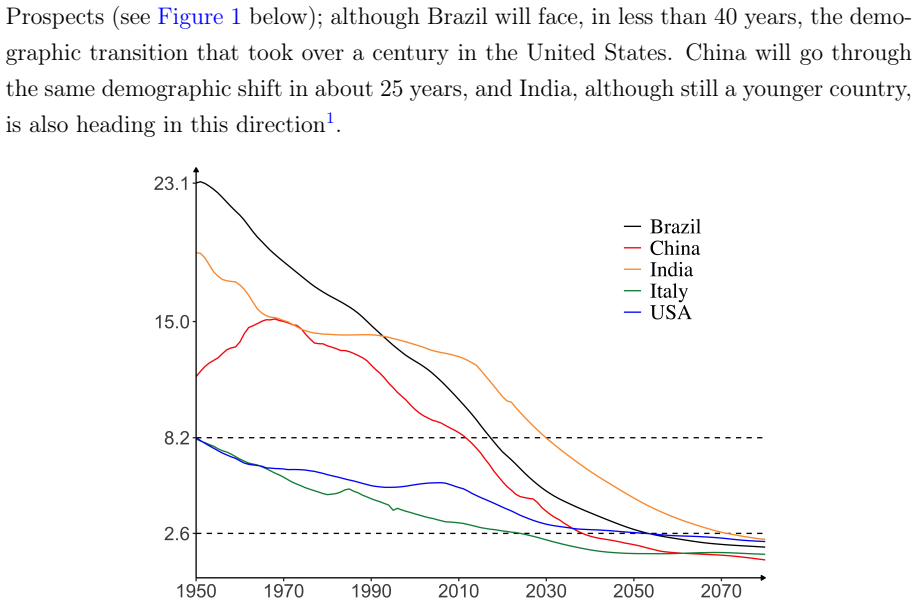
The central discovery is that optimally balanced pay-as-you-go systems can be conceived by using the backward calculation algorithm to find optimal monetary equilibria in prone-to-savings non-stationary overlapping generations economies with heterogeneous households. Due to Walras' law ensuring balanced household budgets under equilibrium prices, these systems resemble well-known notional accounts systems. The design is illustrated in a simplified framework with the demographic and productivity dynamics of five countries from 1950 to 2070.
What carries the argument
The backward calculation algorithm from Dognini (2025) that identifies optimal monetary equilibria in non-stationary OLG economies.
Load-bearing premise
The backward calculation algorithm correctly identifies optimal monetary equilibria in prone-to-savings non-stationary overlapping generations economies with heterogeneous households, and this optimality transfers to real-world PAYG reform without additional frictions.
What would settle it
Applying the algorithm to demographic data for one of the five countries and finding that the resulting system fails to balance budgets or optimize household welfare under equilibrium prices would falsify the central claim.
Figures


read the original abstract
This paper bridges social security design and general equilibrium theory to conceive optimally balanced pay-as-you-go systems. The design is based on the backward calculation algorithm from Dognini (2025), which is used to find optimal monetary equilibria of prone-to-savings non-stationary overlapping generations economies with heterogeneous households. In particular, this algorithm makes the design applicable for reforming pay-as-you-go systems in countries undergoing demographic transitions. Due to households balanced budgets under equilibrium prices (i.e., Walras' law), these optimally balanced pay-as-you-go systems resemble the well-known notional accounts systems. The design is illustrated in a simplified framework using the past and forecast demographic and productivity dynamics of Brazil, China, India, Italy, and the United States from 1950 to 2070.
Editorial analysis
A structured set of objections, weighed in public.
Referee Report
Summary. The paper proposes a design for optimally balanced pay-as-you-go (PAYG) social security systems by applying the backward calculation algorithm from Dognini (2025) to identify optimal monetary equilibria in non-stationary OLG economies with heterogeneous households. It claims that, due to Walras' law and balanced household budgets at equilibrium prices, the resulting PAYG parameters produce systems that resemble notional accounts. The method is illustrated in a simplified framework using 1950-2070 demographic and productivity data for Brazil, China, India, Italy, and the United States to support PAYG reforms during demographic transitions.
Significance. If the algorithm correctly identifies optimal equilibria and the Walras' law implication holds rigorously, the paper would provide a general-equilibrium foundation for PAYG design that links theoretical optimality to practical notional-account-like reforms in aging economies. The multi-country numerical illustration offers a concrete demonstration, though the absence of self-contained verification or robustness tests limits its immediate applicability.
major comments (3)
- [Introduction and §3 (algorithm application)] The central optimality claim for the designed PAYG systems rests on the backward calculation algorithm from Dognini (2025) without any self-contained derivation, equilibrium conditions, or numerical verification in this manuscript. No section provides independent proof that the algorithm solves the general-equilibrium problem for non-stationary heterogeneous OLG economies or confirms optimality transfers to the PAYG parameters.
- [§2 (theoretical framework)] The resemblance to notional accounts is asserted via Walras' law and household budget balance, but the manuscript contains no explicit derivation or equilibrium equations showing how the computed PAYG contribution and benefit schedules satisfy notional account properties. This step is load-bearing for the bridging claim between GE theory and social security design.
- [§4 (numerical illustration)] Table or figure presenting the 1950-2070 country results (likely §4): the illustration uses a simplified framework but reports no robustness checks, such as perturbing demographic or productivity forecasts, to verify that the equilibria remain optimal. This undermines the applicability to real-world PAYG reforms under forecast uncertainty.
minor comments (3)
- [Abstract and Introduction] The abstract and introduction should more explicitly distinguish the novel contribution of this paper from the application of the Dognini (2025) algorithm.
- [§2] Notation for OLG model variables (e.g., heterogeneous household types, non-stationary demographics) should be defined in a self-contained manner or with clearer cross-references to the prior paper.
- [§4] The numerical results section would benefit from additional tables or figures showing sensitivity of the optimal PAYG parameters to small changes in the underlying forecasts.
Simulated Author's Rebuttal
We thank the referee for the constructive comments on our manuscript. We address each major comment in turn and indicate the revisions we will make to strengthen the paper.
read point-by-point responses
-
Referee: [Introduction and §3 (algorithm application)] The central optimality claim for the designed PAYG systems rests on the backward calculation algorithm from Dognini (2025) without any self-contained derivation, equilibrium conditions, or numerical verification in this manuscript. No section provides independent proof that the algorithm solves the general-equilibrium problem for non-stationary heterogeneous OLG economies or confirms optimality transfers to the PAYG parameters.
Authors: The paper applies the algorithm developed in Dognini (2025) to the design of PAYG systems rather than re-deriving the full general-equilibrium solution method. To improve accessibility, we will add a concise summary subsection in §3 outlining the algorithm's key steps, the equilibrium conditions it enforces for non-stationary OLG economies with heterogeneous households, and the sense in which it identifies optimal monetary equilibria. This will clarify how optimality carries over to the resulting PAYG parameters without duplicating the complete proof from the cited work. revision: yes
-
Referee: [§2 (theoretical framework)] The resemblance to notional accounts is asserted via Walras' law and household budget balance, but the manuscript contains no explicit derivation or equilibrium equations showing how the computed PAYG contribution and benefit schedules satisfy notional account properties. This step is load-bearing for the bridging claim between GE theory and social security design.
Authors: We agree that the link via Walras' law requires an explicit derivation. In the revised manuscript we will insert a new subsection in §2 that starts from the household budget constraints at equilibrium prices and shows, step by step, how the computed PAYG contribution and benefit schedules inherit the notional-account structure. This will make the theoretical bridge between general-equilibrium optimality and notional-account-like PAYG design fully transparent. revision: yes
-
Referee: [§4 (numerical illustration)] Table or figure presenting the 1950-2070 country results (likely §4): the illustration uses a simplified framework but reports no robustness checks, such as perturbing demographic or productivity forecasts, to verify that the equilibria remain optimal. This undermines the applicability to real-world PAYG reforms under forecast uncertainty.
Authors: The absence of robustness checks is a valid concern for practical applicability. We will add a sensitivity subsection to §4 that perturbs key demographic and productivity forecasts (e.g., fertility and productivity growth rates) for each of the five countries and reports the resulting changes in the optimal PAYG schedules. This will illustrate the stability of the designed systems under forecast uncertainty while remaining within the computational scope of the backward algorithm. revision: yes
Circularity Check
Optimality claim for PAYG systems rests on self-cited Dognini (2025) backward algorithm
specific steps
-
self citation load bearing
[Abstract]
"The design is based on the backward calculation algorithm from Dognini (2025), which is used to find optimal monetary equilibria of prone-to-savings non-stationary overlapping generations economies with heterogeneous households. In particular, this algorithm makes the design applicable for reforming pay-as-you-go systems in countries undergoing demographic transitions. Due to households balanced budgets under equilibrium prices (i.e., Walras' law), these optimally balanced pay-as-you-go systems resemble the well-known notional accounts systems."
The paper defines its 'optimally balanced' PAYG systems as those produced by the Dognini (2025) algorithm applied to the OLG model; the resemblance to notional accounts is then asserted via Walras' law on the resulting equilibria. No new proof or verification of optimality appears in the manuscript, so the central claim reduces directly to the correctness of the self-cited prior algorithm.
full rationale
The paper's core contribution is the design of 'optimally balanced' PAYG systems obtained by applying the backward calculation algorithm from the author's own 2025 paper to non-stationary heterogeneous OLG economies. This makes the optimality label and the Walras'-law resemblance to notional accounts dependent on the prior work's correctness, with no independent derivation, proof, or robustness verification supplied here. The numerical illustration uses the algorithm's outputs directly, so the central result reduces to the self-citation chain rather than a self-contained argument.
Axiom & Free-Parameter Ledger
axioms (1)
- standard math Walras' law holds under the equilibrium prices generated by the backward algorithm
Reference graph
Works this paper leans on
-
[1]
Borrowing constraints and two-sided altruism with an application to social security
Altig, David and Steven J. Davis (1993). “Borrowing constraints and two-sided altruism with an application to social security”. In:Journal of Economic Dynamics and Control 17.3, pp. 467–494. Arrow, Kenneth J. and Frank Hahn (1971).General Competitive Analysis. New York: North-Holland. Auerbach, Alan J. and Laurence J. Kotlikoff (1987).Dynamic Fiscal Polic...
1993
-
[2]
Pure exchange equilibrium of dynamic economic models
Handbook of Public Economics. Elsevier, pp. 2245–2324. Gale, David (1973). “Pure exchange equilibrium of dynamic economic models”. In:Journal of Economic Theory6.1, pp. 12–36. Gottardi, Piero and Felix Kubler (2011). “Social security and risk sharing”. In:Journal of Economic Theory146.3, pp. 1078–1106. Hahn, Frank (1965). “On Some Problems of Proving the ...
1973
-
[3]
On the efficiency of a competitive equilibrium in infinite horizon monetary economies
Okuno, Masahiro and Itzhak Zilcha (1980). “On the efficiency of a competitive equilibrium in infinite horizon monetary economies”. In:The Review of Economic Studies47.4, pp. 797–807. — (1981).“Aproofoftheexistenceofcompetitiveequilibriuminageneration-overlapping exchange economy with money”. In:International Economic Review22.1, pp. 239–252. Samuelson, Pa...
1980
discussion (0)
Sign in with ORCID, Apple, or X to comment. Anyone can read and Pith papers without signing in.