Tunable Polariton Canalization in Natural van der Waals Oxide
Pith reviewed 2026-05-10 15:19 UTC · model grok-4.3
The pith
Natural alpha-V2O5 exhibits frequency-tunable polariton canalization for unidirectional nanoscale energy flow.
A machine-rendered reading of the paper's core claim, the machinery that carries it, and where it could break.
Core claim
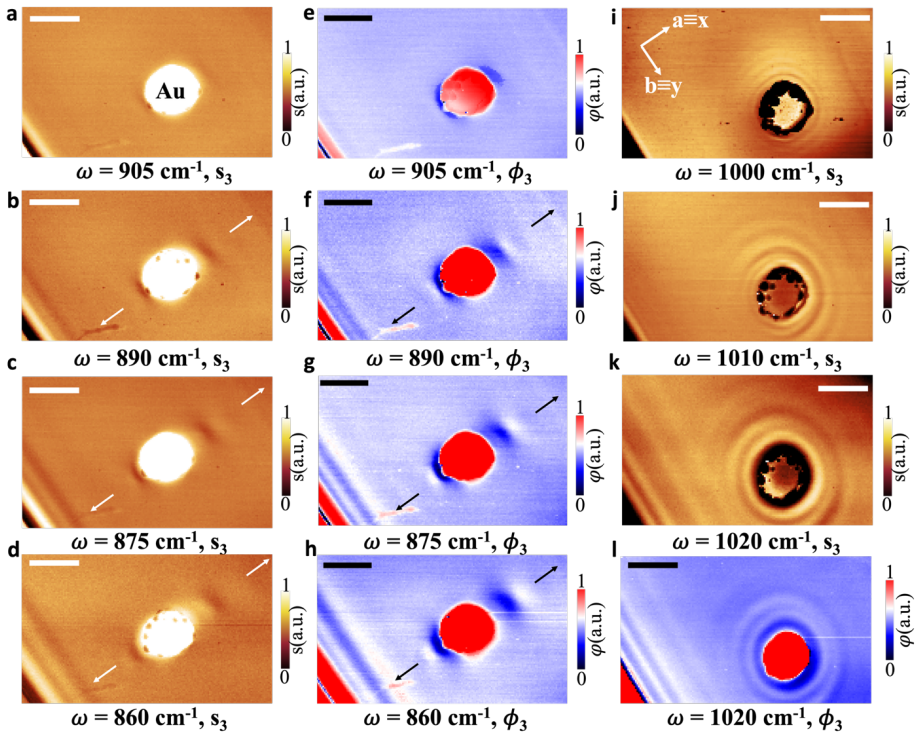
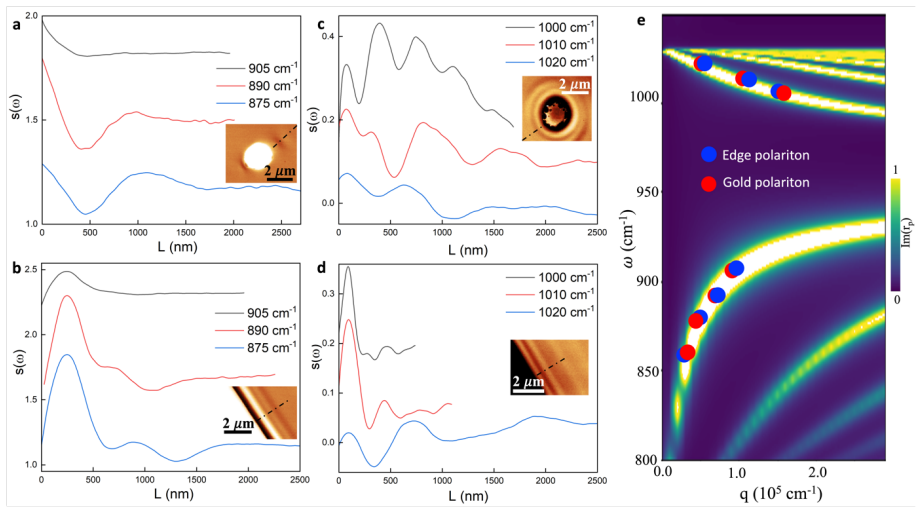
In alpha-V2O5 the permittivity tensor exhibits in-plane hyperbolicity, producing a dispersion contour for hyperbolic phonon polaritons whose shape permits continuous tuning of the canalization direction by the incident light frequency. Infrared nano-imaging directly visualizes the resulting unidirectional Poynting-vector propagation without any additional treatments to the sample.
What carries the argument
The in-plane hyperbolicity arising from the anisotropic permittivity tensor of alpha-V2O5, which dictates the frequency-dependent shape of the polariton dispersion contour to achieve canalization.
Load-bearing premise
The observed unidirectional propagation and frequency tunability result purely from the intrinsic in-plane anisotropy of the alpha-V2O5 permittivity tensor and not from any experimental artifacts or tip interactions.
What would settle it
Observation of isotropic or bidirectional polariton propagation in high-quality alpha-V2O5 samples under varying frequencies, or evidence that the canalization disappears when tip-sample interactions are minimized.
Figures



read the original abstract
Hyperbolic phonon polaritons (HPPs) are coupled oscillations of anisotropic lattice vibrations and electromagnetic fields that confine the latter to the nanoscale, enabling novel nano-polaritonic devices. While HPPs have been identified in multiple layered materials, achieving advanced control and manipulation - particularly polariton canalization for unidirectional energy flow - often necessitates complex device fabrications or crystal modifications. Here we visualize and elucidate the properties of in-plane hyperbolicity in alpha-V2O5, a layered compound with a highly anisotropic permittivity tensor. We show unidirectional Poynting-vector propagation of polaritons in alpha-V2O5 without additional treatments. Combined with theoretical modeling, our infrared nano-imaging studies unveil a novel form of polariton canalization, with its dispersion contour continuously tunable by the incident light frequency. Additionally, we provide a theoretically calculated permittivity phase diagram for tailoring polaritonic wavefronts. These findings suggest that the metal-oxide alpha-V2O5 holds great promise for on-demand light canalization and control at the nanoscale.
Editorial analysis
A structured set of objections, weighed in public.
Referee Report
Summary. The manuscript reports infrared nano-imaging of hyperbolic phonon polaritons in natural alpha-V2O5, claiming unidirectional Poynting-vector propagation and a novel frequency-tunable canalization arising purely from the material's intrinsic in-plane hyperbolicity, supported by theoretical modeling and a calculated permittivity phase diagram for wavefront control.
Significance. If the central observations hold after addressing potential artifacts, the work identifies an unmodified natural oxide as a platform for on-demand nanoscale polariton canalization, reducing reliance on complex fabrication; the phase diagram provides a concrete tool for material tailoring, strengthening the practical impact.
major comments (2)
- [Nano-imaging experiments] The claim that canalization and unidirectional propagation are intrinsic (Abstract and main results) requires that nano-imaging patterns arise solely from the permittivity tensor without tip-induced anisotropy. No controls varying tip radius, height, or material at fixed illumination are described, leaving open the possibility that observed contours include near-field launching or interference effects.
- [Theoretical modeling and dispersion analysis] The theoretical modeling interprets the tunable dispersion contours, but it is not stated whether the in-plane permittivity components are obtained from independent far-field measurements or fitted to the same nano-images; if the latter, the argument for intrinsic origin risks circularity.
minor comments (2)
- [Abstract] The abstract states 'without additional treatments' but does not clarify what sample preparation steps (e.g., exfoliation or substrate choice) were used; a brief methods summary would help.
- [Figures] Figure captions should explicitly label the incident frequency for each canalization image and include the calculated Poynting-vector direction overlay for direct comparison with data.
Simulated Author's Rebuttal
We thank the referee for the constructive comments and positive assessment of the work's potential impact. We address each major comment point by point below, providing clarifications and indicating where revisions will be made to strengthen the manuscript.
read point-by-point responses
-
Referee: [Nano-imaging experiments] The claim that canalization and unidirectional propagation are intrinsic (Abstract and main results) requires that nano-imaging patterns arise solely from the permittivity tensor without tip-induced anisotropy. No controls varying tip radius, height, or material at fixed illumination are described, leaving open the possibility that observed contours include near-field launching or interference effects.
Authors: We acknowledge the importance of ruling out tip-induced artifacts to support the intrinsic nature of the observed canalization. The experimental patterns show clear frequency-dependent tunability of the canalization direction that aligns quantitatively with calculations using the independently determined permittivity tensor. To address this concern, we will add a dedicated discussion section with finite-difference time-domain simulations of the tip-sample interaction, demonstrating that variations in tip radius or height do not alter the unidirectional Poynting vector propagation or the canalization angle. We will also include data from measurements on a reference isotropic material under identical conditions to show that the anisotropic contours are material-specific rather than tip-induced. revision: partial
-
Referee: [Theoretical modeling and dispersion analysis] The theoretical modeling interprets the tunable dispersion contours, but it is not stated whether the in-plane permittivity components are obtained from independent far-field measurements or fitted to the same nano-images; if the latter, the argument for intrinsic origin risks circularity.
Authors: The in-plane permittivity components used in the modeling were obtained from independent far-field infrared reflectivity measurements on bulk alpha-V2O5 crystals, as reported in prior literature (e.g., the anisotropic dielectric function determined via ellipsometry and FTIR). These values were not fitted to the nano-imaging data; instead, the nano-images serve as validation of the predicted dispersion contours. We will revise the methods and theoretical sections to explicitly state the source of the permittivity data, include the relevant references, and add a sentence clarifying that no fitting to the s-SNOM images was performed, thereby eliminating any risk of circular reasoning. revision: yes
Circularity Check
No circularity: experimental nano-imaging and independent modeling remain distinct
full rationale
The paper presents infrared nano-imaging as direct visualization of unidirectional Poynting-vector flow and frequency-tunable canalization in alpha-V2O5, supported by separate theoretical modeling of the permittivity tensor. No step reduces a claimed prediction to a parameter fitted from the identical dataset, nor does any load-bearing claim rest on a self-citation chain that itself assumes the target result. The derivation chain is therefore self-contained against external benchmarks.
Axiom & Free-Parameter Ledger
axioms (1)
- domain assumption alpha-V2O5 possesses a highly anisotropic permittivity tensor enabling in-plane hyperbolicity.
Forward citations
Cited by 1 Pith paper
-
Intrinsic plasmon canalization in the biaxial van der Waals crystal MoOCl$_2$
MoOCl2 shows intrinsic plasmon-polariton canalization at the low-loss Drude crossing point, remaining directional over a broad window and tunable by thickness into the 4.5-6 μm range.
Reference graph
Works this paper leans on
-
[1]
Foteinopoulou, S., Devarapu, G. C. R., Subramania, G. S., Krishna, S. & Wasserman, D. Phonon-polaritonics: enabling powerful capabilities for infrared photonics. Nanophotonics 8, 2129–2175 (2019). 7. Li, P. et al. Collective near-field coupling and nonlocal phenomena in infrared-phononic metasurfaces for nano-light canalization. Nat. Commun 11, 3663 (2020...
work page 2019
-
[2]
Passler, N. et al. Hyperbolic shear polaritons in low-symmetry crystals. Nature 602, 595–600 (2022). 18. Matson, J. et al. Controlling the propagation asymmetry of hyperbolic shear polaritons in beta-gallium oxide. Nat. Commun. 14, 5240 (2023). 19. Hu, G. et al. Real-space nanoimaging of hyperbolic shear polaritons in a monoclinic crystal. Nat. Nanotechno...
work page 2022
-
[3]
Duan, J. et al. Canalization-based super-resolution imaging using an individual van der Waals thin layer. Sci. Adv. 11, eads0569 (2025). 29. Ni, G. et al. Fundamental limits to graphene plasmonics. Nature 557, 530–533 (2018). 30. Ni, G. et al. Ultrafast optical switching of infrared plasmon polaritons in high-mobility graphene. Nat. Photonics 10, 244–247 ...
work page 2025
discussion (0)
Sign in with ORCID, Apple, or X to comment. Anyone can read and Pith papers without signing in.