Recognition: unknown
Characterizing normality via automata and random matrix products
Pith reviewed 2026-05-10 14:08 UTC · model grok-4.3
The pith
A sequence is normal precisely when every probabilistic finite automaton gambler sees its expected capital converge exponentially to a finite limit.
A machine-rendered reading of the paper's core claim, the machinery that carries it, and where it could break.
Core claim
A sequence X is normal if and only if for any gambling strategy implementable with a probabilistic finite automaton the expected value of the gambler's capital converges exponentially fast to a finite value when playing against X. Equivalently, for any family of non-negative matrices {M_a | a in A}, the norm ||v M_{X[1]} ... M_{X[n]}|| converges exponentially fast to a finite value for any non-negative starting vector v. Moreover, any such matrix product sequence falls into one of three distinctive behaviors, and the problem of determining which case holds is decidable.
What carries the argument
The norm convergence of iterated products of non-negative matrices derived from probabilistic automata transitions, which must stabilize exponentially for normal sequences.
Load-bearing premise
That convergence of capital expectations for probabilistic automaton strategies fully captures the property of normality without missing or overcounting betting behaviors.
What would settle it
Construct a non-normal sequence for which some probabilistic finite automaton has expected capital that fails to converge exponentially to a finite value.
Figures
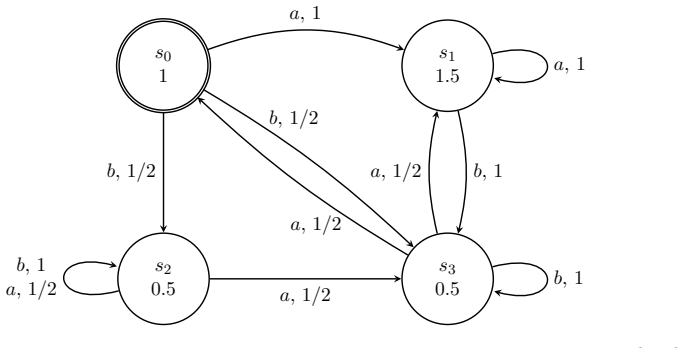

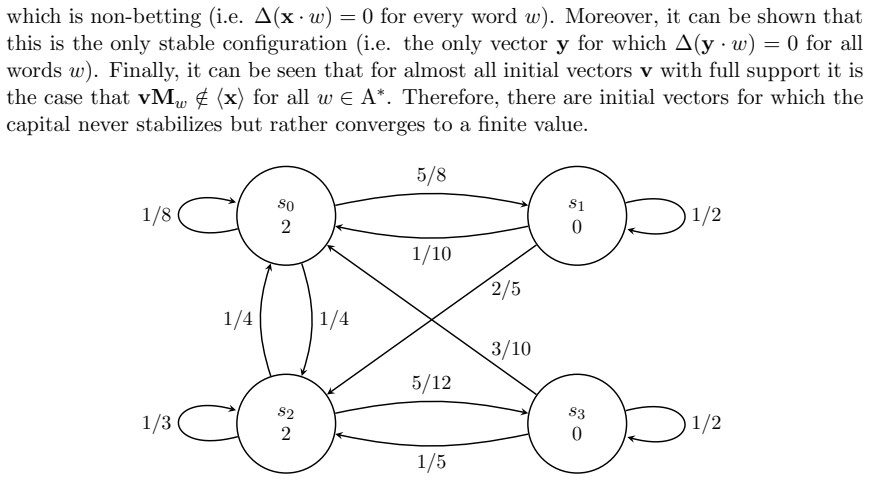

read the original abstract
For a fixed alphabet A, an infinite sequence X is said to be normal if every word w over A appears in X with the same frequency as any other word of the same length. A classical result relates normality to finite automata as follows: a sequence X is normal if and only if all gambling strategies implementable with finite deterministic automata lose all their capital when trying to predict the next bit of X after seing the ones before. More precisely, Schnorr and Stimm (1972) proved that the capital goes exponentially fast to zero unless the automaton represents the gambler that never bets, in which case the capital remains constant. In this paper we show that an analogous result holds when considering probabilistic automata: a sequence X is normal if and only if for any gambling strategy implementable with probabilistic finite automaton it holds that the expected value of the capital of the gambler converges exponentially fast to a finite value when playing against X. To obtain this result, we show a more general statement related to the convergence of martingales given by finite sets of non-negative matrices {M a } a$\in$A . In particular, we show that X is normal if and only if ||vM X[1] . . . M X[n] || converges exponentially fast to a finite value for any non-negative starting vector v. Moreover, we distinguish three distinctive behaviours that this sequence can attain, and prove that the problem of recognizing, given a family of matrices, to which case it belongs, is decidable.
Editorial analysis
A structured set of objections, weighed in public.
Referee Report
Summary. The manuscript extends the Schnorr-Stimm theorem by showing that an infinite sequence X over a finite alphabet is normal if and only if, for every gambling strategy realizable by a probabilistic finite automaton, the expected capital converges exponentially fast to a finite limit. Equivalently, X is normal if and only if ||v M_{X[1]} ⋯ M_{X[n]}|| converges exponentially fast to a finite value for every family of non-negative matrices {M_a} and every non-negative initial vector v. The paper distinguishes three asymptotic regimes for such products and proves that, given a matrix family, deciding which regime holds is decidable.
Significance. If the central equivalences hold, the work supplies a clean matrix-product characterization of normality that faithfully encodes all probabilistic finite-automaton strategies via non-negative linear updates, thereby generalizing the deterministic-automaton case while preserving the martingale property under the uniform measure. The accompanying decidability result for the three regimes is a concrete algorithmic contribution that may be useful for classifying families of non-negative matrices with respect to their growth along normal sequences.
minor comments (3)
- Abstract and introduction: the three asymptotic regimes are referred to but never enumerated; an explicit list (decay to zero, convergence to a positive finite limit, unbounded growth) should appear in the first paragraph that introduces the matrix-product statement.
- Notation: the norm symbol ||·|| is used without an immediate definition in the abstract and early sections; the paper should state which matrix norm is employed (e.g., the 1-norm or max-norm) and verify that the claimed exponential convergence is independent of the choice among equivalent norms.
- The decidability claim for the classification problem is stated in the abstract; the manuscript should include a brief complexity remark (e.g., whether the procedure is polynomial-time) or at least a pointer to the section containing the algorithm.
Simulated Author's Rebuttal
We thank the referee for their positive and accurate summary of our manuscript, which correctly captures the extension of the Schnorr-Stimm theorem to probabilistic finite automata, the equivalent matrix-product characterization of normality, and the decidability result for the three asymptotic regimes. We are pleased that the referee views these contributions as significant and recommends only minor revision.
Circularity Check
No significant circularity; derivation is self-contained
full rationale
The paper establishes an equivalence between normality (uniform word frequencies) and exponential convergence of matrix-product norms for non-negative matrices arising from probabilistic finite automata. This is obtained by explicitly encoding any PFA gambling strategy as a linear capital update whose expectation is the product v M_{X[1]} … M_{X[n]}, then distinguishing the three asymptotic regimes (decay, finite limit, unbounded growth) via martingale arguments. The classical deterministic-automaton result of Schnorr-Stimm is cited as external background; the extension to the probabilistic case is proved directly from the matrix representation without fitting parameters to the target property, without self-citation load-bearing the central claim, and without renaming a known empirical pattern. The matrix condition is shown to capture exactly the set of implementable strategies, so the iff statement does not collapse to a tautology or a fitted input.
Axiom & Free-Parameter Ledger
axioms (2)
- standard math Non-negative matrices induce submultiplicative norms and the product norm converges or diverges in one of three regimes.
- domain assumption Probabilistic automata correspond to families of non-negative matrices whose action on capital vectors yields martingales.
Reference graph
Works this paper leans on
-
[1]
Normal sequences and fini te automata
Valerii Nikolaevich Agafonov. Normal sequences and fini te automata. In Doklady Akademii Nauk , volume 179, pages 255–256. Russian Academy of Sciences, 19 68
-
[2]
The Probabilistic Method, 4th Edition
Noga Alon and Joel Spencer. The Probabilistic Method, 4th Edition . Wiley, 2016
2016
-
[3]
Computational Complexity: A Modern Approach
Sanjeev Arora and Boaz Barak. Computational Complexity: A Modern Approach . Cambridge University Press, 2009
2009
-
[4]
An example of a computable absolutely normal number
Ver´ onica Becher and Santiago Figueira. An example of a computable absolutely normal number. Theoretical Computer Science , 270(1-2):947–958, 2002
2002
-
[5]
The Ag afonov and Schnorr- Stimm theorems for probabilistic automata
Laurent Bienvenu, Hugo Gimbert, and Subin Pulari. The Ag afonov and Schnorr- Stimm theorems for probabilistic automata. In 45th IARCS Annual Conference on Foundations of Software Technology and Theoretical Computer Science (FSTTCS 2025), volume 360 of Leibniz International Proceedings in Informatics (LIPIcs) , pages 16:1–16:15, 2025
2025
-
[6]
Probabilistic vs deter- ministic gamblers
Laurent Bienvenu, Valentino Delle Rose, and Tomasz Stei fer. Probabilistic vs deter- ministic gamblers. In 39th International Symposium on Theoretical Aspects of Com- puter Science, STACS 2022 , volume 219 of LIPIcs, pages 11:1–11:13. Schloss Dagstuhl - Leibniz-Zentrum f¨ ur Informatik, 2022
2022
-
[7]
Extensions of Jentzsch’s theorem
Garrett Birkhoff. Extensions of Jentzsch’s theorem. Transactions of the American Mathematical Society, 85(1):219–227, 1957. 38
1957
-
[8]
Probabilistic algorithmic rand omness
Sam Buss and Mia Minnes. Probabilistic algorithmic rand omness. The Journal of Symbolic Logic, 78(2):579–601, 2013
2013
-
[9]
Some algebraic and geometric computations i n PSPACE
John Canny. Some algebraic and geometric computations i n PSPACE. In Proceedings of the twentieth annual ACM symposium on Theory of computing , pages 460–467, 1988
1988
-
[10]
The construction of decimals nor mal in the scale of ten
David G Champernowne. The construction of decimals nor mal in the scale of ten. Journal of the London Mathematical Society , 1(4):254–260, 1933
1933
-
[11]
Note on normal number s
Arthur H Copeland and Paul Erd¨ os. Note on normal number s. Bull. Amer. Math. Soc., 52(10):857–860, 1946
1946
-
[12]
Algorithmic randomness and complexity
Rodney Downey and Denis Hirschfeldt. Algorithmic randomness and complexity . The- ory and Applications of Computability. Springer, 2010
2010
-
[13]
Les probabilit´ es d´ enombrables et leurs appl ications arithm´ etiques
M ´Emile Borel. Les probabilit´ es d´ enombrables et leurs appl ications arithm´ etiques. Rendiconti del Circolo Matematico di Palermo (1884-1940) , 27(1):247–271, 1909
1940
-
[14]
Horn and Charles R
Roger A. Horn and Charles R. Johnson. Matrix analysis. Cambridge University Press, 2012
2012
-
[15]
Agafonov’s theorem for probabilistic selectors
Ulysse L´ echine, Thomas Seiller, and Jakob Grue Simons en. Agafonov’s theorem for probabilistic selectors. In 49th International Symposium on Mathematical Foundations of Computer Science, MFCS 2024 , volume 306 of LIPIcs, pages 67:1–67:15. Schloss Dagstuhl - Leibniz-Zentrum f¨ ur Informatik, 2024
2024
-
[16]
Markov chains and mixing times , volume 107
David A Levin and Yuval Peres. Markov chains and mixing times , volume 107. Amer- ican Mathematical Society, 2017
2017
-
[17]
An introduction to Kolmogorov complexity and its appli- cations
Ming Li and Paul Vit´ anyi. An introduction to Kolmogorov complexity and its appli- cations. Texts in Computer Science. Springer-Verlag, New York, 3rd edition, 2008
2008
-
[18]
Computability and randomness
Andr´ e Nies. Computability and randomness . Oxford Logic Guides. Oxford University Press, 2009
2009
-
[19]
Endliche Autom aten und Zufallsfolgen
Claus-Peter Schnorr and Hermann Stimm. Endliche Autom aten und Zufallsfolgen. Acta Informatica, 1(4):345–359, 1972
1972
-
[20]
Kolmogorov Com- plexity and Algorithmic Randomness , volume 220 of Mathematical Surveys and Mono- graphs
Alexander Shen, Vladimir Uspensky, and Nikolai Veresh chagin. Kolmogorov Com- plexity and Algorithmic Randomness , volume 220 of Mathematical Surveys and Mono- graphs. American Mathematical Society, 2017. 39
2017
discussion (0)
Sign in with ORCID, Apple, or X to comment. Anyone can read and Pith papers without signing in.