Recognition: unknown
The converse to Borsuk's result on fans fails
Pith reviewed 2026-05-10 13:59 UTC · model grok-4.3
The pith
Not every union of arcs intersecting at one point is a fan
A machine-rendered reading of the paper's core claim, the machinery that carries it, and where it could break.
Core claim
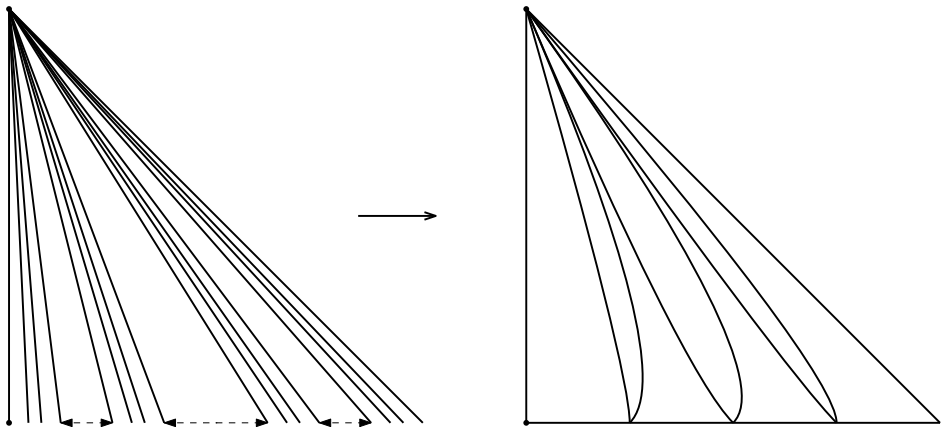
Borsuk showed that every fan is a one-dimensional continuum expressible as the union of a family of arcs such that the intersection of any two is exactly the branching point. The paper proves that the converse does not hold by providing a more general result: there exists a continuum that admits such a union representation yet fails to be arc-wise connected and hereditarily unicoherent with exactly one branching point.
What carries the argument
A one-dimensional continuum constructed as the union of arcs all intersecting at a single common point but failing to satisfy hereditary unicoherence.
If this is right
- The arc-union property alone does not force a continuum to be a fan.
- Hereditary unicoherence and arc-wise connectedness with one branching point are independent of the union representation in at least one direction.
- Classification of fans requires the full definition rather than the union property by itself.
- Other continua may share the arc-union structure without qualifying as fans.
Where Pith is reading between the lines
- The same union property might appear in non-fan continua embedded in the plane, suggesting the need for embedding-dependent conditions.
- Researchers could test whether minimal modifications to the counterexample produce borderline cases between fans and non-fans.
- Analogous converses for related objects such as dendrites or dendroids may also fail for similar reasons.
Load-bearing premise
The constructed continuum meets the union-of-arcs condition while violating hereditary unicoherence or the single-branching-point requirement under standard definitions.
What would settle it
Explicit verification that the constructed continuum contains a subcontinuum disconnected by removal of a point other than the common intersection point would show it is not hereditarily unicoherent and hence not a fan.
Figures


read the original abstract
A fan is an arc-wise connected hereditarily unicoherent continuum with exactly one branching point. By a result of Borsuk, every fan is a 1-dimensional continuum that can be expressed as the union of a family of arcs, each pair of which intersects in the branching point. In this paper, we prove that the converse does not hold by providing a more general result.
Editorial analysis
A structured set of objections, weighed in public.
Referee Report
Summary. The paper claims that the converse to Borsuk's theorem on fans fails. A fan is defined as an arc-wise connected hereditarily unicoherent continuum with exactly one branching point. Borsuk proved that every such fan is 1-dimensional and expressible as the union of a family of arcs whose pairwise intersections occur only at the branching point. The manuscript asserts that this property does not characterize fans, by establishing a more general result that produces a counterexample continuum satisfying the union-of-arcs condition but failing to be a fan.
Significance. If the counterexample is correctly constructed and verified, the result would separate the geometric representation property (union of arcs meeting at one point) from the full fan axioms (arc-wise connectedness plus hereditary unicoherence), refining the classification of 1-dimensional continua in continuum theory. The paper does not supply machine-checked proofs, reproducible code, or explicit falsifiable predictions, but a valid counterexample would be a concrete, checkable contribution to the field.
major comments (1)
- [Abstract] Abstract (and entire manuscript as provided): the claim that 'the converse does not hold by providing a more general result' is asserted without any construction of the counterexample continuum, without the statement of the more general result, and without any indication of how the example satisfies the 1-dimensional union-of-arcs condition while violating arc-wise connectedness or hereditary unicoherence. This absence makes it impossible to verify that the example meets the topological requirements or that the intersections are confined to a single point as required.
Simulated Author's Rebuttal
We thank the referee for identifying the lack of detail in the abstract and the provided manuscript excerpt. We agree that the current abstract is overly terse and does not outline the counterexample or the more general result, which hinders verification. We will revise the abstract and main text accordingly.
read point-by-point responses
-
Referee: [Abstract] Abstract (and entire manuscript as provided): the claim that 'the converse does not hold by providing a more general result' is asserted without any construction of the counterexample continuum, without the statement of the more general result, and without any indication of how the example satisfies the 1-dimensional union-of-arcs condition while violating arc-wise connectedness or hereditary unicoherence. This absence makes it impossible to verify that the example meets the topological requirements or that the intersections are confined to a single point as required.
Authors: We acknowledge this is a valid criticism of the abstract's brevity. The full manuscript contains the construction of a specific 1-dimensional continuum X that is the union of a family of arcs with pairwise intersections only at a single point p, yet X fails to be arcwise connected (hence not a fan) while satisfying the union-of-arcs property. The more general result is a theorem characterizing when such a union-of-arcs continuum is hereditarily unicoherent. To address the concern, we will expand the abstract to state the more general theorem and briefly describe the counterexample's key properties (including why it violates arcwise connectedness but meets the geometric condition). We will also add explicit verification steps in the main text confirming the intersections are confined to p and that the continuum is 1-dimensional. revision: yes
Circularity Check
No circularity; counterexample construction is independent
full rationale
The paper cites Borsuk's external theorem on fans, then constructs an explicit counterexample continuum satisfying the arc-union property but failing to be a fan (i.e., not arc-wise connected hereditarily unicoherent with exactly one ramification point). This is a standard direct disproof via counterexample and does not reduce any claim to a self-definition, fitted parameter renamed as prediction, or load-bearing self-citation. The derivation chain is self-contained against the stated topological definitions.
Axiom & Free-Parameter Ledger
axioms (1)
- domain assumption Standard definitions of continua, arcs, arc-wise connectedness, and hereditarily unicoherent spaces in general topology.
Reference graph
Works this paper leans on
-
[1]
Towards the complete classification of fans
I. Baniˇ c, G. Erceg, A. Illanes, I. Jeli´ c, J. Kennedy, and V. Nall. Towards the complete classification of fans.arXiv e-prints, page arXiv:2504.07267, Apr. 2025
work page internal anchor Pith review Pith/arXiv arXiv 2025
-
[2]
K. Borsuk. A theorem on fixed points.Bull. Acad. Polon. Sci. Cl. III., 2:17–20, 1954
1954
-
[3]
K. Borsuk. A countable broom which cannot be imbedded in the plane.Colloq. Math., 10:233–236, 1963
1963
-
[4]
J. J. Charatonik. On ramification points in the classical sense.Fund. Math., 51:229–252, 1962/63
1962
-
[5]
J. J. Charatonik. On fans.Dissertationes Math. (Rozprawy Mat.), 54:39, 1967
1967
-
[6]
Engelking.Theory of dimensions finite and infinite, volume 10 ofSigma Series in Pure Mathematics
R. Engelking.Theory of dimensions finite and infinite, volume 10 ofSigma Series in Pure Mathematics. Heldermann Verlag, Lemgo, 1995
1995
-
[7]
J. E. Hanson. Compact metrizable 1-dimensional space that is a disjoint union of arcs. MathOverflow. URL:https://mathoverflow.net/q/507984 (version: 2026-02-10)
2026
-
[8]
Illanes and P
A. Illanes and P. Krupski. On local fixed or periodic point properties.J. Fixed Point Theory Appl., 17(3):495–505, 2015
2015
-
[9]
Kuratowski.Topology
K. Kuratowski.Topology. Vol. II. Academic Press, New York-London; Pa´ nstwowe Wydawnictwo Naukowe [Polish Scientific Publishers], Warsaw, new edition, 1968. Trans- lated from the French by A. Kirkor
1968
- [10]
-
[11]
S. B. Nadler, Jr.Continuum theory, volume 158 ofMonographs and Textbooks in Pure and Applied Mathematics. Marcel Dekker, Inc., New York, 1992. An introduction
1992
-
[12]
B. Vejnar. A topological characterization of the Sierpi´ nski triangle.Topology Appl., 159(5):1404–1408, 2012
2012
-
[13]
R. Winkler. Topological automorphisms of modified Sierpi´ nski gaskets realize arbitrary finite permutation groups.Topology Appl., 101(2):137–142, 2000. 7
2000
discussion (0)
Sign in with ORCID, Apple, or X to comment. Anyone can read and Pith papers without signing in.