Recognition: unknown
Cross-Modal Knowledge Distillation for PET-Free Amyloid-Beta Detection from MRI
Pith reviewed 2026-05-10 14:57 UTC · model grok-4.3
The pith
A teacher model trained on paired PET and MRI data can distill its knowledge into an MRI-only student that detects amyloid-beta positivity without PET scans or clinical variables.
A machine-rendered reading of the paper's core claim, the machinery that carries it, and where it could break.
Core claim
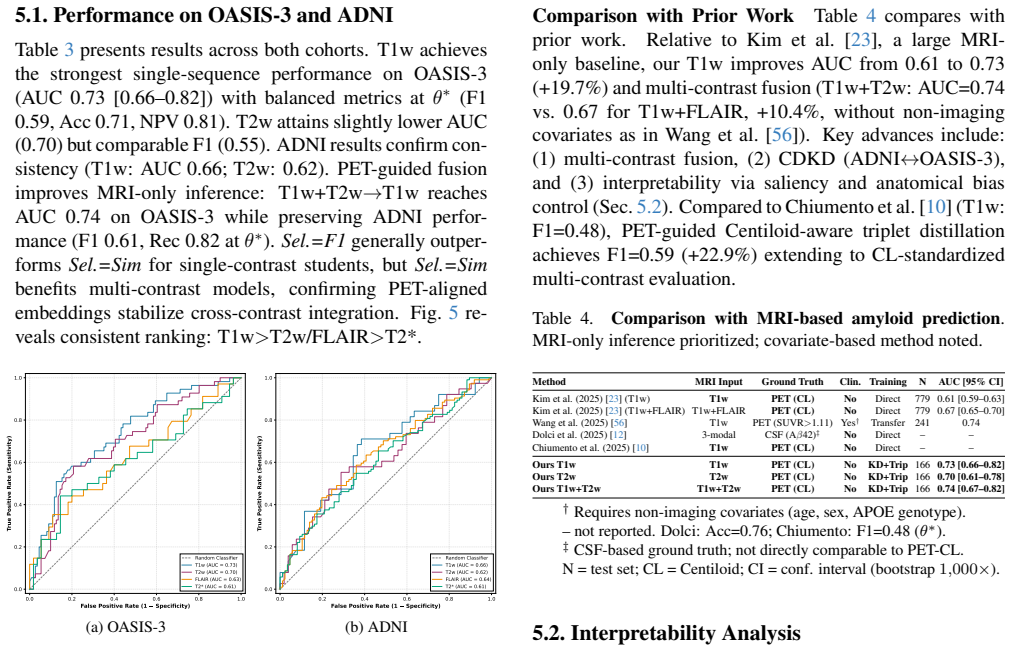
The authors establish that cross-modal knowledge distillation from a teacher learning PET-MRI alignments enables an MRI-only student to perform amyloid-beta detection with AUC values up to 0.74 on one independent collection and 0.68 on another, across four MRI contrasts, without clinical covariates and with anatomically plausible explanations.
What carries the argument
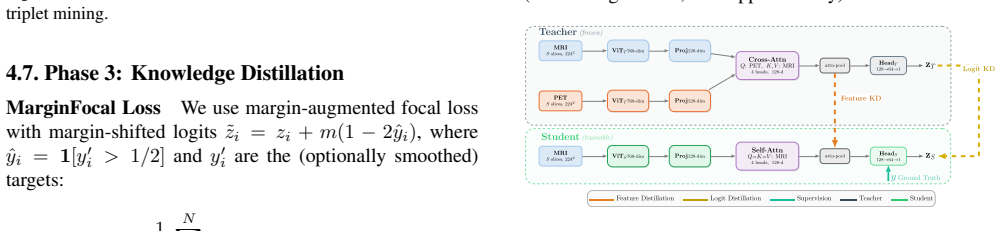
The PET-guided teacher-student distillation framework, in which the teacher learns cross-modal alignments from paired scans and the student replicates its features and outputs from MRI alone.
If this is right
- Amyloid-beta status becomes estimable from standard MRI scans without any PET imaging.
- The method removes the need for clinical covariates at inference time.
- Interpretability is retained through saliency analysis focused on relevant brain areas.
- Performance generalizes across multiple MRI sequence types and independent test collections.
Where Pith is reading between the lines
- Similar distillation could support prediction of other brain biomarkers from accessible scans.
- Routine clinical MRI workflows might incorporate this for wider early-risk identification.
- Validation across more diverse populations would test how broadly the approach applies.
Load-bearing premise
The cross-modal alignments and predictive patterns learned from paired PET-MRI data transfer effectively to standalone MRI inputs without major loss of accuracy or added spurious correlations.
What would settle it
An MRI-only model showing AUC below 0.65 on a new independent collection or producing saliency maps that ignore known amyloid-affected cortical regions would show the transfer has not worked.
Figures




read the original abstract
Detecting amyloid-$\beta$ (A$\beta$) positivity is crucial for early diagnosis of Alzheimer's disease but typically requires PET imaging, which is costly, invasive, and not widely accessible, limiting its use for population-level screening. We address this gap by proposing a PET-guided knowledge distillation framework that enables A$\beta$ prediction from MRI alone, without requiring non-imaging clinical covariates or PET at inference. Our approach employs a BiomedCLIP-based teacher model that learns PET-MRI alignment via cross-modal attention and triplet contrastive learning with PET-informed (Centiloid-aware) online negative sampling. An MRI-only student then mimics the teacher via feature-level and logit-level distillation. Evaluated across four MRI contrasts (T1w, T2w, FLAIR, T2*) and two independent datasets, our approach demonstrates effective knowledge transfer (best AUC: 0.74 on OASIS-3, 0.68 on ADNI) while maintaining interpretability and eliminating the need for clinical variables. Saliency analysis confirms that predictions focus on anatomically relevant cortical regions, supporting the clinical viability of PET-free A$\beta$ screening. Code is available at https://github.com/FrancescoChiumento/pet-guided-mri-amyloid-detection.
Editorial analysis
A structured set of objections, weighed in public.
Referee Report
Summary. The manuscript proposes a PET-guided knowledge distillation framework for amyloid-beta positivity prediction from MRI alone. A BiomedCLIP-based teacher learns cross-modal PET-MRI alignment via attention and Centiloid-aware triplet contrastive learning with online negative sampling; an MRI-only student then mimics the teacher through feature- and logit-level distillation. The approach is evaluated on four MRI contrasts (T1w, T2w, FLAIR, T2*) across OASIS-3 and ADNI, reporting peak AUCs of 0.74 and 0.68, with saliency maps focused on cortical regions. The work emphasizes elimination of PET and clinical covariates at inference while providing open code.
Significance. If the knowledge-transfer mechanism is shown to be effective, the result would enable more accessible Aβ screening using routine MRI, addressing a clear clinical need. The open-source code and focus on interpretability are strengths that support potential adoption and extension. However, the current empirical evidence does not yet establish that the reported AUCs derive from the PET-informed components rather than standard MRI classification.
major comments (3)
- [Abstract / Results] Abstract and Results: The AUC values (0.74 on OASIS-3, 0.68 on ADNI) are reported without any baseline comparisons to supervised MRI-only models, non-distilled students, or alternative distillation strategies, nor ablations that remove the Centiloid-aware contrastive term or cross-modal attention. This directly undermines the central claim that the framework demonstrates effective PET-guided knowledge transfer.
- [Methods] Methods: No quantitative validation of representation transfer is provided, such as CKA similarity, Procrustes alignment, or feature correlations computed on held-out paired PET-MRI cases. Without such metrics, it remains possible that the student simply learns generic MRI patterns, rendering the teacher’s PET-informed representations unnecessary.
- [Experiments] Experiments: Dataset split details, statistical significance tests, confidence intervals or error bars on the AUCs, and per-contrast performance breakdowns are absent. These omissions prevent assessment of whether the reported numbers are robust or generalizable across the two independent cohorts.
minor comments (2)
- [Abstract] Abstract: The statement 'best AUC' should explicitly identify the MRI contrast and model configuration that achieves the quoted numbers.
- [Results] The saliency analysis is mentioned but the precise method (e.g., Grad-CAM variant) and quantitative overlap with known Aβ-vulnerable regions could be stated more precisely in the main text.
Simulated Author's Rebuttal
We thank the referee for the constructive feedback, which identifies key areas where additional validation will strengthen the manuscript. We address each major comment below and will revise the paper to incorporate the requested elements.
read point-by-point responses
-
Referee: [Abstract / Results] Abstract and Results: The AUC values (0.74 on OASIS-3, 0.68 on ADNI) are reported without any baseline comparisons to supervised MRI-only models, non-distilled students, or alternative distillation strategies, nor ablations that remove the Centiloid-aware contrastive term or cross-modal attention. This directly undermines the central claim that the framework demonstrates effective PET-guided knowledge transfer.
Authors: We agree that baseline comparisons are necessary to isolate the contribution of the PET-guided components. In the revised manuscript we will add: (i) results from supervised MRI-only models trained from scratch on the same task, (ii) performance of the student model without any distillation, and (iii) ablations that remove the Centiloid-aware triplet contrastive term and the cross-modal attention mechanism. These will be reported alongside the original AUCs in the Results section with the same evaluation protocol. revision: yes
-
Referee: [Methods] Methods: No quantitative validation of representation transfer is provided, such as CKA similarity, Procrustes alignment, or feature correlations computed on held-out paired PET-MRI cases. Without such metrics, it remains possible that the student simply learns generic MRI patterns, rendering the teacher’s PET-informed representations unnecessary.
Authors: We acknowledge the value of direct quantitative evidence of representation transfer. We will compute and report Centered Kernel Alignment (CKA) similarities as well as Pearson correlations between corresponding teacher and student feature maps on held-out paired PET-MRI cases. These metrics will be added to the Methods or supplementary material to demonstrate that the student is aligning with the teacher’s PET-informed representations rather than learning generic MRI features. revision: yes
-
Referee: [Experiments] Experiments: Dataset split details, statistical significance tests, confidence intervals or error bars on the AUCs, and per-contrast performance breakdowns are absent. These omissions prevent assessment of whether the reported numbers are robust or generalizable across the two independent cohorts.
Authors: We apologize for these omissions. The revised manuscript will include: detailed train/validation/test split sizes and stratification criteria for both OASIS-3 and ADNI; DeLong’s test p-values for AUC comparisons; 95% confidence intervals obtained via bootstrapping for all AUCs; and a complete per-contrast performance table (T1w, T2w, FLAIR, T2*) for each dataset. These additions will allow readers to evaluate robustness and cross-cohort generalizability. revision: yes
Circularity Check
No significant circularity: empirical ML pipeline with independent experimental validation
full rationale
The paper describes a standard teacher-student knowledge distillation framework for MRI-based amyloid prediction, trained on paired PET-MRI data and evaluated via AUC on held-out datasets (OASIS-3, ADNI). No equations, parameters, or predictions are defined in terms of themselves or reduced to fitted inputs by construction. The central claims rest on empirical performance metrics and saliency maps rather than any self-citation chain, uniqueness theorem, or ansatz that imports the result. This is a purely data-driven pipeline whose validity can be checked against external benchmarks without circular reduction.
Axiom & Free-Parameter Ledger
free parameters (1)
- Distillation loss weights and contrastive temperature
axioms (2)
- domain assumption Paired PET-MRI data exists and is sufficient to learn transferable cross-modal representations
- domain assumption Saliency maps on cortical regions indicate genuine clinical relevance rather than dataset artifacts
Reference graph
Works this paper leans on
-
[1]
Alzheimer’s disease neuroimaging initiative
Alzheimer’s Disease Neuroimaging Initiative (ADNI). Alzheimer’s disease neuroimaging initiative. Public dataset, https://adni.loni.usc.edu/, 2025. 2, 3, 13
2025
-
[2]
McLean, Fairlie Hinton, Claire E
Sanka Amadoru, Vincent Dor ´e, Catriona A. McLean, Fairlie Hinton, Claire E. Shepherd, Glenda M. Halliday, Cristian E. Leyton, Paul A. Yates, John R. Hodges, Colin L. Masters, Victor L. Villemagne, and Christopher C. Rowe. Compari- son of amyloid PET measured in Centiloid units with neu- ropathological findings in Alzheimer’s disease.Alzheimer’s Research ...
2020
-
[3]
Avants, Charles L
Brian B. Avants, Charles L. Epstein, Murray Grossman, and James C. Gee. Symmetric Diffeomorphic Image Registra- tion with Cross-Correlation: Evaluating Automated Label- ing of Elderly and Neurodegenerative Brain.Medical Image Analysis, 12(1):26–41, 2008. 4
2008
-
[4]
PET Neuroimaging of Alzheimer’s Disease: Radiotracers and Their Utility in Clinical Research
Weiqi Bao, Fang Xie, Chuantao Zuo, Yihui Guan, and Yiyun Henry Huang. PET Neuroimaging of Alzheimer’s Disease: Radiotracers and Their Utility in Clinical Research. Frontiers in Aging Neuroscience, 13:624330, 2021. 2
2021
-
[5]
Deep Learning in Large and Multi-Site Structural Brain MR Imaging Datasets.Frontiers in Neu- roinformatics, 15:805669, 2022
Mariana Bento, Irene Fantini, Justin Park, Leticia Rittner, and Richard Frayne. Deep Learning in Large and Multi-Site Structural Brain MR Imaging Datasets.Frontiers in Neu- roinformatics, 15:805669, 2022. 8
2022
-
[6]
Ariane Bollack, Lyduine E. Collij, David V ´allez Garc ´ıa, Mahnaz Shekari, Daniele Altomare, Pierre Payoux, Bruno Dubois, Oriol Grau-Rivera, Merc `e Boada, Marta Marqui ´e, Agneta Nordberg, Zuzana Walker, Philip Scheltens, Michael Sch¨oll, Robin Wolz, Jonathan M. Schott, Rossella Gis- mondi, Andrew Stephens, Christopher Buckley, Giovanni B. Frisoni, Bern...
2024
-
[7]
Using PET with 18F-A V- 45 (florbetapir) to quantify brain amyloid load in a clinical environment.European Journal of Nuclear Medicine and Molecular Imaging, 39(4):621–631, 2012
Vincent Camus, Pierre Payoux, Louisa Barr ´e, B´eatrice Des- granges, Thierry V oisin, Clovis Tauber, Renaud La Joie, Mathieu Tafani, Caroline Hommet, Ga ¨el Ch ´etelat, Karl Mondon, Vincent de La Sayette, Jean-Philippe Cottier, Em- ilie Beaufils, Maria-Joao Santiago Ribeiro, Val ´erie Gissot, Emilie Vierron, Johnny Vercouillie, Bruno Vellas, Francis Eust...
2012
-
[8]
Caselli, Blake T
Richard J. Caselli, Blake T. Langlais, Amylou C. Dueck, Yinghua Chen, Yi Su, Dona E.C. Locke, Bryan K. Woodruff, and Eric M. Reiman. Neuropsychological decline up to 20 years before incident mild cognitive impairment. Alzheimer’s & Dementia: The Journal of the Alzheimer’s As- sociation, 16(3):512–523, 2020. 2
2020
-
[9]
Ozarkar, Ketaki Buwa, Neha Ann Joshy, Dheeraj Komandur, Jayati Naik, Sophia I
Tamoghna Chattopadhyay, Saket S. Ozarkar, Ketaki Buwa, Neha Ann Joshy, Dheeraj Komandur, Jayati Naik, Sophia I. Thomopoulos, Greg Ver Steeg, Jose Luis Ambite, and Paul M. Thompson. Comparison of deep learning architec- tures for predicting amyloid positivity in Alzheimer’s dis- ease, mild cognitive impairment, and healthy aging, from T1-weighted brain str...
2024
-
[10]
Killeen, Kathleen M
Francesco Chiumento, Julia Dietlmeier, Ronan P. Killeen, Kathleen M. Curran, Noel E. O’Connor, and Mingming Liu. Detecting Beta-Amyloid via Cross-Modal Knowledge Dis- tillation from PET to MRI. In2025 Medical Image Un- derstanding and Analysis Conference (MIUA), Leeds, UK,
-
[11]
Lyduine E. Collij, Ariane Bollack, Renaud La Joie, Mah- naz Shekari, Santiago Bullich, N ´uria Ro ´e-Vellv´e, Norman 9 Koglin, Aleksandar Jovalekic, David Vall´ez Garci´a, Alexan- der Drzezga, Valentina Garibotto, Andrew W. Stephens, Mark Battle, Christopher Buckley, Frederik Barkhof, Gill Farrar, Juan Domingo Gispert, and Amypad Consortium. Centiloid rec...
2024
-
[12]
Ellis, Federica Cruciani, Lorenza Brusini, Anees Abrol, Ilaria Boscolo Galazzo, Gloria Menegaz, and Vince D
Giorgio Dolci, Charles A. Ellis, Federica Cruciani, Lorenza Brusini, Anees Abrol, Ilaria Boscolo Galazzo, Gloria Menegaz, and Vince D. Calhoun. Multimodal MRI ac- curately identifies amyloid status in unbalanced cohorts in Alzheimer’s disease continuum.Network Neuroscience, 9 (1):259–279, 2025. 2, 3, 7
2025
-
[13]
Use hirescam instead of grad-cam for faithful explanations of convolutional neural networks,
Rachel Lea Draelos and Lawrence Carin. Use HiResCAM instead of Grad-CAM for faithful explanations of convolu- tional neural networks.arXiv preprint arXiv:2011.08891,
-
[14]
Fonov, Alan C
Vladimir S. Fonov, Alan C. Evans, Robert C. McKinstry, C. Robert Almli, and D. Louis Collins. Unbiased nonlinear average age-appropriate brain templates from birth to adult- hood.NeuroImage, 47:S102, 2009. 4, 13
2009
-
[15]
Fonov, Alan C
Vladimir S. Fonov, Alan C. Evans, Kelly Botteron, C. Robert Almli, Robert C. McKinstry, D. Louis Collins, and Brain Development Cooperative Group. Unbiased average age- appropriate atlases for pediatric studies.NeuroImage, 54(1): 313–327, 2011. 4
2011
-
[16]
Goldman, Susan E
Jill S. Goldman, Susan E. Hahn, Jennifer Williamson Cata- nia, Susan LaRusse-Eckert, Melissa Barber Butson, Malia Rumbaugh, Michelle N. Strecker, J. Scott Roberts, Wylie Burke, Richard Mayeux, Thomas Bird, and American Col- lege of Medical Genetics and the National Society of Genetic Counselors. Genetic counseling and testing for Alzheimer disease: Joint ...
2011
-
[17]
Biomarkers for Alzheimer’s Disease in the Current State: A Narrative Re- view.International Journal of Molecular Sciences, 23(9): 4962, 2022
Serafettin Gunes, Yumi Aizawa, Takuma Sugashi, Masahiro Sugimoto, and Pedro Pereira Rodrigues. Biomarkers for Alzheimer’s Disease in the Current State: A Narrative Re- view.International Journal of Molecular Sciences, 23(9): 4962, 2022. 2
2022
-
[18]
Distilling the Knowledge in a Neural Network
Geoffrey Hinton, Oriol Vinyals, and Jeff Dean. Distill- ing the Knowledge in a Neural Network.arXiv preprint arXiv:1503.02531, 2015. 6
work page internal anchor Pith review Pith/arXiv arXiv 2015
-
[19]
Hu, Yelong Shen, Phillip Wallis, Zeyuan Allen- Zhu, Yuanzhi Li, Shean Wang, Lu Wang, and Weizhu Chen
Edward J. Hu, Yelong Shen, Phillip Wallis, Zeyuan Allen- Zhu, Yuanzhi Li, Shean Wang, Lu Wang, and Weizhu Chen. LoRA: Low-Rank Adaptation of Large Language Models. InInternational Conference on Learning Representations,
-
[20]
Burnham, Ilke Tunali, Jian Wang, Michael Navitsky, Anupa K
Leonardo Iaccarino, Samantha C. Burnham, Ilke Tunali, Jian Wang, Michael Navitsky, Anupa K. Arora, and Michael J. Pontecorvo. A practical overview of the use of amyloid-PET Centiloid values in clinical trials and research.NeuroImage: Clinical, 46:103765, 2025. 2, 3, 4
2025
-
[21]
Automated brain extraction of multi- sequence MRI using artificial neural networks.Human Brain Mapping, 40(17):4952–4964, 2019
Fabian Isensee, Marianne Schell, Irada Tursunova, Gian- luca Brugnara, David Bonekamp, Ulf Neuberger, Antje Wick, Heinz-Peter Schlemmer, Sabine Heiland, Wolfgang Wick, Martin Bendszus, Klaus Hermann Maier-Hein, and Philipp Kickingereder. Automated brain extraction of multi- sequence MRI using artificial neural networks.Human Brain Mapping, 40(17):4952–496...
2019
-
[22]
Jack, Arvin Arani, Bret J
Clifford R. Jack, Arvin Arani, Bret J. Borowski, Dave M. Cash, Karen Crawford, Sandhitsu R. Das, Charles De- Carli, Evan Fletcher, Nick C. Fox, Jeffrey L. Gunter, Ran- jit Ittyerah, Danielle J. Harvey, Neda Jahanshad, Pauline Maillard, Ian B. Malone, Talia M. Nir, Robert I. Reid, Denise A. Reyes, Christopher G. Schwarz, Matthew L. Sen- jem, David L. Thoma...
2024
-
[23]
Ho, Elsa Bismuth, Christina B
Donghoon Kim, Jon Andr ´e Ottesen, Ashwin Kumar, Bran- don C. Ho, Elsa Bismuth, Christina B. Young, Elizabeth Mormino, Greg Zaharchuk, and Alzheimer’s Disease Neu- roimaging Initiative (ADNI). Deep Learning-Based Predic- tion of PET Amyloid Status Using MRI.AJNR. American Journal of Neuroradiology, 46(12):2590–2598, 2025. 2, 3, 7
2025
-
[24]
Na, Hee Jin Kim, Sang Won Seo, and Hyunjin Park
Jun Pyo Kim, Jonghoon Kim, Hyemin Jang, Jaeho Kim, Sung Hoon Kang, Ji Sun Kim, Jongmin Lee, Duk L. Na, Hee Jin Kim, Sang Won Seo, and Hyunjin Park. Predict- ing amyloid positivity in patients with mild cognitive im- pairment using a radiomics approach.Scientific Reports, 11: 6954, 2021. 2
2021
-
[25]
Klunk, Robert A
William E. Klunk, Robert A. Koeppe, Julie C. Price, Tam- mie Benzinger, Michael D. Devous, William Jagust, Keith Johnson, Chester A. Mathis, Davneet Minhas, Michael J. Pontecorvo, Christopher C. Rowe, Daniel Skovronsky, and Mark Mintun. The Centiloid Project: Standardizing Quan- titative Amyloid Plaque Estimation by PET.Alzheimer’s & Dementia: The Journal...
2015
-
[26]
Aschenbrenner, Jason Hassenstab, Chengie Xiong, Beau Ances, John Morris, Tammie L
Sayantan Kumar, Tom Earnest, Braden Yang, Deydeep Kothapalli, Andrew J. Aschenbrenner, Jason Hassenstab, Chengie Xiong, Beau Ances, John Morris, Tammie L. S. Benzinger, Brian A. Gordon, Philip Payne, Aristeidis Sotiras, and Alzheimer’s Disease Neuroimaging Initiative (ADNI). Analyzing heterogeneity in Alzheimer disease us- ing multimodal normative modelin...
2025
-
[27]
LaMontagne, Tammie LS Benzinger, John C
Pamela J. LaMontagne, Tammie LS Benzinger, John C. Mor- ris, Sarah Keefe, Russ Hornbeck, Chengjie Xiong, Eliza- beth Grant, Jason Hassenstab, Krista Moulder, Andrei G. Vlassenko, Marcus E. Raichle, Carlos Cruchaga, and Daniel Marcus. OASIS-3: Longitudinal Neuroimaging, Clinical, and Cognitive Dataset for Normal Aging and Alzheimer Dis- ease.medRxiv : the ...
2019
-
[28]
Cost-effectiveness of using amyloid positron emission to- mography in individuals with mild cognitive impairment
Young-Sil Lee, HyunChul Youn, Hyun-Ghang Jeong, Tae- Jin Lee, Ji Won Han, Joon Hyuk Park, and Ki Woong Kim. Cost-effectiveness of using amyloid positron emission to- mography in individuals with mild cognitive impairment. Cost Effectiveness and Resource Allocation, 19(1):50, 2021. 2 10
2021
-
[29]
Comparative perfor- mance of plasma pTau181/Aβ42, pTau217/Aβ42 ratios, and individual measurements in detecting brain amyloidosis
Sylvain Lehmann, Audrey Gabelle, Marie Duchiron, Germain Busto, Mehdi Morchikh, Constance Delaby, Christophe Hirtz, Etienne Mondesert, Jean-Paul Cristol, Genevieve Barnier-Figue, Florence Perrein, C´edric Turpinat, Snejana Jurici, Karim Bennys, and Alzheimer’s Disease Neuroimaging Initiative (ADNI). Comparative perfor- mance of plasma pTau181/Aβ42, pTau21...
2025
-
[30]
Lew, Longfei Zhou, Maciej A
Christopher O. Lew, Longfei Zhou, Maciej A. Mazurowski, P. Murali Doraiswamy, and Jeffrey R. Petrella. MRI-based Deep Learning Assessment of Amyloid, Tau, and Neurode- generation Biomarker Status across the Alzheimer Disease Spectrum.Radiology, 309(1):e222441, 2023. 2, 3
2023
-
[31]
Knowledge distillation and teacher–student learning in medical imaging: Comprehen- sive overview, pivotal role, and future directions.Medical Image Analysis, 107:103819, 2026
Xiang Li, Like Li, Minglei Li, Pengfei Yan, Ting Feng, Hao Luo, Yong Zhao, and Shen Yin. Knowledge distillation and teacher–student learning in medical imaging: Comprehen- sive overview, pivotal role, and future directions.Medical Image Analysis, 107:103819, 2026. 3
2026
-
[32]
Decoupled Weight De- cay Regularization
Ilya Loshchilov and Frank Hutter. Decoupled Weight De- cay Regularization. InInternational Conference on Learning Representations, 2019. 5, 13
2019
-
[33]
An Explainable AI Paradigm for Alzheimer’s Diagnosis Using Deep Transfer Learning.Diagnostics, 14 (3):345, 2024
Tanjim Mahmud, Koushick Barua, Sultana Umme Habiba, Nahed Sharmen, Mohammad Shahadat Hossain, and Karl Andersson. An Explainable AI Paradigm for Alzheimer’s Diagnosis Using Deep Transfer Learning.Diagnostics, 14 (3):345, 2024. 7
2024
-
[34]
The reliability of a deep learn- ing model in clinical out-of-distribution MRI data: A mul- ticohort study.Medical Image Analysis, 66:101714, 2020
Gustav M ˚artensson, Daniel Ferreira, Tobias Granberg, Lena Cavallin, Ketil Oppedal, Alessandro Padovani, Irena Rek- torova, Laura Bonanni, Matteo Pardini, Milica G Kram- berger, John-Paul Taylor, Jakub Hort, J ´on Snædal, Jaime Kulisevsky, Frederic Blanc, Angelo Antonini, Patrizia Mecocci, Bruno Vellas, Magda Tsolaki, Iwona Kłoszewska, Hilkka Soininen, S...
2020
-
[35]
Nancy Maserejian, Henry Krzywy, Susan Eaton, and James E. Galvin. Cognitive measures lacking in EHR prior to dementia or Alzheimer’s disease diagnosis.Alzheimer’s & Dementia: The Journal of the Alzheimer’s Association, 17 (7):1231–1243, 2021. 2, 3
2021
-
[36]
Monteiro, Daniel J
Ana R. Monteiro, Daniel J. Barbosa, Fernando Remi ˜ao, and Renata Silva. Alzheimer’s disease: Insights and new prospects in disease pathophysiology, biomarkers and disease-modifying drugs.Biochemical Pharmacology, 211: 115522, 2023. 2
2023
-
[37]
OASIS-3: Imaging Methods & Data Dictionary (Version 2.3, Data Release 2.0)
OASIS-3 Imaging Core. OASIS-3: Imaging Methods & Data Dictionary (Version 2.3, Data Release 2.0). Technical report, Washington University in St. Louis, Knight ADRC,
-
[38]
van der Flier, and Betty M
Wiesje Pelkmans, Ellen Dicks, Frederik Barkhof, Hugo Vrenken, Philip Scheltens, Wiesje M. van der Flier, and Betty M. Tijms. Gray matter T1-w/T2-w ratios are higher in Alzheimer’s disease.Human Brain Mapping, 40(13):3900– 3909, 2019. 6
2019
-
[39]
Osorio, Lidia Glodzik, Yi- beltal Ashebir, and Yongzhao Shao
Elizabeth Pirraglia, Ricardo S. Osorio, Lidia Glodzik, Yi- beltal Ashebir, and Yongzhao Shao. Subtypes of multiple- etiology dementias and the heterogeneous impact of APOE variants.Alzheimer’s & Dementia, 21(11):e70872, 2025. 2, 3
2025
-
[40]
Raji and Tammie L
Cyrus A. Raji and Tammie L. S. Benzinger. The Value of Neuroimaging in Dementia Diagnosis.Continuum (Min- neapolis, Minn.), 28(3):800–821, 2022. 3
2022
-
[41]
Moving Beyond Medical Statistics: A Systematic Review on Missing Data Handling in Elec- tronic Health Records.Health Data Science, 4:0176, 2024
Wenhui Ren, Zheng Liu, Yanqiu Wu, Zhilong Zhang, Shenda Hong, and Huixin Liu. Moving Beyond Medical Statistics: A Systematic Review on Missing Data Handling in Elec- tronic Health Records.Health Data Science, 4:0176, 2024. 3
2024
-
[42]
Marina Ritchie, Seyed Ahmad Sajjadi, and Joshua D. Grill. Apolipoprotein E Genetic Testing in a New Age of Alzheimer Disease Clinical Practice.Neurology: Clinical Practice, 14(2):e200230, 2024. 3
2024
-
[43]
Royse, Davneet S
Sarah K. Royse, Davneet S. Minhas, Brian J. Lopresti, Al- ice Murphy, Tyler Ward, Robert A. Koeppe, Santiago Bul- lich, Susan DeSanti, William J. Jagust, and Susan M. Lan- dau. Validation of amyloid PET positivity thresholds in cen- tiloids: A multisite PET study approach.Alzheimer’s Re- search & Therapy, 13:99, 2021. 4
2021
-
[44]
Schulz, Greg Zaharchuk, Tammie L
Michelle Roytman, Faizullah Mashriqi, Khaled Al-Tawil, Paul E. Schulz, Greg Zaharchuk, Tammie L. S. Benzinger, and Ana M. Franceschi. Amyloid-Related Imaging Abnor- malities: An Update.American Journal of Roentgenology, 220(4):562–574, 2023. 3
2023
-
[45]
Saeid Safiri, Amir Ghaffari Jolfayi, Asra Fazlollahi, Soroush Morsali, Aila Sarkesh, Amin Daei Sorkhabi, Behnam Golabi, Reza Aletaha, Kimia Motlagh Asghari, Sana Hamidi, Seyed Ehsan Mousavi, Sepehr Jamalkhani, Nahid Karamzad, Ali Shamekh, Reza Mohammadinasab, Mark J. M. Sullman, Fikrettin S ¸ahin, and Ali-Asghar Kolahi. Alzheimer’s disease: A comprehensiv...
2024
-
[46]
Repro- ducible evaluation of classification methods in Alzheimer’s disease: Framework and application to MRI and PET data
Jorge Samper-Gonz ´alez, Ninon Burgos, Simona Bottani, Sabrina Fontanella, Pascal Lu, Arnaud Marcoux, Alexandre Routier, J´er´emy Guillon, Michael Bacci, Junhao Wen, Anne Bertrand, Hugo Bertin, Marie-Odile Habert, Stanley Dur- rleman, Theodoros Evgeniou, and Olivier Colliot. Repro- ducible evaluation of classification methods in Alzheimer’s disease: Frame...
2018
-
[47]
Selvaraju, Michael Cogswell, Abhishek Das, Ramakrishna Vedantam, Devi Parikh, and Dhruv Ba- tra
Ramprasaath R. Selvaraju, Michael Cogswell, Abhishek Das, Ramakrishna Vedantam, Devi Parikh, and Dhruv Ba- tra. Grad-CAM: Visual Explanations from Deep Networks via Gradient-Based Localization. In2017 IEEE Interna- tional Conference on Computer Vision (ICCV), pages 618– 626, 2017. 7
2017
-
[48]
Deep Inside Convolutional Networks: Visualising Image Classification Models and Saliency Maps
Karen Simonyan, Andrea Vedaldi, and Andrew Zisserman. Deep inside convolutional networks: Visualising image classification models and saliency maps.arXiv preprint arXiv:1312.6034, 2013. 13
work page Pith review arXiv 2013
-
[49]
Ysu001/PUP
Yi Su. Ysu001/PUP. GitHub repository,https://gith ub.com/ysu001/PUP, 2025. 3, 4, 13 11
2025
-
[50]
Tustison, Brian B
Nicholas J. Tustison, Brian B. Avants, Philip A. Cook, Yuanjie Zheng, Alexander Egan, Paul A. Yushkevich, and James C. Gee. N4ITK: Improved N3 Bias Correction.IEEE Transactions on Medical Imaging, 29(6):1310–1320, 2010. 4, 13
2010
-
[51]
Tustison, Philip A
Nicholas J. Tustison, Philip A. Cook, Andrew J. Hol- brook, Hans J. Johnson, John Muschelli, Gabriel A. De- venyi, Jeffrey T. Duda, Sandhitsu R. Das, Nicholas C. Cullen, Daniel L. Gillen, Michael A. Yassa, James R. Stone, James C. Gee, and Brian B. Avants. The ANTsX ecosystem for quantitative biological and medical imaging.Scientific Reports, 11(1):9068, 2021. 13
2021
-
[52]
Food and Drug Administration
U.S. Food and Drug Administration. Leqembi (lecanemab- irmb) injection, for intravenous use: Prescribing Informa- tion, 2023. 2
2023
-
[53]
Food and Drug Administration
U.S. Food and Drug Administration. KISUNLA (donanemab-azbt) injection, for intravenous use: Pre- scribing Information, 2024
2024
-
[54]
Antoine Verger, Igor Yakushev, Nathalie L. Albert, Bart van Berckel, Matthias Brendel, Diego Cecchin, Pablo Aguiar Fernandez, Francesco Fraioli, Eric Guedj, Silvia Morbelli, Nelleke Tolboom, Tatjana Traub-Weidinger, Donatienne Van Weehaeghe, and Henryk Barthel. FDA approval of lecanemab: The real start of widespread amyloid PET use? - the EANM Neuroimagin...
2023
-
[55]
Vernooij, Francesca Benedetta Pizzini, Rein- hold Schmidt, Marion Smits, Tarek A
Meike W. Vernooij, Francesca Benedetta Pizzini, Rein- hold Schmidt, Marion Smits, Tarek A. Yousry, N ´uria Bar- gall´o, Giovanni Battista Frisoni, Sven Haller, and Fred- erik Barkhof. Dementia imaging in clinical practice: A European-wide survey of 193 centres and conclusions by the ESNR working group.Neuroradiology, 61(6):633–642,
-
[56]
Deep-learning based multi-modal models for brain age, cog- nition and amyloid pathology prediction.Alzheimer’s Re- search & Therapy, 17(1):126, 2025
Chenxi Wang, Weiwei Zhang, Ming Ni, Qiong Wang, Chang Liu, Linbin Dai, Mengguo Zhang, Yong Shen, and Feng Gao. Deep-learning based multi-modal models for brain age, cog- nition and amyloid pathology prediction.Alzheimer’s Re- search & Therapy, 17(1):126, 2025. 2, 7
2025
-
[57]
World Health Organization, 2022
WHO.A Blueprint for Dementia Research. World Health Organization, 2022. 2
2022
-
[58]
Ghiam Yamin and David B. Teplow. Pittsburgh Compound- B (PiB) binds amyloidβ-protein protofibrils.Journal of Neurochemistry, 140(2):210–215, 2017. 2, 13
2017
-
[59]
Recent advances in Alzheimer’s dis- ease: Mechanisms, clinical trials and new drug development strategies.Signal Transduction and Targeted Therapy, 9(1): 211, 2024
Jifa Zhang, Yinglu Zhang, Jiaxing Wang, Yilin Xia, Jiaxian Zhang, and Lei Chen. Recent advances in Alzheimer’s dis- ease: Mechanisms, clinical trials and new drug development strategies.Signal Transduction and Targeted Therapy, 9(1): 211, 2024. 2
2024
-
[60]
Lungren, Tristan Naumann, Sheng Wang, and Hoifung Poon
Sheng Zhang, Yanbo Xu, Naoto Usuyama, Hanwen Xu, Jaspreet Bagga, Robert Tinn, Sam Preston, Rajesh Rao, Mu Wei, Naveen Valluri, Cliff Wong, Andrea Tupini, Yu Wang, Matt Mazzola, Swadheen Shukla, Lars Liden, Jian- feng Gao, Angela Crabtree, Brian Piening, Carlo Bifulco, Matthew P. Lungren, Tristan Naumann, Sheng Wang, and Hoifung Poon. A Multimodal Biomedic...
2025
-
[61]
The role of mag- netic resonance imaging in the diagnosis and prognosis of dementia.Biomolecules and Biomedicine, 23(2):209–224,
Milica ˇZivanovi´c, Aleksandra Aracki Trenki ´c, Vuk Miloˇsevi´c, Dragan Stojanov, Miroslav Mi ˇsi´c, Milica Radovanovi´c, and Vukota Radovanovi ´c. The role of mag- netic resonance imaging in the diagnosis and prognosis of dementia.Biomolecules and Biomedicine, 23(2):209–224,
-
[62]
List of Abbreviations Table 7 summarizes the main abbreviations used throughout the main paper and supplementary material
6 12 Cross-Modal Knowledge Distillation for PET-Free Amyloid-Beta Detection from MRI Supplementary Material A. List of Abbreviations Table 7 summarizes the main abbreviations used throughout the main paper and supplementary material. Table 7.Abbreviations used throughout the main paper and supplementary material. Abbr. Full Form Abbr. Full Form Medical & ...
discussion (0)
Sign in with ORCID, Apple, or X to comment. Anyone can read and Pith papers without signing in.