Recognition: unknown
Primordial Black Holes Formation Beyond the Standard Cosmic QCD Transition
Pith reviewed 2026-05-10 14:38 UTC · model grok-4.3
The pith
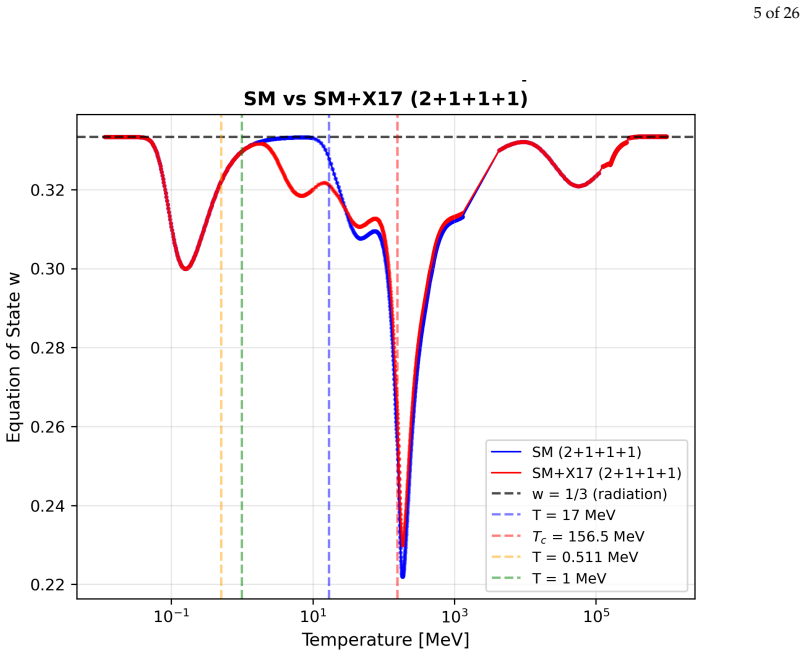
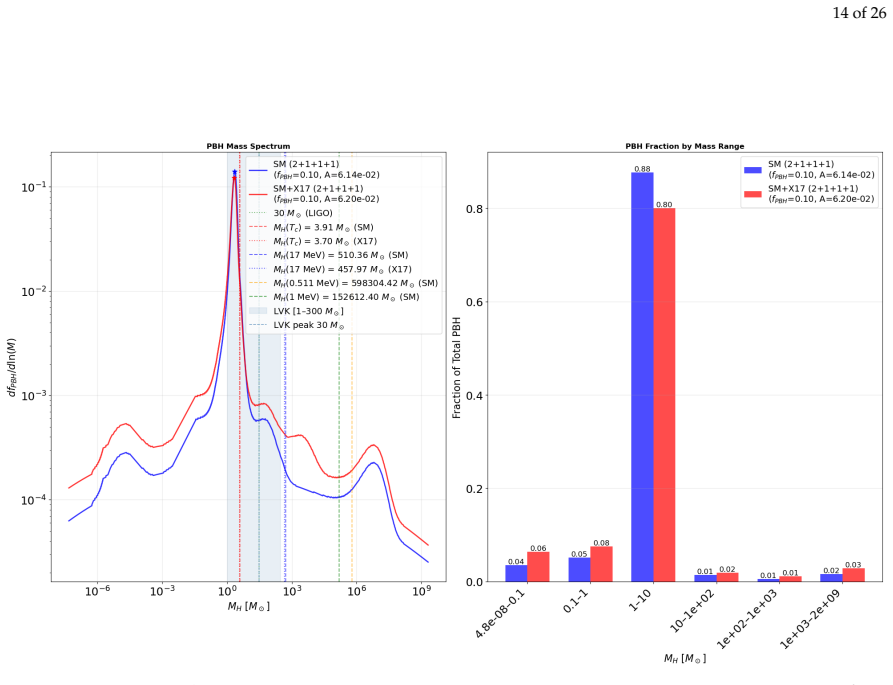
Physics beyond the Standard Model changes the cosmic equation of state during the quark-hadron transition and thereby alters the probability that density fluctuations collapse into primordial black holes.
A machine-rendered reading of the paper's core claim, the machinery that carries it, and where it could break.
Core claim
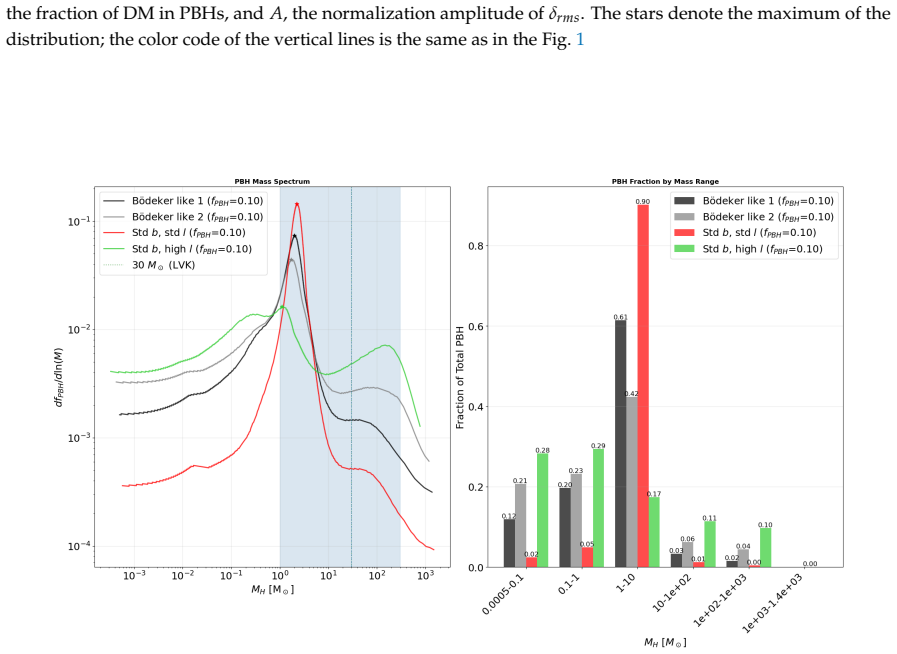
A recent microscopical model of the cosmological QCD phase transition shows clear sensitivity to beyond-Standard-Model physics, which alters the cosmic equation of state and thereby changes the probability distribution for primordial black hole formation; these objects can serve as dark matter candidates and contribute to present-day binary black-hole merger events.
What carries the argument
The microscopical model of the cosmological QCD phase transition extended to include beyond-Standard-Model degrees of freedom, which determines the cosmic equation of state and is inserted into the calculation of collapse probabilities from primordial density perturbations.
Load-bearing premise
The recent microscopical model accurately captures the dynamics of the cosmological QCD phase transition and its sensitivity to beyond-Standard-Model physics.
What would settle it
A future survey that measures the abundance and mass spectrum of primordial black holes and finds no difference between predictions that include only Standard Model physics and those that include plausible beyond-Standard-Model extensions would undermine the claimed impact.
Figures




read the original abstract
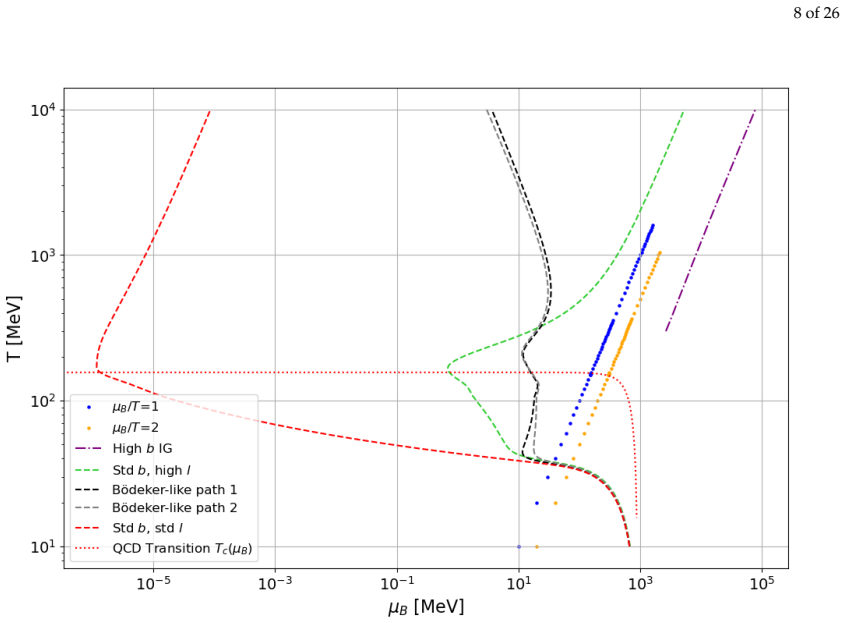
We review the role of primordial black holes (PBHs) for illuminating the dark ages of the cosmological evolution and as dark matter (DM) candidates. We elucidate the role of phase transitions for primordial black hole formation in the early Universe and focus our attention on the cosmological QCD phase transition within a recent microscopical model. We explore the impact of physics beyond the Standard Model (SM) on the cosmic equation of state and the probability distribution for the formation of PBHs which serve as candidates for DM and contribute to present-day binary black-hole merger events.
Editorial analysis
A structured set of objections, weighed in public.
Referee Report
Summary. The manuscript reviews the role of primordial black holes (PBHs) as dark matter candidates and contributors to binary black hole mergers. It focuses on PBH formation during the cosmological QCD phase transition, employing a recent microscopical model to compute the equation of state. The central claim is that beyond-Standard-Model (BSM) physics modifies the cosmic EOS at the transition temperature, thereby altering the PBH formation probability distribution and associated observables.
Significance. If the microscopical model is shown to be reliable, the work could meaningfully connect BSM particle content to early-universe cosmology via PBH abundances and merger rates. This offers a pathway to constrain new physics using dark matter density and gravitational-wave data. The emphasis on a microscopical rather than purely phenomenological treatment of the QCD transition is a constructive approach, though its impact hinges on quantitative validation against known results.
major comments (2)
- [Sections describing the microscopical model and EOS modifications] The central claim that BSM physics alters the PBH formation probability distribution rests on the microscopical model's computation of pressure, energy density, and speed of sound across the QCD transition (including BSM contributions). No explicit validation against lattice QCD results for the Standard Model case, nor detailed checks on the effective potential and thermal integrals for BSM extensions, is provided. This is load-bearing for the probability distribution and subsequent DM/merger implications.
- [Results on PBH probability distribution] The probability distribution for PBH formation is stated to change under BSM scenarios, but without quantitative tables or figures showing the magnitude of the shift relative to the SM baseline (e.g., change in peak mass or abundance), it is difficult to assess whether the effect is observationally relevant or within current uncertainties.
minor comments (2)
- [Abstract and Introduction] The abstract and introduction would benefit from a clearer statement of the specific BSM scenarios considered (e.g., additional scalar fields or modified couplings) and how they enter the microscopical model.
- [Throughout] Notation for the equation of state parameters (e.g., w, c_s^2) should be defined consistently when transitioning from the QCD model to the PBH formation calculation.
Simulated Author's Rebuttal
We thank the referee for the constructive and insightful report. The comments identify key areas where the presentation of the microscopical model and its quantitative implications can be strengthened. We address each major comment below and will incorporate revisions to improve clarity and robustness.
read point-by-point responses
-
Referee: [Sections describing the microscopical model and EOS modifications] The central claim that BSM physics alters the PBH formation probability distribution rests on the microscopical model's computation of pressure, energy density, and speed of sound across the QCD transition (including BSM contributions). No explicit validation against lattice QCD results for the Standard Model case, nor detailed checks on the effective potential and thermal integrals for BSM extensions, is provided. This is load-bearing for the probability distribution and subsequent DM/merger implications.
Authors: We appreciate the referee's emphasis on validation. The microscopical model employed is taken from a recent publication in which the SM equation of state was already compared to lattice QCD results for pressure, energy density, and speed of sound. To make the present manuscript self-contained, we will add an explicit comparison figure or table in the revised version that overlays our SM results against published lattice data near the QCD transition. For the BSM extensions we will expand the description of the effective potential and thermal integrals, including consistency checks in the high-temperature and decoupling limits. These additions will directly support the reliability of the subsequent PBH probability distributions. revision: yes
-
Referee: [Results on PBH probability distribution] The probability distribution for PBH formation is stated to change under BSM scenarios, but without quantitative tables or figures showing the magnitude of the shift relative to the SM baseline (e.g., change in peak mass or abundance), it is difficult to assess whether the effect is observationally relevant or within current uncertainties.
Authors: We agree that quantitative benchmarks are necessary to evaluate observational relevance. In the revised manuscript we will add a dedicated figure and accompanying table that directly compares the PBH formation probability distribution, peak mass, and integrated abundance between the SM baseline and representative BSM scenarios. The table will report the relative shifts in peak mass and abundance together with a brief discussion of how these shifts compare with current uncertainties in dark-matter density and binary black-hole merger rates. This will allow readers to assess the magnitude and potential detectability of the BSM effects. revision: yes
Circularity Check
No circularity identified; derivation chain not visible in provided text
full rationale
The manuscript text supplied consists only of the abstract and high-level description. No equations, specific model definitions, derivation steps, or self-citations are quoted or visible. The central claim—that BSM physics modifies the QCD equation of state via a microscopical model and thereby alters PBH formation probabilities—cannot be walked for reductions to inputs by construction. Per the hard rules, circularity is only claimed when exact paper text exhibits the reduction (e.g., a fitted parameter renamed as prediction or a self-citation that is the sole justification). Absent such evidence, the finding is no significant circularity (score 0). The paper may be self-contained against external benchmarks once the full model details are examined, but that examination is impossible here.
Axiom & Free-Parameter Ledger
Forward citations
Cited by 1 Pith paper
-
Asteroid-mass Primordial Black Holes as Dark Matter from Supersymmetry
Supersymmetry with heavy particles above ~10^5 GeV enhances asteroid-mass PBH production via transient equation-of-state softening, allowing them to comprise all dark matter unlike in the Standard Model.
Reference graph
Works this paper leans on
-
[1]
The origin of the formalism intrinsic degeneracies and their influence on H 0
Abbott, R.; et al. Search for subsolar-mass black hole binaries in the second part of Advanced LIGO’s and Advanced Virgo’s third observing run.Mon. Not. Roy. Astron. Soc.2023,524, 5984–5992, [arXiv:astro- ph.HE/2212.01477]. [Erratum: Mon.Not.Roy.Astron.Soc. 526, 6234 (2023)], https://doi.org/10.1093/mnras/ stad588
-
[2]
The LIGO Scientific Collaboration.; the Virgo Collaboration.; the KAGRA Collaboration.; Abac, A.G.; Abouelfettouh, I.; Acernese, F.; Ackley, K.; Adamcewicz, C.; Adhicary, S.; Adhikari, D.; et al. Search for planetary-mass ultra-compact binaries using data from the first part of the LIGO–Virgo–KAGRA fourth observing run.arXiv e-prints2025, p. arXiv:2511.19...
-
[3]
Search for Sub-Solar Mass Binaries in the First Part of LIGO's Fourth Observing Run
Kacanja, K.; Soni, K.; Akyüz, A.; Nitz, A.H. Search for Sub-Solar Mass Binaries in the First Part of LIGO’s Fourth Observing Run.arXiv e-prints2026, p. arXiv:2602.12115, [arXiv:astro-ph.HE/2602.12115]. https: //doi.org/10.48550/arXiv.2602.12115
-
[4]
2025, Living Reviews in Relativity, 28, 1, doi:10.1007/s41114-024-00053-w
Bagui, E.; et al. Primordial black holes and their gravitational-wave signatures.Living Rev. Rel.2025,28, 1, [arXiv:astro-ph.CO/2310.19857]. https://doi.org/10.1007/s41114-024-00053-w
-
[5]
LIGO/Virgo/KAGRA S251112cm: Classification of reported candidates with SOAR/Goodman.GRB Coordinates Network2025,42724, 1
Santos, A.; Kilpatrick, C.D.; Bom, C.R.; Santana-Silva, L.; Darc, P .; Teixeira, G.; Mendes de Oliveira, C.; STEP-GW Collaboration. LIGO/Virgo/KAGRA S251112cm: Classification of reported candidates with SOAR/Goodman.GRB Coordinates Network2025,42724, 1
-
[6]
Primordial black holes: constraints, potential evidence and prospects,
Carr, B.; Iovino, A.J.; Perna, G.; Vaskonen, V .; Veermäe, H. Primordial black holes: constraints, potential evidence and prospects.arXiv e-prints2026, p. arXiv:2601.06024, [arXiv:astro-ph.CO/2601.06024]. https: //doi.org/10.48550/arXiv.2601.06024
-
[7]
Kasliwal, M.M.; et al. ZTF25abjmnps (AT2025ulz) and S250818k: A Candidate Superkilonova from a Subthreshold Subsolar Gravitational-wave Trigger.Astrophys. J. Lett.2025,995, L59, [arXiv:astro- ph.HE/2510.23732]. https://doi.org/10.3847/2041-8213/ae2000
-
[8]
Black holes in the early Universe.Mon
Carr, B.J.; Hawking, S.W. Black holes in the early Universe.Mon. Not. Roy. Astron. Soc.1974,168, 399–415. https://doi.org/10.1093/mnras/168.2.399
-
[9]
The Primordial black hole mass spectrum.Astrophys
Carr, B.J. The Primordial black hole mass spectrum.Astrophys. J.1975,201, 1–19. https://doi.org/10.1086/ 153853
1975
-
[11]
Musco, I.; Jedamzik, K.; Young, S. Primordial black hole formation during the QCD phase transition: Thresh- old, mass distribution, and abundance.Phys. Rev. D2024,109, 083506, [arXiv:astro-ph.CO/2303.07980]. https://doi.org/10.1103/PhysRevD.109.083506. 18 of 26
-
[12]
Gonin, M.; Hasinger, G.; Blaschke, D.; Ivanytskyi, O.; Röpke, G. Primordial black-hole formation and heavy r-process element synthesis from the cosmological QCD transition.Eur. Phys. J. A2025,61, 170, [arXiv:hep-ph/2505.05463]. https://doi.org/10.1140/epja/s10050-025-01639-w
-
[13]
Primordial Black Holes as Dark Matter: Recent Developments
Carr, B.; Kuhnel, F. Primordial Black Holes as Dark Matter: Recent Developments.Ann. Rev. Nucl. Part. Sci. 2020,70, 355–394, [arXiv:astro-ph.CO/2006.02838]. https://doi.org/10.1146/annurev-nucl-050520-125911
-
[14]
2021, Reports on Progress in Physics, 84, 116902, doi: 10.1088/1361-6633/ac1e31
Carr, B.; Kohri, K.; Sendouda, Y.; Yokoyama, J. Constraints on primordial black holes.Rept. Prog. Phys.2021, 84, 116902, [arXiv:astro-ph.CO/2002.12778]. https://doi.org/10.1088/1361-6633/ac1e31
-
[15]
Cosmic conundra explained by thermal history and primordial black holes.Phys
Carr, B.; Clesse, S.; García-Bellido, J.; Kühnel, F. Cosmic conundra explained by thermal history and primordial black holes.Phys. Dark Univ.2021,31, 100755, [arXiv:astro-ph.CO/1906.08217]. https: //doi.org/10.1016/j.dark.2020.100755
-
[16]
Hasinger, G. Illuminating the dark ages: Cosmic backgrounds from accretion onto primordial black hole dark matter.JCAP2020,07, 022, [arXiv:astro-ph.CO/2003.05150]. https://doi.org/10.1088/1475-7516/2020 /07/022
-
[17]
Calculation of the axion mass based on high-temperature lattice quantum chromodynamics
Borsanyi, S.; et al. Calculation of the axion mass based on high-temperature lattice quantum chromodynamics. Nature2016,539, 69–71, [arXiv:hep-lat/1606.07494]. https://doi.org/10.1038/nature20115
-
[18]
Experimental status of QCD phase diagram.J
Pandav, A. Experimental status of QCD phase diagram.J. Subatomic Part. Cosmol.2025,4, 100167. https://doi.org/10.1016/j.jspc.2025.100167
-
[19]
SciPost Physics Lecture Notes , author =
Hindmarsh, M.B.; Lüben, M.; Lumma, J.; Pauly, M. Phase transitions in the early universe.SciPost Phys. Lect. Notes2021,24, 1, [arXiv:astro-ph.CO/2008.09136]. https://doi.org/10.21468/SciPostPhysLectNotes.24
-
[20]
Overview of the QCD phase diagram: Recent progress from the lattice.Eur
Guenther, J.N. Overview of the QCD phase diagram: Recent progress from the lattice.Eur. Phys. J. A2021, 57, 136, [arXiv:hep-lat/2010.15503]. https://doi.org/10.1140/epja/s10050-021-00354-6
-
[21]
Guenther, J.N. An overview of the QCD phase diagram at finite T and µ.PoS2022,LATTICE2021, 013, [arXiv:hep-lat/2201.02072]. https://doi.org/10.22323/1.396.0013
-
[22]
Constructing the equation of state of QCD in a functional QCD based scheme.Phys
Lu, Y.; Gao, F.; Fu, B.; Song, H.; Liu, Y.X. Constructing the equation of state of QCD in a functional QCD based scheme.Phys. Rev. D2024,109, 114031, [arXiv:hep-ph/2310.16345]. https://doi.org/10.1103/ PhysRevD.109.114031
-
[23]
Gravitational waves from strong first-order phase transitions.Phys
Correia, J.; Hindmarsh, M.; Rummukainen, K.; Weir, D.J. Gravitational waves from strong first-order phase transitions.Phys. Rev. D2025,112, 123546, [arXiv:astro-ph.CO/2505.17824]. https://doi.org/10.1103/ 8wmq-f635
-
[24]
Baryogenesis from the weak scale to the grand unification scale.Rev
Bodeker, D.; Buchmuller, W. Baryogenesis from the weak scale to the grand unification scale.Rev. Mod. Phys. 2021,93, 035004, [arXiv:hep-ph/2009.07294]. https://doi.org/10.1103/RevModPhys.93.035004
-
[25]
van de Vis, J.; de Vries, J.; Postma, M. Bubble Trouble: a Review on Electroweak Baryogenesis.arXiv e-prints 2025, p. arXiv:2508.09989, [arXiv:hep-ph/2508.09989]. https://doi.org/10.48550/arXiv.2508.09989
-
[26]
Sakharov, A.D. Violation of CP Invariance, C asymmetry, and baryon asymmetry of the universe.Pisma Zh. Eksp. T eor. Fiz.1967,5, 32–35. https://doi.org/10.1070/PU1991v034n05ABEH002497
-
[27]
Review of Particle Physics.PTEP2022,2022, 083C01
Workman, R.L.; et al. Review of Particle Physics.PTEP2022,2022, 083C01. https://doi.org/10.1093/ptep/ ptac097
-
[28]
Kajantie, K.; Laine, M.; Rummukainen, K.; Shaposhnikov, M.E. Is there a hot electroweak phase transition at mH ≳m W?Phys. Rev. Lett.1996,77, 2887–2890, [hep-ph/9605288]. https://doi.org/10.1103/PhysRevLett. 77.2887
-
[29]
A Nonperturbative analysis of the finite T phase transition in SU(2) x U(1) electroweak theory.Nucl
Kajantie, K.; Laine, M.; Rummukainen, K.; Shaposhnikov, M.E. A Nonperturbative analysis of the finite T phase transition in SU(2) x U(1) electroweak theory.Nucl. Phys. B1997,493, 413–438, [hep-lat/9612006]. https://doi.org/10.1016/S0550-3213(97)00164-8
-
[30]
The Cosmological QCD Phase Transition Revisited.Prog
Boeckel, T.; Schettler, S.; Schaffner-Bielich, J. The Cosmological QCD Phase Transition Revisited.Prog. Part. Nucl. Phys.2011,66, 266–270, [arXiv:astro-ph.CO/1012.3342]. https://doi.org/10.1016/j.ppnp.2011.01.017
-
[31]
A little inflation at the cosmological QCD phase transition.Phys
Boeckel, T.; Schaffner-Bielich, J. A little inflation at the cosmological QCD phase transition.Phys. Rev. D 2012,85, 103506, [arXiv:astro-ph.CO/1105.0832]. https://doi.org/10.1103/PhysRevD.85.103506
-
[32]
QCD-Electroweak First-Order Phase Transition in a Supercooled Universe
Iso, S.; Serpico, P .D.; Shimada, K. QCD-Electroweak First-Order Phase Transition in a Supercooled Universe. Phys. Rev. Lett.2017,119, 141301, [arXiv:hep-ph/1704.04955]. https://doi.org/10.1103/PhysRevLett.119.14 1301
-
[33]
What comes after the Standard Model?Prog
Khlopov, M. What comes after the Standard Model?Prog. Part. Nucl. Phys.2021,116, 103824. https: //doi.org/10.1016/j.ppnp.2020.103824
-
[34]
Lepton asymmetry and the cosmic QCD transition.JCAP2009,11, 025, [arXiv:hep- ph/0906.3434]
Schwarz, D.J.; Stuke, M. Lepton asymmetry and the cosmic QCD transition.JCAP2009,11, 025, [arXiv:hep- ph/0906.3434]. [Erratum: JCAP 10, E01 (2010)], https://doi.org/10.1088/1475-7516/2009/11/025. 19 of 26
-
[35]
The Small observed baryon asymmetry from a large lepton asymmetry.JHEP1999,11, 015, [hep-ph/9908396]
March-Russell, J.; Murayama, H.; Riotto, A. The Small observed baryon asymmetry from a large lepton asymmetry.JHEP1999,11, 015, [hep-ph/9908396]. https://doi.org/10.1088/1126-6708/1999/11/015
-
[36]
Barenboim, G.; Park, W.I. A full picture of large lepton number asymmetries of the Universe.JCAP2017, 04, 048, [arXiv:hep-ph/1703.08258]. https://doi.org/10.1088/1475-7516/2017/04/048
-
[37]
Gao, F.; Oldengott, I.M. Cosmology Meets Functional QCD: First-Order Cosmic QCD Transition Induced by Large Lepton Asymmetries.Phys. Rev. Lett.2022,128, 131301, [arXiv:hep-ph/2106.11991]. https: //doi.org/10.1103/PhysRevLett.128.131301
-
[38]
Sphaleron freeze-in baryogenesis with gravitational waves from the QCD transition.Phys
Gao, F.; Harz, J.; Hati, C.; Lu, Y.; Oldengott, I.M.; White, G. Sphaleron freeze-in baryogenesis with gravitational waves from the QCD transition.Phys. Lett. B2025,869, 139849, [arXiv:hep-ph/2309.00672]. https://doi.org/10.1016/j.physletb.2025.139849
-
[39]
Gao, F.; Harz, J.; Hati, C.; Lu, Y.; Oldengott, I.M.; White, G. Baryogenesis and first-order QCD transition with gravitational waves from a large lepton asymmetry.JHEP2025,06, 247, [arXiv:hep-ph/2407.17549]. https://doi.org/10.1007/JHEP06(2025)247
-
[40]
Resurrection of large lepton number asymmetries from neutrino flavor oscillations.Phys
Barenboim, G.; Kinney, W.H.; Park, W.I. Resurrection of large lepton number asymmetries from neutrino flavor oscillations.Phys. Rev. D2017,95, 043506, [arXiv:hep-ph/1609.01584]. https://doi.org/10.1103/ PhysRevD.95.043506
-
[41]
Constraints on primordial lepton asymmetries with full neutrino transport.Phys
Froustey, J.; Pitrou, C. Constraints on primordial lepton asymmetries with full neutrino transport.Phys. Rev. D2024,110, 103551, [arXiv:hep-ph/2405.06509]. https://doi.org/10.1103/PhysRevD.110.103551
-
[42]
Lepton flavor asymmetries and the mass spectrum of primordial black holes.Phys
Bödeker, D.; Kühnel, F.; Oldengott, I.M.; Schwarz, D.J. Lepton flavor asymmetries and the mass spectrum of primordial black holes.Phys. Rev. D2021,103, 063506, [arXiv:astro-ph.CO/2011.07283]. https: //doi.org/10.1103/PhysRevD.103.063506
-
[43]
Blaschke, D.; Cierniak, M.; Ivanytskyi, O.; Röpke, G. Thermodynamics of quark matter with multiquark clusters in an effective Beth-Uhlenbeck type approach.Eur. Phys. J. A2024,60, 14, [arXiv:nucl-th/2308.07950]. https://doi.org/10.1140/epja/s10050-023-01229-8
-
[44]
Cosmic trajectories calculation with a state of the art lattice QCD equation of state.Phys
Formaggio, L.; Di Clemente, F.; Yadav, G.; Drago, A.; Ratti, C. Cosmic trajectories calculation with a state of the art lattice QCD equation of state.Phys. Rev. D2026,113, 023522, [arXiv:astro-ph.CO/2508.00094]. https://doi.org/10.1103/lnwp-gzss
-
[45]
Rafelski, J.; Birrell, J.; Grayson, C.; Steinmetz, A.; Yang, C.T. Quarks to Cosmos:.Eur. Phys. J. ST2025, 234, 1125–1329, [arXiv:hep-ph/2409.19031]. https://doi.org/10.1140/epjs/s11734-025-01470-w
-
[46]
Husdal, L. On Effective Degrees of Freedom in the Early Universe.Galaxies2016,4, 78, [arXiv:astro- ph.CO/1609.04979]. https://doi.org/10.3390/galaxies4040078
-
[47]
The inflationary universe: A possible solu- tion to the horizon and flatness problems,
Guth, A.H. The Inflationary Universe: A Possible Solution to the Horizon and Flatness Problems.Phys. Rev. D1981,23, 347–356. https://doi.org/10.1103/PhysRevD.23.347
-
[48]
Chiral crossover in QCD at zero and non-zero chemical potentials.Phys
Bazavov, A.; et al. Chiral crossover in QCD at zero and non-zero chemical potentials.Phys. Lett. B2019, 795, 15–21, [arXiv:hep-lat/1812.08235]. https://doi.org/10.1016/j.physletb.2019.05.013
-
[49]
Thermodynamics of charmed hadrons across chiral crossover from lattice QCD.J
Sharma, S.; Karsch, F.; Petreczky, P . Thermodynamics of charmed hadrons across chiral crossover from lattice QCD.J. Subatomic Part. Cosmol.2025,3, 100044, [arXiv:hep-lat/2501.01300]. https://doi.org/10.1016/ j.jspc.2025.100044
-
[50]
Kaczmarek, O.; Karsch, F.; Petreczky, P .; Schmidt, C.; Sharma, S. Generalized susceptibilities and the properties of charm degrees of freedom across the QCD crossover temperature.Phys. Rev. D2025, 112, 034509, [arXiv:hep-lat/2505.01734]. https://doi.org/10.1103/tz74-d3kh
-
[51]
Escudero Abenza, JCAP05, 048 (2020), arXiv:2001.04466 [hep-ph]
Escudero Abenza, M. Precision early universe thermodynamics made simple: Neff and neutrino decoupling in the Standard Model and beyond.JCAP2020,05, 048, [arXiv:hep-ph/2001.04466]. https://doi.org/10.108 8/1475-7516/2020/05/048
-
[52]
Fast and flexible neutrino decoupling
Escudero, M.; Jackson, G.; Laine, M.; Sandner, S. Fast and flexible neutrino decoupling. Part I. The Stan- dard Model.JCAP2026,02, 046, [arXiv:hep-ph/2511.04747]. https://doi.org/10.1088/1475-7516/2026/02/ 046
-
[53]
Laine, M.; Meyer, M. Standard Model thermodynamics across the electroweak crossover.JCAP2015,07, 035, [arXiv:hep-ph/1503.04935]. https://doi.org/10.1088/1475-7516/2015/07/035
-
[54]
Anomalies in Particle Physcis.PoS2025,DIS2024, 007
Crivellin, A.; Mellado, B. Anomalies in Particle Physcis.PoS2025,DIS2024, 007. https://doi.org/10.22323 /1.469.0007
-
[55]
An Update of the Hypothetical X17 Particle.Universe2024,10, 409, [arXiv:nucl-ex/2409.16300]
Krasznahorkay, A.J.; Krasznahorkay, A.; Csatlós, M.; Timár, J.; Begala, M.; Krakó, A.; Rajta, I.; Vajda, I.; Sas, N.J. An Update of the Hypothetical X17 Particle.Universe2024,10, 409, [arXiv:nucl-ex/2409.16300]. https://doi.org/10.3390/universe10110409. 20 of 26
-
[56]
Shedding light on X17: community report.Eur
Alves, D.S.M.; et al. Shedding light on X17: community report.Eur. Phys. J. C2023,83, 230. https: //doi.org/10.1140/epjc/s10052-023-11271-x
-
[58]
Cosmological Baryon and Lepton Number in the Presence of Electroweak Fermion Number Violation.Phys
Harvey, J.A.; Turner, M.S. Cosmological Baryon and Lepton Number in the Presence of Electroweak Fermion Number Violation.Phys. Rev. D1990,42, 3344–3349. https://doi.org/10.1103/PhysRevD.42.3344
-
[59]
A mini review on Affleck-Dine baryogenesis.New J
Allahverdi, R.; Mazumdar, A. A mini review on Affleck-Dine baryogenesis.New J. Phys.2012,14, 125013. https://doi.org/10.1088/1367-2630/14/12/125013
-
[60]
Kasai, K.; Kawasaki, M.; Murai, K. Revisiting the Affleck-Dine mechanism for primordial black hole formation.JCAP2022,10, 048, [arXiv:astro-ph.CO/2205.10148]. https://doi.org/10.1088/1475-7516/2022/1 0/048
-
[61]
Oldengott, I.M.; Schwarz, D.J. Improved constraints on lepton asymmetry from the cosmic microwave background.EPL2017,119, 29001, [arXiv:astro-ph.CO/1706.01705]. https://doi.org/10.1209/0295-5075/11 9/29001
-
[62]
Lepton asymmetric universe.JCAP2022,08, 041, [arXiv:hep-ph/2203.09713]
Kawasaki, M.; Murai, K. Lepton asymmetric universe.JCAP2022,08, 041, [arXiv:hep-ph/2203.09713]. https://doi.org/10.1088/1475-7516/2022/08/041
-
[63]
Escudero, M.; Ibarra, A.; Maura, V . Primordial lepton asymmetries in the precision cosmology era: Cur- rent status and future sensitivities from BBN and the CMB.Phys. Rev. D2023,107, 035024, [arXiv:hep- ph/2208.03201]. https://doi.org/10.1103/PhysRevD.107.035024
-
[64]
Lepton Asymmetries in Cosmology.Symmetry2024,16, 1657
Lattanzi, M.; Moretti, M. Lepton Asymmetries in Cosmology.Symmetry2024,16, 1657. https://doi.org/10 .3390/sym16121657
-
[65]
Li, Y.Z.; Yu, J.H. Primordial lepton asymmetries: neutrino transport, spectral distortions and cosmological constraints.JHEP2025,06, 213, [arXiv:hep-ph/2409.08280]. https://doi.org/10.1007/JHEP06(2025)213
-
[66]
Domcke, V .; Escudero, M.; Fernandez Navarro, M.; Sandner, S. Lepton flavor asymmetries: from the early Universe to BBN.JHEP2025,06, 137, [arXiv:hep-ph/2502.14960]. https://doi.org/10.1007/JHEP06(2025)137
-
[67]
Cosmic QCD Epoch at Nonvanishing Lepton Asymmetry.Phys
Wygas, M.M.; Oldengott, I.M.; Bödeker, D.; Schwarz, D.J. Cosmic QCD Epoch at Nonvanishing Lepton Asymmetry.Phys. Rev. Lett.2018,121, 201302, [arXiv:hep-ph/1807.10815]. https://doi.org/10.1103/ PhysRevLett.121.201302
-
[68]
Large Lepton Asymmetry and the Cosmic QCD Transition
Wygas, M.M. Large Lepton Asymmetry and the Cosmic QCD Transition. PhD thesis, U. Bielefeld (main), 2019
2019
-
[69]
New 4D lattice QCD equation of state: Extended density coverage from a generalized T’ expansion.Phys
Abuali, A.; Borsányi, S.; Fodor, Z.; Jahan, J.; Kahangirwe, M.; Parotto, P .; Pásztor, A.; Ratti, C.; Shah, H.; Trabulsi, S.A. New 4D lattice QCD equation of state: Extended density coverage from a generalized T’ expansion.Phys. Rev. D2025,112, 054502, [arXiv:hep-lat/2504.01881]. https://doi.org/10.1103/2dmh-26yh
-
[70]
Numerical approximation to the thermodynamic integrals.Astrophys
Johns, S.M.; Ellis, P .J.; Lattimer, J.M. Numerical approximation to the thermodynamic integrals.Astrophys. J. 1996,473, 1020–1028, [nucl-th/9604004]. https://doi.org/10.1086/178212
-
[71]
QCD Equation of State with Nf=3 Flavors up to the Electroweak Scale.Phys
Bresciani, M.; Brida, M.D.; Giusti, L.; Pepe, M. QCD Equation of State with Nf=3 Flavors up to the Electroweak Scale.Phys. Rev. Lett.2025,134, 201904, [arXiv:hep-lat/2501.11603]. https://doi.org/10.1103/ PhysRevLett.134.201904
-
[72]
Thermal-FIST: A package for heavy-ion collisions and hadronic equation of state
Vovchenko, V .; Stoecker, H. Thermal-FIST: A package for heavy-ion collisions and hadronic equation of state. Comput. Phys. Commun.2019,244, 295–310, [arXiv:nucl-th/1901.05249]. https://doi.org/10.1016/j.cpc.2019 .06.024
-
[73]
Constraints on the electrical charge asymmetry of the universe.JCAP 2005,02, 006, [hep-ph/0310066]
Caprini, C.; Biller, S.; Ferreira, P .G. Constraints on the electrical charge asymmetry of the universe.JCAP 2005,02, 006, [hep-ph/0310066]. https://doi.org/10.1088/1475-7516/2005/02/006
-
[75]
Cosmic QCD transition for large lepton flavor asymmetries.Phys
Middeldorf-Wygas, M.M.; Oldengott, I.M.; Bödeker, D.; Schwarz, D.J. Cosmic QCD transition for large lepton flavor asymmetries.Phys. Rev. D2022,105, 123533, [arXiv:hep-ph/2009.00036]. https://doi.org/10.1 103/PhysRevD.105.123533
-
[76]
Vovchenko, V .; Brandt, B.B.; Cuteri, F.; Endr˝ odi, G.; Hajkarim, F.; Schaffner-Bielich, J. Pion Condensation in the Early Universe at Nonvanishing Lepton Flavor Asymmetry and Its Gravitational Wave Signatures.Phys. Rev. Lett.2021,126, 012701, [arXiv:hep-ph/2009.02309]. https://doi.org/10.1103/PhysRevLett.126.012701. 21 of 26
-
[77]
Chiral symmetry breaking and pion condensation in the early Universe.Phys
Ferreira, O.; Fraga, E.S.; Hippert, M.; Schaffner-Bielich, J. Chiral symmetry breaking and pion condensation in the early Universe.Phys. Rev. D2025,112, 094009, [arXiv:hep-ph/2507.06518]. https://doi.org/10.1103/ bcz6-xxn8
-
[78]
Di Clemente, F.; Drago, A.; Formaggio, L.; Ratti, C.; Vovchenko, V .; Yadav, G. Upper Bound on the Cosmic Baryon Chemical Potential from Lepton-Flavor Asymmetry.arXiv e-prints2025, p. arXiv:2511.11995, [arXiv:hep-ph/2511.11995]. https://doi.org/10.48550/arXiv.2511.11995
-
[79]
Escrivà, A.; Bagui, E.; Clesse, S. Simulations of PBH formation at the QCD epoch and comparison with the GWTC-3 catalog.JCAP2023,05, 004, [arXiv:astro-ph.CO/2209.06196]. https://doi.org/10.1088/1475-7516/ 2023/05/004
-
[80]
Simulation of primordial black hole formation using pseudo-spectral methods.Phys
Escrivà, A. Simulation of primordial black hole formation using pseudo-spectral methods.Phys. Dark Univ. 2020,27, 100466, [arXiv:gr-qc/1907.13065]. https://doi.org/10.1016/j.dark.2020.100466
-
[81]
Computations of primordial black hole formation.Class
Musco, I.; Miller, J.C.; Rezzolla, L. Computations of primordial black hole formation.Class. Quant. Grav. 2005,22, 1405–1424, [gr-qc/0412063]. https://doi.org/10.1088/0264-9381/22/7/013
-
[82]
Primordial black hole formation in the early universe: critical behaviour and self- similarity.Class
Musco, I.; Miller, J.C. Primordial black hole formation in the early universe: critical behaviour and self- similarity.Class. Quant. Grav.2013,30, 145009, [arXiv:gr-qc/1201.2379]. https://doi.org/10.1088/0264-938 1/30/14/145009
-
[83]
Escrivà, A. PBH Formation from Spherically Symmetric Hydrodynamical Perturbations: A Review.Universe 2022,8, 66, [arXiv:gr-qc/2111.12693]. https://doi.org/10.3390/universe8020066
discussion (0)
Sign in with ORCID, Apple, or X to comment. Anyone can read and Pith papers without signing in.