Recognition: unknown
Asteroid-mass Primordial Black Holes as Dark Matter from Supersymmetry
Pith reviewed 2026-05-07 15:46 UTC · model grok-4.3
The pith
Supersymmetry lets asteroid-mass primordial black holes explain all dark matter by softening the early universe.
A machine-rendered reading of the paper's core claim, the machinery that carries it, and where it could break.
Core claim
In supersymmetric extensions of the Standard Model the presence of heavy particles leads to a transient softening of the equation of state during their non-relativistic transition. This effect enhances the formation of asteroid-mass primordial black holes, enabling them to account for the total dark matter abundance when supersymmetric masses exceed approximately 10^5 GeV while remaining consistent with current bounds. For lighter spectra production shifts toward masses above 10^22 g that are excluded by microlensing searches.
What carries the argument
The transient softening of the equation of state during the non-relativistic transition of heavy supersymmetric particles, which increases the efficiency of PBH formation from curvature perturbations.
If this is right
- For supersymmetric masses above 10^5 GeV the PBH mass function rises enough in the asteroid window to supply the entire dark matter density.
- The same initial conditions in the Standard Model produce PBH abundances excluded by existing constraints.
- Lighter supersymmetric mass spectra move PBH production above 10^22 g and thereby reduce the allowed dark matter fraction.
- The shape of the PBH mass function varies with the three characteristic mass scales of the MSSM spectrum.
Where Pith is reading between the lines
- Asteroid-mass PBH searches could indirectly constrain the scale of supersymmetry.
- Similar softening effects might appear in other models containing heavy non-relativistic species.
- The mechanism ties the amplitude of the primordial spectrum directly to the supersymmetry-breaking scale.
- Gravitational-wave backgrounds from PBH binaries could carry a distinct signature of the enhanced low-mass population.
Load-bearing premise
The primordial curvature power spectrum is assumed to be broad and approximately scale-invariant.
What would settle it
A null result from microlensing or gravitational-wave searches that rules out an enhanced asteroid-mass PBH population at the predicted level for supersymmetric masses above 10^5 GeV would falsify the claim.
Figures


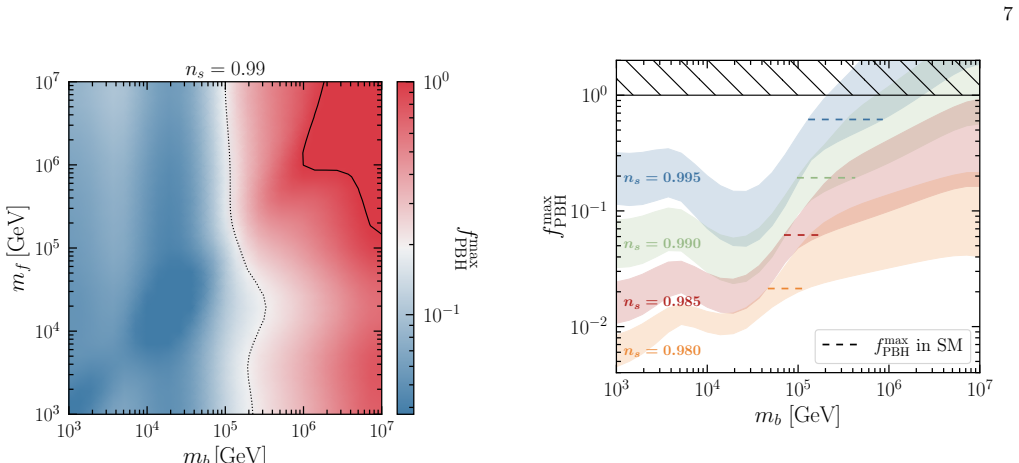
read the original abstract
We study the formation of asteroid-mass Primordial Black Holes (PBHs) as a dark matter candidate in supersymmetric extensions of the Standard Model. We show that the presence of heavy particles predicted in the Minimal Supersymmetric Standard Model (MSSM) can lead to a transient softening of the equation of state of the Universe during their non-relativistic transition, enhancing PBH formation. We compute the effective equation of state for different realizations of the MSSM mass spectrum, parametrized by three characteristic mass scales. Assuming a broad and approximately scale-invariant primordial curvature power spectrum, we evaluate the resulting PBH mass functions and compare them with current observational constraints. We find that, for supersymmetric masses above $\sim 10^5\,\mathrm{GeV}$, the PBH mass function is significantly enhanced in the asteroid-mass window, allowing PBHs to account for the total dark matter abundance without violating existing bounds. In contrast, within the Standard Model the same configurations lead to PBH mass functions that are observationally excluded. For lighter supersymmetric mass spectra, PBH production is shifted toward masses above $\sim 10^{22}\,\mathrm{g}$, which are strongly constrained by microlensing searches, thereby reducing their allowed contribution to the dark matter density.
Editorial analysis
A structured set of objections, weighed in public.
Referee Report
Summary. The manuscript studies the formation of asteroid-mass primordial black holes (PBHs) as dark matter in supersymmetric extensions of the Standard Model. It argues that heavy MSSM particles induce a transient softening of the cosmic equation of state during their non-relativistic transition, enhancing PBH production. Parametrizing the MSSM spectrum by three characteristic mass scales and assuming a broad, approximately scale-invariant primordial curvature power spectrum, the authors compute effective equations of state, derive PBH mass functions, and conclude that supersymmetric masses above ~10^5 GeV allow PBHs to comprise all dark matter in the asteroid-mass window without violating bounds, while the Standard Model case is excluded and lighter spectra are constrained by microlensing.
Significance. If the quantitative results hold, the work establishes a concrete link between supersymmetry and viable PBH dark matter by exploiting beyond-Standard-Model particle thresholds to evade Standard Model constraints on early-universe PBH formation. This could motivate targeted searches for asteroid-mass PBHs and high-scale supersymmetry, while highlighting the sensitivity of PBH abundance to the timing of non-relativistic transitions in extended particle spectra.
major comments (2)
- [Abstract and results on PBH mass functions] The central quantitative claim (PBH mass function enhancement allowing all dark matter for supersymmetric masses ≳10^5 GeV) is presented without visible error propagation, full numerical details of the effective EoS integration, or explicit uncertainty bands on the power spectrum amplitude; this renders the precise mass threshold and abundance normalization only partially substantiated.
- [Section on primordial power spectrum and PBH formation] The derivation of the PBH mass function relies on the assumption of a broad and approximately scale-invariant primordial curvature power spectrum; no sensitivity analysis to deviations from exact scale invariance or to the amplitude normalization is provided, yet this assumption directly controls the overall normalization and the localization of the enhancement to the asteroid-mass window.
minor comments (2)
- [Abstract] The abstract would benefit from a brief statement of the asteroid-mass range (e.g., 10^17–10^22 g) and the precise observational bounds used for comparison.
- [MSSM spectrum parametrization] Notation for the three characteristic mass scales should be introduced with explicit symbols and ranges in the main text to improve readability of the EoS parametrization.
Simulated Author's Rebuttal
We thank the referee for their careful reading of our manuscript and for the positive assessment of its potential significance. We address each major comment below and describe the revisions we will implement to improve the substantiation and robustness of our results.
read point-by-point responses
-
Referee: [Abstract and results on PBH mass functions] The central quantitative claim (PBH mass function enhancement allowing all dark matter for supersymmetric masses ≳10^5 GeV) is presented without visible error propagation, full numerical details of the effective EoS integration, or explicit uncertainty bands on the power spectrum amplitude; this renders the precise mass threshold and abundance normalization only partially substantiated.
Authors: We agree that greater transparency in the numerical procedures and uncertainties would strengthen the presentation. In the revised manuscript we will expand the relevant sections to provide explicit details of the effective equation-of-state integration, including the numerical method, time-stepping scheme, and convergence tests. We will also add uncertainty bands to the PBH mass-function figures that reflect the range of primordial power-spectrum amplitudes consistent with our broad, approximately scale-invariant assumption. A full Bayesian error-propagation analysis over all model parameters lies beyond the scope of the present study, but the added documentation and bands will make the reported threshold of ~10^5 GeV and the associated abundance more clearly substantiated. revision: partial
-
Referee: [Section on primordial power spectrum and PBH formation] The derivation of the PBH mass function relies on the assumption of a broad and approximately scale-invariant primordial curvature power spectrum; no sensitivity analysis to deviations from exact scale invariance or to the amplitude normalization is provided, yet this assumption directly controls the overall normalization and the localization of the enhancement to the asteroid-mass window.
Authors: We acknowledge that the robustness of the results with respect to the primordial spectrum assumptions merits explicit demonstration. In the revised manuscript we will add a dedicated subsection (and accompanying figures) that explores the sensitivity of the PBH mass function to (i) small deviations from exact scale invariance, parameterized by a spectral index n_s = 1 + δ with |δ| ≲ 0.05, and (ii) variations in the overall amplitude within the window that still permits appreciable PBH formation. These tests will show that the enhancement in the asteroid-mass range for supersymmetric masses ≳ 10^5 GeV persists across the explored variations, while clarifying how the normalization and localization depend on the assumed spectrum. revision: yes
Circularity Check
No circularity: derivation uses standard inputs to compute output
full rationale
The paper takes as given a broad approximately scale-invariant primordial curvature power spectrum and parametrizes the MSSM by three mass scales. It computes the effective equation of state from the non-relativistic transitions of those particles, then applies standard PBH formation formulas to obtain the mass function. The enhancement in the asteroid-mass window for m ≳ 10^5 GeV (and the contrast with the SM) follows directly as a calculated consequence; it is not equivalent to any input by construction, nor is any result renamed from a fit. No load-bearing self-citation or ansatz smuggling is present in the stated chain.
Axiom & Free-Parameter Ledger
free parameters (2)
- three characteristic mass scales
- amplitude of primordial curvature power spectrum
axioms (2)
- standard math Standard FLRW cosmology with radiation-to-matter transitions governed by particle content
- domain assumption MSSM particle spectrum and their decoupling behavior
Reference graph
Works this paper leans on
-
[1]
When the den- sity perturbationsδre-enter the horizon after inflation, they may collapse to form a black hole if their ampli- tude exceeds a critical thresholdδ c
cos(kR/ √ 3) (kR/ √ 3)3 (5) is the radiation transfer function [93]. When the den- sity perturbationsδre-enter the horizon after inflation, they may collapse to form a black hole if their ampli- tude exceeds a critical thresholdδ c. This threshold de- pends on the details of the collapse, including the shape of the perturbation and the equation of state o...
-
[2]
G. Jungman, M. Kamionkowski, and K. Griest, Super- symmetric dark matter, Phys. Rept.267, 195 (1996), arXiv:hep-ph/9506380
-
[3]
Particle Dark Matter: Evidence, Candidates and Constraints
G. Bertone, D. Hooper, and J. Silk, Particle dark mat- ter: Evidence, candidates and constraints, Phys. Rept. 405, 279 (2005), arXiv:hep-ph/0404175
work page Pith review arXiv 2005
-
[4]
D. J. E. Marsh, Axion Cosmology, Phys. Rept.643, 1 (2016), arXiv:1510.07633 [astro-ph.CO]
work page Pith review arXiv 2016
- [5]
-
[6]
Y. B. Zel’dovich and I. D. Novikov, The Hypothesis of Cores Retarded during Expansion and the Hot Cosmo- logical Model, Sov. Astron.10, 602 (1967)
1967
-
[7]
Hawking, Gravitationally collapsed objects of very low mass, Mon
S. Hawking, Gravitationally collapsed objects of very low mass, Mon. Not. Roy. Astron. Soc.152, 75 (1971)
1971
-
[8]
B. J. Carr and S. W. Hawking, Black holes in the early Universe, Mon. Not. Roy. Astron. Soc.168, 399 (1974)
1974
-
[9]
S. W. Hawking, Particle Creation by Black Holes, Com- mun. Math. Phys.43, 199 (1975), [Erratum: Com- mun.Math.Phys. 46, 206 (1976)]
1975
- [10]
- [11]
- [12]
- [13]
-
[14]
J. Garc´ ıa-Bellido, Massive Primordial Black Holes as Dark Matter and their detection with Gravita- tional Waves, J. Phys. Conf. Ser.840, 012032 (2017), arXiv:1702.08275 [astro-ph.CO]
-
[15]
Primordial Black Holes - Perspectives in Gravitational Wave Astronomy -
M. Sasaki, T. Suyama, T. Tanaka, and S. Yokoyama, Primordial black holes—perspectives in gravitational wave astronomy, Class. Quant. Grav.35, 063001 (2018), arXiv:1801.05235 [astro-ph.CO]
work page Pith review arXiv 2018
-
[16]
N. Bartolo, V. De Luca, G. Franciolini, A. Lewis, M. Peloso, and A. Riotto, Primordial Black Hole Dark Matter: LISA Serendipity, Phys. Rev. Lett.122, 211301 (2019), arXiv:1810.12218 [astro-ph.CO]
- [17]
-
[18]
R. Laha, Primordial Black Holes as a Dark Matter Can- didate Are Severely Constrained by the Galactic Cen- ter 511 keVγ-Ray Line, Phys. Rev. Lett.123, 251101 (2019), arXiv:1906.09994 [astro-ph.HE]
-
[19]
M. Boudaud and M. Cirelli, Voyager 1e ± Further Con- strain Primordial Black Holes as Dark Matter, Phys. Rev. Lett.122, 041104 (2019), arXiv:1807.03075 [astro- ph.HE]
- [20]
-
[21]
B. Dasgupta, R. Laha, and A. Ray, Neutrino and positron constraints on spinning primordial black hole dark matter, Phys. Rev. Lett.125, 101101 (2020), arXiv:1912.01014 [hep-ph]
- [22]
- [23]
-
[24]
Kim, A constraint on light primordial black holes from the interstellar medium temperature, Mon
H. Kim, A constraint on light primordial black holes from the interstellar medium temperature, Mon. Not. Roy. Astron. Soc.504, 5475 (2021), arXiv:2007.07739 [hep-ph]
-
[25]
R. Calabrese, D. F. G. Fiorillo, G. Miele, S. Morisi, and A. Palazzo, Primordial black hole dark matter evapo- rating on the neutrino floor, Phys. Lett. B829, 137050 (2022), arXiv:2106.02492 [hep-ph]
- [26]
- [27]
-
[28]
X.-h. Tan and J.-q. Xia, Revisiting bounds on primor- dial black hole as dark matter with X-ray background, JCAP09, 022, arXiv:2404.17119 [astro-ph.CO]
-
[29]
P. De la Torre Luque, J. Koechler, and S. Balaji, Re- fining Galactic primordial black hole evaporation con- straints, Phys. Rev. D110, 123022 (2024), [Erratum: Phys.Rev.D 112, 109904 (2025)], arXiv:2406.11949 [astro-ph.HE]
- [30]
- [31]
-
[32]
Tisserandet al.(EROS-2), Astron
P. Tisserandet al.(EROS-2), Limits on the Macho Con- tent of the Galactic Halo from the EROS-2 Survey of the Magellanic Clouds, Astron. Astrophys.469, 387 (2007), arXiv:astro-ph/0607207
-
[33]
J. Garcia-Bellido, S. Clesse, and P. Fleury, Primordial black holes survive SN lensing constraints, Phys. Dark Univ.20, 95 (2018), arXiv:1712.06574 [astro-ph.CO]
- [34]
- [35]
-
[36]
T. Blaineauet al., New limits from microlensing on Galactic black holes in the mass range 10 M⊙<M <1000 M⊙, Astron. Astrophys.664, A106 (2022), arXiv:2202.13819 [astro-ph.GA]
-
[37]
C. Leunget al., Constraining primordial black holes using fast radio burst gravitational-lens interferometry with CHIME/FRB, Phys. Rev. D106, 043017 (2022), arXiv:2204.06001 [astro-ph.HE]
-
[38]
A. Esteban-Guti´ errez, E. Mediavilla, J. Jim´ enez- Vicente, and J. A. Mu˜ noz, Constraints on the Abun- dance of Primordial Black Holes from X-Ray Quasar Mi- crolensing Observations: Substellar to Planetary Mass Range, Astrophys. J.954, 172 (2023), arXiv:2307.07473 [astro-ph.CO]
-
[39]
P. Mr´ ozet al., Limits on Planetary-mass Primordial Black Holes from the OGLE High-cadence Survey of the Magellanic Clouds, Astrophys. J. Lett.976, L19 (2024), arXiv:2410.06251 [astro-ph.CO]
-
[40]
G. Dvali, A Microscopic Model of Holography: Survival by the Burden of Memory, (2018), arXiv:1810.02336 [hep-th]
- [41]
-
[42]
A. Alexandre, G. Dvali, and E. Koutsangelas, New mass window for primordial black holes as dark matter from the memory burden effect, Phys. Rev. D110, 036004 (2024), arXiv:2402.14069 [hep-ph]
- [43]
- [44]
-
[45]
M. Chianese, A. Boccia, F. Iocco, G. Miele, and N. Sa- viano, The light burden of memory: constraining pri- mordial black holes with high-energy neutrinos, Phys. Rev. D (2025), arXiv:2410.07604 [astro-ph.HE]
-
[46]
M. Zantedeschi and L. Visinelli, Ultralight black holes as sources of high-energy particles, Phys. Dark Univ. 49, 102034 (2025), arXiv:2410.07037 [astro-ph.HE]
-
[47]
A. Boccia and F. Iocco, Could the KM3–230213A event be caused by an evaporating primordial black hole?, Phys. Rev. D112, 063045 (2025), arXiv:2502.19245 [astro-ph.HE]
-
[48]
R. Calabrese, M. Chianese, and N. Saviano, Impact of memory-burdened primordial black holes on high- scale leptogenesis, Phys. Rev. D111, 083008 (2025), arXiv:2501.06298 [hep-ph]
-
[49]
Chianese, High-energy gamma-ray emission from memory-burdened primordial black holes, Phys
M. Chianese, High-energy gamma-ray emission from memory-burdened primordial black holes, Phys. Rev. D 112, 023043 (2025), arXiv:2504.03838 [astro-ph.HE]
-
[50]
A. Ambrosone, M. Chianese, and C. Evoli, Exploring memory-burdened primordial black holes with ultra- high-energy cosmic-rays, (2026), arXiv:2603.15827 [astro-ph.HE]
-
[51]
Jedamzik, Primordial black hole formation dur- ing the QCD epoch, Phys
K. Jedamzik, Primordial black hole formation dur- ing the QCD epoch, Phys. Rev. D55, 5871 (1997), arXiv:astro-ph/9605152
-
[52]
Jedamzik, Could MACHOS be primordial black holes formed during the QCD epoch?, Phys
K. Jedamzik, Could MACHOS be primordial black holes formed during the QCD epoch?, Phys. Rept.307, 155 (1998), arXiv:astro-ph/9805147
-
[53]
P. Widerin and C. Schmid, Primordial black holes from the QCD transition?, (1998), arXiv:astro-ph/9808142
work page internal anchor Pith review arXiv 1998
-
[54]
C. T. Byrnes, M. Hindmarsh, S. Young, and M. R. S. Hawkins, Primordial black holes with an accurate QCD 10 equation of state, JCAP08, 041, arXiv:1801.06138 [astro-ph.CO]
- [55]
-
[56]
P. Conzinu, M. Gasperini, and G. Marozzi, Primordial Black Holes from Pre-Big Bang inflation, JCAP08, 031, arXiv:2004.08111 [gr-qc]
-
[57]
P. Conzinu and G. Marozzi, Primordial black holes for- mation in an early matter dominated era from the pre- big-bang scenario, Phys. Rev. D108, 043533 (2023), arXiv:2305.01430 [gr-qc]
- [58]
-
[59]
Primordial Black Holes Formation Beyond the Standard Cosmic QCD Transition
M. Gonin, O. Ivanytskyi, D. Blaschke, and G. Hasinger, Primordial Black Holes Formation Beyond the Stan- dard Cosmic QCD Transition, (2026), arXiv:2604.12581 [astro-ph.CO]
work page internal anchor Pith review Pith/arXiv arXiv 2026
-
[60]
X. Pritchard and C. T. Byrnes, Constraining the impact of standard model phase transitions on primordial black holes, JCAP01, 076, arXiv:2407.16563 [astro-ph.CO]
- [61]
-
[62]
R. Allahverdiet al., The First Three Seconds: a Re- view of Possible Expansion Histories of the Early Uni- verse, Open J. Astrophys.4, astro.2006.16182 (2021), arXiv:2006.16182 [astro-ph.CO]
-
[63]
Primordial black hole formation in the matter-dominated phase of the Universe,
T. Harada, C.-M. Yoo, K. Kohri, K.-i. Nakao, and S. Jhingan, Primordial black hole formation in the matter-dominated phase of the Universe, Astrophys. J. 833, 61 (2016), arXiv:1609.01588 [astro-ph.CO]
-
[64]
Spins of primordial black holes formed in the matter-dominated phase of the Universe,
T. Harada, C.-M. Yoo, K. Kohri, and K.-I. Nakao, Spins of primordial black holes formed in the matter- dominated phase of the Universe, Phys. Rev. D96, 083517 (2017), [Erratum: Phys.Rev.D 99, 069904 (2019)], arXiv:1707.03595 [gr-qc]
- [65]
- [66]
-
[67]
H. E. Haber, Introductory low-energy supersymme- try, inTheoretical Advanced Study Institute (TASI 92): From Black Holes and Strings to Particles(1993) pp. 589–686, arXiv:hep-ph/9306207
work page internal anchor Pith review arXiv 1993
-
[68]
Baeret al., Low-energy supersymmetry phenomenol- ogy 10.2172/72994 (1995), arXiv:hep-ph/9503479
H. Baeret al., Low-energy supersymmetry phenomenol- ogy 10.2172/72994 (1995), arXiv:hep-ph/9503479
-
[69]
M. Drees and S. P. Martin, Implications of SUSY model building, inElectroweak symmetry breaking and new physics at the TeV scale, edited by T. L. Barklow, S. Dawson, H. E. Haber, and J. L. Siegrist (1995) pp. 146–215, arXiv:hep-ph/9504324
-
[70]
Csaki, The Minimal supersymmetric standard model (MSSM), Mod
C. Csaki, The Minimal supersymmetric standard model (MSSM), Mod. Phys. Lett. A11, 599 (1996), arXiv:hep- ph/9606414
-
[71]
A. Escriva, Y. Tada, and C.-M. Yoo, Primordial black holes and induced gravitational waves from a smooth crossover beyond standard model theories, Phys. Rev. D110, 063521 (2024), arXiv:2311.17760 [astro-ph.CO]
-
[72]
X. Pritchard, M. Starbuck, and W. Leung, Beyond Stan- dard Model equation of state and primordial black holes, JCAP02, 071, arXiv:2510.19629 [astro-ph.CO]
- [73]
-
[74]
Explaining PTA results by metastable cosmic strings from SO(10) GUT,
S. Antusch, K. Hinze, and S. Saad, Explaining PTA results by metastable cosmic strings from SO(10) GUT, JCAP10, 007, arXiv:2406.17014 [hep-ph]
-
[75]
S. Borsanyi, Z. Fodor, C. Hoelbling, S. D. Katz, S. Krieg, and K. K. Szabo, Full result for the QCD equation of state with 2+1 flavors, Phys. Lett. B730, 99 (2014), arXiv:1309.5258 [hep-lat]
-
[76]
A. Bazavovet al.(HotQCD), Equation of state in ( 2+1 )-flavor QCD, Phys. Rev. D90, 094503 (2014), arXiv:1407.6387 [hep-lat]
-
[77]
L. Husdal, On Effective Degrees of Freedom in the Early Universe, Galaxies4, 78 (2016), arXiv:1609.04979 [astro-ph.CO]
-
[78]
Z. Berezhiani, M. Chianese, G. Miele, and S. Morisi, Chances for SUSY-GUT in the LHC Epoch, JHEP08, 083, arXiv:1505.04950 [hep-ph]
-
[79]
Dimopoulos, S
S. Dimopoulos, S. Raby, and F. Wilczek, Supersymme- try and the Scale of Unification, Phys. Rev. D24, 1681 (1981)
1981
-
[80]
L. E. Ibanez and G. G. Ross, Low-Energy Predictions in Supersymmetric Grand Unified Theories, Phys. Lett. B105, 439 (1981)
1981
discussion (0)
Sign in with ORCID, Apple, or X to comment. Anyone can read and Pith papers without signing in.