Recognition: unknown
Relaxing Anchor-Frame Dominance for Mitigating Hallucinations in Video Large Language Models
Pith reviewed 2026-05-10 14:51 UTC · model grok-4.3
The pith
Video LLMs over-rely on one dominant frame in attention, and relaxing that dominance through decoder rebalancing reduces hallucinations.
A machine-rendered reading of the paper's core claim, the machinery that carries it, and where it could break.
Core claim
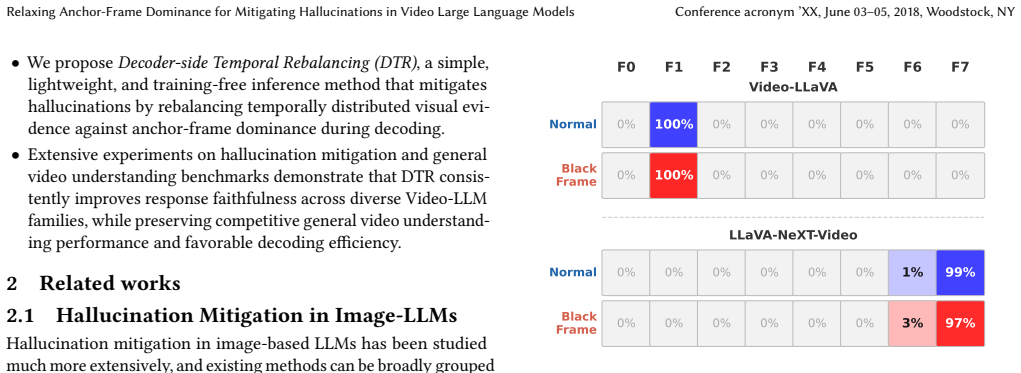
Video-LLMs exhibit a temporally imbalanced concentration pattern in which one anchor frame dominates aggregated attention mass; this bias appears model-specific and structural rather than input-dependent, and its over-dominance correlates with hallucination-prone generation. Decoder-side Temporal Rebalancing counters the imbalance by adaptively calibrating visual attention in selected decoder layers, guiding the model to ground responses in temporally broader evidence.
What carries the argument
The anchor frame, defined as the video frame with the highest aggregated frame-level attention mass, whose dominance DTR relaxes through layer-selective attention calibration.
If this is right
- DTR improves hallucination robustness across multiple Video-LLM families on existing benchmarks.
- Video understanding performance remains competitive after the adjustment.
- Inference efficiency stays high because the method requires no training or auxiliary models.
- The decoder is guided to draw on a wider set of temporal frames when forming responses.
Where Pith is reading between the lines
- The finding suggests hallucinations in these models stem more from decoder positional biases than from the visual encoder itself.
- Similar selective rebalancing could be tested on other sequential modalities such as audio or long text to reduce analogous attention skews.
- The approach may generalize to other forms of attention imbalance in multimodal models without requiring parameter updates.
Load-bearing premise
The anchor-frame bias is largely independent of the input video and instead reflects a persistent, model-specific structural or positional bias whose over-dominance is closely associated with hallucination-prone generation.
What would settle it
A controlled test in which the identified anchor frame changes substantially across different input videos, or in which DTR produces no measurable reduction in hallucination rates on standard benchmarks, would falsify the central claim.
Figures



read the original abstract
Recent Video Large Language Models (Video-LLMs) have demonstrated strong capability in video understanding, yet they still suffer from hallucinations. Existing mitigation methods typically rely on training, input modification, auxiliary guidance, or additional decoding procedures, while largely overlooking a more fundamental challenge. During generation, Video-LLMs tend to over-rely on a limited portion of temporal evidence, leading to temporally imbalanced evidence aggregation across the video. To address this issue, we investigate a decoder-side phenomenon in which the model exhibits a temporally imbalanced concentration pattern. We term the frame with the highest aggregated frame-level attention mass the anchor frame. We find that this bias is largely independent of the input video and instead appears to reflect a persistent, model-specific structural or positional bias, whose over-dominance is closely associated with hallucination-prone generation. Motivated by this insight, we propose Decoder-side Temporal Rebalancing (DTR), a training-free, layer-selective inference method that rebalances temporal evidence allocation in middle-to-late decoder layers without altering visual encoding or requiring auxiliary models. DTR adaptively calibrates decoder-side visual attention to alleviate temporally imbalanced concentration and encourage under-attended frames to contribute more effectively to response generation. In this way, DTR guides the decoder to ground its outputs in temporally broader and more balanced video evidence. Extensive experiments on hallucination and video understanding benchmarks show that DTR consistently improves hallucination robustness across diverse Video-LLM families, while preserving competitive video understanding performance and high inference efficiency.
Editorial analysis
A structured set of objections, weighed in public.
Referee Report
Summary. The paper identifies a decoder-side 'anchor-frame' phenomenon in Video-LLMs, in which attention mass concentrates on a single frame that is largely independent of video content and instead reflects a model-specific structural bias; this over-dominance is posited to drive hallucination-prone generation. The authors introduce Decoder-side Temporal Rebalancing (DTR), a training-free, layer-selective inference intervention that adaptively rebalances visual attention in middle-to-late decoder layers to promote temporally broader evidence aggregation. Extensive experiments on hallucination and video-understanding benchmarks are reported to show consistent gains in hallucination robustness across multiple Video-LLM families while preserving competitive understanding performance and inference speed.
Significance. If the claimed causal link between anchor-frame dominance and hallucinations is substantiated, the work supplies a lightweight, training-free, and architecture-agnostic mitigation strategy that avoids auxiliary models or input modifications. The emphasis on decoder-side rebalancing without retraining or efficiency loss is a practical strength for deployment of existing Video-LLMs.
major comments (2)
- [§3] §3 (Motivation and Observations): The central assertion that the anchor-frame bias 'is largely independent of the input video' and 'reflects a persistent, model-specific structural or positional bias' is presented as an empirical finding but is not supported by quantitative measurements (e.g., variance or entropy of the anchor index across videos, mutual information between anchor location and video features, or controlled ablations that isolate dominance from other attention statistics). Without such metrics, it remains unclear whether DTR's benefit arises specifically from relaxing the claimed model-specific bias or from generic attention smoothing.
- [§4] §4 (Experiments): The abstract and experimental claims state that DTR 'consistently improves hallucination robustness' and 'preserves competitive video understanding performance,' yet no numerical values, baseline comparisons, statistical significance tests, or ablation results isolating the rebalancing component are provided in the summary sections. This absence makes it impossible to assess the magnitude or robustness of the reported gains relative to the weakest-assumption concern.
minor comments (2)
- [§3] Notation for 'aggregated frame-level attention mass' and the precise definition of the anchor frame should be formalized with an equation early in §3 to avoid ambiguity when describing the rebalancing operation.
- [§4] The paper would benefit from a short table summarizing the exact Video-LLM families, benchmark names, and hallucination metrics used, even if full results appear later.
Simulated Author's Rebuttal
We thank the referee for the constructive comments, which help clarify the presentation of our empirical observations and experimental results. We address each major comment below and outline targeted revisions to strengthen the manuscript.
read point-by-point responses
-
Referee: [§3] §3 (Motivation and Observations): The central assertion that the anchor-frame bias 'is largely independent of the input video' and 'reflects a persistent, model-specific structural or positional bias' is presented as an empirical finding but is not supported by quantitative measurements (e.g., variance or entropy of the anchor index across videos, mutual information between anchor location and video features, or controlled ablations that isolate dominance from other attention statistics). Without such metrics, it remains unclear whether DTR's benefit arises specifically from relaxing the claimed model-specific bias or from generic attention smoothing.
Authors: We agree that additional quantitative support would strengthen the claim. In the current manuscript, §3 presents the observation through consistent anchor-frame patterns across diverse video inputs (visualized in Figure 2 and accompanying examples), which appear independent of content. However, we did not report explicit metrics such as variance/entropy of the anchor index or mutual information with video features. We will add these quantitative measurements in the revised §3, along with a controlled ablation comparing DTR against generic attention smoothing baselines. This will better isolate the effect of relaxing the model-specific bias and substantiate the motivation for DTR. revision: yes
-
Referee: [§4] §4 (Experiments): The abstract and experimental claims state that DTR 'consistently improves hallucination robustness' and 'preserves competitive video understanding performance,' yet no numerical values, baseline comparisons, statistical significance tests, or ablation results isolating the rebalancing component are provided in the summary sections. This absence makes it impossible to assess the magnitude or robustness of the reported gains relative to the weakest-assumption concern.
Authors: The detailed numerical results, baseline comparisons, and ablations isolating the rebalancing component are provided in §4 (including Tables 1–4 and Figure 4). However, we acknowledge that the abstract and high-level summary sections contain only qualitative claims without specific numbers or significance tests. In the revision, we will incorporate key quantitative improvements (e.g., hallucination reduction percentages and understanding benchmark deltas) into the abstract and add a concise summary of statistical significance and ablation outcomes in the introduction to allow readers to assess magnitude and robustness without immediately consulting the full experimental section. revision: yes
Circularity Check
No circularity: empirical intervention validated externally
full rationale
The paper identifies an observed decoder-side attention pattern (anchor frame), proposes a training-free rebalancing heuristic DTR applied at inference time, and reports performance gains on independent hallucination and video-understanding benchmarks. No equations, fitted parameters, or self-citations are shown that would make the claimed improvement or the bias-independence statement equivalent to the authors' own inputs by construction. The derivation chain therefore remains self-contained against external test sets.
Axiom & Free-Parameter Ledger
Reference graph
Works this paper leans on
-
[1]
Kyungho Bae, Jinhyung Kim, Sihaeng Lee, Soonyoung Lee, Gunhee Lee, and Jinwoo Choi. 2025. Mash-vlm: Mitigating action-scene hallucination in video- llms through disentangled spatial-temporal representations. InProceedings of the Computer Vision and Pattern Recognition Conference. 13744–13753
2025
-
[2]
Shuai Bai, Yuxuan Cai, Ruizhe Chen, Keqin Chen, Xionghui Chen, Zesen Cheng, Lianghao Deng, Wei Ding, Chang Gao, Chunjiang Ge, et al . 2025. Qwen3-vl technical report.arXiv preprint arXiv:2511.21631(2025)
work page internal anchor Pith review Pith/arXiv arXiv 2025
-
[3]
Shuai Bai, Keqin Chen, Xuejing Liu, Jialin Wang, Wenbin Ge, Sibo Song, Kai Dang, Peng Wang, Shijie Wang, Jun Tang, Humen Zhong, Yuanzhi Zhu, Mingkun Yang, Zhaohai Li, Jianqiang Wan, Pengfei Wang, Wei Ding, Zheren Fu, Yiheng Xu, Jiabo Ye, Xi Zhang, Tianbao Xie, Zesen Cheng, Hang Zhang, Zhibo Yang, Haiyang Xu, and Junyang Lin. 2025. Qwen2.5-VL Technical Rep...
work page internal anchor Pith review Pith/arXiv arXiv 2025
- [4]
-
[5]
Zesen Cheng, Sicong Leng, Hang Zhang, Yifei Xin, Xin Li, Guanzheng Chen, Yongxin Zhu, Wenqi Zhang, Ziyang Luo, Deli Zhao, et al. 2024. Videollama 2: Advancing spatial-temporal modeling and audio understanding in video-llms. arXiv preprint arXiv:2406.07476(2024)
work page internal anchor Pith review arXiv 2024
-
[6]
Wey Yeh Choong, Yangyang Guo, and Mohan Kankanhalli. 2024. Vidhal: Bench- marking temporal hallucinations in vision llms.arXiv preprint arXiv:2411.16771 (2024)
work page internal anchor Pith review Pith/arXiv arXiv 2024
-
[7]
Xinpeng Ding, Jianhua Han, Hang Xu, Xiaodan Liang, Wei Zhang, and Xiaomeng Li. 2024. Holistic autonomous driving understanding by bird’s-eye-view injected multi-modal large models. InProceedings of the IEEE/CVF Conference on Computer Vision and Pattern Recognition. 13668–13677
2024
- [8]
-
[9]
Alessandro Favero, Luca Zancato, Matthew Trager, Siddharth Choudhary, Pra- muditha Perera, Alessandro Achille, Ashwin Swaminathan, and Stefano Soatto
-
[10]
InPro- ceedings of the IEEE/CVF Conference on Computer Vision and Pattern Recognition
Multi-modal hallucination control by visual information grounding. InPro- ceedings of the IEEE/CVF Conference on Computer Vision and Pattern Recognition. 14303–14312
-
[11]
Chaoyou Fu, Yuhan Dai, Yongdong Luo, Lei Li, Shuhuai Ren, Renrui Zhang, Zihan Wang, Chenyu Zhou, Yunhang Shen, Mengdan Zhang, et al. 2025. Video-mme: The first-ever comprehensive evaluation benchmark of multi-modal llms in video analysis. InProceedings of the IEEE/CVF conference on computer vision and pattern recognition. 24108–24118
2025
- [12]
-
[13]
Anisha Gunjal, Jihan Yin, and Erhan Bas. 2024. Detecting and preventing halluci- nations in large vision language models. InProceedings of the AAAI Conference on Artificial Intelligence, Vol. 38. 18135–18143
2024
-
[14]
Wen Huang, Hongbin Liu, Minxin Guo, and Neil Gong. 2024. Visual hallucina- tions of multi-modal large language models. InFindings of the Association for Computational Linguistics: ACL 2024. 9614–9631
2024
- [15]
-
[16]
Ming Kong, Xianzhou Zeng, Luyuan Chen, Yadong Li, Bo Yan, and Qiang Zhu
-
[17]
InProceedings of the AAAI Conference on Artificial Intelligence, Vol
Mhbench: Demystifying motion hallucination in videollms. InProceedings of the AAAI Conference on Artificial Intelligence, Vol. 39. 4401–4409
-
[18]
Sicong Leng, Hang Zhang, Guanzheng Chen, Xin Li, Shijian Lu, Chunyan Miao, and Lidong Bing. 2024. Mitigating object hallucinations in large vision-language models through visual contrastive decoding. InProceedings of the IEEE/CVF Conference on Computer Vision and Pattern Recognition. 13872–13882
2024
-
[19]
Chaoyu Li, Eun Woo Im, and Pooyan Fazli. 2025. Vidhalluc: Evaluating temporal hallucinations in multimodal large language models for video understanding. In Proceedings of the IEEE/CVF Conference on Computer Vision and Pattern Recognition. 13723–13733
2025
-
[20]
KunChang Li, Yinan He, Yi Wang, Yizhuo Li, Wenhai Wang, Ping Luo, Yali Wang, Limin Wang, and Yu Qiao. 2025. Videochat: Chat-centric video understanding. Science China Information Sciences68, 10 (2025), 200102
2025
-
[21]
Kunchang Li, Yali Wang, Yinan He, Yizhuo Li, Yi Wang, Yi Liu, Zun Wang, Jilan Xu, Guo Chen, Ping Luo, et al. 2024. Mvbench: A comprehensive multi-modal video understanding benchmark. InProceedings of the IEEE/CVF Conference on Computer Vision and Pattern Recognition. 22195–22206
2024
- [22]
-
[23]
Bin Lin, Yang Ye, Bin Zhu, Jiaxi Cui, Munan Ning, Peng Jin, and Li Yuan. 2024. Video-llava: Learning united visual representation by alignment before projection. InProceedings of the 2024 conference on empirical methods in natural language processing. 5971–5984
2024
-
[24]
Qika Lin, Yifan Zhu, Xin Mei, Ling Huang, Jingying Ma, Kai He, Zhen Peng, Erik Cambria, and Mengling Feng. 2025. Has multimodal learning delivered universal intelligence in healthcare? A comprehensive survey.Information Fusion116 (2025), 102795
2025
-
[25]
Shi Liu, Kecheng Zheng, and Wei Chen. 2024. Paying more attention to image: A training-free method for alleviating hallucination in lvlms. InEuropean Conference on Computer Vision. Springer, 125–140
2024
-
[26]
Fan Ma, Xiaojie Jin, Heng Wang, Yuchen Xian, Jiashi Feng, and Yi Yang. 2024. Vista-llama: Reducing hallucination in video language models via equal distance to visual tokens. InProceedings of the IEEE/CVF Conference on Computer Vision and Pattern Recognition. 13151–13160
2024
-
[27]
Muhammad Maaz, Hanoona Rasheed, Salman Khan, and Fahad Khan. 2024. Video-chatgpt: Towards detailed video understanding via large vision and lan- guage models. InProceedings of the 62nd Annual Meeting of the Association for Computational Linguistics (Volume 1: Long Papers). 12585–12602
2024
-
[28]
Maxime Oquab, Timothée Darcet, Théo Moutakanni, Huy Vo, Marc Szafraniec, Vasil Khalidov, Pierre Fernandez, Daniel Haziza, Francisco Massa, Alaaeldin El- Nouby, et al. 2023. Dinov2: Learning robust visual features without supervision. arXiv preprint arXiv:2304.07193(2023)
work page internal anchor Pith review Pith/arXiv arXiv 2023
-
[29]
Yunlong Tang, Jing Bi, Siting Xu, Luchuan Song, Susan Liang, Teng Wang, Daoan Zhang, Jie An, Jingyang Lin, Rongyi Zhu, et al. 2025. Video understanding with large language models: A survey.IEEE Transactions on Circuits and Systems for Video Technology(2025)
2025
-
[30]
Weiyun Wang, Zhangwei Gao, Lixin Gu, Hengjun Pu, Long Cui, Xingguang Wei, Zhaoyang Liu, Linglin Jing, Shenglong Ye, Jie Shao, et al. 2025. Internvl3. 5: Ad- vancing open-source multimodal models in versatility, reasoning, and efficiency. arXiv preprint arXiv:2508.18265(2025)
work page internal anchor Pith review Pith/arXiv arXiv 2025
-
[31]
Xintong Wang, Jingheng Pan, Liang Ding, and Chris Biemann. 2024. Mitigat- ing hallucinations in large vision-language models with instruction contrastive decoding. InFindings of the Association for Computational Linguistics: ACL 2024. 15840–15853
2024
-
[32]
Yuxuan Wang, Yueqian Wang, Dongyan Zhao, Cihang Xie, and Zilong Zheng
- [33]
- [34]
-
[35]
Hao Yin, Guangzong Si, and Zilei Wang. 2025. Clearsight: Visual signal en- hancement for object hallucination mitigation in multimodal large language models. InProceedings of the Computer Vision and Pattern Recognition Conference. 14625–14634
2025
-
[36]
Shukang Yin, Chaoyou Fu, Sirui Zhao, Tong Xu, Hao Wang, Dianbo Sui, Yunhang Shen, Ke Li, Xing Sun, and Enhong Chen. 2024. Woodpecker: Hallucination correction for multimodal large language models.Science China Information Sciences67, 12 (2024), 220105
2024
-
[37]
Tianyu Yu, Yuan Yao, Haoye Zhang, Taiwen He, Yifeng Han, Ganqu Cui, Jinyi Hu, Zhiyuan Liu, Hai-Tao Zheng, Maosong Sun, et al . 2024. Rlhf-v: Towards trustworthy mllms via behavior alignment from fine-grained correctional human feedback. InProceedings of the IEEE/CVF Conference on Computer Vision and Pattern Recognition. 13807–13816. Conference acronym ’XX...
2024
-
[38]
Hang Zhang, Xin Li, and Lidong Bing. 2023. Video-llama: An instruction-tuned audio-visual language model for video understanding. InProceedings of the 2023 conference on empirical methods in natural language processing: system demon- strations. 543–553
2023
- [39]
-
[40]
Yuanhan Zhang, Bo Li, haotian Liu, Yong jae Lee, Liangke Gui, Di Fu, Jiashi Feng, Ziwei Liu, and Chunyuan Li. 2024. LLaVA-NeXT: A Strong Zero-shot Video Understanding Model. https://llava-vl.github.io/blog/2024-04-30-llava-next- video/
2024
- [41]
-
[42]
Ke Zhu, Yu Wang, Yanpeng Sun, Qiang Chen, Jiangjiang Liu, Gang Zhang, and Jingdong Wang. 2025. Continual sft matches multimodal rlhf with negative super- vision. InProceedings of the Computer Vision and Pattern Recognition Conference. 14615–14624
2025
-
[43]
Xin Zou, Yizhou Wang, Yibo Yan, Yuanhuiyi Lyu, Kening Zheng, Sirui Huang, Junkai Chen, Peijie Jiang, Jia Liu, Chang Tang, et al . 2024. Look twice before you answer: Memory-space visual retracing for hallucination mitigation in mul- timodal large language models.arXiv preprint arXiv:2410.03577(2024). A Robustness Across Frame Sampling We further examine w...
discussion (0)
Sign in with ORCID, Apple, or X to comment. Anyone can read and Pith papers without signing in.