Recognition: unknown
Experimental demonstration for precisely tuning the focal length of finite-aperture focused beams and vortex
Pith reviewed 2026-05-10 14:10 UTC · model grok-4.3
The pith
The focal length of finite-aperture focused ultrasound beams varies approximately linearly with excitation frequency near the design frequency.
A machine-rendered reading of the paper's core claim, the machinery that carries it, and where it could break.
Core claim
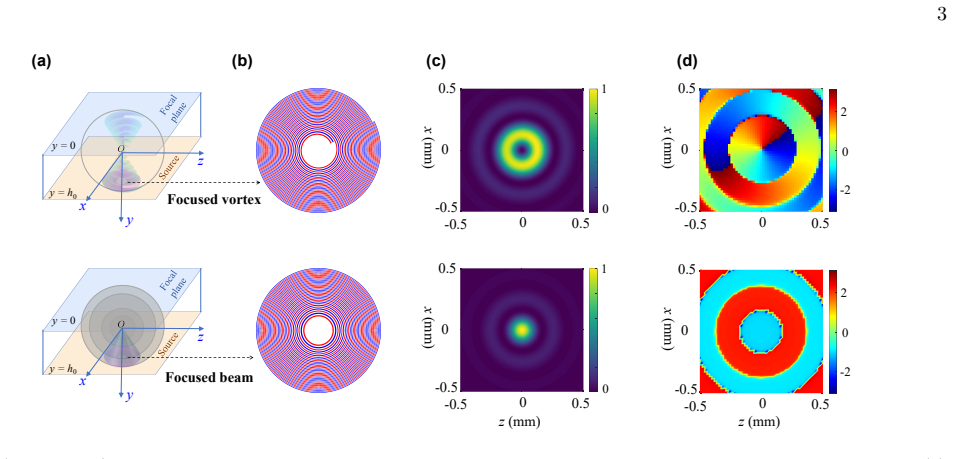
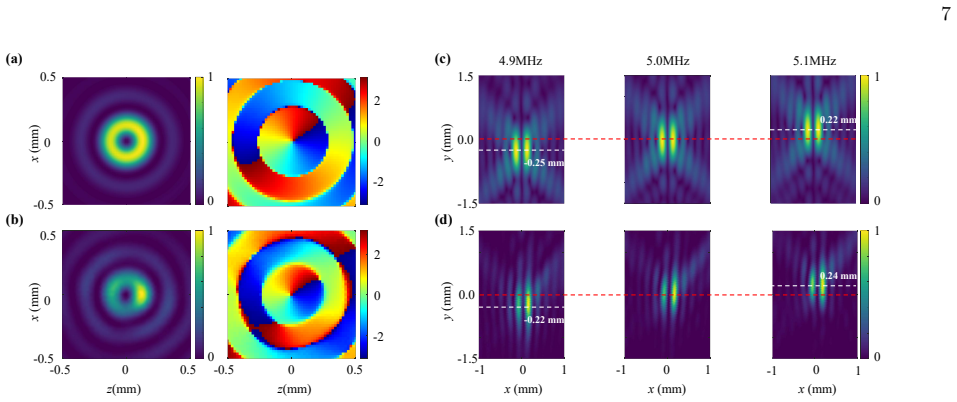
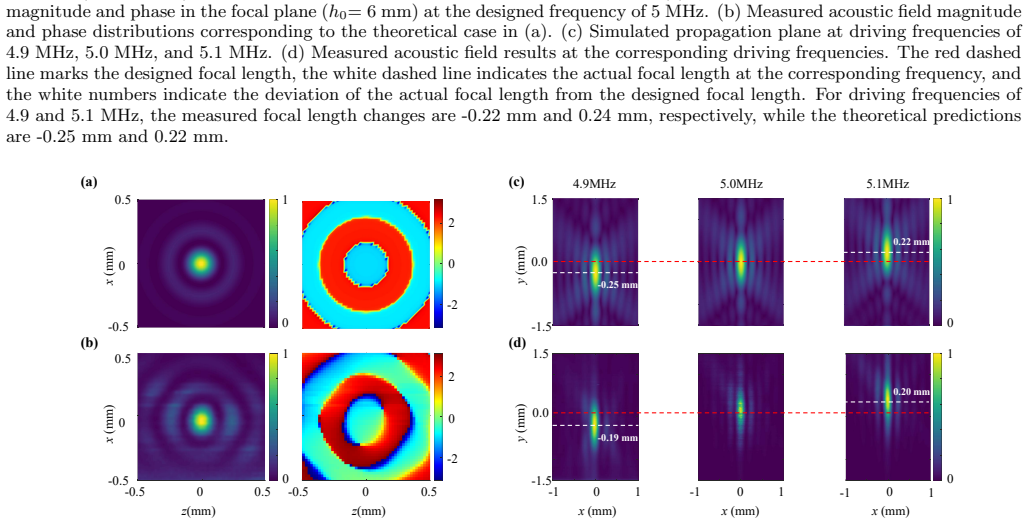
By truncating an ideal spherical wavefront with a plane, a finite-aperture focused beam is produced whose focal length varies approximately linearly with excitation frequency near the design frequency. The finite-range tuning is interpreted using the stationary-phase condition. Both theory and water-tank measurements agree that the focal length changes linearly with frequency, validating the model.
What carries the argument
Truncation of an ideal spherical wavefront by a plane to form a finite-aperture transducer, with focal position determined by the stationary-phase condition.
If this is right
- Focal tuning is possible without mechanical adjustments or complex control systems.
- The device is compact and planar, allowing easy integration with microscopic platforms.
- High-frequency focused ultrasound can be dynamically adjusted for applications like imaging and particle manipulation.
- The linear relation holds near the design frequency, enabling precise control within a finite range.
Where Pith is reading between the lines
- This frequency-based tuning could simplify real-time adjustments in biomedical ultrasound applications.
- The approach may extend to generating and tuning acoustic vortex beams as suggested by the title.
- Operation away from the design frequency might introduce non-linear effects not captured by the current model.
Load-bearing premise
The stationary-phase condition and the truncated spherical wavefront model accurately describe the finite-aperture acoustic field near the design frequency.
What would settle it
Water-tank measurements near the design frequency that show the focal length does not vary linearly with excitation frequency or deviate from the theoretical prediction.
Figures

read the original abstract
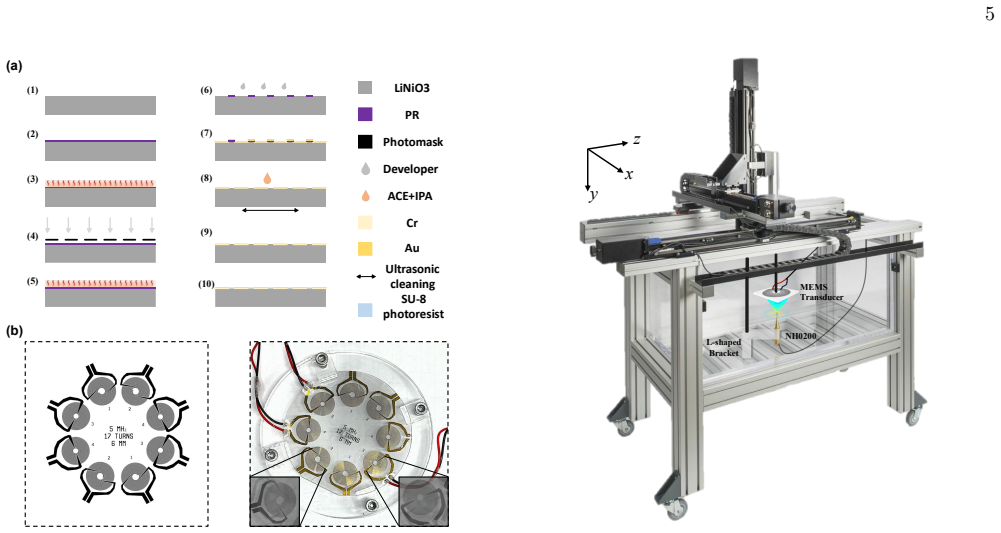
High-frequency focused ultrasound is widely used in biomedical applications such as high-resolution imaging, neuromodulation, particle manipulation, and so on. However, dynamic tuning of the focal plane in conventional systems often relies on mechanically adjustable components or array-based control with complex system and high cost. In this work, an optically transparent, planar compact piezoelectric ultrasonic transducer was designed and fabricated by truncating an ideal spherical wavefront with a plane, enabling high-frequency focused ultrasound generation and convenient integration with microscopic platforms. The acoustic field was characterized experimentally at the focal plane under the design frequency and at propagation planes near the design frequency to evaluate the focal tuning. An approximate linear relation between the focal length and driving frequency near the design one is derived theoretically, and the finite-range tuning behavior is interpreted using the stationary-phase condition. Both theory and experiment show that the focal length varies approximately linearly with excitation frequency near the design frequency. Water-tank measurements agree well with the theoretical prediction, confirming the proposed model. This work provides a simple and cost-effective approach for focal tuning in compact high-frequency ultrasound devices.
Editorial analysis
A structured set of objections, weighed in public.
Referee Report
Summary. The manuscript presents the design and fabrication of an optically transparent planar piezoelectric ultrasonic transducer formed by truncating an ideal spherical wavefront with a plane. This produces high-frequency focused ultrasound suitable for integration with microscopic platforms. Using stationary-phase analysis on the truncated-wavefront model, the authors derive an approximate linear relation between focal length and excitation frequency near the design frequency. Water-tank experiments characterize the acoustic field at the focal plane under the design frequency and at nearby propagation planes, with the data reported to agree with the theoretical prediction of linear focal tuning.
Significance. If the central claim holds, the work offers a passive, frequency-based method for focal-length tuning in compact high-frequency ultrasound transducers without mechanical components or phased arrays. This is potentially useful for biomedical applications such as imaging and neuromodulation. The combination of a stationary-phase derivation with experimental checks is a strength, though the experimental validation lacks quantitative rigor.
major comments (1)
- [Experimental results] Experimental results section: The manuscript states that water-tank measurements 'agree well' with the theoretical prediction and thereby confirm the model, yet reports no error bars on measured focal positions, no quantitative fit metrics (e.g., slope comparison, R², or residual analysis), and no details on data acquisition, focal-position extraction algorithm, or exclusion criteria. Because the linear-tuning claim rests on this experimental confirmation, the absence of these elements leaves the strength of the validation unclear.
Simulated Author's Rebuttal
We thank the referee for the thoughtful review and for identifying ways to strengthen the experimental validation. We have revised the manuscript to incorporate additional quantitative details, methodological information, and metrics as outlined below.
read point-by-point responses
-
Referee: Experimental results section: The manuscript states that water-tank measurements 'agree well' with the theoretical prediction and thereby confirm the model, yet reports no error bars on measured focal positions, no quantitative fit metrics (e.g., slope comparison, R², or residual analysis), and no details on data acquisition, focal-position extraction algorithm, or exclusion criteria. Because the linear-tuning claim rests on this experimental confirmation, the absence of these elements leaves the strength of the validation unclear.
Authors: We agree that the experimental validation would be more robust with explicit quantitative reporting. In the revised manuscript we have added: (i) error bars on all measured focal positions derived from repeated scans at each frequency; (ii) a description of the data-acquisition protocol (hydrophone positioning, sampling rate, and averaging); (iii) the focal-position extraction procedure (parabolic fit to the on-axis intensity profile to locate the peak); and (iv) a linear regression of the experimental focal lengths versus frequency, including the fitted slope, its uncertainty, the R² value, and a direct comparison with the theoretical slope. These additions confirm the linear trend within the stated uncertainty and directly address the concern about the strength of the validation. revision: yes
Circularity Check
No significant circularity identified
full rationale
The central derivation applies the standard stationary-phase approximation to a truncated spherical wavefront model whose phase profile is fixed by geometry; the resulting approximate linear focal-length vs. frequency relation is obtained directly from that analytic step and is then compared against independent water-tank measurements. No parameter is fitted to the target data and then re-labeled as a prediction, no self-citation supplies a load-bearing uniqueness theorem, and the model assumptions are stated explicitly without reducing to the experimental outcome. The reported agreement therefore constitutes external confirmation rather than a closed loop.
Axiom & Free-Parameter Ledger
axioms (1)
- domain assumption The acoustic pressure field of the finite-aperture transducer can be modeled by truncating an ideal spherical wavefront with a plane.
Reference graph
Works this paper leans on
-
[1]
Following the steps above, the sound field at any target position can be calculated as: pin(x, y, z) = 1 4π2 ZZ k2x+k2z≤k2 S(k x, kz) y=0 ×e ikxx+ikzz+i √ k2−k2x−k2zydkxdkz
to the target plane (y=y s), andk y = p k2 −k 2x −k 2z is they-component of the wave vector. Following the steps above, the sound field at any target position can be calculated as: pin(x, y, z) = 1 4π2 ZZ k2x+k2z≤k2 S(k x, kz) y=0 ×e ikxx+ikzz+i √ k2−k2x−k2zydkxdkz. (10) Here, the integration is confined to the regionk 2 x +k 2 z ≤ k2, so as to eliminate ...
2030
-
[2]
F. S. Foster, C. J. Pavlin, K. A. Harasiewicz, D. A. Christopher, and D. H. Turnbull, Advances in ultrasound biomicroscopy, Ultrasound in medicine & biology26, 1 (2000)
2000
-
[3]
G. R. Ter Haar, High intensity focused ultrasound for the treatment of tumors, Echocardiography18, 317 (2001)
2001
-
[4]
Izadifar, Z
Z. Izadifar, Z. Izadifar, D. Chapman, and P. Babyn, An introduction to high intensity focused ultrasound: sys- tematic review on principles, devices, and clinical appli- cations, Journal of clinical medicine9, 460 (2020)
2020
-
[5]
S. Li, L. Chen, Y. Feng, X. Cheng, and Z. Gong, A review on single-beam acoustical tweezers: From tractor beam to selective trapping, Ultrasonics , 108061 (2026)
2026
-
[6]
Baudoin and J.-L
M. Baudoin and J.-L. Thomas, Acoustic tweezers for particle and fluid micromanipulation, Annual Review of Fluid Mechanics52, 205 (2020)
2020
-
[7]
Baudoin, J.-L
M. Baudoin, J.-L. Thomas, R. A. Sahely, J.-C. Gerbe- doen, Z. Gong, A. Sivery, O. B. Matar, N. Smagin, P. Favreau, and A. Vlandas, Spatially selective manipula- tion of cells with single-beam acoustical tweezers, Nature communications11, 4244 (2020)
2020
-
[8]
Malietzis, L
G. Malietzis, L. Monzon, J. Hand, H. Wasan, E. Leen, M. Abel, A. Muhammad, P. Price, and P. Abel, High- intensity focused ultrasound: advances in technology and experimental trials support enhanced utility of focused ultrasound surgery in oncology, The British journal of radiology86, 20130044 (2013)
2013
-
[9]
Zhang, Z
X. Zhang, Z. Zeng, and Z. Wang, The design method and test of a dual-focused ultrasound transducer toward small and adjustable f-numbers, Applied Acoustics224, 110148 (2024)
2024
-
[10]
L. Azar, Y. Shi, and S.-C. Wooh, Beam focusing behavior of linear phased arrays, NDT & e International33, 189 (2000)
2000
-
[11]
Hynynen and R
K. Hynynen and R. M. Jones, Image-guided ultra- sound phased arrays are a disruptive technology for non- invasive therapy, Physics in Medicine & Biology61, R206 (2016)
2016
-
[12]
Kim and M
J. Kim and M. Kim, Focal position control of ultrasonic transducer made of plano-concave form piezoelectric vi- brator, Ultrasonics121, 106668 (2022)
2022
-
[13]
Zhang, H
T. Zhang, H. Hu, H. Jiang, Z. Wang, J. Lin, Y. Cheng, W. Guo, D. Ke, H. Hang, M. Ta,et al., Knn- based frequency-adjustable ferroelectric heterojunction and biomedical applications, Nature Communications 16, 7120 (2025)
2025
-
[14]
Baudoin, J.-C
M. Baudoin, J.-C. Gerbedoen, A. Riaud, O. B. Matar, N. Smagin, and J.-L. Thomas, Folding a focalized acous- tical vortex on a flat holographic transducer: Miniatur- ized selective acoustical tweezers, Science advances5, eaav1967 (2019)
2019
-
[15]
Gong and M
Z. Gong and M. Baudoin, Single beam acoustical tweez- ers based on focused beams: A numerical analysis of two- dimensional and three-dimensional trapping capabilities, Physical Review Applied18, 044033 (2022)
2022
-
[16]
Li and Z
S. Li and Z. Gong, Reversing the acoustic contrast factor by tuning the medium can make focused beams trap cells in three dimensions, Physics of Fluids37, 012003 (2025)
2025
-
[17]
Gong and M
Z. Gong and M. Baudoin, Three-dimensional trapping and dynamic axial manipulation with frequency-tuned spiraling acoustical tweezers: A theoretical study, Phys- ical Review Applied16, 024034 (2021)
2021
-
[18]
C. Song, L. Xi, and H. Jiang, Acoustic lens with vari- able focal length for photoacoustic microscopy, Journal of Applied Physics114, 194703 (2013)
2013
-
[19]
C. M. Donahue, P. W. Anzel, L. Bonanomi, T. A. Keller, and C. Daraio, Experimental realization of a nonlinear acoustic lens with a tunable focus, Applied Physics Let- ters104, 014103 (2014)
2014
-
[20]
Kujawska, W
T. Kujawska, W. Secomski, M. Byra, M. Postema, and A. Nowicki, Annular phased array transducer for preclin- ical testing of anti-cancer drug efficacy on small animals, Ultrasonics76, 92 (2017)
2017
-
[21]
M. M. El-Desouki and K. Hynynen, Driving circuitry for focused ultrasound noninvasive surgery and drug delivery applications, Sensors11, 539 (2011)
2011
-
[22]
R. D. Muelas-Hurtado, J. L. Ealo, and K. Volke- Sep´ ulveda, Active-spiral fresnel zone plate with tunable focal length for airborne generation of focused acoustic vortices, Applied Physics Letters116, 114101 (2020)
2020
-
[23]
Baresch, J.-L
D. Baresch, J.-L. Thomas, and R. Marchiano, Spherical vortex beams of high radial degree for enhanced single- beam tweezers, Journal of Applied Physics113, 184901 (2013)
2013
-
[24]
G. B. Arfken, H. J. Weber, and F. E. Harris,Mathe- matical methods for physicists: a comprehensive guide (Academic press, 2011)
2011
discussion (0)
Sign in with ORCID, Apple, or X to comment. Anyone can read and Pith papers without signing in.