Recognition: unknown
Distributional Change in Ordinal Data with Missing Observations: Minimal Mobility and Partial Identification
Pith reviewed 2026-05-10 13:55 UTC · model grok-4.3
The pith
The L1 distance between cumulative distribution functions represents the minimal reallocation of probability mass across ordered categories, yielding a scalar measure and minimal-mobility configurations of distributional change that can be,
A machine-rendered reading of the paper's core claim, the machinery that carries it, and where it could break.
Core claim
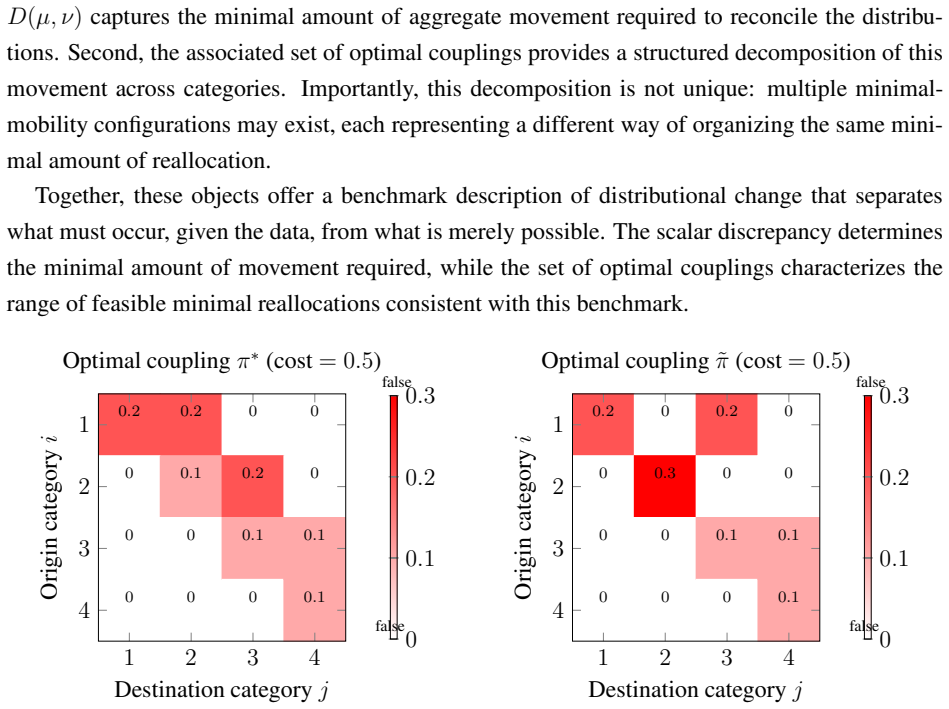
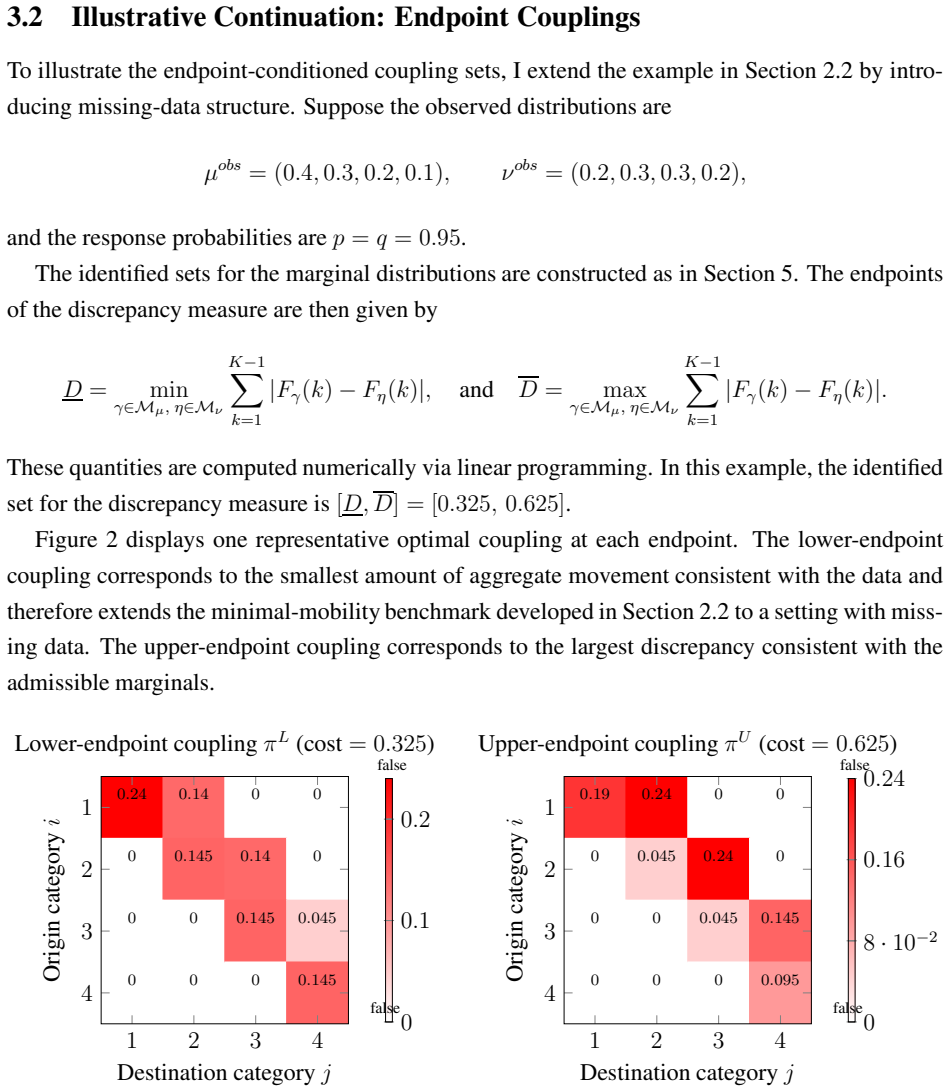
The L1 distance between cumulative distribution functions admits an optimal transport representation as the minimal reallocation of probability mass across ordered categories. This yields both a scalar measure of discrepancy and a structured characterization of how distributional change must occur, which the paper terms minimal-mobility configurations. To address missing data, a partial identification approach delivers sharp bounds on the marginal distributions and, in turn, on both the discrepancy measure and its associated configurations.
What carries the argument
The optimal transport representation of the L1 distance between cumulative distribution functions, which characterizes minimal-mobility configurations of distributional change.
If this is right
- A scalar measure of distributional discrepancy is obtained for ordinal data under limited information.
- Minimal-mobility configurations describe the structure any observed change must satisfy.
- Sharp bounds on both the measure and configurations are available despite missing observations.
- Inference on the bounds proceeds with standard resampling methods.
- Sensitivity of the results to nonresponse can be assessed directly from the data.
Where Pith is reading between the lines
- Comparing observed changes to the minimal-mobility configurations would indicate how much additional reallocation beyond the minimum is present.
- The same representation could be used to bound mobility measures when only repeated cross-sections rather than true panels are available.
- Additional identifying assumptions on response behavior could be layered on top to narrow the bounds further in specific applications.
Load-bearing premise
The partial identification approach based on observed marginal information from repeated cross-sections produces sharp bounds on the marginal distributions and thereby on the discrepancy measure and minimal-mobility configurations.
What would settle it
Panel data that reveals joint distributions lying outside the partial identification bounds computed from the corresponding repeated cross-sectional marginals would show that the bounds are not sharp.
Figures


read the original abstract
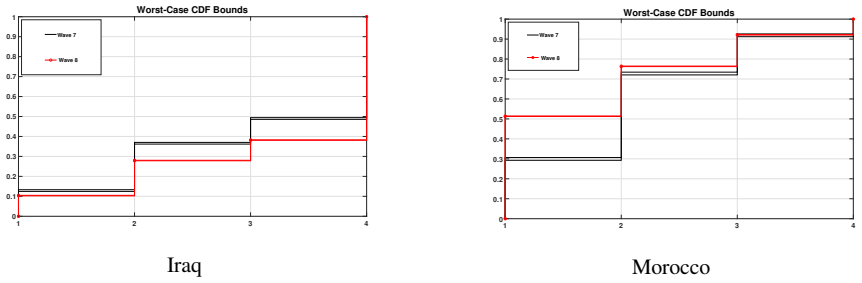
Empirical analyses of ordinal outcomes using repeated cross-sectional data rely on marginal distributions, leaving the joint distribution unobserved and the sources of distributional change unidentified. This paper develops a framework to measure and interpret such changes under limited information. The $L_1$ distance between cumulative distribution functions admits an optimal transport representation as the minimal reallocation of probability mass across ordered categories, which provides a foundation for the analysis. This yields both a scalar measure of discrepancy and a structured characterization of how distributional change must occur, which I term minimal-mobility configurations. To address missing data, I adopt a partial identification approach that delivers sharp bounds on the marginal distributions and, in turn, on both the discrepancy measure and its associated configurations. The resulting framework supports inference using standard resampling methods and provides a transparent basis for assessing sensitivity to nonresponse. An application to Arab Barometer data illustrates the approach.
Editorial analysis
A structured set of objections, weighed in public.
Referee Report
Summary. The paper develops a framework for measuring and interpreting distributional change in ordinal outcomes from repeated cross-sections with missing observations. It shows that the L1 distance between CDFs equals the minimal reallocation of probability mass under the natural ordering (via optimal transport), yielding both a scalar discrepancy measure and a characterization of 'minimal-mobility configurations'. A partial-identification strategy then supplies sharp bounds on the marginal distributions and, in turn, on the measure and configurations; the framework supports resampling-based inference and sensitivity analysis to nonresponse, illustrated with Arab Barometer data.
Significance. If the sharpness claims hold, the work offers a transparent, interpretable way to bound and decompose ordinal distributional change when only marginals are partially identified. It usefully combines a standard OT representation (W1 distance on ordered support) with partial-ID techniques to address a common data limitation in survey research. The application demonstrates feasibility, and the emphasis on configurations provides more than a scalar summary. Credit is due for the clean link between the transport representation and the mobility interpretation.
major comments (1)
- [Abstract] Abstract: the statement that partial identification 'delivers sharp bounds on the marginal distributions and, in turn, on both the discrepancy measure and its associated configurations' requires explicit justification that the joint identification region for the pair of marginals (F,G) is rectangular or that the extremal minimal-mobility plans are attained at the vertices of the separate marginal regions. If the missingness mechanism creates dependence across periods, the feasible set of transport plans inside the joint region may be strictly smaller than the product of the marginal bounds; the manuscript must characterize this joint region and recompute the configurations within it to confirm sharpness.
minor comments (2)
- The notation for minimal-mobility configurations and the associated transport plans should be introduced with a small numerical example early in the text to aid readability.
- Clarify whether the resampling procedure for inference accounts for the partial-identification step or treats the bounds as fixed.
Simulated Author's Rebuttal
We thank the referee for the constructive and positive report. The single major comment raises an important technical point about the joint identification region, which we address directly below. We will revise the manuscript to incorporate the requested clarification.
read point-by-point responses
-
Referee: [Abstract] Abstract: the statement that partial identification 'delivers sharp bounds on the marginal distributions and, in turn, on both the discrepancy measure and its associated configurations' requires explicit justification that the joint identification region for the pair of marginals (F,G) is rectangular or that the extremal minimal-mobility plans are attained at the vertices of the separate marginal regions. If the missingness mechanism creates dependence across periods, the feasible set of transport plans inside the joint region may be strictly smaller than the product of the marginal bounds; the manuscript must characterize this joint region and recompute the configurations within it to confirm sharpness.
Authors: We appreciate the referee's careful attention to the sharpness claim. The framework is developed for repeated cross-sectional surveys, where the two periods are sampled independently. The partial-identification analysis therefore treats the missingness process in each period separately, with no cross-period linkage in the sampling design or in the maintained assumptions on the nonresponse mechanism. As a result, the identification regions for the two marginal distributions F and G are independent, so that the joint identification region for the pair (F, G) is exactly the Cartesian product of the two marginal regions. Because the L1 discrepancy is a continuous functional of the pair of CDFs alone, its sharp bounds are obtained by optimizing over this product set. The associated minimal-mobility configurations are the optimal transport plans for the extremal pairs (F, G) lying on the boundary of the product region; these extrema are therefore attained at combinations of the vertices of the separate marginal identification sets. We will add an explicit paragraph to the abstract and to Section 3 (Partial Identification) stating the independence of the two cross-sections and confirming that the joint region is rectangular under the maintained sampling assumptions. A short remark will also be added noting that the rectangularity would not hold in a genuine panel with attrition, but that case lies outside the repeated-cross-section setting of the paper. revision: yes
Circularity Check
No circularity; derivation builds on external OT representation and partial-ID bounds without self-referential reduction
full rationale
The paper's core step equates the L1 distance on CDFs to the minimal reallocation distance via the standard optimal-transport representation for ordered support (a known result, not derived internally). Minimal-mobility configurations are then defined directly from this representation. Partial identification is invoked to bound the marginal distributions, with the discrepancy measure and configurations bounded 'in turn' as a consequence. No equation reduces the target quantities to fitted parameters by construction, no load-bearing premise rests on a self-citation chain, and no ansatz is smuggled via prior work by the same author. The framework remains self-contained against external benchmarks.
Axiom & Free-Parameter Ledger
axioms (1)
- domain assumption Categories are ordered and the ordering is known and fixed.
Reference graph
Works this paper leans on
-
[1]
Bickel, P . J. and D. A. Freedman (1981, 11). Some asymptotic t heory for the bootstrap. Ann. Statist. 9(6), 1196–1217
1981
-
[2]
Hong, and E
Chernozhukov, V ., H. Hong, and E. Tamer (2007). Estimation and confidence regions for parameter sets in econometric models. Econometrica 75(5), 1243–1284
2007
-
[3]
Daljord, O. y., G. Pouliot, J. Xiao, and M. Hu (2026). The blac k market for beijing license plates. Working paper, Rice University. D’Haultfoeuille, X., C. Gaillac, and A. Maurel (2024). Line ar regressions with combined data
2026
-
[4]
Galichon, and Y
Dupuy, A., A. Galichon, and Y . Sun (2019, 12). Estimating mat ching affinity matrices under low-rank constraints. Information and Inference: A Journal of the IMA 8 (4), 677–689
2019
-
[5]
Makdissi, W
Fakih, A., P . Makdissi, W. Marrouch, R. V . Tabri, and M. Y azbeck (2022). A stochastic dominance test under survey nonresponse with an application to compar ing trust levels in lebanese public institutions. Journal of Econometrics 228 (2), 342–358. Fréchet, M. (1935). Généralisations du théorème des probab ilités totales. Fundamenta Mathemat- icae 25, 3...
2022
-
[6]
Galichon, A. (2016). Optimal Transport Methods in Economics . Princeton University Press
2016
-
[7]
Galichon, A. and M. Henry (2011, 04). Set Identification in Mo dels with Multiple Equilibria. The Review of Economic Studies 78 (4), 1264–1298
2011
-
[8]
Galichon, A. and M. Henry (2026). An econometrician’s guide to optimal transport. Technical Report arXiv:2604.04227, arXiv. Working paper
work page internal anchor Pith review Pith/arXiv arXiv 2026
-
[9]
Galichon, A. and B. Salanié (2022). Cupid’s invisible hand: Social surplus and identification in matching models. The Review of Economic Studies 89 (5), 2600–2629
2022
-
[10]
Horowitz, J. L. and C. F. Manski (1995). Identification and ro bustness with contaminated and corrupted data. Econometrica 63(2), 281–302
1995
-
[11]
Horowitz, J. L. and C. F. Manski (2000). Nonparametric analy sis of randomized experiments with missing covariate and outcome data. Journal of the American Statistical Association 95 (449), 77–84. 25
2000
-
[12]
Jenkins, S. P . (2020, March). Comparing distributions of or dinal data. IZA Discussion Paper No.13057
2020
-
[13]
Manski, C. F. (2005). Partial identification with missing da ta: concepts and findings. International Journal of Approximate Reasoning 39 (2-3), 151–165
2005
-
[14]
Molinari, F. (2020). Microeconometrics with partial ident ification. In S. N. Durlauf, L. P . Hansen, J. J. Heckman, and R. L. Matzkin (Eds.), Handbook of Econometrics, V olume 7A, pp. 355–486. Elsevier
2020
-
[15]
Schennach, S. M. and V . Starck (2026). Optimally transporte d generalized method of moments. Econometrica. Forthcoming
2026
-
[16]
Shorrocks, A. F. (1978). The measurement of mobility. Econometrica 46(5), 1013–1024
1978
-
[17]
Sunada, K. and K. Izumi (2025). Optimal treatment assignmen t rules under capacity constraints. V allender, S. S. (1974). Calculation of the Wasserstein dis tance between probability distributions on the line. Theory of Probability & Its Applications 18 (4), 784–786
2025
-
[18]
Villani, C. (2009). Optimal Transport: Old and New . Grundlehren der mathematischen Wis- senschaften. Springer Berlin Heidelberg. A Proofs of Results A.1 Proposition 1 Proof. The result follows from the one-dimensional characterizat ion of the Wasserstein-1 distance as the L1 distance between cumulative distribution functions descr ibed in V allender (197...
2009
discussion (0)
Sign in with ORCID, Apple, or X to comment. Anyone can read and Pith papers without signing in.