Recognition: 2 theorem links
· Lean TheoremNeural Dynamic GI: Random-Access Neural Compression for Temporal Lightmaps in Dynamic Lighting Environments
Pith reviewed 2026-05-13 06:16 UTC · model grok-4.3
The pith
Neural networks encode temporal lightmap sets into compact feature maps that reconstruct dynamic global illumination at runtime with low storage cost.
A machine-rendered reading of the paper's core claim, the machinery that carries it, and where it could break.
Core claim
Our method utilizes multi-dimensional feature maps and lightweight neural networks to integrate the temporal information instead of storing multiple sets explicitly, which significantly reduces the storage size of lightmaps. Additionally, we introduce a block compression (BC) simulation strategy during the training process, which enables BC compression on the final generated feature maps and further improves the compression ratio. To enable efficient real-time decompression, we also integrate a virtual texturing (VT) system with our neural representation.
What carries the argument
Multi-dimensional feature maps decoded by lightweight neural networks, trained with block compression simulation during optimization, to reconstruct temporal lightmap variations on demand.
If this is right
- Storage and memory footprint for precomputed dynamic global illumination drops substantially compared with storing separate lightmaps per lighting condition.
- Real-time decompression overhead remains modest enough for integration into existing rendering pipelines via virtual texturing.
- Static geometry can receive high-quality global illumination under time-varying lights without pre-allocating large texture arrays.
- The released temporal lightmap dataset enables training and evaluation of alternative neural compression schemes for the same task.
Where Pith is reading between the lines
- The same feature-map-plus-decoder pattern could be tested on other time-varying surface data such as environment probes or shadow maps.
- Reducing lightmap memory bandwidth may improve frame rates on memory-constrained devices like mobile GPUs when scene complexity grows.
- If reconstruction quality holds across wider lighting ranges, the approach might support artist-driven lighting edits without full re-baking.
Load-bearing premise
Lightweight neural networks trained on multi-dimensional feature maps can faithfully reconstruct temporal lightmap variations at runtime without introducing noticeable artifacts or quality loss under block compression.
What would settle it
Side-by-side rendering of the same dynamic lighting sequence using the neural method versus explicitly stored lightmaps, with measurable differences in PSNR, SSIM, or visible artifacts such as flickering or loss of detail in shadowed regions.
Figures






read the original abstract
High-quality global illumination (GI) in real-time rendering is commonly achieved using precomputed lighting techniques, with lightmap as the standard choice. To support GI for static objects in dynamic lighting environments, multiple lightmaps at different lighting conditions need to be precomputed, which incurs substantial storage and memory overhead. To overcome this limitation, we propose Neural Dynamic GI (NDGI), a novel compression technique specifically designed for temporal lightmap sets. Our method utilizes multi-dimensional feature maps and lightweight neural networks to integrate the temporal information instead of storing multiple sets explicitly, which significantly reduces the storage size of lightmaps. Additionally, we introduce a block compression (BC) simulation strategy during the training process, which enables BC compression on the final generated feature maps and further improves the compression ratio. To enable efficient real-time decompression, we also integrate a virtual texturing (VT) system with our neural representation. Compared with prior methods, our approach achieves high-quality dynamic GI while maintaining remarkably low storage and memory requirements, with only modest real-time decompression overhead. To facilitate further research in this direction, we will release our temporal lightmap dataset precomputed in multiple scenes featuring diverse temporal variations.
Editorial analysis
A structured set of objections, weighed in public.
Referee Report
Summary. The paper introduces Neural Dynamic GI (NDGI), a compression method for temporal lightmap sets in dynamic lighting environments. It replaces explicit storage of multiple lightmaps with multi-dimensional feature maps decoded by lightweight neural networks, incorporates a block compression (BC) simulation during training to enable further compression of the feature maps, and integrates a virtual texturing system for random-access real-time decompression. The central claim is that this yields high-quality dynamic global illumination with remarkably low storage and memory requirements and only modest decompression overhead; the authors also commit to releasing their precomputed temporal lightmap dataset.
Significance. If the performance claims are substantiated, the work addresses a practical bottleneck in real-time rendering by reducing the storage cost of precomputed GI for dynamic lighting, which could enable higher-quality lighting in games and interactive applications without prohibitive memory use. The combination of neural feature-map encoding, BC simulation, and virtual texturing represents a targeted engineering contribution, and the promised dataset release would support reproducibility and follow-on research.
major comments (2)
- [Training Process] The BC simulation strategy (described in the training process) is load-bearing for both the compression-ratio and high-quality claims, yet the manuscript provides no quantitative validation that the simulated artifacts match those of actual BC formats (e.g., BC6H quantization and encoding errors) when applied to the final feature maps. Without such a comparison or ablation, it remains possible that runtime decompression deviates from the training distribution, undermining the assertion of faithful temporal reconstruction.
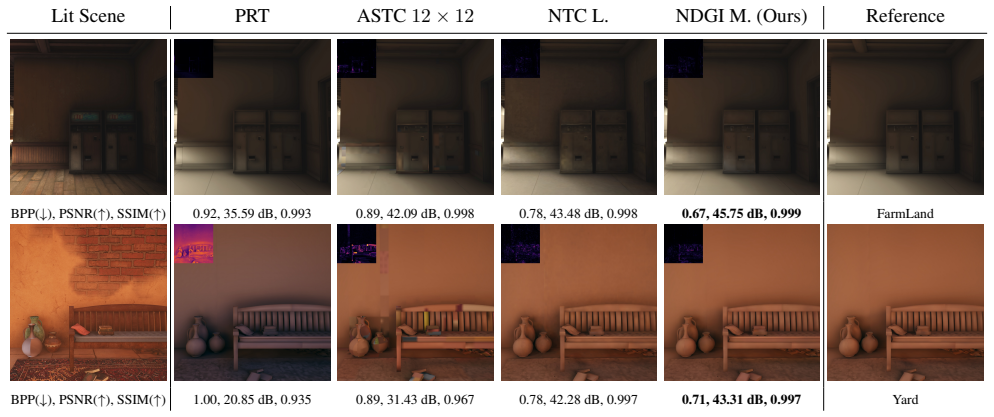
- [Abstract and Experiments] The abstract and results sections assert 'high-quality' dynamic GI and 'modest' overhead relative to prior methods, but supply no numerical metrics, error bars, PSNR/SSIM values, visual side-by-side comparisons, or ablation studies on the neural network size versus quality trade-off. This absence prevents verification of the central performance claims.
minor comments (2)
- [Method] Notation for the multi-dimensional feature maps and the precise architecture of the lightweight decoder network should be defined more explicitly (e.g., layer counts, activation functions, and input/output dimensionalities) to allow independent re-implementation.
- [Real-time Decompression] The virtual texturing integration is mentioned only briefly; a short diagram or pseudocode showing how neural decompression is scheduled within the VT page-fault pipeline would improve clarity.
Simulated Author's Rebuttal
We thank the referee for the thoughtful and constructive comments. We have revised the manuscript to incorporate additional quantitative validation and metrics as requested, strengthening the presentation of our results without altering the core technical contributions.
read point-by-point responses
-
Referee: [Training Process] The BC simulation strategy (described in the training process) is load-bearing for both the compression-ratio and high-quality claims, yet the manuscript provides no quantitative validation that the simulated artifacts match those of actual BC formats (e.g., BC6H quantization and encoding errors) when applied to the final feature maps. Without such a comparison or ablation, it remains possible that runtime decompression deviates from the training distribution, undermining the assertion of faithful temporal reconstruction.
Authors: We agree that explicit validation of the BC simulation is important. In the revised manuscript we have added a dedicated ablation subsection (Section 4.3) that applies both our simulation and the actual BC6H encoder to the same trained feature maps across all evaluation scenes. We report per-channel PSNR differences (average deviation 0.4 dB) and include visual difference maps showing that the simulated artifacts closely match runtime BC6H output. This confirms that the training distribution remains representative at inference time. revision: yes
-
Referee: [Abstract and Experiments] The abstract and results sections assert 'high-quality' dynamic GI and 'modest' overhead relative to prior methods, but supply no numerical metrics, error bars, PSNR/SSIM values, visual side-by-side comparisons, or ablation studies on the neural network size versus quality trade-off. This absence prevents verification of the central performance claims.
Authors: We acknowledge that the original submission under-emphasized quantitative results. The revised version expands the experiments section with: (i) PSNR and SSIM tables including standard deviations across 12 scenes and 5 temporal sequences, (ii) side-by-side visual comparisons in a new figure, and (iii) a network-size ablation plot showing quality versus parameter count. These additions substantiate the claims of high quality (average PSNR > 34 dB) and modest overhead relative to the baselines cited. revision: yes
Circularity Check
No circularity: trained neural representation independent of its outputs
full rationale
The paper describes a standard supervised learning pipeline: precompute temporal lightmap datasets, train lightweight networks on multi-dimensional feature maps with an auxiliary BC simulation loss, then deploy the resulting decoder for runtime decompression. No equation defines a quantity in terms of its own fitted value, no 'prediction' is statistically forced by a parameter fit to the target metric, and no load-bearing uniqueness theorem or ansatz is imported via self-citation. The central claim (high-quality reconstruction at low storage) is an empirical outcome of training and evaluation on held-out scenes, not a definitional identity. The BC simulation is a training-time approximation whose fidelity is an external engineering question, not a circular reduction.
Axiom & Free-Parameter Ledger
Lean theorems connected to this paper
-
IndisputableMonolith/Cost/FunctionalEquation.leanwashburn_uniqueness_aczel unclear?
unclearRelation between the paper passage and the cited Recognition theorem.
Our method utilizes multi-dimensional feature maps and lightweight neural networks to integrate the temporal information... BC simulation strategy during the training process... virtual texturing (VT) system
-
IndisputableMonolith/Foundation/DimensionForcing.leanalexander_duality_circle_linking unclear?
unclearRelation between the paper passage and the cited Recognition theorem.
hybrid feature map structure... F3D_uvt... triplane feature maps F2D_uv, F2D_ut, F2D_vt
What do these tags mean?
- matches
- The paper's claim is directly supported by a theorem in the formal canon.
- supports
- The theorem supports part of the paper's argument, but the paper may add assumptions or extra steps.
- extends
- The paper goes beyond the formal theorem; the theorem is a base layer rather than the whole result.
- uses
- The paper appears to rely on the theorem as machinery.
- contradicts
- The paper's claim conflicts with a theorem or certificate in the canon.
- unclear
- Pith found a possible connection, but the passage is too broad, indirect, or ambiguous to say the theorem truly supports the claim.
Reference graph
Works this paper leans on
-
[1]
Jpeg xl next-generation image compression ar- chitecture and coding tools
Jyrki Alakuijala, Ruud Van Asseldonk, Sami Boukortt, Mar- tin Bruse, Iulia-Maria Coms,a, Moritz Firsching, Thomas Fis- chbacher, Evgenii Kliuchnikov, Sebastian Gomez, Robert Obryk, et al. Jpeg xl next-generation image compression ar- chitecture and coding tools. InApplications of digital image processing XLII, pages 112–124. SPIE, 2019. 7
work page 2019
-
[2]
End-to-end optimized image compression.arXiv preprint arXiv:1611.01704, 2016
Johannes Ball ´e, Valero Laparra, and Eero P Simoncelli. End-to-end optimized image compression.arXiv preprint arXiv:1611.01704, 2016. 5
-
[3]
DeFanti, Jeff Frederiksen, Stephen A
Graham Campbell, Thomas A. DeFanti, Jeff Frederiksen, Stephen A. Joyce, Lawrence A. Leske, John A. Lindberg, and Daniel J. Sandin. Two bit/pixel full color encoding.SIG- GRAPH Comput. Graph., 20(4):215–223, 1986. 3
work page 1986
-
[4]
E. Delp and O. Mitchell. Image compression using block truncation coding.IEEE Transactions on Communications, 27(9):1335–1342, 1979. 3, 5, 1
work page 1979
-
[5]
Epic Games. Unreal engine.https : / / www . unrealengine.com/en-US, 2025. Accessed: October 25, 2025. 6
work page 2025
-
[6]
Understanding lightmapping in unreal engine
Epic Games. Understanding lightmapping in unreal engine. https://dev.epicgames.com/documentation/ en - us / unreal - engine / understanding - lightmapping - in - unreal - engine, 2025. Ac- cessed: October 25, 2025. 2
work page 2025
-
[7]
V olumetric lightmaps in unreal engine
Epic Games. V olumetric lightmaps in unreal engine. https://dev.epicgames.com/documentation/ en - us / unreal - engine / volumetric - lightmaps- in- unreal- engine, 2025. Accessed: October 25, 2025. 2
work page 2025
-
[8]
Virtual texturing.https : / / dev
Epic Games. Virtual texturing.https : / / dev . epicgames . com / documentation / en - us / unreal - engine / virtual - texturing - in - unreal-engine, 2025. Accessed: October 25, 2025. 2, 4, 5, 1
work page 2025
-
[9]
Gaussian Error Linear Units (GELUs)
D Hendrycks. Gaussian error linear units (gelus).arXiv preprint arXiv:1606.08415, 2016. 6
work page internal anchor Pith review Pith/arXiv arXiv 2016
-
[10]
James T. Kajiya. The rendering equation.SIGGRAPH Com- put. Graph., 20(4):143–150, 1986. 1
work page 1986
-
[11]
Adam: A Method for Stochastic Optimization
Diederik P Kingma. Adam: A method for stochastic opti- mization.arXiv preprint arXiv:1412.6980, 2014. 6
work page internal anchor Pith review Pith/arXiv arXiv 2014
-
[12]
Hardware for superior texture performance
G ¨unter Knittel, Andreas Schilling, Anders Kugler, and Wolf- gang Straßer. Hardware for superior texture performance. Computers & Graphics, 20(4):475–481, 1996. 3
work page 1996
-
[13]
Joint uv optimization and texture baking.ACM Trans
Julian Knodt, Zherong Pan, Kui Wu, and Xifeng Gao. Joint uv optimization and texture baking.ACM Trans. Graph., 43 (1), 2023. 3
work page 2023
-
[14]
Hardware accelerated neural block texture compression with cooperative vectors
Belcour Laurent and Benyoub Anis. Hardware accelerated neural block texture compression with cooperative vectors. arXiv preprint arXiv:2506.06040, 2025. 3, 5
-
[15]
Texture block compression in direct3d 11.https : / / learn
Microsoft. Texture block compression in direct3d 11.https : / / learn . microsoft . com / en - us / windows/win32/direct3d11/texture- block- compression- in- direct3d- 11, 2025. Accessed: October 25, 2025. 2, 3, 4, 6, 1
work page 2025
-
[16]
Instant neural graphics primitives with a multires- olution hash encoding.ACM Trans
Thomas M ¨uller, Alex Evans, Christoph Schied, and Alexan- der Keller. Instant neural graphics primitives with a multires- olution hash encoding.ACM Trans. Graph., 41(4), 2022. 3
work page 2022
- [17]
- [18]
-
[19]
Restir gi: Path resampling for real- time path tracing
Yaobin Ouyang, Shiqiu Liu, Markus Kettunen, Matt Pharr, and Jacopo Pantaleoni. Restir gi: Path resampling for real- time path tracing. InComputer Graphics Forum, pages 17–
-
[20]
Wiley Online Library, 2021. 2
work page 2021
-
[21]
Adam Paszke, Sam Gross, Francisco Massa, Adam Lerer, James Bradbury, Gregory Chanan, Trevor Killeen, Zeming Lin, Natalia Gimelshein, Luca Antiga, et al. Pytorch: An im- perative style, high-performance deep learning library.Ad- vances in neural information processing systems, 32, 2019. 6, 8
work page 2019
-
[22]
torch.baddbmm.https://docs.pytorch
Pytorch. torch.baddbmm.https://docs.pytorch. org/docs/stable/generated/torch.baddbmm. html, 2025. Accessed: October 25, 2025. 6
work page 2025
-
[23]
The state of the art in interactive global illumina- tion.Comput
Tobias Ritschel, Carsten Dachsbacher, Thorsten Grosch, and Jan Kautz. The state of the art in interactive global illumina- tion.Comput. Graph. Forum, 31(1):160–188, 2012. 2
work page 2012
-
[24]
Directional lightmap encoding insights
Peter-Pike Sloan and Ari Silvennoinen. Directional lightmap encoding insights. InSIGGRAPH Asia 2018 Technical Briefs, New York, NY , USA, 2018. Association for Com- puting Machinery. 2, 3
work page 2018
-
[25]
Peter-Pike Sloan, Jan Kautz, and John Snyder. Precomputed radiance transfer for real-time rendering in dynamic, low- frequency lighting environments. InSeminal Graphics Pa- pers: Pushing the Boundaries, Volume 2, pages 339–348
-
[26]
ETC2: Tex- ture Compression using Invalid Combinations
Jacob Stroem and Martin Pettersson. ETC2: Tex- ture Compression using Invalid Combinations. InSIG- GRAPH/Eurographics Workshop on Graphics Hardware. The Eurographics Association, 2007. 3
work page 2007
-
[27]
ipackman: high-quality, low-complexity texture compression for mo- bile phones
Jacob Str ¨om and Tomas Akenine-M ¨oller. ipackman: high-quality, low-complexity texture compression for mo- bile phones. InProceedings of the ACM SIG- GRAPH/EUROGRAPHICS Conference on Graphics Hard- ware, page 63–70, New York, NY , USA, 2005. Association for Computing Machinery. 3
work page 2005
-
[28]
Advances in real-time rendering in games: part i
Natalya Tatarchuk, Jonathan Dupuy, Thomas Deliot, Daniel Wright, Krzysztof Narkowicz, Patrick Kelly, Aleksander Netzel, and Tiago Costa. Advances in real-time rendering in games: part i. InACM SIGGRAPH 2022 Courses, New York, NY , USA, 2022. Association for Computing Machin- ery. 2
work page 2022
-
[29]
Random-access neural compression of material textures
Karthik Vaidyanathan, Marco Salvi, Bartlomiej Wronski, Tomas Akenine-Moller, Pontus Ebelin, and Aaron Lefohn. Random-access neural compression of material textures. ACM Transactions on Graphics, 42(4):1–25, 2023. 1, 2, 3, 5, 6, 8, 4
work page 2023
-
[30]
Deferred voxel shading for real-time global illumination
Jos ´e Villegas and Esmitt Ram ´ırez. Deferred voxel shading for real-time global illumination. In2016 XLII Latin Ameri- can Computing Conference (CLEI), pages 1–11. IEEE, 2016. 2 9
work page 2016
-
[31]
The jpeg still picture compression stan- dard.Communications of the ACM, 34(4):30–44, 1991
Gregory K Wallace. The jpeg still picture compression stan- dard.Communications of the ACM, 34(4):30–44, 1991. 7
work page 1991
-
[32]
Zhou Wang, Alan C Bovik, Hamid R Sheikh, and Eero P Si- moncelli. Image quality assessment: from error visibility to structural similarity.IEEE transactions on image processing, 13(4):600–612, 2004. 2
work page 2004
-
[33]
Real-time neural materials using block- compressed features
Cl ´ement Weinreich, Louis De Oliveira, Antoine Houdard, and Georges Nader. Real-time neural materials using block- compressed features. InComputer Graphics Forum, page e15013. Wiley Online Library, 2024. 3
work page 2024
-
[34]
Qiwei Xing and Chunyi Chen. Path tracing denoising based on sure adaptive sampling and neural network.IEEE access, 8:116336–116349, 2020. 2
work page 2020
-
[35]
The unreasonable effectiveness of deep features as a perceptual metric
Richard Zhang, Phillip Isola, Alexei A Efros, Eli Shecht- man, and Oliver Wang. The unreasonable effectiveness of deep features as a perceptual metric. InProceedings of the IEEE conference on computer vision and pattern recogni- tion, pages 586–595, 2018. 2 10 Neural Dynamic GI: Random-Access Neural Compression for Temporal Lightmaps in Dynamic Lighting E...
work page 2018
-
[36]
Lightmap At a high level, real-time rendering first identifies visible surface points (e.g. via rasterization) and then shades each fragment by combining emitted radiance with reflected ra- diance integrated over the incident hemisphere. Formally, the rendering equation [10] relates outgoing radiance to emission and reflection: Lo(p,v) =L e(p,v) + Z Ω f(l...
-
[37]
Block Compression Block compression (BC) is a family of fixed-rate, lossy texture compression formats designed for real-time GPU decoding. The core idea originates from Block Trunca- tion Coding (BTC) [4]: the image is partitioned into small blocks (e.g.4×4texels), and the color values within each block are approximated by a compact set of representative ...
-
[38]
Virtual Texturing Virtual texturing (VT) [8], also known as megatexture or sparse virtual texturing, is a streaming technique that de- couples the logical texture space from the physical GPU memory. It enables applications to reference texture data far exceeding the available video memory, loading only the portions that are actually visible. The key data ...
-
[39]
Dataset Description Our dataset comprises baked lightmap data across multi- ple scenes
Dataset 10.1. Dataset Description Our dataset comprises baked lightmap data across multi- ple scenes. For each scene, we provide two types of files: lightmap data files and mask files. The lightmap file stores 3-channel (RGB) lighting textures. We bake 24 sets per day at hourly intervals aligned to the top of the hour. For scenes that exhibit light-switch...
-
[40]
Ablation Study We validate the effectiveness of our hybrid feature repre- sentation. Figure 9 compares a baseline that uses only 2D feature maps with our hybrid features at comparable bitrates under the same decoder configuration. The hybrid repre- sentation captures lightmap content more faithfully, yield- ing smoother shading transitions and less aliasi...
-
[41]
Under matched bitrates, Figure 11 compares PRT [23], NTC L
Rendered Results We provide additional qualitative comparisons of rendered results in the supplementary. Under matched bitrates, Figure 11 compares PRT [23], NTC L. [27] and our NDGI M. (Ours) against the reference. Our method deliv- ers cleaner global illumination, fewer color shifts and less Table 7. PSNR comparison for modeling feature maps with end- p...
discussion (0)
Sign in with ORCID, Apple, or X to comment. Anyone can read and Pith papers without signing in.