Recognition: unknown
Dark Matter's influence on Evolution of MBHB in Dwarf Galaxies: A Case Study of Leo I dSph
Pith reviewed 2026-05-10 15:23 UTC · model grok-4.3
The pith
Massive black hole binaries in dwarf galaxies like Leo I shrink to about 1 parsec but then stall and fail to merge within a Hubble time even when dark matter is included.
A machine-rendered reading of the paper's core claim, the machinery that carries it, and where it could break.
Core claim
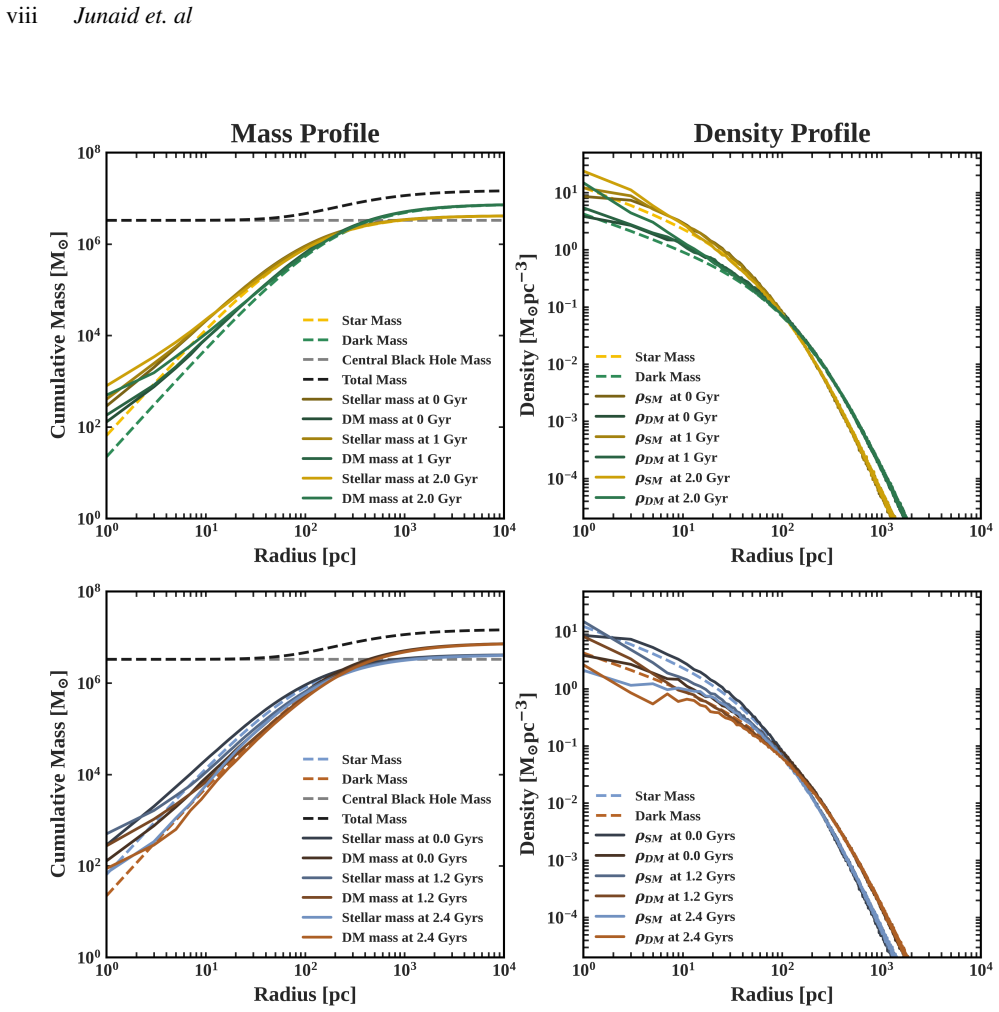
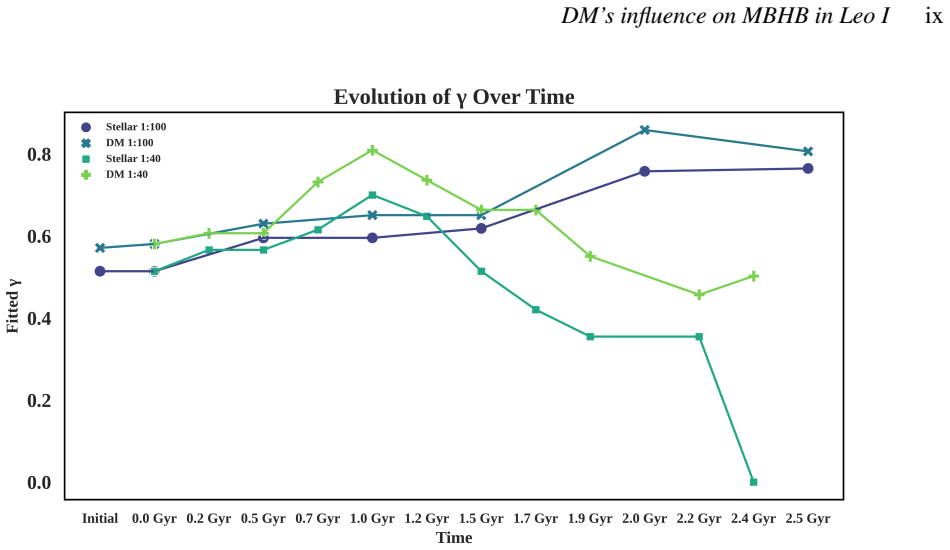
Using high-resolution direct N-body simulations, the orbital evolution of a massive binary black hole in a realistic model of the Leo I stellar and dark matter distribution shows the separation decreasing from an initial 300-parsec orbit to roughly 1 parsec over about 2 Gyr, driven primarily by dynamical friction and stellar hardening. The evolution then stalls, the eccentricity increases, and modest inner mass-profile redistribution occurs in some cases. Gravitational-wave emission models applied to the stalled state indicate the binary is unlikely to merge within a Hubble time, so massive binary black holes in dwarf spheroidal galaxies such as Leo I will not contribute to the gravitational
What carries the argument
High-resolution direct N-body integration of a massive binary black hole embedded in a combined stellar-plus-dark-matter density model of Leo I, which follows dynamical friction, stellar hardening, eccentricity growth, and eventual gravitational-wave driven inspiral.
If this is right
- The binary reaches a stalled separation of roughly 1 parsec after 2 Gyr and does not continue shrinking appreciably.
- Orbital eccentricity increases steadily once the separation has stalled.
- Some modest redistribution of the galaxy's inner mass profile occurs during the evolution.
- Gravitational-wave losses at the stalled separation are too slow for merger within a Hubble time.
- Massive binaries in low-density dwarf galaxies do not reach the separations required for LISA-band emission.
Where Pith is reading between the lines
- The same stalling behavior is likely to appear in other low-density dwarf galaxies whose central stellar and dark matter densities are comparable to Leo I.
- If many dwarf galaxies host stalled binaries, the contribution of such systems to the overall low-frequency gravitational-wave background would be smaller than models that assume rapid merging.
- Changing the assumed dark matter density slope or adding triaxiality to the galaxy model could shorten or lengthen the time to stall and therefore change the predicted merger rate.
- Future high-resolution imaging or stellar-dynamics measurements that resolve sub-parsec scales in nearby dwarfs could directly test whether the simulated separation floor is reached.
Load-bearing premise
The chosen N-body density profile for Leo I's stars and dark matter, together with the initial binary separation and simulation resolution, faithfully represents the real dynamical environment over gigayear timescales.
What would settle it
A direct observation or measurement showing a massive black hole binary in Leo I with separation well below 1 parsec, or a confirmed gravitational-wave detection from a source unambiguously located in a dwarf spheroidal galaxy like Leo I.
Figures


read the original abstract
In this study, we investigate the dynamical evolution of a massive binary black hole (MBHB) in the Leo I dwarf spheroidal galaxy model and examine how dark matter along with stellar matter's gravitational interactions influence its long-term behavior. Using high-resolution direct N-body simulations, we follow the orbital evolution of the binary within a realistic model of the Leo I stellar and dark matter distribution. We found that the binary separation decreases from an initial 300-parsec orbit to roughly 1 parsec over a period of about 2 Gyr, primarily driven by dynamical friction and stellar hardening. The orbital evolution then stalls at this scale, illustrating the well-known final parsec problem. During this phase, the binary also develops increasing orbital eccentricity and produces a modest redistribution of the inner mass profiles in some cases. We then further estimate the final stage of the system's evolution using gravitational-wave emission models and find that the binary is unlikely to merge within a Hubble time. The prolonged dynamical friction phase appears to be related to the low stellar and dark matter densities in Leo I. These results suggest that massive binary black holes in dwarf spheroidal galaxies such as Leo I will not contribute to the gravitational-waves detectable from LISA even if dark matter is considered.
Editorial analysis
A structured set of objections, weighed in public.
Referee Report
Summary. The paper claims that direct N-body simulations of an MBHB in a Leo I dSph model including dark matter show the binary hardening from 300 pc to ~1 pc in 2 Gyr via dynamical friction and stellar encounters, stalling thereafter due to the final parsec problem, and not merging within a Hubble time according to GW emission models. Consequently, such binaries in dwarf galaxies like Leo I are unlikely to produce detectable gravitational waves for LISA.
Significance. If robust, the result is significant as it illustrates that dark matter does not alleviate the final parsec problem in low-density dwarf spheroidal galaxies, suggesting MBHBs there evolve too slowly for LISA detection. The direct N-body approach is a positive aspect, enabling self-consistent dynamics without fitted parameters. This adds to understanding of MBHB evolution in diverse galactic environments.
major comments (3)
- [Methods/Simulation Setup] The manuscript does not report the number of particles N, the gravitational softening length, or any resolution/convergence tests. The central claim of stalling at 1 pc after 2 Gyr in this low-density system is sensitive to these choices, as artificial relaxation can alter the hardening rate (see stress-test note on numerical resolution).
- [Results] There are no reported checks on energy conservation, angular momentum conservation, or sensitivity to initial conditions over the gigayear timescale. This is load-bearing because the low densities in Leo I make the simulation prone to numerical noise dominating the physical stellar hardening process.
- [Discussion/Gravitational Wave Phase] The estimate that the binary does not merge within a Hubble time is based on standard GW formulas applied to the stalled state, but no explicit calculation or parameter values (e.g., how eccentricity growth affects the timescale) are provided to support this.
minor comments (2)
- [Abstract] The claim of 'high-resolution' simulations lacks supporting details such as particle number or softening; this should be substantiated in the main text.
- [Introduction] A brief comparison to previous N-body studies of MBHBs in dwarfs would strengthen the context.
Simulated Author's Rebuttal
We thank the referee for their constructive and detailed comments on our manuscript. We address each major comment point by point below and will revise the manuscript to incorporate the requested details and clarifications where the original text was incomplete.
read point-by-point responses
-
Referee: [Methods/Simulation Setup] The manuscript does not report the number of particles N, the gravitational softening length, or any resolution/convergence tests. The central claim of stalling at 1 pc after 2 Gyr in this low-density system is sensitive to these choices, as artificial relaxation can alter the hardening rate (see stress-test note on numerical resolution).
Authors: We agree that these numerical parameters and tests should have been reported explicitly, as they are essential for assessing potential artifacts in low-density N-body simulations. We will revise the Methods section to state the particle number N (for both stellar and dark matter components), the gravitational softening length, and to describe the resolution and convergence tests performed. These tests confirm that the reported hardening from 300 pc to ~1 pc and subsequent stalling are robust and not driven by artificial relaxation. revision: yes
-
Referee: [Results] There are no reported checks on energy conservation, angular momentum conservation, or sensitivity to initial conditions over the gigayear timescale. This is load-bearing because the low densities in Leo I make the simulation prone to numerical noise dominating the physical stellar hardening process.
Authors: We acknowledge that explicit checks on conservation laws and initial-condition sensitivity are important for validating long-term integrations in low-density systems. We will add to the revised manuscript (in Results or a new appendix) the time evolution of total energy and angular momentum, showing conservation to within numerical tolerances, along with results from simulations with varied initial conditions. This will demonstrate that the stalling at ~1 pc is driven by physical interactions rather than numerical noise. revision: yes
-
Referee: [Discussion/Gravitational Wave Phase] The estimate that the binary does not merge within a Hubble time is based on standard GW formulas applied to the stalled state, but no explicit calculation or parameter values (e.g., how eccentricity growth affects the timescale) are provided to support this.
Authors: We thank the referee for this suggestion. We will revise the Discussion section to include the explicit merger timescale calculation using the standard Peters quadrupole formula, with the specific parameter values from our stalled binary (semi-major axis ~1 pc, component masses, and measured eccentricity). This will show quantitatively that the timescale remains longer than a Hubble time even with eccentricity growth included. revision: yes
Circularity Check
No significant circularity: results from direct N-body integration
full rationale
The paper derives its claims via high-resolution direct N-body simulations that numerically integrate particle trajectories under Newtonian gravity plus standard gravitational-wave emission formulas applied post-simulation. The reported stalling at ~1 pc after 2 Gyr and the Hubble-time merger estimate follow from the computed orbital evolution and independent GW timescale expressions; neither step reduces algebraically to fitted parameters, self-defined quantities, or load-bearing self-citations. The final-parsec reference is to a well-known external phenomenon, not an internal premise that embeds the result. The derivation chain is therefore self-contained against external benchmarks.
Axiom & Free-Parameter Ledger
free parameters (2)
- Initial binary separation =
300 pc
- Leo I stellar and dark matter density profile parameters
axioms (2)
- standard math Newtonian gravity and direct summation govern all particle interactions
- domain assumption The adopted static or slowly evolving density profile of Leo I remains a valid background over 2 Gyr
Reference graph
Works this paper leans on
-
[1]
Abe Y., Toma T., Tsumura K., 2020, @doi [Journal of High Energy Physics] 10.1007/jhep05(2020)057
-
[2]
Abramowski A., et al., 2015, @doi [Physical Review Letters] 10.1103/physrevlett.114.081301
-
[3]
Laser Interferometer Space Antenna
Amaro-Seoane P., et al., 2017, arXiv e-prints, https://ui.adsabs.harvard.edu/abs/2017arXiv170200786A p. arXiv:1702.00786
work page internal anchor Pith review Pith/arXiv arXiv 2017
-
[4]
Askar A., Baldassare V. F., Mezcua M., 2024, Intermediate-Mass Black Holes in Star Clusters and Dwarf Galaxies ( @eprint arXiv 2311.12118 ), https://arxiv.org/abs/2311.12118
-
[5]
C., Adams J., Bringmann T., Clark H
Aslanyan G., Price L. C., Adams J., Bringmann T., Clark H. A., Easther R., Lewis G. F., Scott P., 2016, @doi [Physical Review Letters] 10.1103/physrevlett.117.141102
-
[6]
Bartelmann M., Schneider P., 2001, @doi [Physics Reports] 10.1016/s0370-1573(00)00082-x
-
[7]
C., Blandford R
Begelman M. C., Blandford R. D., Rees M. J., 1980, Nature, 287, 307
1980
-
[8]
Bellovary J., et al., 2019, Where are the Intermediate Mass Black Holes?, @doi 10.48550/ARXIV.1903.08144 , https://arxiv.org/abs/1903.08144
-
[9]
pp 8--18
Berczik P., et al., 2011, in International conference on High Performance Computing. pp 8--18
2011
-
[10]
Berera A., 2011, @doi [Pramana] 10.1007/s12043-011-0086-3
-
[11]
Bertone G., Hooper D., Silk J., 2005, @doi [Physics Reports] 10.1016/j.physrep.2004.08.031
-
[12]
Bosler T., Smecker-Hane T., Stetson P. B., 2007, @doi [Monthly Notices of the Royal Astronomical Society] 10.1111/j.1365-2966.2007.11792.x
-
[13]
J., Noyola E., Gebhardt K., Fabricius M
Bustamante-Rosell M. J., Noyola E., Gebhardt K., Fabricius M. H., Mazzalay X., Thomas J., Zeimann G., 2021, The Astrophysical Journal, 921, 107
2021
-
[14]
Calore F., 2020, @doi [Physics] 10.1103/physics.13.31
-
[15]
Dehnen W., 1993, @doi [Monthly Notices of the Royal Astronomical Society] 10.1093/mnras/265.1.250 , https://ui.adsabs.harvard.edu/abs/1993MNRAS.265..250D 265, 250
-
[16]
Esmaili A., Ibarra A., G. Peres O. L., 2012, @doi [Journal of Cosmology and Astroparticle Physics] 10.1088/1475-7516/2012/11/034
-
[17]
Grebel E. K., Gallagher J. S., Harbeck D., 2003, @doi [The Astronomical Journal] 10.1086/368363
-
[18]
Gualandris A., Merritt D., 2008, The Astrophysical Journal, 678, 780
2008
-
[19]
Guo W., Wu Y., 2009, @doi [Physical Review D] 10.1103/physrevd.79.055012
-
[20]
P., Berczik P., 2007, New Astronomy, 12, 357
Harfst S., Gualandris A., Merritt D., Spurzem R., Zwart S. P., Berczik P., 2007, New Astronomy, 12, 357
2007
-
[21]
Khan F. M., Holley-Bockelmann K., 2021, @doi [ ] 10.1093/mnras/stab2646 , https://ui.adsabs.harvard.edu/abs/2021MNRAS.508.1174K 508, 1174
-
[22]
I., Kleyna J., Gilmore G., Grebel E
Koch A., Wilkinson M. I., Kleyna J., Gilmore G., Grebel E. K., Mackey A. D., Evans N. W., G. Wyse R. F., 2007, @doi [The Astrophysical Journal] 10.1086/510879
-
[23]
Kronawitter A., Saglia R., Gerhard O., Bender R., 2000, @doi [Astronomy and Astrophysics Supplement Series] 10.1051/aas:2000199
-
[24]
Maness H., Taylor G., Zavala R., Peck A., Pollack L., 2004, The Astrophysical Journal, 602, 123
2004
-
[25]
Mateo M., Olszewski E. W., Vogt S. S., Keane M., 1998, @doi [The Astronomical Journal] 10.1086/300618
-
[26]
Mezcua M., 2017, @doi [International Journal of Modern Physics D] 10.1142/s021827181730021x , 26, 1730021
-
[27]
Okamoto S., Arimoto N., Yamada Y., Onodera M., 2011, @doi [The Astrophysical Journal] 10.1088/0004-637x/744/2/96
-
[28]
Pacucci F., Ni Y., Loeb A., 2023, The Astrophysical Journal Letters, 956, L37
2023
-
[29]
Pefianco J., 2022, @doi [Journal of Student Research] 10.47611/jsrhs.v11i3.3042
-
[30]
C., 1964, Physical Review, 136, B1224
Peters P. C., 1964, Physical Review, 136, B1224
1964
-
[31]
Pires S., Starck J.-L., Réfrégier A., 2010, @doi [Ieee Signal Processing Magazine] 10.1109/msp.2009.934720
-
[32]
D., 1996, New Astronomy, 1, 35
Quinlan G. D., 1996, New Astronomy, 1, 35
1996
-
[33]
Read J., Agertz O., Collins M., 2016, Monthly Notices of the Royal Astronomical Society, 459, 2573
2016
-
[34]
B., Zavala R., Peck A., Pollack L., Romani R., 2006, The Astrophysical Journal, 646, 49
Rodriguez C., Taylor G. B., Zavala R., Peck A., Pollack L., Romani R., 2006, The Astrophysical Journal, 646, 49
2006
-
[35]
, archivePrefix = "arXiv", eprint =
Salucci P., Wilkinson M. I., Walker M. G., Gilmore G., Grebel E. K., Koch A., Martins C. F., G. Wyse R. F., 2012, @doi [Monthly Notices of the Royal Astronomical Society] 10.1111/j.1365-2966.2011.20144.x
-
[36]
Scoggins M. T., Haiman Z., Pacucci F., 2025, Heavy black hole seed survivors in dwarf galaxies: a case study of Leo I ( @eprint arXiv 2511.04736 ), https://arxiv.org/abs/2511.04736
-
[37]
Sesana A., Khan F. M., 2015, @doi [ ] 10.1093/mnrasl/slv131 , https://ui.adsabs.harvard.edu/abs/2015MNRAS.454L..66S 454, L66
-
[38]
Spergel D. N., Steinhardt P. J., 2000, @doi [Physical Review Letters] 10.1103/physrevlett.84.3760
-
[39]
Vasiliev E., 2018, @doi [Monthly Notices of the Royal Astronomical Society] 10.1093/mnras/sty2672 , 482, 1525–1544
-
[40]
W. McQuinn K. B., et al., 2015, @doi [The Astrophysical Journal] 10.1088/0004-637x/812/2/158
-
[41]
write newline
" write newline "" before.all 'output.state := FUNCTION fin.entry write newline FUNCTION new.block output.state before.all = 'skip after.block 'output.state := if FUNCTION new.sentence output.state after.block = 'skip output.state before.all = 'skip after.sentence 'output.state := if if FUNCTION not #0 #1 if FUNCTION and 'skip pop #0 if FUNCTION or pop #1...
discussion (0)
Sign in with ORCID, Apple, or X to comment. Anyone can read and Pith papers without signing in.