Evaluating Differential Privacy Against Membership Inference in Federated Learning: Insights from the NIST Genomics Red Team Challenge
Pith reviewed 2026-05-10 16:18 UTC · model grok-4.3
The pith
Stacking attack achieves membership inference at ε=200 in differentially private federated learning where single-signal baselines fail.
A machine-rendered reading of the paper's core claim, the machinery that carries it, and where it could break.
Core claim
The central claim is that a stacking-based membership inference attack, by ensembling multiple estimators on model outputs and cross-entropy losses, maintains measurable success against differentially private federated learning models at ε=200, outperforming single-signal approaches like LiRA which collapse at that privacy level, while providing an empirical characterization of leakage degradation across DP tiers in the NIST challenge setup.
What carries the argument
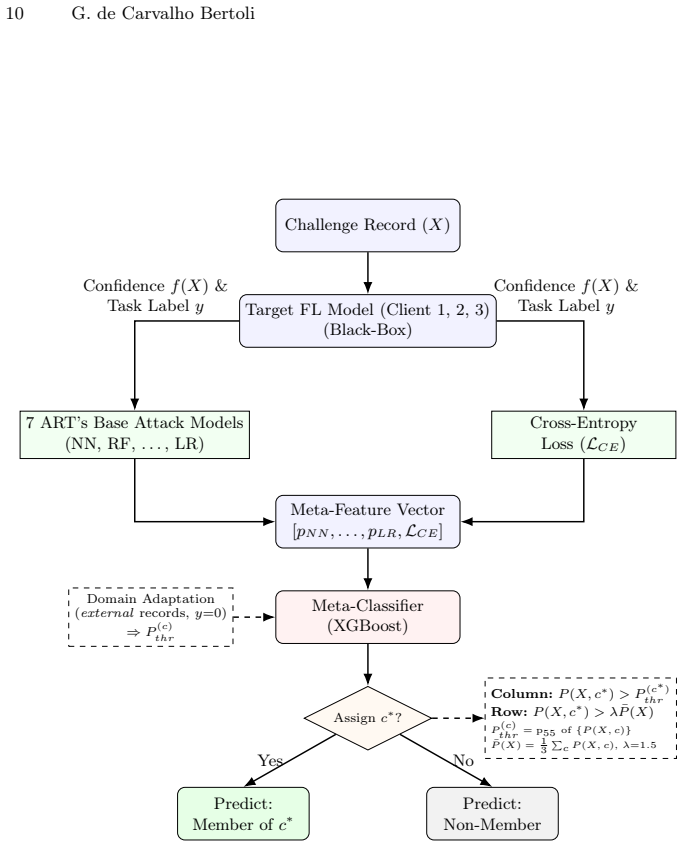
The stacking meta-classifier that ensembles seven black-box estimators trained on the target model's prediction probabilities and cross-entropy losses.
If this is right
- In the absence of differential privacy or with ε=200, stacking attacks can extract more membership information than standard methods.
- At ε=10, higher privacy appears to reduce leakage more effectively.
- The results highlight the need to consider ensemble attacks when setting privacy budgets in federated learning for sensitive data.
- Independent third-party benchmarks confirm the attack's performance across the tested privacy configurations.
Where Pith is reading between the lines
- If the stacking approach generalizes to other datasets and model architectures, then moderate differential privacy may be insufficient for protecting membership in federated learning generally.
- Real-world deployments of DP in FL should account for the possibility of meta-classifiers combining multiple signals.
- Further tests on non-genomics data could reveal whether the observed leakage pattern is domain-specific.
Load-bearing premise
The NIST genomics dataset and the specific DP implementations in the red team challenge accurately reflect the vulnerabilities present in real-world federated learning systems.
What would settle it
A demonstration that the stacking attack loses its advantage over LiRA at ε=200 when applied to a different dataset or under alternative DP mechanisms would falsify the claim of persistent measurable leakage.
Figures




read the original abstract
While Federated Learning (FL) mitigates direct data exposure, the resulting trained models remain susceptible to membership inference attacks (MIAs). This paper presents an empirical evaluation of Differential Privacy (DP) as a defense mechanism against MIAs in FL, leveraging the environment of the 2025 NIST Genomics Privacy-Preserving Federated Learning (PPFL) Red Teaming Event. To improve inference accuracy, we propose a stacking attack strategy that ensembles seven black-box estimators to train a meta-classifier on prediction probabilities and cross-entropy losses. We evaluate this methodology against target models under three privacy configurations: an unprotected convolutional neural network (CNN, $\epsilon=\infty$), a low-privacy DP model ($\epsilon=200$), and a high-privacy DP model ($\epsilon=10$). The attack outperforms all baselines in the No DP and Low Privacy settings and, critically, maintains measurable membership leakage at $\epsilon=200$ where a single-signal LiRA baseline collapses. Evaluated on an independent third-party benchmark, these results provide an empirical characterisation of how stacking-based inference degrades across calibrated DP tiers in FL.
Editorial analysis
A structured set of objections, weighed in public.
Referee Report
Summary. This paper empirically evaluates the resilience of differential privacy (DP) in federated learning (FL) against membership inference attacks (MIAs) by leveraging the 2025 NIST Genomics Privacy-Preserving Federated Learning Red Teaming Event. The authors propose a stacking attack that trains a meta-classifier on outputs from seven black-box estimators using prediction probabilities and cross-entropy losses. They compare this attack to baselines across three DP levels: no DP (ε=∞), low privacy (ε=200), and high privacy (ε=10), finding that the stacking attack outperforms baselines in the first two settings and detects leakage at ε=200 where LiRA fails.
Significance. The results, if validated, offer important insights into how DP parameters affect MIA leakage in real FL deployments for sensitive genomics data. The paper's strength lies in its use of an independent third-party benchmark, which supports reproducibility and avoids self-referential biases in evaluation. This contributes to the understanding that moderate DP (ε=200) may not fully mitigate advanced ensemble attacks in FL.
minor comments (2)
- [Abstract] The abstract could include specific quantitative metrics (e.g., AUC or accuracy values) for the stacking attack versus baselines to immediately convey the magnitude of outperformance.
- [Methods] Clarify the selection criteria and training details for the seven black-box estimators, as well as the precise DP noise application mechanism within the FL training process, to improve reproducibility.
Simulated Author's Rebuttal
We thank the referee for their positive summary and significance assessment of our work. We appreciate the recognition that our use of the independent NIST Genomics benchmark strengthens reproducibility and that the results provide useful empirical insights into how moderate DP (ε=200) may still permit advanced ensemble attacks in FL. The recommendation for minor revision is noted.
Circularity Check
No significant circularity
full rationale
The paper is an empirical evaluation of a proposed stacking attack against membership inference in federated learning, using results from the external NIST Genomics PPFL Red Teaming Challenge benchmark. No derivation chain, equations, parameter fitting, or self-citations are present that would reduce any claim to its own inputs by construction. The central results (outperformance under No DP and ε=200) rest on external data and standard black-box estimators, remaining independent of internal self-referential logic.
Axiom & Free-Parameter Ledger
axioms (1)
- domain assumption The differential privacy mechanisms and membership inference attack models used in the NIST challenge are correctly implemented and representative.
Reference graph
Works this paper leans on
-
[1]
Communication-Efficient Learning of Deep Net- works from Decentralized Data
Brendan McMahan, Eider Moore, Daniel Ramage, Seth Hampson, and Blaise Aguera y Arcas. “Communication-Efficient Learning of Deep Net- works from Decentralized Data”. In:Proceedings of the 20th International Conference on Artificial Intelligence and Statistics. Ed. by Aarti Singh and Jerry Zhu. Vol. 54. Proceedings of Machine Learning Research. PMLR, Differ...
work page 2017
-
[2]
Feder- ated Learning in Healthcare: From Research to Real-World Deployment
Spyridon Bakas, Xiaoxiao Li, Prashant Shah, and Holger R. Roth. “Feder- ated Learning in Healthcare: From Research to Real-World Deployment”. In:Annual Review of Biomedical Engineering(2026).issn: 1523-9829. doi:https : / / doi . org / 10 . 1146 / annurev - bioeng - 080125 - 041414. url:https://www.annualreviews.org/content/journals/10.1146/ annurev-bioen...
work page 2026
-
[3]
Asaf Raza, Ciro Benito Raggio, Antonella Guzzo, Maria Francesca Spadea, and Giancarlo Fortino. “Towards robust neurocomputing model in efficient federated brain tumour segmentation with sparsification and weights clus- tering”. In:Neurocomputing677 (2026), p. 133142.issn: 0925-2312.doi: https://doi.org/10.1016/j.neucom.2026.133142.url:https:// www.science...
work page doi:10.1016/j.neucom.2026.133142.url:https:// 2026
-
[4]
FedCrime: Zero-inflation adaptive federated learning for crime prediction
Bhumika, Philippe Lalanda, German Vega, and Debasis Das. “FedCrime: Zero-inflation adaptive federated learning for crime prediction”. In:Neuro- computing679 (2026), p. 133217.issn: 0925-2312.doi:https://doi.org/ 10.1016/j.neucom.2026.133217.url:https://www.sciencedirect. com/science/article/pii/S0925231226006144
work page doi:10.1016/j.neucom.2026.133217.url:https://www.sciencedirect 2026
-
[5]
275–283.doi:10.1109/ icdmw51313.2020.00046
Geet Shingi. “A federated learning based approach for loan defaults pre- diction”. In:2020 International Conference on Data Mining Workshops (ICDMW). 2020, pp. 362–368.doi:10.1109/ICDMW51313.2020.00057
-
[7]
Membership infer- ence attacks from first principles
Nicholas Carlini, Steve Chien, Milad Nasr, Shuang Song, Andreas Terzis, and Florian Tramèr. “Membership Inference Attacks From First Princi- ples”. In:2022 IEEE Symposium on Security and Privacy (SP). 2022, pp. 1897–1914.doi:10.1109/SP46214.2022.9833649
-
[8]
Cynthia Dwork. “Differential Privacy”. In:Automata, Languages and Pro- gramming. Ed. by Michele Bugliesi, Bart Preneel, Vladimiro Sassone, and Ingo Wegener. Berlin, Heidelberg: Springer Berlin Heidelberg, 2006, pp. 1– 12.isbn: 978-3-540-35908-1
work page 2006
-
[9]
Model-based development of QoS- aware reconfigurable autonomous robotic systems
Samuel Yeom, Irene Giacomelli, Matt Fredrikson, and Somesh Jha. “Pri- vacy Risk in Machine Learning: Analyzing the Connection to Overfitting”. In:2018 IEEE 31st Computer Security Foundations Symposium (CSF). 2018, pp. 268–282.doi:10.1109/CSF.2018.00027
-
[10]
arXiv preprint arXiv:1807.01069 , year=
Maria-Irina Nicolae, Mathieu Sinn, Minh Ngoc Tran, Beat Buesser, Am- brish Rawat, Martin Wistuba, Valentina Zantedeschi, Nathalie Baracaldo, Bryant Chen, Heiko Ludwig, Ian M. Molloy, and Ben Edwards.Adver- sarial Robustness Toolbox v1.0.0. 2019. arXiv:1807.01069 [cs.LG].url: https://arxiv.org/abs/1807.01069. 20 G. de Carvalho Bertoli
-
[11]
Ahmed Salem, Yang Zhang, Mathias Humbert, Pascal Berrang, Mario Fritz, and Michael Backes. “ML-leaks: Model and data independent mem- bership inference attacks and defenses on machine learning models”. In: Proceedings 2019 Network and Distributed System Security Symposium. San Diego, CA: Internet Society, 2019
work page 2019
-
[12]
Networks of spiking neurons: the third generation of neural network models,
DavidH.Wolpert.“Stackedgeneralization”.In:Neural Networks5.2(1992), pp. 241–259.issn: 0893-6080.doi:https://doi.org/10.1016/S0893- 6080(05)80023- 1.url:https://www.sciencedirect.com/science/ article/pii/S0893608005800231
-
[13]
Membership Inference Attacks Against Machine Learning Models
Reza Shokri, Marco Stronati, Congzheng Song, and Vitaly Shmatikov. “Membership Inference Attacks Against Machine Learning Models”. In: 2017 IEEE Symposium on Security and Privacy (SP). 2017, pp. 3–18. doi:10.1109/SP.2017.41
-
[14]
Tianqi Chen and Carlos Guestrin. “XGBoost: A Scalable Tree Boosting System”. In:Proceedings of the 22nd ACM SIGKDD International Confer- ence on Knowledge Discovery and Data Mining. KDD ’16. San Francisco, California, USA: Association for Computing Machinery, 2016, pp. 785– 794.isbn: 9781450342322.doi:10.1145/2939672.2939785.url:https: //doi.org/10.1145/2...
-
[15]
Flower: A Friendly Federated Learning Research Framework
DanielJ.Beutel,TanerTopal,AkhilMathur,XinchiQiu,JavierFernandez- Marques, Yan Gao, Lorenzo Sani, Kwing Hei Li, Titouan Parcollet, Pedro Porto Buarque de Gusmão, and Nicholas D. Lane.Flower: A Friendly Fed- erated Learning Research Framework. 2022. arXiv:2007.14390 [cs.LG]. url:https://arxiv.org/abs/2007.14390
work page internal anchor Pith review arXiv 2022
-
[16]
Milad Nasr, Reza Shokri, and Amir Houmansadr. “Comprehensive Pri- vacy Analysis of Deep Learning: Passive and Active White-box Inference Attacks against Centralized and Federated Learning”. In:2019 IEEE Sym- posium on Security and Privacy (SP). 2019, pp. 739–753.doi:10.1109/ SP.2019.00065
-
[17]
In: 2019 IEEE Symposium on Security and Privacy (SP), pp
LucaMelis,CongzhengSong,EmilianoDeCristofaro,andVitalyShmatikov. “Exploiting Unintended Feature Leakage in Collaborative Learning”. In: 2019 IEEE Symposium on Security and Privacy (SP). 2019, pp. 691–706. doi:10.1109/SP.2019.00029
-
[18]
Martin Abadi, Andy Chu, Ian Goodfellow, H. Brendan McMahan, Ilya Mironov, Kunal Talwar, and Li Zhang. “Deep Learning with Differential Privacy”. In:Proceedings of the 2016 ACM SIGSAC Conference on Com- puter and Communications Security. CCS ’16. Vienna, Austria: Associa- tion for Computing Machinery, 2016, pp. 308–318.isbn: 9781450341394. doi:10 . 1145 / ...
-
[19]
Evaluating Differentially Private Machine Learning in Practice
Bargav Jayaraman and David Evans. “Evaluating Differentially Private Machine Learning in Practice”. In:28th USENIX Security Symposium (USENIX Security 19). Santa Clara, CA: USENIX Association, Aug. 2019, pp. 1895–1912.isbn: 978-1-939133-06-9.url:https://www.usenix.org/ conference/usenixsecurity19/presentation/jayaraman. Differential Privacy Against Member...
work page 2019
-
[20]
meMIA: Multilevel Ensemble Membership Inference Attack
Najeeb Ullah, Muhammad Naveed Aman, and Biplab Sikdar. “meMIA: Multilevel Ensemble Membership Inference Attack”. In:IEEE Transac- tions on Artificial Intelligence6.1 (2025), pp. 93–106.doi:10.1109/TAI. 2024.3445326
work page doi:10.1109/tai 2025
-
[21]
Evaluating Differential Privacy in Federated Learn- ing Based on Membership Inference Attacks
PengHe,XinyuWang,WeijiaoZhang,ZhongkaiWang,SongWang,Chuangxin Ou, and Guozheng Li. “Evaluating Differential Privacy in Federated Learn- ing Based on Membership Inference Attacks”. In:2024 10th International Conference on Big Data Computing and Communications (BigCom). 2024, pp. 196–203.doi:10.1109/BIGCOM65357.2024.00035
-
[22]
Knapsack problems in products of groups
Zirun Zhao, Zhaowen Lin, and Yi Sun. “ADPF: Anti-inference differen- tially private protocol for federated learning”. In:Computer Networks261 (2025), p. 111130.issn: 1389-1286.doi:https://doi.org/10.1016/j. comnet.2025.111130.url:https://www.sciencedirect.com/science/ article/pii/S1389128625000982
work page doi:10.1016/j 2025
-
[23]
Enhance membership inference attacks in federated learning
Xinlong He, Yang Xu, Sicong Zhang, Weida Xu, and Jiale Yan. “Enhance membership inference attacks in federated learning”. In:Computers & Se- curity136 (2024), p. 103535.issn: 0167-4048.doi:https://doi.org/10. 1016/j.cose.2023.103535.url:https://www.sciencedirect.com/ science/article/pii/S0167404823004455
-
[24]
Enhancing black-box mem- bership inference attacks in federated learning
Qiang Shi, Luzhen Ren, and Xinfeng He. “Enhancing black-box mem- bership inference attacks in federated learning”. In:Journal of Informa- tion Security and Applications96 (2026), p. 104302.issn: 2214-2126.doi: https://doi.org/10.1016/j.jisa.2025.104302.url:https://www. sciencedirect.com/science/article/pii/S2214212625003394
work page doi:10.1016/j.jisa.2025.104302.url:https://www 2026
- [25]
discussion (0)
Sign in with ORCID, Apple, or X to comment. Anyone can read and Pith papers without signing in.