Recognition: unknown
Localization and Flat Bands in Edge-Inflated Lattices
Pith reviewed 2026-05-10 13:35 UTC · model grok-4.3
The pith
Replacing each bond in a lattice with a tight-binding chain creates multiple classes of flat bands that remain robust even when the inflation process is randomized.
A machine-rendered reading of the paper's core claim, the machinery that carries it, and where it could break.
Core claim
By repeatedly replacing each edge of parent lattices with finite tight-binding chains we obtain ordered and randomly inflated graphs that host chain-induced flat bands, symmetry-protected zero-energy flat bands in bipartite geometries, and nearly flat junction bands. These flat bands persist under several classes of disorder; in particular, the count of zero-energy eigenstates in randomly inflated graphs is well estimated by the matching deficiency N-2ν(G), showing that local tree-like connectivity governs the low-energy nullity.
What carries the argument
The matching deficiency N-2ν(G) of the underlying graph, which directly estimates the number of zero-energy states in the tight-binding Hamiltonian on the inflated lattice.
If this is right
- Chain-induced flat bands broaden under bond and site disorder while symmetry-protected zero bands and junction bands remain robust for certain perturbations.
- Flat-band features persist at substantial density even when translational symmetry is completely absent.
- The low-energy spectrum continues to be governed by local tree-like structure rather than global periodicity.
- Multiple distinct flat-band mechanisms coexist and can be tuned by the parent lattice and the length of the inserted chains.
Where Pith is reading between the lines
- The same geometric inflation procedure could be applied to other parent graphs to produce localized modes in systems lacking long-range order.
- The robustness to random inflation lengths suggests that exact uniformity of chain lengths is not required for the appearance of flat bands.
- The matching-deficiency prediction supplies a parameter-free way to estimate the density of zero modes in any graph obtained by edge inflation.
Load-bearing premise
The assumption that a nearest-neighbor tight-binding model on the edge-inflated graph captures the low-energy spectrum without long-range interactions or other effects introduced by the inflation process.
What would settle it
Numerical exact diagonalization of a large randomly edge-inflated graph in which the number of zero-energy eigenvalues deviates significantly from the predicted value N-2ν(G) would falsify the claim that local matching deficiency controls the nullity.
Figures





read the original abstract
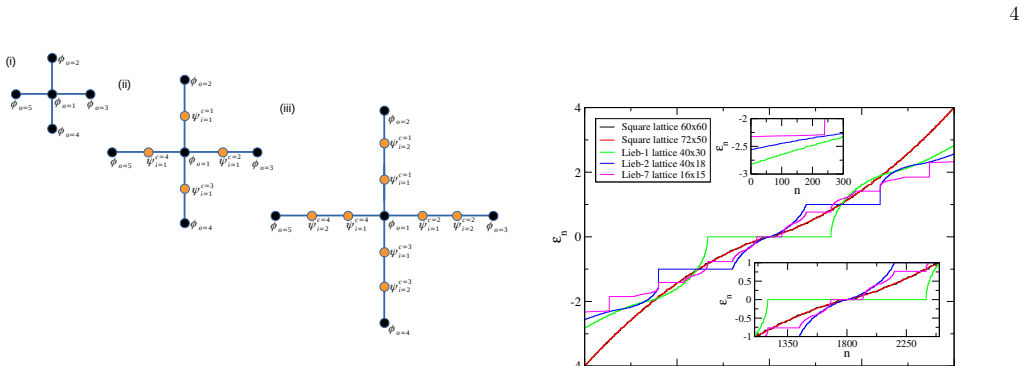
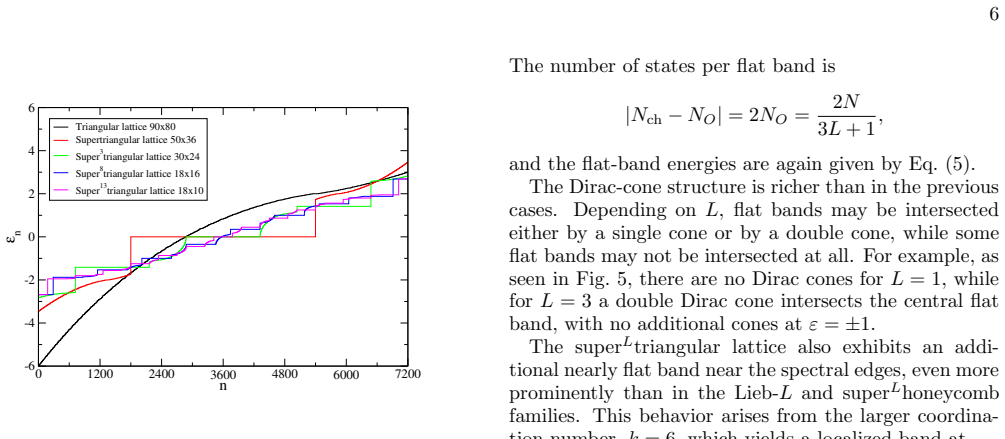
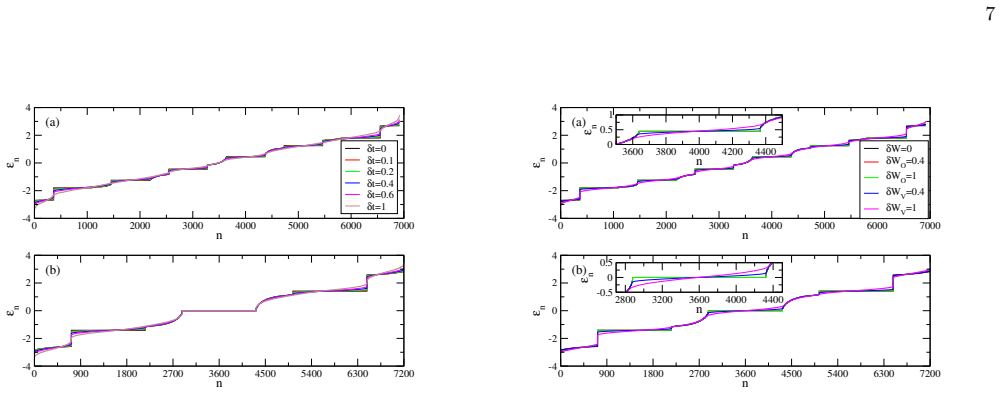
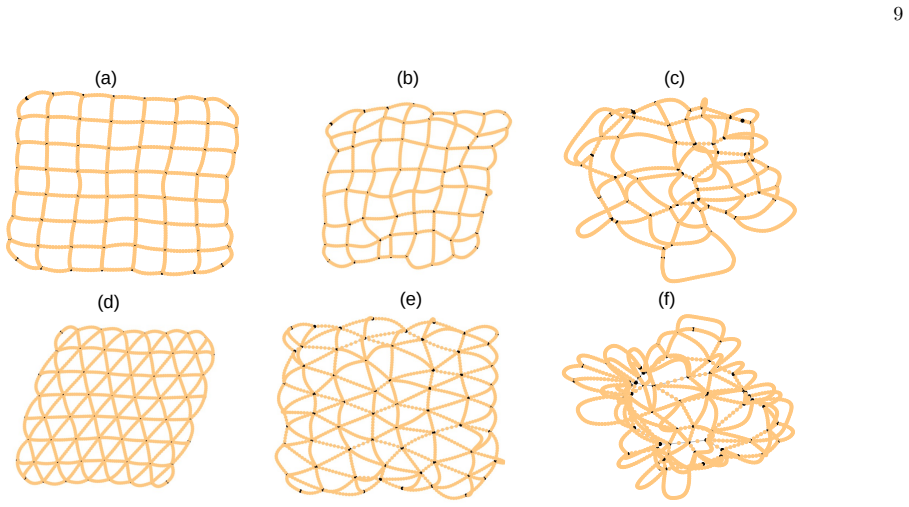
We study localization and flat-band formation in lattices generated by repeated edge inflation of square, honeycomb, and triangular parent lattices. Replacing each bond by a finite tight-binding chain produces several distinct classes of flat bands: chain-induced flat bands at the eigenenergies of the inserted chains, symmetry-protected zero-energy flat bands in bipartite edge-inflated lattices, and nearly flat junction bands near the spectral edges for sufficiently long chains. We analyze these mechanisms for ordered Lieb-$L$, super$^{L}$honeycomb, and super$^{L}$triangular lattices, and examine their response to bond disorder, site disorder, random magnetic flux, and randomness in the inflation process itself. While bond and site disorder broaden most flat bands, the zero-energy chiral band and the junction-induced flat bands remain robust under certain perturbations. Remarkably, substantial flat-band features also persist in randomly edge-inflated graphs, even in the absence of translational symmetry. In particular, the number of zero-energy states is found to be well estimated by the matching deficiency $N-2\nu(G)$, indicating that local tree-like structure continues to control the low-energy nullity. These results identify edge-inflated lattices as a broad class of systems in which geometry alone generates robust localization in both ordered and random settings.
Editorial analysis
A structured set of objections, weighed in public.
Referee Report
Summary. The manuscript examines flat-band formation and localization in edge-inflated lattices obtained by replacing bonds in square, honeycomb, and triangular parent lattices with finite tight-binding chains. It identifies chain-induced flat bands at the inserted-chain energies, symmetry-protected zero-energy flat bands in the bipartite cases, and nearly flat junction bands near spectral edges for long chains. The work analyzes these features in ordered Lieb-L, super^L honeycomb, and super^L triangular lattices, tests their stability under bond disorder, site disorder, random flux, and random inflation, and reports that substantial flat-band features survive in randomly edge-inflated graphs, with the number of zero-energy states well estimated by the graph-theoretic matching deficiency N-2ν(G).
Significance. If the central claims hold, the paper supplies a geometrically tunable construction for robust flat bands and zero modes that operates in both periodic and disordered settings. The explicit link to the parameter-free matching deficiency N-2ν(G) for the zero-mode count is a clear strength, as is the demonstration that local tree-like structure continues to control the low-energy nullity even after random inflation. These results could inform the design of lattices hosting protected flat bands without fine-tuning of hoppings or potentials.
minor comments (2)
- The abstract introduces the notation 'super^L honeycomb' and 'super^L triangular' without definition; a parenthetical gloss or reference to the construction in the introduction would improve immediate readability.
- The statement that zero-energy states are 'well estimated' by N-2ν(G) in the random-inflation case would benefit from a quantitative measure (e.g., average deviation or histogram of residuals) rather than a qualitative description.
Simulated Author's Rebuttal
We thank the referee for the careful and positive assessment of our manuscript. The summary accurately reflects our findings on flat-band mechanisms in edge-inflated lattices, their persistence under various disorders, and the graph-theoretic control of zero-mode count via matching deficiency. We appreciate the recognition of the geometric tunability and robustness in both ordered and random settings. As the recommendation is for minor revision with no specific major comments raised, we will incorporate any editorial clarifications in the revised version.
Circularity Check
No significant circularity identified
full rationale
The paper constructs edge-inflated lattices explicitly as nearest-neighbor tight-binding models on bipartite graphs (for square and honeycomb parents) and invokes the standard graph-theory identity that the nullity of the adjacency matrix equals N-2ν(G) for any bipartite graph. This identity is an external mathematical fact, not derived from or fitted to the paper's data; the numerical counts of near-zero eigenvalues are therefore expected to match by construction of the Hamiltonian. No self-citations, ansatzes, or fitted parameters are used to obtain the central claims about flat bands or the persistence of zero modes under disorder. The derivation chain remains self-contained against external benchmarks.
Axiom & Free-Parameter Ledger
axioms (2)
- domain assumption Tight-binding approximation with nearest-neighbor hopping only
- domain assumption Bipartiteness for symmetry-protected zero modes
Reference graph
Works this paper leans on
-
[1]
In all of these cases one also findsN−2ν(G) = 0. For oddL, there is a substantial number of zero-energy 0 900 1800 2700 3600 n(ε=0) 0 900 1800 2700 3600 N-2ν(G) triangle original lattice Square original lattice Honeycomb original lattice 50x36 30x24 25x18 18x10 40x30 16x15 40x36 FIG. 12. The number of zero-energy states,n(ε= 0), as a function of the match...
-
[2]
Honeycomb lattices are not shown because, as seen in Fig
is compared withN−2ν(G), and the agreement is remarkably accurate, with most data points lying close to the linen(ε= 0) =N−2ν(G). Honeycomb lattices are not shown because, as seen in Fig. 10, for these parent lattices bothn(ε= 0) andN−2ν(G) are approximately zero. Thus, the matching deficiency provides a useful esti- mate of the number of zero-energy eige...
-
[3]
Leykam, A
D. Leykam, A. Andreanov, and S. Flach, Artificial flat band systems: from lattice models to experiments, Adv. Phys. X3, 1473052 (2018)
2018
-
[4]
Derzhko, J
O. Derzhko, J. Richter, and M. Maksymenko, Strongly correlated flat-band systems: The route from Heisen- berg spins to Hubbard electrons, International Journal of Modern Physics B29, 1530007 (2015)
2015
-
[5]
E. H. Lieb, Two theorems on the Hubbard model, Phys. Rev. Lett.62, 1201 (1989)
1989
-
[6]
Mielke, Ferromagnetism in the Hubbard model on line graphs and further considerations, J
A. Mielke, Ferromagnetism in the Hubbard model on line graphs and further considerations, J. Phys. A: Math. Gen.24, 3311 (1991)
1991
-
[7]
Tasaki, Ferromagnetism in the Hubbard models with degenerate single-electron ground states, Phys
H. Tasaki, Ferromagnetism in the Hubbard models with degenerate single-electron ground states, Phys. Rev. Lett. 69, 1608 (1992)
1992
-
[8]
Mukherjee, M
S. Mukherjee, M. Di Liberto, P. ¨Ohberg, R. R. Thom- son, and M. C. Rechtsman, Unconventional flatband line states in photonic lieb lattices, Phys. Rev. Lett.121, 263902 (2018)
2018
-
[9]
M. Inui, S. A. Trugman, and E. Abrahams, Unusual prop- erties of midband states in systems with off-diagonal dis- order, Phys. Rev. B49, 3190 (1994)
1994
-
[10]
D. L. Bergman, C. Wu, and L. Balents, Band touching from real-space topology in frustrated hopping models, Phys. Rev. B78, 125104 (2008)
2008
-
[11]
Flach, D
S. Flach, D. Leykam, J. D. Bodyfelt, P. Matthies, and 13 A. S. Desyatnikov, Detangling flat bands into Fano lat- tices, Europhys. Lett.105, 30001 (2014)
2014
-
[12]
Zhang, Y
D. Zhang, Y. Zhang, H. Zhong, C. Li, Z. Zhang, Y. Zhang, and M. R. Beli´ c, New edge-centered photonic square lattices with flat bands, Annals of Physics382, 160 (2017)
2017
-
[13]
Hanafi, P
H. Hanafi, P. Menz, A. McWilliam, J. Imbrock, and C. Denz, Localized dynamics arising from multiple flat bands in a decorated photonic Lieb lattice, APL Photon- ics7, 111301 (2022)
2022
-
[14]
Khatua, S
S. Khatua, S. Srinivasan, and R. Ganesh, State selection in frustrated magnets, Phys. Rev. B103, 174412 (2021)
2021
-
[15]
He and R
E. He and R. Ganesh, Bound states without potentials: Localization at singularities, Phys. Rev. A108, 022202 (2023)
2023
-
[16]
Apaja, M
V. Apaja, M. Hyrk¨ as, and M. Manninen, Flat bands, dirac cones, and atom dynamics in an optical lattice, Phys. Rev. A82, 041402 (2010)
2010
-
[17]
Weeks and M
C. Weeks and M. Franz, Topological insulators on the lieb and perovskite lattices, Phys. Rev. B82, 085310 (2010)
2010
-
[18]
R. Shen, L. B. Shao, B. Wang, and D. Y. Xing, Single Dirac cone with a flat band touching on line-centered- square optical lattices, Phys. Rev. B81, 041410(R) (2010)
2010
-
[19]
M. Nita, B. Ostahie, and A. Aldea, Spectral and trans- port properties of the lieb lattice, Phys. Rev. B87, 125428 (2013)
2013
-
[20]
M. R. Slot, T. S. Gardenier, P. H. Jacobse, G. C. P. van Miert, S. N. Kempkes, S. J. M. Zevenhuizen, C. Morais Smith, D. Vanmaekelbergh, and I. Swart, Ex- perimental realization and characterization of an elec- tronic Lieb lattice, Nature Physics13, 672 (2017)
2017
-
[21]
Diebel, D
F. Diebel, D. Leykam, S. Kroesen, C. Denz, and A. S. Desyatnikov, Conical diffraction and composite lieb bosons in photonic lattices, Phys. Rev. Lett.116, 183902 (2016)
2016
-
[22]
S. Xia, A. Ramachandran, S. Xia, D. Li, X. Liu, L. Tang, Y. Hu, D. Song, and J. Xu, Unconventional flatband line states in photonic lieb lattices, Phys. Rev. Lett.121, 263902 (2018)
2018
-
[23]
Danieli, A
C. Danieli, A. Andreanov, D. Leykam, and S. Flach, Flat band fine-tuning and its photonic applications, Nanopho- tonics13, 3925 (2024)
2024
-
[24]
Krawczyk, P
M. Krawczyk, P. Gruszecki, W. Swiercz, J. W. Klos, A. V. Chumak, M. L. Sokolovskyy,et al., Compact local- ized states in magnonic Lieb lattices, Scientific Reports 13, 12676 (2023)
2023
-
[25]
Bhattacharya and B
A. Bhattacharya and B. Pal, Flat bands and nontrivial topological properties in an extended lieb lattice, Phys. Rev. B100, 235145 (2019)
2019
-
[26]
A. H. Castro Neto, F. Guinea, N. M. R. Peres, K. S. Novoselov, and A. K. Geim, The electronic properties of graphene, Rev.s of Modern Physics81, 109 (2009)
2009
-
[27]
M. Z. Hasan and C. L. Kane, Colloquium: Topological insulators, Rev. Mod. Phys.82, 3045 (2010)
2010
-
[28]
Qi and S.-C
X.-L. Qi and S.-C. Zhang, Topological insulators and su- perconductors, Rev. Mod. Phys.83, 1057 (2011)
2011
-
[29]
Polini, F
M. Polini, F. Guinea, M. Lewenstein, H. C. Manoha- ran, and V. Pellegrini, Artificial honeycomb lattices for electrons, atoms and photons, Nat. Nanotechnol,8, 625 (2013)
2013
-
[30]
Eggenberger and G
F. Eggenberger and G. P´ olya, ¨Uber die statistik verket- teter vorg¨ ange, Z. Angew. Math. Mech.3, 279 (1923)
1923
-
[31]
H. M. Mahmoud,P´ olya Urn Models(CRC Press, 2008)
2008
-
[32]
Godsil and G
C. Godsil and G. Royle,Algebraic Graph Theory, Grad- uate Texts in Mathematics, Vol. 207 (Springer, 2001)
2001
-
[33]
Cvetkovi´ c, P
D. Cvetkovi´ c, P. Rowlinson, and S. Simi´ c,An Introduc- tion to the Theory of Graph Spectra(Cambridge Univer- sity Press, 2010)
2010
-
[34]
D. M. Cvetkovi´ c, M. Doob, and H. Sachs,Spectra of Graphs: Theory and Application, 3rd ed. (Johann Am- brosius Barth Verlag, Heidelberg–Leipzig, 1995). Appendix A: Line graphs and flat bands To clarify the appearance of flat bands in line graphs, consider a simple undirected graphG= (V, E) with |V|=Nvertices and|E|=Medges. The unoriented vertex-edge inci...
1995
discussion (0)
Sign in with ORCID, Apple, or X to comment. Anyone can read and Pith papers without signing in.