Recognition: unknown
Exact demagnetisation field for periodic one-dimensional array of rectangular prisms
Pith reviewed 2026-05-10 14:49 UTC · model grok-4.3
The pith
The paper derives an analytical solution for the demagnetizing field of an infinite periodic array of rectangular prisms that is exact on the axis for thin prisms.
A machine-rendered reading of the paper's core claim, the machinery that carries it, and where it could break.
Core claim
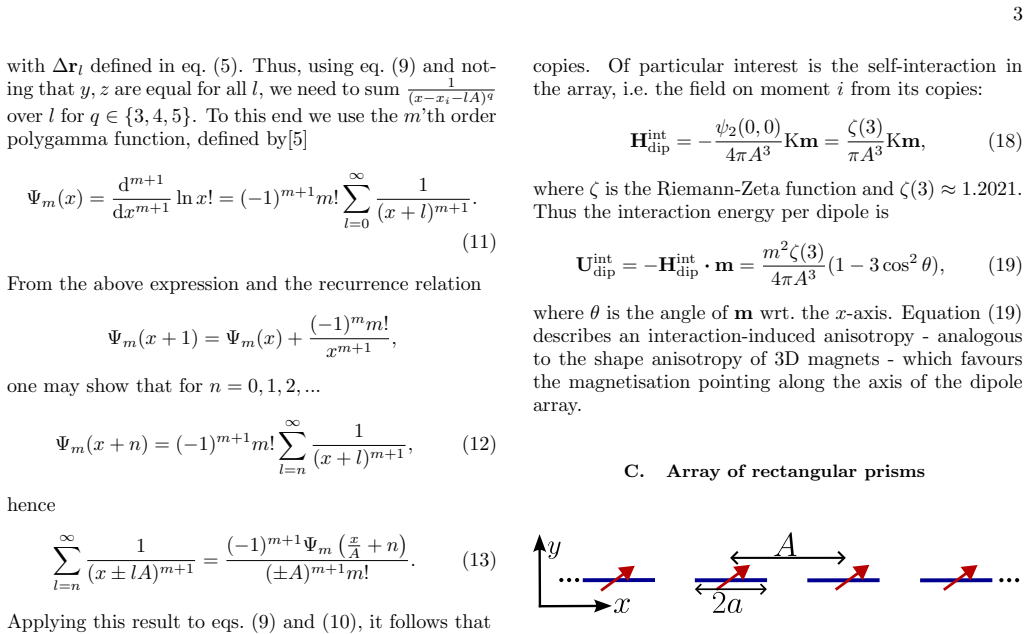
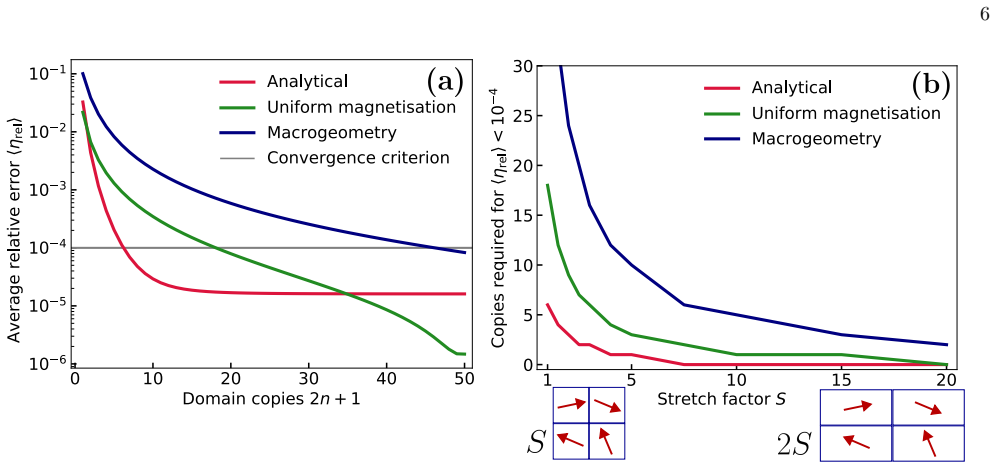
We derive an analytical solution for the field from a periodically repeating infinite array of prisms aligned end-to-end, which becomes exact on the center axis in the limit of infinitesimally thin prisms. Using the same method we derive the on-axis field for a one-dimensional array of point dipoles. We validate the obtained results numerically and furthermore compare with the common macrogeometry approach and more recent uniform magnetisation method, demonstrating an excellent convergence rate for the novel method.
What carries the argument
Summation of the known single-prism demagnetizing field over the infinite periodic lattice, evaluated exactly on the central axis after taking the thin-prism limit.
If this is right
- The derived series converges faster than the macrogeometry approximation and the uniform magnetization method.
- Numerical checks confirm that the analytical expressions match direct computations of the field.
- The same summation technique produces an exact on-axis field for a periodic array of point dipoles.
- The expressions supply a practical tool for computing demagnetizing fields in one-dimensional periodic magnetic structures.
Where Pith is reading between the lines
- The on-axis exact result can serve as a benchmark for testing numerical codes that model periodic magnetic chains.
- The summation approach may be adapted to compute fields at off-axis locations or for finite numbers of prisms if the single-prism field remains known.
- This class of exact thin-limit results could guide the design of more efficient micromagnetic models for elongated magnetic elements such as nanowires.
Load-bearing premise
The derivation assumes uniform magnetization inside each prism and becomes exact only on the central axis when the prism thickness approaches zero.
What would settle it
A direct numerical integration or finite-element calculation of the field on the axis for a long but finite chain of very thin prisms should agree with the analytical series to within numerical error; systematic disagreement would falsify the exactness claim.
Figures



read the original abstract
The magnetic field from a uniformly magnetised, rectangular prism is known exactly, which is the basis for a large number of micromagnetic simulations. Here we derive an analytical solution for the field from a periodically repeating infinite array of prisms aligned end-to-end, which becomes exact on the center axis in the limit of infinitesimally thin prisms. Using the same method we derive the on-axis field for a one-dimensional array of point dipoles. We validate the obtained results numerically and furthermore compare with the common macrogeometry approach and more recent uniform magnetisation method, demonstrating an excellent convergence rate for the novel method.
Editorial analysis
A structured set of objections, weighed in public.
Referee Report
Summary. The paper derives an analytical expression for the demagnetizing field of an infinite periodic one-dimensional array of uniformly magnetized rectangular prisms aligned end-to-end. The central result is obtained by superposing the known exact single-prism field and reduces to a closed-form expression that is exact on the center axis in the limit of vanishing prism thickness. The same approach yields the on-axis field for a 1D lattice of point dipoles. Results are validated by direct numerical summation and compared against the macrogeometry approximation and the uniform-magnetization method, showing rapid convergence.
Significance. If the derivation holds, the work supplies a parameter-free, analytically closed expression for a common geometry in micromagnetic modeling. This is a direct extension of the established single-prism solution and therefore inherits its rigor while removing the need for numerical lattice sums or fitted demagnetizing factors in the thin-prism limit. The explicit point-dipole result and the documented numerical checks against two independent methods constitute reproducible, falsifiable content that can be immediately adopted in simulation codes.
minor comments (3)
- [Abstract] The abstract states that the solution 'becomes exact on the center axis in the limit of infinitesimally thin prisms' but does not restate the uniform-magnetization assumption that underlies the starting single-prism field; a single clarifying clause would prevent misreading.
- [Derivation section] Equation numbers for the infinite periodic sum (the superposition step) and for the final closed-form on-axis expression are not cross-referenced in the text; adding these references would improve traceability.
- [Numerical validation] The convergence plots compare the new method to macrogeometry and uniform-magnetization results, but the figure captions do not specify the exact error norm (e.g., L2 or pointwise) or the number of terms retained in the reference sums.
Simulated Author's Rebuttal
We thank the referee for their positive assessment of the manuscript and for recommending acceptance. The report contains no major comments or criticisms requiring a point-by-point response.
Circularity Check
No significant circularity; derivation is an analytic superposition of an externally known single-prism result
full rationale
The paper starts from the established exact demagnetizing field of an isolated uniformly magnetized rectangular prism (a result external to this work) and performs an analytic summation over a one-dimensional periodic lattice. The central closed-form expression on the axis in the thin-prism limit follows directly from this summation under the uniform-magnetization assumption; no parameters are fitted to the target data, no self-citation supplies a load-bearing uniqueness theorem or ansatz, and the result is not equivalent to its inputs by construction. Numerical validation and comparison to macrogeometry methods are independent checks. This is a standard, non-circular analytic derivation.
Axiom & Free-Parameter Ledger
axioms (1)
- domain assumption The magnetic field produced by a single uniformly magnetized rectangular prism is known exactly.
Reference graph
Works this paper leans on
-
[1]
Abert, L
C. Abert, L. Exl, F. Bruckner, et al. magnum.fe: A micromagnetic finite-element simulation code based on fenics.Journal of Magnetism and Magnetic Materials, 345:29–35, 2013
2013
-
[2]
A. Aharoni. Elongated single-domain ferromagnetic par- ticles.Journal of Applied Physics, 63(12):5879–5882, June 1988
1988
-
[3]
A. Aharoni. Single-domain ferromagnetic cylinder.IEEE Transactions on Magnetics, 25(5):3470–3472, Sept. 1989
1989
-
[4]
M. J. Akbari, A. R. Khedmati, M. A. Bijarchi, and M. B. Shafii. Impact dynamics of a ferrofluid marble on surfaces under a vertical magnetic field: Pre-impact motion and maximum spreading.Physics of Fluids, 37(9):092128, Sept. 2025
2025
-
[5]
G. B. Arfken and H.-J. Weber.Mathematical Methods for Physicists. Elsevier, Boston, 6th ed edition, 2005. ch. 8.2, pp. 510-516
2005
-
[6]
Bjørk and M
R. Bjørk and M. d’Aquino. Accuracy of the analytical demagnetization tensor for various geometries.Journal of Magnetism and Magnetic Materials, 587:171245, 2023
2023
-
[7]
Bjørk, E
R. Bjørk, E. Poulsen, K. Nielsen, and A. Insinga. MagTense: A micromagnetic framework using the an- alytical demagnetization tensor.Journal of Magnetism and Magnetic Materials, 535:168057, Oct. 2021
2021
-
[8]
W. F. Brown. The Fundamental Theorem of Fine- Ferromagnetic-Particle Theory.Journal of Applied Physics, 39(2):993–994, Feb. 1968
1968
-
[9]
W. F. Brown. THE FUNDAMENTAL THEOREM OF THE THEORY OF FINE FERROMAGNETIC PARTI- CLES*.Annals of the New York Academy of Sciences, 147(12):463–488, June 1969
1969
-
[10]
Caciagli, R
A. Caciagli, R. J. Baars, A. P. Philipse, and B. W. Kuipers. Exact expression for the magnetic field of a fi- nite cylinder with arbitrary uniform magnetization.Jour- nal of Magnetism and Magnetic Materials, 456:423–432, June 2018
2018
-
[11]
M. J. Donahue and D. G. Porter. Oommf user’s guide: Version 1.0, 1999
1999
-
[12]
F. L. Durhuus, M. Beleggia, and C. Frandsen. Magnetic and viscous dynamics of spheroidal nanoparticles.Phys- ical Review B, 110(14):144425, Oct. 2024
2024
-
[13]
F. L. Durhuus, E. Fogh, T. Jauho, and M. Beleggia. Demagnetization factors and field of hemispherical ob- jects.Journal of Magnetism and Magnetic Materials, 626:173047, Aug. 2025
2025
-
[14]
F. L. Durhuus, A. R. Insinga, and R. Bjørk. Including sample shape in micromagnetics with 3D periodic bound- ary conditions.arXiv, (arXiv:2604.08777), Apr. 2026
work page internal anchor Pith review Pith/arXiv arXiv 2026
-
[15]
Fangohr, G
H. Fangohr, G. Bordignon, M. Franchin, A. Knittel, P. A. J. De Groot, and T. Fischbacher. A new approach to (quasi) periodic boundary conditions in micromagnet- ics: The macrogeometry.Journal of Applied Physics, 105(7):07D529, Apr. 2009
2009
-
[16]
D. J. Griffiths.Introduction to Electrodynamics. Pearson, Boston, fourth edition edition, 2013
2013
-
[17]
K. M. Lebecki, M. J. Donahue, and M. W. Gutowski. Periodic boundary conditions for demagnetization inter- actions in micromagnetic simulations.Journal of Physics D: Applied Physics, 41(17):175005, Sept. 2008
2008
-
[18]
J. C. Maxwell.A Treatise on Electricity and Magnetism, volume 2. Clarendon Press ; Oxford University Press, third edition, 1891. chapter V, pp. 66-70. Note that Maxwell attributes the argument to Poisson without cit- ing a specific text
-
[19]
K. K. Nielsen, A. R. Insinga, and R. Bjork. The Stray and Demagnetizing Field of a Homogeneously Magnetized Tetrahedron.IEEE Magnetics Letters, 10:1–5, 2019
2019
-
[20]
J. A. Osborn. Demagnetizing Factors of the General El- lipsoid.Physical Review, 67(11-12):351–357, June 1945
1945
-
[21]
Smith, K
A. Smith, K. K. Nielsen, D. V. Christensen, C. R. H. Bahl, R. Bjørk, and J. Hattel. The demagnetizing field of a nonuniform rectangular prism.Journal of Applied Physics, 107(10):103910, May 2010
2010
-
[22]
E. C. Stoner. XCVII. The demagnetizing factors for ellip- soids.The London, Edinburgh, and Dublin Philosophical Magazine and Journal of Science, 36(263):803–821, Dec. 1945
1945
-
[23]
Tejedor, H
M. Tejedor, H. Rubio, L. Elbaile, and R. Iglesias. Exter- nal fields created by uniformly magnetized ellipsoids and spheroids.IEEE Transactions on Magnetics, 31(1):830– 836, Jan. 1995
1995
-
[24]
Vansteenkiste, J
A. Vansteenkiste, J. Leliaert, M. Dvornik, M. Helsen, F. Garcia-Sanchez, and B. Van Waeyenberge. The design and verification of mumax3.AIP advances, 4(10), 2014
2014
-
[25]
Vansteenkiste, J
A. Vansteenkiste, J. Leliaert, M. Dvornik, M. Helsen, F. Garcia-Sanchez, and B. Van Waeyenberge. The design 8 and verification of MuMax3.AIP Advances, 4(10), Oct. 2014
2014
-
[26]
Virtanen, R
P. Virtanen, R. Gommers, T. E. Oliphant, et al. SciPy 1.0: Fundamental algorithms for scientific computing in Python.Nature Methods, 17(3):261–272, Mar. 2020
2020
-
[27]
W. Wang, C. Mu, B. Zhang, Q. Liu, J. Wang, and D. Xue. Two-dimensional periodic boundary condi- tions for demagnetization interactions in micromagnet- ics.Computational Materials Science, 49(1):84–87, June 2010
2010
discussion (0)
Sign in with ORCID, Apple, or X to comment. Anyone can read and Pith papers without signing in.