Recognition: unknown
From edges to meaning: Semantic line sketches as a cognitive scaffold for ancient pictograph invention
Pith reviewed 2026-05-10 15:53 UTC · model grok-4.3
The pith
A model of the visual cortex generates line sketches from semantic knowledge that structurally match ancient pictographs across cultures.
A machine-rendered reading of the paper's core claim, the machinery that carries it, and where it could break.
Core claim
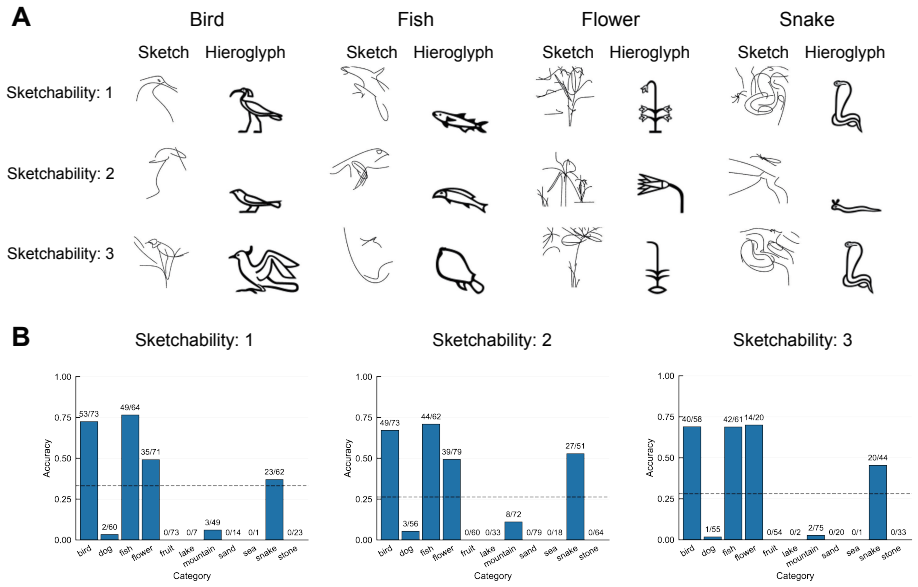
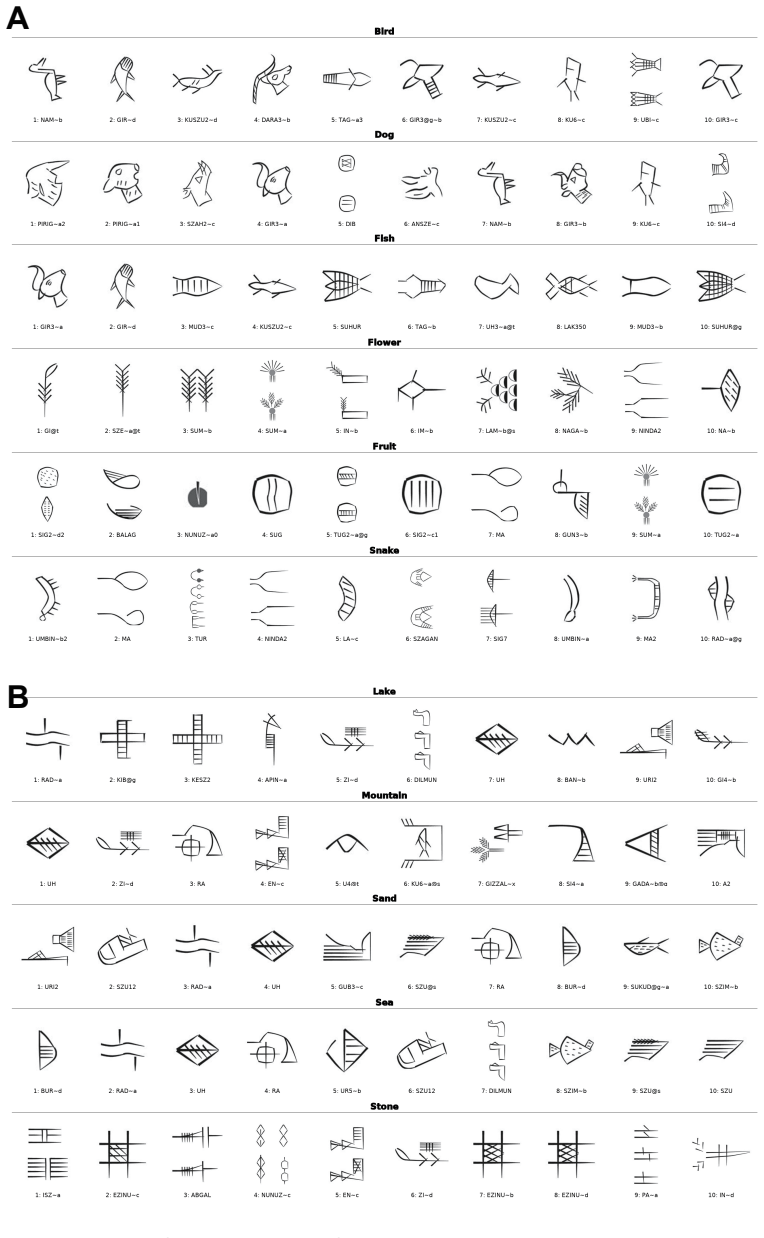
Ancient pictographic writing emerged from the brain's intrinsic compression of visual input into stable boundary-based abstractions, implemented through a feedforward encoding of low-level features followed by recurrent top-down semantic refinement, and a computational model replicating this architecture produces line drawings that structurally match historical pictographs from multiple independent writing systems while generating interpretable candidates for undeciphered scripts.
What carries the argument
Biologically inspired digital twin of the visual hierarchy that encodes an image into low-level features, generates a contour sketch, and iteratively refines it through top-down semantic feedback.
If this is right
- Generated symbols match the structural forms of Egyptian hieroglyphs, Chinese oracle bone characters, and proto-cuneiform.
- The model supplies candidate interpretations for undeciphered scripts.
- Pictographic writing has a neuro-computational origin based on visual compression rather than arbitrary cultural choice.
- AI systems can simulate the perceptual steps by which humans externalized meaning as boundary symbols.
Where Pith is reading between the lines
- The same compression mechanism may explain why line drawings remain effective for object recognition across unrelated cultures.
- The framework could be tested by checking whether removing semantic feedback produces sketches that no longer match historical forms.
- If valid, the model predicts that similar boundary-refinement processes shaped other early symbolic systems such as tally marks or seals.
- It offers a concrete way to generate and test new candidate readings for remaining undeciphered inscriptions.
Load-bearing premise
The iterative top-down semantic refinement step in the model reproduces the actual cognitive processes ancient humans used to turn object knowledge into line symbols.
What would settle it
Applying the model to known ancient objects and finding that the generated line sketches lack the structural features of the corresponding historical pictographs would falsify the central claim.
Figures



read the original abstract
Humans readily recognize objects from sparse line drawings, a capacity that appears early in development and persists across cultures, suggesting neural rather than purely learned origins. Yet the computational mechanism by which the brain transforms high-level semantic knowledge into low-level visual symbols remains poorly understood. Here we propose that ancient pictographic writing emerged from the brain's intrinsic tendency to compress visual input into stable, boundary-based abstractions. We construct a biologically inspired digital twin of the visual hierarchy that encodes an image into low-level features, generates a contour sketch, and iteratively refines it through top-down feedback guided by semantic representations, mirroring the feedforward and recurrent architecture of the human visual cortex. The resulting symbols bear striking structural resemblance to early pictographs across culturally distant writing systems, including Egyptian hieroglyphs, Chinese oracle bone characters, and proto-cuneiform, and offer candidate interpretations for undeciphered scripts. Our findings support a neuro-computational origin of pictographic writing and establish a framework in which AI can recapitulate the cognitive processes by which humans first externalized perception into symbols.
Editorial analysis
A structured set of objections, weighed in public.
Referee Report
Summary. The paper proposes a biologically inspired computational model of the visual hierarchy that encodes images into low-level features, generates contour sketches, and iteratively refines them via top-down semantic feedback. It claims that the resulting line sketches exhibit striking structural resemblance to ancient pictographs from Egyptian hieroglyphs, Chinese oracle bone script, and proto-cuneiform, thereby supporting a neuro-computational origin for pictographic writing and offering candidate interpretations for undeciphered scripts.
Significance. If the claimed resemblances can be shown to exceed those produced by generic sparse line-drawing procedures and to be robust to controls, the work would provide a novel computational framework linking recurrent visual processing to the emergence of symbolic systems, with potential implications for cognitive modeling in AI and the study of writing origins.
major comments (2)
- [Abstract] Abstract: The central claim that outputs 'bear striking structural resemblance' to early pictographs across distant writing systems is presented without any quantitative metrics (e.g., graph-edit distance, normalized compression distance, or blinded similarity ratings), statistical tests, or comparisons against baselines such as random contours or bottom-up edge detectors. This absence prevents evaluation of whether the resemblance arises from the proposed iterative semantic architecture rather than generic properties of line drawings.
- [Methods] Methods (model description): The implementation of semantic representations and the precise mechanism of top-down refinement are not specified in sufficient detail to assess whether the process is independent of the target pictographs or risks circularity, where feedback parameters could be adjusted to favor resemblance to known symbols.
minor comments (2)
- [Abstract] The abstract and introduction would benefit from explicit statements of the model's free parameters and any training data used for the semantic component to clarify reproducibility.
- [Figures] Figure captions describing example outputs should include scale bars, source image references, and direct side-by-side comparisons with the claimed ancient pictographs for clarity.
Simulated Author's Rebuttal
We thank the referee for their constructive comments, which highlight important areas for strengthening the manuscript. We address each major point below and have revised the manuscript to incorporate additional rigor where feasible.
read point-by-point responses
-
Referee: [Abstract] The central claim that outputs 'bear striking structural resemblance' to early pictographs across distant writing systems is presented without any quantitative metrics (e.g., graph-edit distance, normalized compression distance, or blinded similarity ratings), statistical tests, or comparisons against baselines such as random contours or bottom-up edge detectors. This absence prevents evaluation of whether the resemblance arises from the proposed iterative semantic architecture rather than generic properties of line drawings.
Authors: We agree that the absence of quantitative metrics limits the strength of the claim. In the revised manuscript we will add direct comparisons using graph-edit distance and normalized compression distance between model outputs and target pictographs, alongside the same metrics computed for baselines (random contours and standard bottom-up edge detectors). We will also report statistical tests and include blinded human similarity ratings to evaluate whether the observed resemblances exceed those expected from generic line-drawing procedures. revision: yes
-
Referee: [Methods] The implementation of semantic representations and the precise mechanism of top-down refinement are not specified in sufficient detail to assess whether the process is independent of the target pictographs or risks circularity, where feedback parameters could be adjusted to favor resemblance to known symbols.
Authors: We acknowledge that the current Methods section lacks sufficient implementation detail. In the revision we will expand this section to specify (i) how semantic representations are obtained from a fixed, pre-trained object-recognition network operating on broad visual categories independent of any writing system, and (ii) the exact equations and parameter values governing top-down refinement, which are derived from neurophysiological constraints on cortical recurrence rather than optimized against the pictographic targets. We will also add explicit controls demonstrating that the same fixed parameters produce coherent sketches for images unrelated to known scripts. revision: yes
Circularity Check
No circularity: model outputs compared to pictographs via independent observation
full rationale
The paper constructs a contour-sketch generator with top-down semantic refinement and reports that its outputs resemble ancient pictographs. No equations, fitted parameters, or self-citations are presented that reduce the resemblance claim to the model's inputs by construction. The derivation proceeds from an independently specified architecture to an external visual comparison, remaining self-contained without any of the enumerated circular patterns.
Axiom & Free-Parameter Ledger
axioms (1)
- domain assumption The human visual cortex encodes images via low-level features, generates contour sketches, and refines them through top-down semantic feedback.
Reference graph
Works this paper leans on
-
[1]
Radford, A. et al. Learning Transferable Visual Models From Natural Language Supervision. Preprint at https://doi.org/10.48550/arXiv.2103.00020 (2021). 33. Wang, A. Y., Kay, K., Naselaris, T., Tarr, M. J. & Wehbe, L. Better models of human high-level visual cortex emerge from natural language supervision with a large and diverse dataset. Nat Mach Intell 5...
work page internal anchor Pith review Pith/arXiv arXiv doi:10.48550/arxiv.2103.00020 2021
-
[2]
& Malach, R
Hasson, U., Levy, I., Behrmann, M., Hendler, T. & Malach, R. Eccentricity bias as an organizing principle for human high-order object areas. Neuron 34, 479–490 (2002). 53. Konkle, T. & Oliva, A. A real-world size organization of object responses in occipitotemporal cortex. Neuron 74, 1114–1124 (2012). 54. Canário, N., Jorge, L., Loureiro Silva, M. F., Alb...
2002
-
[3]
( $ & !' %(!$ %'! *( (
Yuan, Y. & Brown, S. The Neural Basis of Mark Making: A Functional MRI Study of Drawing. PLOS ONE 9, e108628 (2014). 72. Changizi, M. A., Zhang, Q., Ye, H. & Shimojo, S. The Structures of Letters and Symbols throughout Human History Are Selected to Match Those Found in Objects in Natural Scenes. The American Naturalist 167, E117–E139 (2006). Figure S1. Th...
2014
discussion (0)
Sign in with ORCID, Apple, or X to comment. Anyone can read and Pith papers without signing in.