Recognition: unknown
Hyper Separation Logic (extended version)
Pith reviewed 2026-05-10 13:39 UTC · model grok-4.3
The pith
Hyper Separation Logic is the first to support modular reasoning about hyperproperties with arbitrary quantifier alternation for heap-manipulating programs.
A machine-rendered reading of the paper's core claim, the machinery that carries it, and where it could break.
Core claim
Hyper Separation Logic (HSL) generalizes Hyper Hoare Logic by introducing a hyper separating conjunction that lifts the standard separating conjunction to sets of states. This lifting yields a generalized frame rule that preserves soundness for hyperproperties with arbitrary quantifier alternation over programs that manipulate the heap. The paper proves HSL sound in Isabelle/HOL and shows that it can express hyperproperties beyond the reach of earlier separation logics.
What carries the argument
The hyper separating conjunction, which lifts the standard separating conjunction from single states to sets of states and thereby supports a sound generalized frame rule for hyperproperties.
If this is right
- Allows modular proofs of generalized non-interference for imperative programs that allocate and access the heap.
- Supports hyperproperties using any combination of universal and existential quantifiers over multiple executions.
- Preserves the frame rule when reasoning about resources shared or separated across those executions.
- Applies directly to common imperative languages with mutable memory.
Where Pith is reading between the lines
- The same lifting technique could be tried on other resource logics that currently lack hyperproperty support.
- It may enable embedding HSL rules into existing automated verifiers for languages with pointers.
- Similar set-based extensions might help connect separation logic to model checkers that already handle hyperproperties.
Load-bearing premise
The hyper separating conjunction must be defined so that it correctly extends the standard one to sets of states without breaking the soundness of the generalized frame rule when programs modify the heap.
What would settle it
A concrete heap-manipulating program together with a hyperproperty that uses quantifier alternation for which HSL derives an incorrect judgment would falsify the claim.
Figures


read the original abstract
Many important functional and security properties--including non-interference, determinism, and generalized non-interference (GNI)--are hyperproperties, i.e., properties relating multiple executions of a program. Existing separation logics allow one to reason about specific classes of hyperproperties, e.g., $\forall\forall$-hyperproperties such as non-interference and $\exists\exists$-properties such as non-determinism. However, they do not support quantifier alternation, which is for instance needed to express GNI. The only existing logic that can reason about such properties is Hyper Hoare Logic, but it does not support heap-manipulating programs and, thus, is not applicable to common imperative programs. This paper introduces Hyper Separation Logic (HSL), the first program logic that supports modular reasoning about hyperproperties with arbitrary quantifier alternation over programs that manipulate the heap. HSL generalizes Hyper Hoare Logic with a novel hyper separating conjunction that lifts the standard separating conjunction to sets of states, enabling a generalized frame rule for hyperproperties. We prove HSL sound in Isabelle/HOL and demonstrate its expressiveness for hyperproperties that lie beyond the reach of existing separation logics.
Editorial analysis
A structured set of objections, weighed in public.
Referee Report
Summary. The paper introduces Hyper Separation Logic (HSL), the first program logic supporting modular reasoning about hyperproperties with arbitrary quantifier alternation (e.g., generalized non-interference) over heap-manipulating programs. It generalizes Hyper Hoare Logic via a novel hyper separating conjunction that lifts the standard separating conjunction to sets of states, yielding a generalized frame rule. Soundness is established via a machine-checked proof in Isabelle/HOL, and expressiveness is demonstrated for hyperproperties beyond the reach of prior separation logics limited to ∀∀ or ∃∃ cases.
Significance. If the soundness result holds, the work is significant: it closes the gap between separation logics (which handle heaps but only specific hyperproperties) and Hyper Hoare Logic (which handles quantifier alternation but not heaps). The machine-checked Isabelle/HOL proof for the hyper separating conjunction and generalized frame rule is a clear strength, providing direct verification of the central lifting construction rather than an unverified claim. This enables modular verification of important security and functional hyperproperties in realistic imperative code with dynamic memory.
minor comments (3)
- [§3.1] §3.1, Definition 3.3: the inductive definition of the hyper separating conjunction would benefit from an immediate concrete example (e.g., two singleton state sets) to illustrate how heap disjointness is lifted to sets of states.
- [§4.2] §4.2, Theorem 4.1 (generalized frame rule): the proof sketch references the Isabelle lemma but does not list the exact lemma name or theory file; adding this would aid reproducibility.
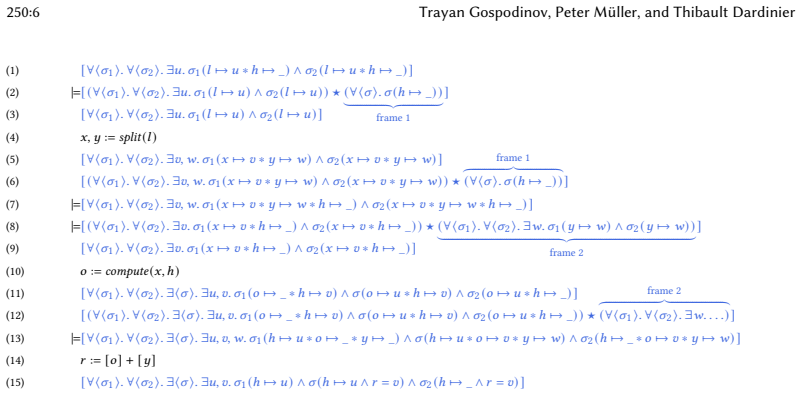
- [Figure 2] Figure 2 (expressiveness example for GNI): the diagram omits explicit quantifier labels on the execution traces, making it harder to see the alternation at a glance.
Simulated Author's Rebuttal
We thank the referee for their positive summary and significance assessment of Hyper Separation Logic, as well as the recommendation for minor revision. No specific major comments were raised in the report.
Circularity Check
No significant circularity; machine-checked proof supplies independent support
full rationale
The paper defines a novel hyper separating conjunction that lifts standard separation to sets of states and proves a generalized frame rule sound for arbitrary quantifier alternation over heap programs. Soundness is established via a machine-checked Isabelle/HOL development supplied in the paper itself, satisfying the criterion for independent evidence. No step reduces by construction to a fitted parameter, self-definition, or load-bearing self-citation chain; the central claims remain externally falsifiable through the formalization rather than being renamed or presupposed inputs.
Axiom & Free-Parameter Ledger
axioms (2)
- domain assumption Standard separation logic axioms and rules for heap-manipulating programs
- domain assumption Semantics of hyperproperties and quantifier alternation over program executions
invented entities (1)
-
hyper separating conjunction
no independent evidence
Reference graph
Works this paper leans on
-
[1]
Timos Antonopoulos, Eric Koskinen, Ton Chanh Le, Ramana Nagasamudram, David A. Naumann, and Minh Ngo. 2023. An Algebra of Alignment for Relational Verification.Proc. ACM Program. Lang.7, POPL (Jan. 2023), 20:573–20:603. doi:10.1145/3571213
-
[2]
Flavio Ascari, Roberto Bruni, Roberta Gori, and Francesco Logozzo. 2024. Sufficient Incorrectness Logic: SIL and Separation SIL. arXiv:2310.18156 [cs] doi:10.48550/arXiv.2310.18156
-
[3]
Flavio Ascari, Roberto Bruni, Roberta Gori, and Francesco Logozzo. 2025. Revealing Sources of (Memory) Errors via Backward Analysis.Proc. ACM Program. Lang.9, OOPSLA1 (April 2025), 1321–1348. doi:10.1145/3720486
-
[4]
Nick Benton. 2004. Simple Relational Correctness Proofs for Static Analyses and Program Transformations. InProceed- ings of the 31st ACM SIGPLAN-SIGACT Symposium on Principles of Programming Languages (POPL ’04). Association for Computing Machinery, New York, NY, USA, 14–25. doi:10.1145/964001.964003
-
[5]
Raven Beutner. 2024. Automated Software Verification of Hyperliveness. InTools and Algorithms for the Construction and Analysis of Systems, Bernd Finkbeiner and Laura Kovács (Eds.). Springer Nature Switzerland, Cham, 196–216. doi:10.1007/978-3-031-57249-4_10
-
[6]
Lars Birkedal, Bernhard Reus, Jan Schwinghammer, and Hongseok Yang. 2008. A Simple Model of Separation Logic for Higher-Order Store. InAutomata, Languages and Programming, Luca Aceto, Ivan Damgård, Leslie Ann Goldberg, Magnús M. Halldórsson, Anna Ingólfsdóttir, and Igor Walukiewicz (Eds.). Springer, Berlin, Heidelberg, 348–360. doi:10.1007/978-3-540-70583-3_29
-
[7]
Arthur Charguéraud. 2020. Separation Logic for Sequential Programs (Functional Pearl).Proc. ACM Program. Lang.4, ICFP (Aug. 2020), 1–34. doi:10.1145/3408998
-
[8]
Michael R. Clarkson and Fred B. Schneider. 2008. Hyperproperties. In2008 21st IEEE Computer Security Foundations Symposium. 51–65. doi:10.1109/CSF.2008.7
-
[10]
Thibault Dardinier and Peter Müller. 2024. Hyper Hoare Logic: (Dis-)Proving Program Hyperproperties (Extended Version).Proc. ACM Program. Lang.8, PLDI (June 2024), 1485–1509. arXiv:2301.10037 [cs] doi:10.1145/3656437
-
[11]
N. G de Bruijn. 1972. Lambda Calculus Notation with Nameless Dummies, a Tool for Automatic Formula Manipulation, with Application to the Church-Rosser Theorem.Indagationes Mathematicae (Proceedings)75, 5 (Jan. 1972), 381–392. doi:10.1016/1385-7258(72)90034-0
-
[12]
Edsko de Vries and Vasileios Koutavas. 2011. Reverse Hoare Logic. InSoftware Engineering and Formal Methods, Gilles Barthe, Alberto Pardo, and Gerardo Schneider (Eds.). Springer, Berlin, Heidelberg, 155–171. doi:10.1007/978-3-642- 24690-6_12
-
[13]
Robert Dickerson, Qianchuan Ye, Michael K. Zhang, and Benjamin Delaware. 2022. RHLE: Modular Deductive Verification of Relational $$\forall \exists $$Properties. InProgramming Languages and Systems, Ilya Sergey (Ed.). Springer Nature Switzerland, Cham, 67–87. doi:10.1007/978-3-031-21037-2_4
-
[14]
Emanuele D’Osualdo, Azadeh Farzan, and Derek Dreyer. 2022. Proving Hypersafety Compositionally.Proc. ACM Program. Lang.6, OOPSLA2 (Oct. 2022), 135:289–135:314. doi:10.1145/3563298
-
[15]
Marco Eilers, Thibault Dardinier, and Peter Müller. 2023. CommCSL: Proving Information Flow Security for Concurrent Programs Using Abstract Commutativity.Proc. ACM Program. Lang.7, PLDI (June 2023), 175:1682–175:1707. doi:10. 1145/3591289
2023
-
[16]
Gidon Ernst and Toby Murray. 2019. SecCSL: Security Concurrent Separation Logic. InComputer Aided Verification, Isil Dillig and Serdar Tasiran (Eds.). Vol. 11562. Springer International Publishing, Cham, 208–230. doi:10.1007/978-3- 030-25543-5_13
-
[17]
Robert W. Floyd. 1967. Assigning Meanings to Programs.Proceedings of Symposium in Applied Mathematics(1967), 19–32
1967
-
[18]
Dan Frumin, Robbert Krebbers, and Lars Birkedal. 2018. ReLoC: A Mechanised Relational Logic for Fine-Grained Concurrency. InProceedings of the 33rd Annual ACM/IEEE Symposium on Logic in Computer Science (LICS ’18). Association for Computing Machinery, New York, NY, USA, 442–451. doi:10.1145/3209108.3209174
-
[19]
Lennard Gäher, Michael Sammler, Simon Spies, Ralf Jung, Hoang-Hai Dang, Robbert Krebbers, Jeehoon Kang, and Derek Dreyer. 2022. Simuliris: A Separation Logic Framework for Verifying Concurrent Program Optimizations.Proc. ACM Program. Lang.6, POPL (Jan. 2022), 28:1–28:31. doi:10.1145/3498689 250:24 Trayan Gospodinov, Peter Müller, and Thibault Dardinier
-
[20]
Vladimir Gladshtein, Qiyuan Zhao, Willow Ahrens, Saman Amarasinghe, and Ilya Sergey. 2024. Mechanised Hypersafety Proofs about Structured Data.Proc. ACM Program. Lang.8, PLDI (June 2024), 173:647–173:670. doi:10.1145/3656403
-
[21]
J. A. Goguen and J. Meseguer. 1982. Security Policies and Security Models. In1982 IEEE Symposium on Security and Privacy. 11–11. doi:10.1109/SP.1982.10014
-
[22]
Trayan Gospodinov, Peter Müller, and Thibault Dardinier. 2026. Hyper Separation Logic (artifact). Zenodo. doi:10. 5281/zenodo.19091148
2026
-
[23]
C. A. R. Hoare. 1969. An Axiomatic Basis for Computer Programming.Commun. ACM12, 10 (Oct. 1969), 576–580. doi:10.1145/363235.363259
-
[24]
Petar Maksimović, Caroline Cronjäger, Andreas Lööw, Julian Sutherland, and Philippa Gardner. 2023. Exact Separation Logic: Towards Bridging the Gap Between Verification and Bug-Finding. In37th European Conference on Object- Oriented Programming (ECOOP 2023) (Leibniz International Proceedings in Informatics (LIPIcs), Vol. 263), Karim Ali and Guido Salvanes...
-
[25]
Daryl McCullough. 1987. Specifications for Multi-Level Security and a Hook-Up. In1987 IEEE Symposium on Security and Privacy. 161–161. doi:10.1109/SP.1987.10009
-
[26]
D. McCullough. 1988. Noninterference and the Composability of Security Properties. InProceedings. 1988 IEEE Symposium on Security and Privacy. 177–186. doi:10.1109/SECPRI.1988.8110
-
[27]
J. McLean. 1996. A General Theory of Composition for a Class of "Possibilistic" Properties.IEEE Transactions on Software Engineering22, 1 (Jan. 1996), 53–67. doi:10.1109/32.481534
-
[28]
Toby Murray. 2020. An Under-Approximate Relational Logic: Heralding Logics of Insecurity, Incorrect Implementation & More. arXiv:2003.04791 [cs] doi:10.48550/arXiv.2003.04791
-
[29]
Toby Murray, Pengbo Yan, and Gidon Ernst. 2023. Compositional Vulnerability Detection with Insecurity Separation Logic. InFormal Methods and Software Engineering, Yi Li and Sofiène Tahar (Eds.). Springer Nature, Singapore, 65–82. doi:10.1007/978-981-99-7584-6_5
-
[30]
Tobias Nipkow, Lawrence C. Paulson, and Markus Wenzel. 2002.Isabelle/HOL - A Proof Assistant for Higher-Order Logic. Lecture Notes in Computer Science, Vol. 2283. Springer. doi:10.1007/3-540-45949-9
-
[31]
Peter W. O’Hearn. 2019. Incorrectness Logic.Proc. ACM Program. Lang.4, POPL (Dec. 2019), 10:1–10:32. doi:10.1145/ 3371078
2019
-
[32]
Azalea Raad, Josh Berdine, Hoang-Hai Dang, Derek Dreyer, Peter O’Hearn, and Jules Villard. 2020. Local Reasoning About the Presence of Bugs: Incorrectness Separation Logic. InComputer Aided Verification, Shuvendu K. Lahiri and Chao Wang (Eds.). Springer International Publishing, Cham, 225–252. doi:10.1007/978-3-030-53291-8_14
-
[33]
Azalea Raad, Josh Berdine, Derek Dreyer, and Peter W. O’Hearn. 2022. Concurrent Incorrectness Separation Logic. Proc. ACM Program. Lang.6, POPL (Jan. 2022), 34:1–34:29. doi:10.1145/3498695
-
[34]
J.C. Reynolds. 2002. Separation Logic: A Logic for Shared Mutable Data Structures. InProceedings 17th Annual IEEE Symposium on Logic in Computer Science. 55–74. doi:10.1109/LICS.2002.1029817
-
[35]
Marcelo Sousa and Isil Dillig. 2016. Cartesian Hoare Logic for Verifying K-Safety Properties. InProceedings of the 37th ACM SIGPLAN Conference on Programming Language Design and Implementation (PLDI ’16). Association for Computing Machinery, New York, NY, USA, 57–69. doi:10.1145/2908080.2908092
-
[36]
Hongseok Yang. 2007. Relational Separation Logic.Theoretical Computer Science375, 1 (May 2007), 308–334. doi:10. 1016/j.tcs.2006.12.036
2007
-
[37]
Noam Zilberstein, Derek Dreyer, and Alexandra Silva. 2023. Outcome Logic: A Unifying Foundation for Correctness and Incorrectness Reasoning.Proc. ACM Program. Lang.7, OOPSLA1 (April 2023), 93:522–93:550. doi:10.1145/3586045
-
[38]
Noam Zilberstein, Angelina Saliling, and Alexandra Silva. 2024. Outcome Separation Logic: Local Reasoning for Correctness and Incorrectness with Computational Effects.Proc. ACM Program. Lang.8, OOPSLA1 (April 2024), 104:276–104:304. doi:10.1145/3649821 Hyper Separation Logic 250:25 ⟨𝑥:=𝑒,⟨𝑠, ℎ⟩⟩ → ⟨skip,⟨𝑠[𝑥↦→𝑒(𝑠)], ℎ⟩⟩⟨𝑥:=nonDet(),⟨𝑠, ℎ⟩⟩ → ⟨skip,⟨𝑠[𝑥↦→𝑣...
discussion (0)
Sign in with ORCID, Apple, or X to comment. Anyone can read and Pith papers without signing in.