Recognition: unknown
Advancing Network Digital Twin Framework for Generating Realistic Datasets
Pith reviewed 2026-05-10 14:09 UTC · model grok-4.3
The pith
An open framework combines vehicle mobility models, site-specific ray tracing, and network simulation to generate realistic wireless datasets for machine learning.
A machine-rendered reading of the paper's core claim, the machinery that carries it, and where it could break.
Core claim
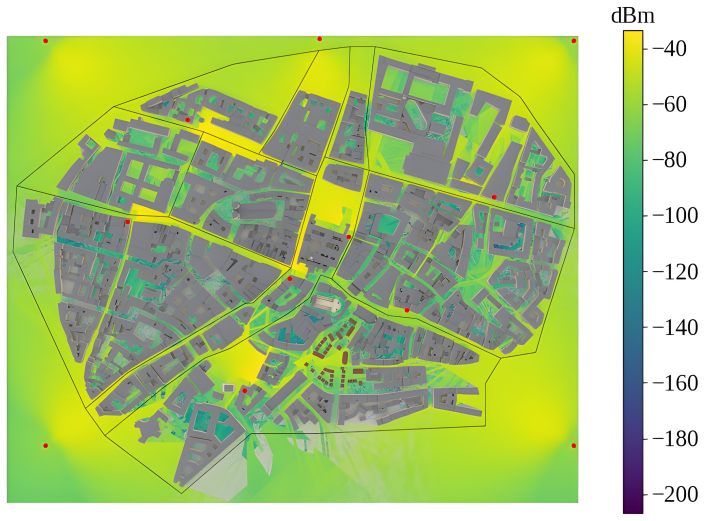
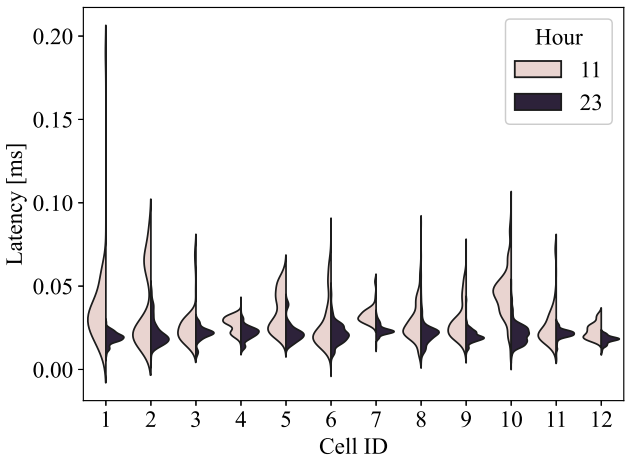
The paper presents an open and user-friendly NDT framework that integrates controllable vehicular mobility with the site-specific ray tracer Sionna and the discrete-event ns-3 network simulator, enabling virtualized end-to-end modeling of wireless networks across the radio, network, and application layers. The framework supports realistic mobility, traffic dynamics, and the extraction of cross-layer metrics, with both the implementation and a sample dataset released for urban vehicular scenarios.
What carries the argument
The integration of controllable vehicular mobility models with the Sionna ray tracer and ns-3 discrete-event simulator, which together enable site-specific propagation, network event modeling, and cross-layer metric extraction for dataset generation.
If this is right
- Enables reproducible benchmarking of machine learning algorithms for quality of service prediction and network optimization.
- Lowers the entry barrier for research on virtualized and open wireless network services.
- Supports controlled extraction of cross-layer metrics in dynamic urban and vehicular deployments.
- Provides a released dataset and code for immediate use in training intelligent network management systems.
Where Pith is reading between the lines
- The approach could shorten development cycles for 5G and 6G network intelligence by substituting some physical measurement campaigns with calibrated simulations.
- Similar integration patterns might extend to non-vehicular scenarios such as indoor or industrial wireless environments.
- Widespread adoption would create shared benchmark datasets that allow direct comparison of different optimization algorithms across research groups.
Load-bearing premise
The combined mobility, ray-tracing, and network simulation produces data close enough to real-world measurements to train and validate machine learning algorithms without additional calibration against field data.
What would settle it
Train the same machine learning model for quality-of-service prediction once on the framework's generated dataset and once on real vehicular network measurements, then compare their accuracy on held-out real data.
Figures



read the original abstract
The integration of accurate and reproducible wireless network simulations is a key enabler for research on open, virtualized, and intelligent communication systems. Network Digital Twins (NDTs) provide a scalable alternative to costly and time-consuming measurement campaigns, while enabling controlled experimentation and data generation for data-driven network design. In this paper, we present an open and user-friendly NDT framework that integrates controllable vehicular mobility with the site-specific ray tracer Sionna and the discrete-event ns-3 network simulator, enabling virtualized end-to-end modeling of wireless networks across the radio, network, and application layers. The proposed framework is particularly well-suited for dynamic vehicular networks and urban deployments, supporting realistic mobility, traffic dynamics, and the extraction of cross-layer metrics. To promote open-source initiatives, we release both the NDT implementation and a representative dataset generated from realistic vehicular and urban scenarios. The framework and dataset facilitate reproducible experimentation and benchmarking of machine learning-based quality of service prediction, network optimization, and intelligent network management algorithms, lowering the entry barrier for research on virtual and open wireless network services.
Editorial analysis
A structured set of objections, weighed in public.
Referee Report
Summary. The paper presents an open Network Digital Twin (NDT) framework integrating controllable vehicular mobility, the site-specific Sionna ray tracer, and the ns-3 discrete-event simulator to enable virtualized end-to-end modeling of wireless networks across radio, network, and application layers. It releases the implementation and a representative dataset from urban vehicular scenarios to support reproducible ML research on QoS prediction, network optimization, and intelligent management.
Significance. If the integrated pipeline produces cross-layer metrics sufficiently close to physical deployments, the open framework would meaningfully advance reproducible research on virtualized wireless systems by providing scalable, controllable data generation as an alternative to costly measurement campaigns. The explicit release of code and dataset strengthens reproducibility and lowers barriers for data-driven network studies.
major comments (1)
- Abstract and dataset-generation description: the central claim that the framework produces 'realistic' datasets usable for ML training and benchmarking without additional calibration rests on the untested assumption that Sionna+ns-3+vehicular-mobility outputs match real-world distributions for metrics such as SINR, received power, latency, and packet delivery. No quantitative validation (e.g., statistical comparison, error metrics, or field-testbed reference) is reported, which is load-bearing for the utility argument.
Simulated Author's Rebuttal
We thank the referee for the constructive report and the positive assessment of the framework's significance and reproducibility value. We address the single major comment below.
read point-by-point responses
-
Referee: Abstract and dataset-generation description: the central claim that the framework produces 'realistic' datasets usable for ML training and benchmarking without additional calibration rests on the untested assumption that Sionna+ns-3+vehicular-mobility outputs match real-world distributions for metrics such as SINR, received power, latency, and packet delivery. No quantitative validation (e.g., statistical comparison, error metrics, or field-testbed reference) is reported, which is load-bearing for the utility argument.
Authors: We agree that the manuscript does not report new quantitative validation (statistical tests, error metrics, or direct field-testbed comparisons) of the generated cross-layer metrics against physical deployments. The term 'realistic' in the abstract and dataset description refers to the use of established, site-specific modeling: Sionna for geometry-based ray tracing in urban 3D environments, standard vehicular mobility traces, and ns-3 for protocol-accurate network and application layers. These components have been individually validated in prior literature, but the present work focuses on their open integration and data release rather than new end-to-end calibration. To address the concern, we will revise the abstract, introduction, and dataset-generation sections to explicitly qualify the realism claim, add a dedicated discussion of component-level validation with citations, and include basic statistical characterization (e.g., distributions of SINR and latency) of the released dataset. This will clarify the framework's scope while preserving its contribution as an open data-generation pipeline. revision: yes
Circularity Check
No circularity: framework integration is self-contained description
full rationale
The paper describes and releases an integrated simulation pipeline combining external tools (vehicular mobility models, Sionna ray tracer, ns-3) for generating cross-layer network datasets. There are no mathematical derivations, equations, parameter fittings, predictions, or uniqueness theorems. The central claim is the open-source framework itself rather than any result derived from prior outputs of the same authors. External components are cited as standard libraries without self-citation chains or ansatzes that reduce to the paper's inputs. This is a systems contribution whose validity rests on the fidelity of the cited simulators, not on internal circular reduction.
Axiom & Free-Parameter Ledger
axioms (2)
- domain assumption Ray-tracing engines such as Sionna produce sufficiently accurate radio propagation predictions for the target urban and vehicular scenarios.
- domain assumption Discrete-event simulation in ns-3 faithfully reproduces packet-level network behavior when fed realistic channel traces.
Reference graph
Works this paper leans on
-
[1]
Wi reless 6G connectivity for massive number of devices and cri tical services,
A. E. Kalør, G. Durisi, S. Coleri, S. Parkvall, et al., “Wi reless 6G connectivity for massive number of devices and cri tical services,” Proc. IEEE , vol. 113, no. 9, pp. 826–848, 2025
2025
-
[2]
6G-enabled vehicle-to-everything communication s: Current research trends and open challenges,
J. Rodr´ ıguez-Pineiro, Z. Wei, J. Wang, C. A. Gutierrez, et al., “6G-enabled vehicle-to-everything communication s: Current research trends and open challenges,” IEEE Open J. V eh. Technol. , pp. 1–34, 2025
2025
-
[3]
5G new radio for automotive, rail, and air transpor t,
G. Fodor, J. Vinogradova, P . Hammarberg, K. K. Nagalapur , et al., “5G new radio for automotive, rail, and air transpor t,” IEEE Commun. Mag. , vol. 59, no. 7, pp. 22–28, 2021
2021
-
[4]
Netwo rk digital twins – outlook and opportunities,
P . ¨Ohl´ en, C. Johnston, H. Olofsson, S. Terrill, et al., “Netwo rk digital twins – outlook and opportunities,” Ericsson Technology Review , vol. 2022, no. 12, pp. 2–11, 2022
2022
-
[5]
Digital twins for a connected vehicular network: A road toward a sustainab le future,
A. Gupta, V . A. Bohara, and A. Srivastava, “Digital twins for a connected vehicular network: A road toward a sustainab le future,” IEEE Syst. Man Cybern. Mag , vol. 11, no. 3, pp. 4–13, 2025
2025
-
[6]
Digital twins and testbeds for supporting AI research with autonomous vehicle networks,
A. G¨ urses, G. Reddy, S. Masrur, ¨O. ¨Ozdemir, et al., “Digital twins and testbeds for supporting AI research with autonomous vehicle networks,” IEEE Commun. Mag. , vol. 63, no. 4, pp. 56–62, 2025
2025
-
[7]
Di gital-twin-empowered interference management for multih op internet of vehicles networks over millimeter wave bands,
M. Elloumi, G. Kaddoum, M. Zoheb Hassan, and B. Selim, “Di gital-twin-empowered interference management for multih op internet of vehicles networks over millimeter wave bands,” IEEE Internet Things J. , vol. 12, no. 11, pp. 17 807–17 827, 2025
2025
-
[8]
ms-van3t: An integrated multi-stack framework fo r virtual validation of V2X communication and services,
F. Raviglione, C. R. Carletti, M. Malinverno, C. Casetti , et al., “ms-van3t: An integrated multi-stack framework fo r virtual validation of V2X communication and services,” Comput. Commun. , vol. 217, pp. 70–86, 2024
2024
-
[9]
The ns-3 network simulat or,
G. F. Riley and T. R. Henderson, “The ns-3 network simulat or,” in Modeling and Tools for Network Simulation . Springer Berlin Heidelberg, 2010, pp. 15–34
2010
-
[10]
OScar: An ET SI-compliant C-ITS stack for field-testing with embedded ha rdware devices,
M. Rapelli, F. Raviglione, and C. Casetti, “OScar: An ET SI-compliant C-ITS stack for field-testing with embedded ha rdware devices,” in MedComNet, 2024, pp. 1–4
2024
-
[11]
Colos seum: The open RAN digital twin,
M. Polese, L. Bonati, S. D’Oro, P . Johari, et al., “Colos seum: The open RAN digital twin,” IEEE Open J. Commun. Soc. , vol. 5, pp. 5452–5466, 2024
2024
-
[12]
Sionna: An Open-Source Library for Next-Generation Physical Layer Research,
J. Hoydis, S. Cammerer, F. A. Aoudia, A. V em, et al., “Sio nna: An open-source library for next-generation physical l ayer research,” arXiv preprint arXiv:2203.11854, 2022
-
[13]
To ward digital network twins: Integrating sionna RT in ns-3 fo r 6G multi-RA T networks simulations,
R. Pegurri, F. Linsalata, E. Moro, J. Hoydis, et al., “To ward digital network twins: Integrating sionna RT in ns-3 fo r 6G multi-RA T networks simulations,” in IEEE INFOCOM WKSHPS , 2025, pp. 1–6
2025
-
[14]
Machine learning for QoS prediction in vehicular co mmunication: Challenges and solution approaches,
A. Palaios, C. L. Vielhaus, D. F. K¨ ulzer, C. Watermann, et al., “Machine learning for QoS prediction in vehicular co mmunication: Challenges and solution approaches,” IEEE Access , vol. 11, pp. 92 459–92 477, 2023
2023
-
[15]
Stenhammar, S
O. Stenhammar, S. Rangan, G. Fodor, and C. Fischione, Realistic dataset for V2X evaluation and prediction , IEEE Dataport, 2025
2025
discussion (0)
Sign in with ORCID, Apple, or X to comment. Anyone can read and Pith papers without signing in.