Recognition: unknown
Joint Clustering and Prediction of the Quality of Service in Vehicular Cellular Networks
Pith reviewed 2026-05-10 14:04 UTC · model grok-4.3
The pith
Clustering cells with similar QoS conditions lets shared predictors forecast latency, jitter, and signal strength more accurately than one global model or separate models for each cell.
A machine-rendered reading of the paper's core claim, the machinery that carries it, and where it could break.
Core claim
By jointly optimizing cell-to-cluster assignments and cluster-level predictors via block coordinate descent, the framework yields compact sets of models that capture local variability in vehicular cellular networks; evaluation on Sionna ray-tracing and ns-3 data shows mean absolute error reductions of 9-27 percent relative to local cell-level predictors while outperforming a single global model and adapting cluster constellations to concept drift.
What carries the argument
Block coordinate descent that alternates between assigning cells to clusters based on similarity of their QoS distributions (modeled as multivariate Gaussian or lognormal) and updating the shared predictor parameters for each cluster.
If this is right
- Each cell selects its predictor from the small shared set without retraining a new model locally.
- The total number of stored models stays small, lowering memory and computation overhead across the network.
- Cluster assignments update over time, allowing predictions to track changes in traffic or environment without manual intervention.
- The same framework can be applied to any QoS metric whose distribution can be approximated by the Gaussian or lognormal form.
Where Pith is reading between the lines
- The approach could extend to other distributed sensing tasks where nearby nodes share similar observation statistics, such as traffic volume forecasting or interference mapping.
- In very large networks the communication cost of exchanging cluster statistics becomes the next bottleneck worth measuring.
- If cluster boundaries prove stable over days rather than hours, the method could support longer prediction horizons with even fewer updates.
Load-bearing premise
Cells can be grouped into stable clusters whose QoS distributions are similar enough that a single predictor per cluster remains accurate without per-cell retraining.
What would settle it
Real-world cellular traces in which the clustered predictors produce higher mean absolute error for latency, jitter, or RSRP than either a single global model or fully local per-cell models, or in which the discovered clusters fail to change when traffic density or propagation conditions shift.
Figures




read the original abstract
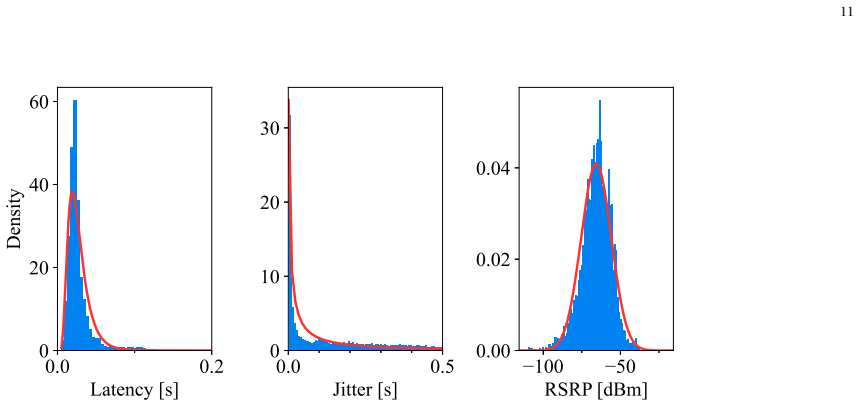
Machine learning models are increasingly deployed in wireless networks with stringent performance requirements. However, dynamic propagation environments and fluctuating traffic densities introduce concept drift, which complicates the ability to maintain accurate predictive machine learning models. We propose a distributed optimization framework that jointly clusters cells and trains cluster-level predictive models, enabling nodes to cooperatively predict quality of service (QoS) distributions under communication constraints. The proposed method models QoS as a multivariate Gaussian/lognormal distribution and uses a novel clustering mechanism that groups cells with similar network conditions, allowing each cell to select the most appropriate predictor without retraining new models for each cell. By leveraging block coordinate descent, our solution efficiently clusters the cells and updates the predictive models to mitigate concept drift, while maintaining a compact model set to minimize computation overhead. Evaluation using data from realistic simulations with the Sionna ray-tracer and the ns-3 simulator shows that the method converges and yields cluster constellations that adapt to changes in the network that cause concept drift. The experimental evaluation focuses on providing a prediction of the distribution latency, jitter, and RSRP over a one-hour prediction horizon. The proposed method significantly outperforms the traditional single global predictive model approach and reduces the mean absolute error by 9-27% compared to local cell-level predictors. This demonstrates that the proposed method effectively captures local variability using far fewer models through scalable distributed clustering.
Editorial analysis
A structured set of objections, weighed in public.
Referee Report
Summary. The manuscript proposes a distributed optimization framework for jointly clustering cells in vehicular cellular networks and training cluster-level predictive models for QoS distributions (latency, jitter, RSRP). QoS is modeled as a multivariate Gaussian/lognormal distribution; block coordinate descent is used to group cells with similar conditions under communication constraints, enabling adaptation to concept drift without per-cell retraining. Simulations with the Sionna ray-tracer and ns-3 simulator are reported to show convergence, adaptive cluster constellations, and 9-27% MAE reduction relative to local cell-level predictors while outperforming a single global model.
Significance. If the central claims hold under rigorous validation, the work could offer a scalable approach to maintaining accurate QoS predictors in highly dynamic vehicular environments by trading off model count against local accuracy. The emphasis on concept-drift adaptation and realistic ray-tracing/ns-3 simulation is a practical strength; the self-contained optimization framework avoids obvious circularity with external benchmarks.
major comments (3)
- [Abstract and Evaluation section] Abstract and Evaluation section: the central performance claim of 9-27% MAE reduction is presented without error bars, number of independent runs, confidence intervals, or statistical significance tests against the local and global baselines; this absence directly limits assessment of whether the reported gains are robust or could be explained by simulation variability.
- [Model description (presumably §3)] Model description (presumably §3): the multivariate Gaussian/lognormal assumption for the joint distribution of latency/jitter/RSRP is adopted without reported goodness-of-fit tests or tail diagnostics on the Sionna/ns-3 data; if empirical distributions exhibit heavier tails or mobility-induced non-stationarities, the block-coordinate-descent clustering may converge to partitions whose shared predictor offers no advantage over per-cell models.
- [Optimization framework (presumably §4)] Optimization framework (presumably §4): the precise mechanism by which communication constraints are encoded in the clustering objective and model-update steps is not fully specified, leaving open whether the resulting partitions remain stable when only partial QoS statistics can be exchanged.
minor comments (2)
- Figure captions and axis labels for the convergence and cluster-adaptation plots should explicitly state the prediction horizon and the exact QoS metrics being plotted.
- The number of free parameters (including the number of clusters) should be listed consistently in the experimental setup to allow reproducibility.
Simulated Author's Rebuttal
We thank the referee for the constructive comments, which highlight important aspects of statistical rigor, model validation, and clarity in the optimization framework. We have carefully reviewed each point and will revise the manuscript to address them where possible, strengthening the evaluation and presentation without altering the core contributions.
read point-by-point responses
-
Referee: [Abstract and Evaluation section] Abstract and Evaluation section: the central performance claim of 9-27% MAE reduction is presented without error bars, number of independent runs, confidence intervals, or statistical significance tests against the local and global baselines; this absence directly limits assessment of whether the reported gains are robust or could be explained by simulation variability.
Authors: We agree that the absence of variability measures and statistical tests limits the strength of the performance claims. In the revised manuscript, we will report results aggregated over 10 independent simulation runs with different random seeds for traffic and mobility patterns, include error bars or standard deviations on the MAE values, and apply paired statistical tests (e.g., t-tests) to confirm the significance of the 9-27% reductions relative to the local and global baselines. revision: yes
-
Referee: [Model description (presumably §3)] Model description (presumably §3): the multivariate Gaussian/lognormal assumption for the joint distribution of latency/jitter/RSRP is adopted without reported goodness-of-fit tests or tail diagnostics on the Sionna/ns-3 data; if empirical distributions exhibit heavier tails or mobility-induced non-stationarities, the block-coordinate-descent clustering may converge to partitions whose shared predictor offers no advantage over per-cell models.
Authors: The multivariate Gaussian/lognormal model was selected based on standard practices for QoS metrics in cellular networks, but we acknowledge the value of empirical validation. We will add Kolmogorov-Smirnov goodness-of-fit tests, QQ-plots, and tail diagnostics on the Sionna/ns-3 data in the revised Section 3. If deviations are observed, we will discuss their potential impact on clustering stability and note that the reported MAE improvements still hold under the current modeling choice in our simulations. revision: yes
-
Referee: [Optimization framework (presumably §4)] Optimization framework (presumably §4): the precise mechanism by which communication constraints are encoded in the clustering objective and model-update steps is not fully specified, leaving open whether the resulting partitions remain stable when only partial QoS statistics can be exchanged.
Authors: The communication constraints are encoded as a regularization term in the joint objective (see Equation 4 in Section 4) that penalizes excessive inter-cell statistic exchanges based on available bandwidth. The block coordinate descent alternates between assignment updates (subject to these constraints) and local model refinements using cluster-aggregated statistics. In the revision, we will provide expanded pseudocode, a dedicated subsection on constraint encoding, and additional experiments demonstrating partition stability under varying levels of partial information exchange. revision: yes
Circularity Check
No significant circularity; framework validated on independent external simulations
full rationale
The paper's derivation uses block coordinate descent to jointly optimize cell clustering and cluster-level predictors under a multivariate Gaussian/lognormal QoS model. All performance claims (9-27% MAE reduction, convergence, adaptation to concept drift) are evaluated against data generated by external tools (Sionna ray-tracer and ns-3 simulator) that are independent of the fitted parameters and clustering decisions. No equation or step reduces by construction to its own inputs, no load-bearing uniqueness theorem is imported via self-citation, and the optimization objective is not self-referential. The central result therefore remains falsifiable against the simulation benchmarks rather than tautological.
Axiom & Free-Parameter Ledger
free parameters (1)
- number of clusters
axioms (1)
- domain assumption QoS metrics follow a multivariate Gaussian/lognormal distribution
Reference graph
Works this paper leans on
-
[1]
On the road to 6G: Visions, requiremen ts, key technologies, and testbeds,
C.-X. Wang et al., “On the road to 6G: Visions, requiremen ts, key technologies, and testbeds,” IEEE Commun. Surv. Tutor ., vol. 25, no. 2, pp. 905–974, 2023
2023
-
[2]
6G-enabled vehicle-to -everything communications: Current research trends and o pen challenges,
J. Rodr´ ıguez-Pi˜ neiro et al., “6G-enabled vehicle-to -everything communications: Current research trends and o pen challenges,” IEEE Open J. V eh. Technol., pp. 1–34, 2025
2025
-
[3]
Toward AI in 6G: Concepts, techniques , and standards,
S. Shafaei et al., “Toward AI in 6G: Concepts, techniques , and standards,” IEEE Access , vol. 13, pp. 143 843–143 874, 2025
2025
-
[4]
A roadmap of next-generation wirele ss technology for 6G-enabled vehicular networks,
M. Adhikari et al., “A roadmap of next-generation wirele ss technology for 6G-enabled vehicular networks,” IEEE IoTM , vol. 4, no. 4, pp. 79–85, 2021
2021
-
[5]
6G for vehicle-to-everything ( V2X) communications: Enabling technologies, challenges, and opportunities,
M. Noor-A-Rahim et al., “6G for vehicle-to-everything ( V2X) communications: Enabling technologies, challenges, and opportunities,” Proc. IEEE , vol. 110, no. 6, pp. 712–734, 2022
2022
-
[6]
Understanding O-RAN: Architecture, i nterfaces, algorithms, security, and research challenges ,
M. Polese et al., “Understanding O-RAN: Architecture, i nterfaces, algorithms, security, and research challenges ,” IEEE Commun. Surv. Tutor ., vol. 25, no. 2, pp. 1376–1411, 2023
2023
-
[7]
Next generation mobile networks’ enab lers: Machine learning-assisted mobility, traffic, and rad io channel prediction,
H. Ryd´ en et al., “Next generation mobile networks’ enab lers: Machine learning-assisted mobility, traffic, and rad io channel prediction,” IEEE Commun. Mag., vol. 61, no. 10, pp. 94–98, 2023
2023
-
[8]
NordicDat: A cross-border predicti ve QoS dataset,
T. Miekkala et al., “NordicDat: A cross-border predicti ve QoS dataset,” in GLOBECOM, 2024, pp. 1281–1286
2024
-
[9]
PRA TA: A framework to enable predictive QoS in vehicular networks via artificial intelligence,
F. Mason et al., “PRA TA: A framework to enable predictive QoS in vehicular networks via artificial intelligence,” IEEE TCOM , pp. 1–1, 2025
2025
-
[10]
Machine learning for QoS prediction in vehicular communication: Challenges and solution appro aches,
A. Palaios et al., “Machine learning for QoS prediction in vehicular communication: Challenges and solution appro aches,” IEEE Access , vol. 11, pp. 92 459–92 477, 2023
2023
-
[11]
The (in-) validity of the WSSUS assu mption in vehicular radio channels,
L. Bernad´ o et al., “The (in-) validity of the WSSUS assu mption in vehicular radio channels,” in IEEE PIMRC , 2012, pp. 1757–1762
2012
-
[12]
Learning under concept drift: A review,
J. Lu et al., “Learning under concept drift: A review,” IEEE Trans. Knowl. Data Eng. , vol. 31, no. 12, pp. 2346–2363, Dec. 2019
2019
-
[13]
Quantifying model drift in mac hine learning for estimating wireless link quality,
A. P . Jagadeesan et al., “Quantifying model drift in mac hine learning for estimating wireless link quality,” in IEEE MeditCom , 2025, pp. 1–6
2025
-
[14]
Predictive quality of service in cellular networks: Chall enges, framework, and application in vehicular communications,
R. Blasco, G. C. Ferrante, C. Watermann, and A. Palaios, “Predictive quality of service in cellular networks: Chall enges, framework, and application in vehicular communications,” IEEE Commun. Mag. , vol. 61, no. 3, pp. 44–49, 2023
2023
-
[15]
Predictive qualit y of service: The next frontier for fully autonomous systems ,
M. Boban, M. Giordani, and M. Zorzi, “Predictive qualit y of service: The next frontier for fully autonomous systems ,” IEEE Netw., vol. 35, no. 6, pp. 104–110, 2021
2021
-
[16]
Concept drift detection and adapta tion for federated and continual learning,
F. E. Casado et al., “Concept drift detection and adapta tion for federated and continual learning,” Multimed. Tools Appl., vol. 81, no. 3, pp. 3397–3419, Jan. 2022
2022
-
[17]
Clustered federated l earning via gradient-based partitioning,
H. Kim, H. Kim, and G. De V eciana, “Clustered federated l earning via gradient-based partitioning,” in ICML, 2024
2024
- [18]
-
[19]
Clustering of geographical segments for predictive qual ity of service of connected vehicles,
O. Stenhammar, S. Razavikia, G. Fodor, and C. Fischione , “Clustering of geographical segments for predictive qual ity of service of connected vehicles,” IEEE TVT , pp. 1–15, 2025
2025
-
[20]
Advanced c lustering for mobile network optimization: A systematic li terature review,
C. M. Nawej, P . A. Owolawi, and T. M. Walingo, “Advanced c lustering for mobile network optimization: A systematic li terature review,” Sensors, vol. 25, no. 23, 2025
2025
-
[21]
Clustered vehicul ar federated learning: Process and optimization,
A. Taik, Z. Mlika, and S. Cherkaoui, “Clustered vehicul ar federated learning: Process and optimization,” IEEE T-ITS, vol. 23, no. 12, pp. 25 371–25 383, Dec. 2022
2022
-
[22]
An effici ent framework for clustered federated learning,
A. Ghosh, J. Chung, D. Yin, and K. Ramchandran, “An effici ent framework for clustered federated learning,” IEEE Trans. Inf. Theory , vol. 68, no. 12, pp. 8076–8091, Dec. 2022
2022
-
[23]
Robust lo ng-term predictive adaptive video streaming under wireles s network uncertainties,
R. Atawia, H. S. Hassanein, and A. Noureldin, “Robust lo ng-term predictive adaptive video streaming under wireles s network uncertainties,” IEEE TCOM, vol. 17, no. 2, pp. 1374–1388, 2018
2018
-
[24]
A mathematical framework for statistical QoS and capacity studies in OFDM n etworks,
I. Siomina, A. Furusk¨ ar, and G. Fodor, “A mathematical framework for statistical QoS and capacity studies in OFDM n etworks,” in IEEE PIMRC , 2009, pp. 2772–2776
2009
-
[25]
S. Mostafavi, G. P . Sharma, A. Traboulsi, and J. Gross, Probabilistic delay forecasting in 5G using recurrent and a ttention-based architectures, 2025. arXiv: 2503.15297 [cs.NI]
-
[26]
On t he log-normal distribution of network traffic,
I. Antoniou, V . Ivanov, V . V . Ivanov, and P . Zrelov, “On t he log-normal distribution of network traffic,” Physica D , vol. 167, no. 1, pp. 72–85, 2002
2002
-
[27]
E. L. Crow and K. Shimizu, Lognormal distributions. Marcel Dekker New Y ork, 1987
1987
-
[28]
Communication-Efficient Learning o f Deep Networks from Decentralized Data,
B. McMahan et al., “Communication-Efficient Learning o f Deep Networks from Decentralized Data,” in AISTATS, vol. 54, PMLR, Apr. 2017, pp. 1273–1282
2017
-
[29]
A comprehensive survey on transfer le arning,
F. Zhuang et al., “A comprehensive survey on transfer le arning,” Proc. IEEE , vol. 109, no. 1, pp. 43–76, 2021
2021
-
[30]
Guaranteed minim um-rank solutions of linear matrix equations via nuclear no rm minimization,
B. Recht, M. Fazel, and P . A. Parrilo, “Guaranteed minim um-rank solutions of linear matrix equations via nuclear no rm minimization,” SIAM rev., vol. 52, no. 3, pp. 471–501, 2010
2010
-
[31]
Exact matrix completion via c onvex optimization,
E. J. Candes and B. Recht, “Exact matrix completion via c onvex optimization,” F ound. Comput. Math., pp. 717–772, 9 2009
2009
-
[32]
NP-ha rdness of Euclidean sum-of-squares clustering,
D. Aloise, A. Deshpande, P . Hansen, and P . Popat, “NP-ha rdness of Euclidean sum-of-squares clustering,” Mach. Learn. , vol. 75, pp. 245–248, May 2009
2009
-
[33]
A block coordinate descent method for r egularized multiconvex optimization with applications to nonnegative tensor factorization and completion,
Y . Xu and W. Yin, “A block coordinate descent method for r egularized multiconvex optimization with applications to nonnegative tensor factorization and completion,” SIAM J. Imaging Sci. , vol. 6, no. 3, pp. 1758–1789, 2013
2013
- [34]
-
[35]
An algorithm for restricted least squar es regression,
R. L. Dykstra, “An algorithm for restricted least squar es regression,” Journal of the American Statistical Association , vol. 78, no. 384, pp. 837–842, 1983
1983
-
[36]
Parallel restarted SGD with f aster convergence and less communication: Demystifying wh y model averaging works for deep learning,
H. Y u, S. Y ang, and S. Zhu, “Parallel restarted SGD with f aster convergence and less communication: Demystifying wh y model averaging works for deep learning,” in AAAI Press , vol. 33, 2019, pp. 5693–5700
2019
-
[37]
The ns-3 network simula tor,
G. F. Riley and T. R. Henderson, “The ns-3 network simula tor,” in Modeling and Tools for Network Simulation . Springer Berlin Heidelberg, 2010, pp. 15–34
2010
-
[38]
Sionna: An Open-Source Library for Next-Generation Physical Layer Research,
J. Hoydis et al., Sionna: An open-source library for next-generation physic al layer research , 2023. arXiv: 2203.11854 [cs.IT]
-
[39]
Toward digital network twins: Integ rating sionna RT in ns-3 for 6G Multi-RA T networks simulatio ns,
R. Pegurri et al., “Toward digital network twins: Integ rating sionna RT in ns-3 for 6G Multi-RA T networks simulatio ns,” in INFOCOM DTWIN, 2025
2025
-
[40]
Probability produ ct kernels,
T. Jebara, R. Kondor, and A. Howard, “Probability produ ct kernels,” J. Mach. Learn. Res. , vol. 5, pp. 819–844, Dec. 2004
2004
-
[41]
A tutorial on spectral clustering,
U. V on Luxburg, “A tutorial on spectral clustering,” Statistics and computing , vol. 17, no. 4, pp. 395–416, 2007
2007
-
[42]
Cholesky factorization,
N. Higham, “Cholesky factorization,” Wiley Interdisciplinary Reviews: Computational Statisti cs, vol. 1, pp. 251–254, Sep. 2009
2009
discussion (0)
Sign in with ORCID, Apple, or X to comment. Anyone can read and Pith papers without signing in.