Recognition: unknown
AbdomenGen: Sequential Volume-Conditioned Diffusion Framework for Abdominal Anatomy Generation
Pith reviewed 2026-05-10 16:16 UTC · model grok-4.3
The pith
A sequential diffusion model generates realistic abdominal anatomies while allowing independent volume control for each of 11 organs.
A machine-rendered reading of the paper's core claim, the machinery that carries it, and where it could break.
Core claim
AbdomenGen synthesizes organ masks sequentially, conditioning each on the body mask and previously generated structures while incorporating the Volume Control Scalar (VCS) as a standardized residual; this decouples organ volume from body habitus and produces stable, disentangled modulation across 11 abdominal organs with measured geometric fidelity such as liver Dice 0.83 ± 0.05 and a 73.6% reduction in distributional distance for a hepatomegaly cohort via Wasserstein-based VCS selection.
What carries the argument
The Volume Control Scalar (VCS), a standardized residual that decouples organ size from body habitus and is injected during sequential diffusion steps to enable independent volume modulation while preserving global coherence.
If this is right
- Stable single-organ calibration holds across the VCS interval from -3 to +3.
- Multi-organ modulation stays disentangled so changes to one organ do not force changes in others.
- Wasserstein-based VCS selection reduces the gap between generated and real data distributions by 73.6 percent in a hepatomegaly cohort.
- The resulting phantoms support controlled simulation studies that vary organ sizes independently.
Where Pith is reading between the lines
- The framework could be used to create large synthetic datasets with precise anatomical variations for training segmentation or detection models.
- It may allow researchers to simulate specific disease states by selectively scaling volumes of affected organs while holding others fixed.
- Integration with existing phantom pipelines could reduce reliance on limited real-patient scans for imaging research.
Load-bearing premise
Sequential conditioning on the body mask, prior organs, and the VCS residual will maintain anatomical coherence and permit independent volume changes without creating artifacts or unrealistic organ relationships.
What would settle it
Visual or quantitative inspection of generated volumes at VCS values outside the training range to check whether spatial relationships between organs remain anatomically plausible and free of distortions when compared to real CT scans.
Figures


read the original abstract
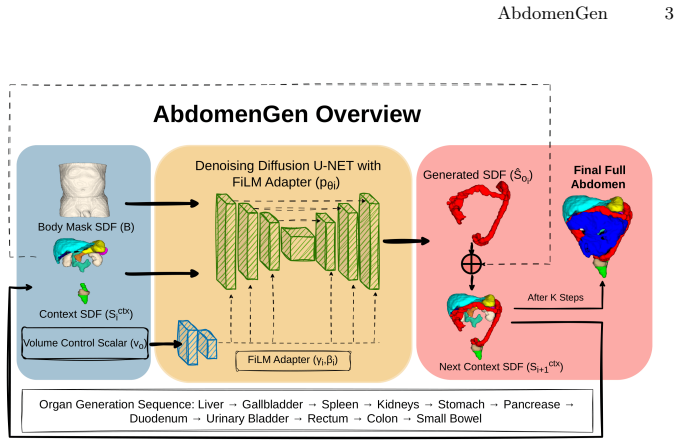
Computational phantoms are widely used in medical imaging research, yet current systems to generate controlled, clinically meaningful anatomical variations remain limited. We present AbdomenGen, a sequential volume-conditioned diffusion framework for controllable abdominal anatomy generation. We introduce the \textbf{Volume Control Scalar (VCS)}, a standardized residual that decouples organ size from body habitus, enabling interpretable volume modulation. Organ masks are synthesized sequentially, conditioning on the body mask and previously generated structures to preserve global anatomical coherence while supporting independent, multi-organ control. Across 11 abdominal organs, the proposed framework achieves strong geometric fidelity (e.g., liver dice $0.83 \pm 0.05$), stable single-organ calibration over $[-3,+3]$ VCS, and disentangled multi-organ modulation. To showcase clinical utility with a hepatomegaly cohort selected from MERLIN, Wasserstein-based VCS selection reduces distributional distance of training data by 73.6\% . These results demonstrate calibrated, distribution-aware anatomical generation suitable for controllable abdominal phantom construction and simulation studies.
Editorial analysis
A structured set of objections, weighed in public.
Referee Report
Summary. The paper introduces AbdomenGen, a sequential volume-conditioned diffusion model for generating controllable abdominal anatomical phantoms. It proposes the Volume Control Scalar (VCS) as a standardized residual to decouple organ volumes from body habitus, enabling independent modulation of 11 organs while using sequential conditioning on the body mask and prior organs to maintain coherence. Empirical results include liver Dice of 0.83 ± 0.05, stable single-organ calibration over VCS ∈ [-3, +3], disentangled multi-organ control, and a 73.6% reduction in distributional distance for a hepatomegaly cohort via Wasserstein-based VCS selection from the MERLIN dataset.
Significance. If validated, the work could provide a practical tool for creating distribution-aware, controllable computational phantoms useful in medical imaging simulation and research on anatomical variations. The VCS mechanism offers an interpretable, parameter-light way to modulate volumes independently, and the sequential diffusion approach targets global coherence in a way that could generalize beyond the abdomen if the empirical claims are substantiated with fuller controls.
major comments (3)
- [Abstract] Abstract: The reported geometric fidelity (liver Dice 0.83 ± 0.05 across 11 organs) is presented without any baseline comparisons to prior abdominal organ generation or segmentation methods, nor ablations isolating the contribution of sequential conditioning versus the VCS residual; this makes it impossible to determine whether the numbers reflect a genuine advance or data-specific effects.
- [Abstract] Abstract: The central claim that sequential conditioning on body mask + prior organs + VCS residual produces independent per-organ volume scaling while preserving global coherence lacks quantitative support such as inter-organ volume correlation matrices, conditional overlap rates, or order-ablation results when multiple VCS values are varied simultaneously (especially in the hepatomegaly use-case).
- [Abstract] Abstract: The 73.6% reduction in distributional distance via Wasserstein-based VCS selection for the hepatomegaly cohort is stated without specifying the exact selection protocol, whether it is post-hoc on the full dataset, or any held-out validation, which bears directly on the claim of distribution-aware generation.
minor comments (1)
- [Abstract] Abstract: The standardization process and exact definition of the VCS residual (how it is computed from organ volume and body habitus) are not detailed, leaving the 'parameter-free' decoupling claim difficult to evaluate from the given text.
Simulated Author's Rebuttal
We thank the referee for the constructive feedback on our manuscript. The comments highlight important aspects of clarity and evidence in the abstract, and we have revised the manuscript to address them directly while preserving the original contributions.
read point-by-point responses
-
Referee: [Abstract] Abstract: The reported geometric fidelity (liver Dice 0.83 ± 0.05 across 11 organs) is presented without any baseline comparisons to prior abdominal organ generation or segmentation methods, nor ablations isolating the contribution of sequential conditioning versus the VCS residual; this makes it impossible to determine whether the numbers reflect a genuine advance or data-specific effects.
Authors: We agree that the abstract's brevity omitted explicit baselines and ablations, which limits immediate assessment of the advance. The full manuscript contextualizes results against related diffusion-based generation approaches in the introduction and discussion. To address this, we have revised the abstract to briefly reference prior methods and note the targeted improvements in coherence and controllability. We have also added an ablation study in the revised results section isolating sequential conditioning from the VCS residual, enabling clearer evaluation of each component's contribution. revision: yes
-
Referee: [Abstract] Abstract: The central claim that sequential conditioning on body mask + prior organs + VCS residual produces independent per-organ volume scaling while preserving global coherence lacks quantitative support such as inter-organ volume correlation matrices, conditional overlap rates, or order-ablation results when multiple VCS values are varied simultaneously (especially in the hepatomegaly use-case).
Authors: The original results include single-organ calibration curves and multi-organ generation examples to illustrate the claim, but we concur that additional quantitative metrics would provide stronger support. In the revision, we have added inter-organ volume correlation matrices demonstrating low correlations (supporting independence), conditional overlap rates to quantify coherence, and order-ablation experiments for simultaneous multi-VCS variations in the hepatomegaly scenario. These new analyses are now referenced in the updated abstract and detailed in the results. revision: yes
-
Referee: [Abstract] Abstract: The 73.6% reduction in distributional distance via Wasserstein-based VCS selection for the hepatomegaly cohort is stated without specifying the exact selection protocol, whether it is post-hoc on the full dataset, or any held-out validation, which bears directly on the claim of distribution-aware generation.
Authors: The abstract summarizes the outcome, with the full manuscript describing the Wasserstein distance computation in the experiments section. We have revised the abstract and methods to explicitly state that VCS selection matches the target distribution using the training data as reference for this demonstration (hence post-hoc on the cohort). The protocol details are now expanded, including the exact Wasserstein formulation. We acknowledge the benefit of held-out validation and have added a note discussing its implications, though the original result remains an illustrative use-case on the provided data. revision: partial
Circularity Check
No significant circularity; claims rest on empirical validation
full rationale
The paper introduces a sequential volume-conditioned diffusion model and the VCS residual as a modeling choice, then reports empirical outcomes (Dice scores, calibration ranges, Wasserstein distance reduction). No derivation chain, equation, or 'prediction' reduces by construction to a fitted parameter, self-citation, or ansatz smuggled from prior work. The Wasserstein selection is an explicit optimization step whose reported reduction follows directly from the selection criterion rather than from any model-derived result. The central claims therefore remain self-contained against external benchmarks.
Axiom & Free-Parameter Ledger
axioms (2)
- domain assumption Diffusion models can be conditioned on masks and prior generations to produce anatomically coherent outputs
- ad hoc to paper VCS functions as a standardized residual that decouples organ size from body habitus
invented entities (1)
-
Volume Control Scalar (VCS)
no independent evidence
Reference graph
Works this paper leans on
-
[1]
Research Square pp
Blankemeier, L., Cohen, J.P., Kumar, A., Van Veen, D., Gardezi, S.J.S., Paschali, M., Chen, Z., Delbrouck, J.B., Reis, E., Truyts, C., et al.: Merlin: A vision language foundation model for 3d computed tomography. Research Square pp. rs–3 (2024)
2024
-
[2]
MONAI: An open-source framework for deep learning in healthcare
Cardoso, M.J., Li, W., Brown, R., Ma, N., Kerfoot, E., Wang, Y., Murrey, B., Myronenko, A., Zhao, C., Yang, D., et al.: Monai: An open-source framework for deep learning in healthcare. arXiv preprint arXiv:2211.02701 (2022)
work page internal anchor Pith review arXiv 2022
-
[3]
Computers & Graphics99, 234–246 (2021)
Chheang, V., Saalfeld, P., Joeres, F., Boedecker, C., Huber, T., Huettl, F., Lang, H., Preim, B., Hansen, C.: A collaborative virtual reality environment for liver surgery planning. Computers & Graphics99, 234–246 (2021)
2021
-
[4]
In: Proceedings of the IEEE/CVF international confer- ence on computer vision
Chou, G., Bahat, Y., Heide, F.: Diffusion-sdf: Conditional generative modeling of signed distance functions. In: Proceedings of the IEEE/CVF international confer- ence on computer vision. pp. 2262–2272 (2023)
2023
-
[5]
Medical Image Analysis p
Dahal, L., Ghojoghnejad, M., Vancoillie, L., Ghosh, D., Bhandari, Y., Kim, D., Ho, F.C., Tushar, F.I., Luo, S., Lafata, K.J., et al.: Xcat 3.0: A comprehensive library of personalized digital twins derived from ct scans. Medical Image Analysis p. 103636 (2025)
2025
- [6]
-
[7]
Advances in neural information processing systems33, 6840–6851 (2020)
Ho, J., Jain, A., Abbeel, P.: Denoising diffusion probabilistic models. Advances in neural information processing systems33, 6840–6851 (2020)
2020
-
[8]
In: Shape in Medical Imaging, Lecture Notes in Computer Science, vol
Li, J., Pepe, A., Luijten, G., Schwarz-Gsaxner, C., Kleesiek, J., Egger, J.: Anatomy completor: A multi-class completion framework for 3d anatomy reconstruction. In: Shape in Medical Imaging, Lecture Notes in Computer Science, vol. 14350, pp. 1–14. Springer, Cham (2023). https://doi.org/10.1007/978-3-031-46914-5_1
-
[9]
Toward Realistic AI-Generated Student Questions to Support Instructor Training
Mouheb, K., Nejad, M.G., Dahal, L., Samei, E., Lafata, K.J., Segars, W.P., Lo, J.Y.: Large intestine 3d shape refinement using conditional latent point diffusion models. In: Shape in Medical Imaging, Lecture Notes in Computer Science, vol. 16171, pp. 103–116. Springer, Cham (2025). https://doi.org/10.1007/978-3-032- 06774-6_8
-
[10]
Surgery166(3), 247–253 (2019)
Olthof, P.B., van Dam, R., Jovine, E., Campos, R.R., de Santibañes, E., Oldhafer, K., Malago, M., Abdalla, E.K., Schadde, E.: Accuracy of estimated total liver volume formulas before liver resection. Surgery166(3), 247–253 (2019)
2019
-
[11]
In: Proceedings of the AAAI conference on artificial intelligence
Perez, E., Strub, F., De Vries, H., Dumoulin, V., Courville, A.: Film: Visual rea- soning with a general conditioning layer. In: Proceedings of the AAAI conference on artificial intelligence. vol. 32 (2018)
2018
-
[12]
In: Shape in Medical Imaging, Lecture Notes in Computer Science, vol
Podobnik, G., Balodi, N., Killeen, B.D., Vrtovec, T., Unberath, M.: Anatomygen: Generating anatomically plausible human phantoms at high resolution. In: Shape in Medical Imaging, Lecture Notes in Computer Science, vol. 16171, pp. 129–139. Springer, Cham (2025). https://doi.org/10.1007/978-3-032-06774-6_10
-
[13]
European radiology7(2), 246–248 (1997)
Prassopoulos, P., Daskalogiannaki, M., Raissaki, M., Hatjidakis, A., Gourtsoyian- nis, N.: Determination of normal splenic volume on computed tomography in re- lation to age, gender and body habitus. European radiology7(2), 246–248 (1997)
1997
-
[14]
Medical Physics37(9), 4902–4915 (2010)
Segars, W.P., Sturgeon, G., Mendonca, S., Grimes, J., Tsui, B.M.W.: 4d xcat phan- tom for multimodality imaging research. Medical Physics37(9), 4902–4915 (2010). https://doi.org/10.1118/1.3480985
-
[15]
Denoising Diffusion Implicit Models
Song, J., Meng, C., Ermon, S.: Denoising diffusion implicit models. arXiv preprint arXiv:2010.02502 (2020) 10 Anonymized Author et al
work page internal anchor Pith review Pith/arXiv arXiv 2010
-
[16]
In: Proceedings of the IEEE/CVF conference on computer vision and pattern recognition
Takikawa, T., Litalien, J., Yin, K., Kreis, K., Loop, C., Nowrouzezahrai, D., Ja- cobson, A., McGuire, M., Fidler, S.: Neural geometric level of detail: Real-time rendering with implicit 3d shapes. In: Proceedings of the IEEE/CVF conference on computer vision and pattern recognition. pp. 11358–11367 (2021)
2021
-
[17]
Scientific reports11(1), 9068 (2021)
Tustison, N.J., Cook, P.A., Holbrook, A.J., Johnson, H.J., Muschelli, J., Devenyi, G.A., Duda, J.T., Das, S.R., Cullen, N.C., Gillen, D.L., et al.: The antsx ecosystem for quantitative biological and medical imaging. Scientific reports11(1), 9068 (2021)
2021
-
[18]
Xu, X.G.: An exponential growth of computational phantom research in radiation protection, imaging, and radiotherapy: A review of the fifty-year history. Physics in Medicine & Biology59(18), R233–R302 (2014). https://doi.org/10.1088/0031- 9155/59/18/R233
discussion (0)
Sign in with ORCID, Apple, or X to comment. Anyone can read and Pith papers without signing in.