Investigating the Impacts of Exchange Rate and Inflation on Exports: A Double Threat or Opportunity for Turkiye?
Pith reviewed 2026-05-10 13:40 UTC · model grok-4.3
The pith
Appreciation of the Turkish lira and higher inflation both reduce exports in the long run.
A machine-rendered reading of the paper's core claim, the machinery that carries it, and where it could break.
Core claim
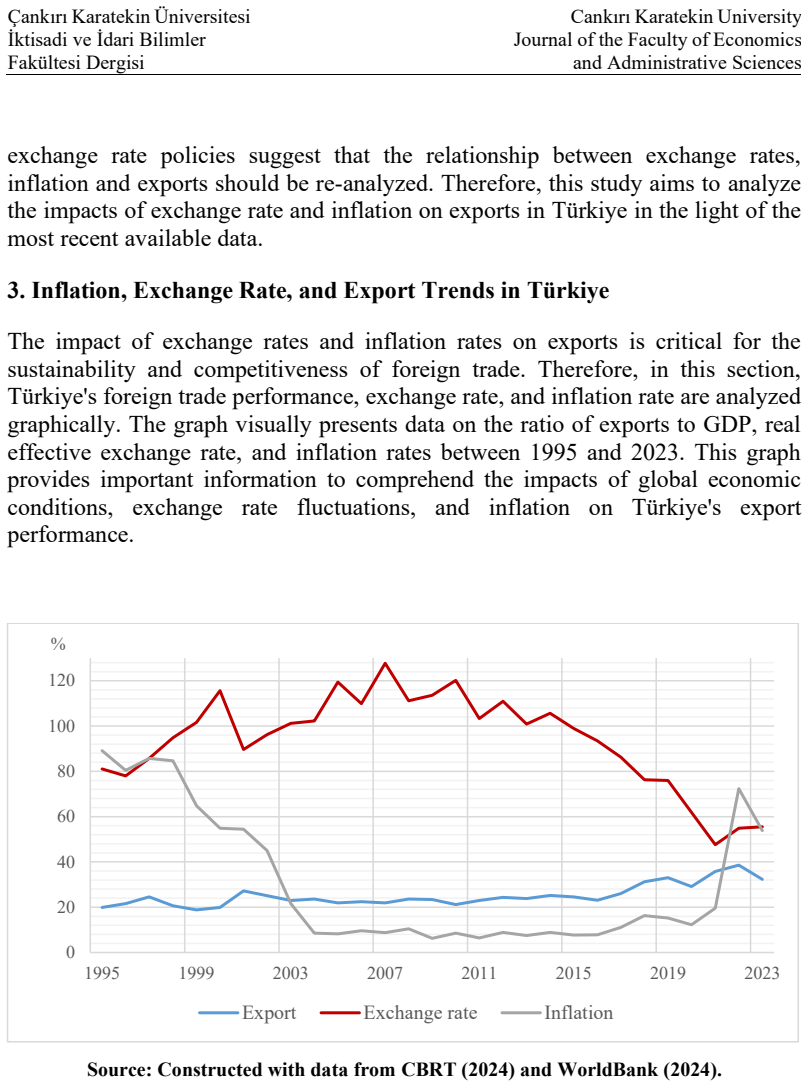
The study establishes a cointegrating relationship and estimates long-run coefficients via Dynamic Least Squares. An increase in the real effective exchange rate reduces exports by 0.185 units, while inflation reduces them by 0.125 units. Foreign direct investment and imports raise exports by 0.117 and 0.849 units respectively. These long-run relationships indicate that lira appreciation and inflation act as drags on export performance in Turkiye.
What carries the argument
Johansen cointegration test followed by the Dynamic Ordinary Least Squares estimator, which recovers consistent long-run parameters after confirming a stable equilibrium relationship.
Load-bearing premise
The series are cointegrated and the DOLS estimator recovers unbiased long-run coefficients without omitted structural breaks, regime shifts, or reverse causality from exports to the exchange rate and inflation.
What would settle it
Re-estimation that finds no cointegration or that produces insignificant or positive coefficients on the real effective exchange rate and inflation would falsify the negative long-run effects.
Figures
read the original abstract
This study analyzes the impacts of exchange rate and inflation on exports in Turkiye. Annual data for the period 1995-2023 were used in the analysis. The Johansen cointegration analysis and Dynamic Least Squares (DOLS) method were employed in the study. Identifying the cointegration relationship enabled the estimation of the long-run coefficients. The results show that an increase in the real effective exchange rate (appreciation of the Turkish lira) and inflation reduce exports with coefficients of -0.185 and -0.125, respectively. Foreign direct investment and imports, added to the study as control variables, have a positive impact on exports with coefficients of 0.117 and 0.849, respectively. These findings indicate that exchange rate stability and inflation control are priorities for improving foreign trade performance. Furthermore, policies that increase foreign direct investment and strategically manage imports complement this process.
Editorial analysis
A structured set of objections, weighed in public.
Referee Report
Summary. The paper analyzes the impacts of the real effective exchange rate and inflation on Turkish exports over 1995-2023 using annual data. It applies Johansen cointegration testing followed by Dynamic OLS (DOLS) estimation, reporting long-run coefficients of -0.185 for REER appreciation, -0.125 for inflation, +0.117 for FDI, and +0.849 for imports. The authors conclude that exchange-rate stability and inflation control are policy priorities for export performance.
Significance. If the cointegration relation is stable and the DOLS estimates are unbiased, the results would supply quantitative evidence on trade elasticities in an emerging market and support standard policy prescriptions. The use of established time-series tools and inclusion of controls are positive features, but the small sample and unaddressed instabilities limit the strength of any contribution.
major comments (3)
- [Empirical analysis / Results] The central claim rests on a single-regime cointegrated relationship over 1995-2023. Turkey experienced multiple large shocks (2001 crisis, 2008 global shock, 2018 currency crisis, COVID-19) that likely altered the export-exchange-inflation nexus, yet no structural-break tests, regime-shift diagnostics, or subsample splits are reported. With T=29 this assumption is load-bearing and unverified.
- [Methodology and Results] The abstract and reported results supply no information on unit-root pre-tests, lag-length selection for Johansen or DOLS, cointegration rank stability, or whether the DOLS lead/lag lengths were chosen by information criteria. Standard errors, t-statistics, or p-values for the quoted coefficients (-0.185, -0.125, etc.) are also absent, preventing assessment of statistical significance.
- [Estimation results] DOLS long-run coefficients are obtained from the same sample used to establish cointegration. In a small annual sample with 4-5 variables, this procedure can produce spurious or over-fitted estimates without additional robustness checks (e.g., FMOLS, ARDL bounds, or out-of-sample validation).
minor comments (2)
- [Data] The manuscript should report the exact data sources, variable definitions (e.g., how real effective exchange rate is constructed), and any transformations applied.
- Minor typographical inconsistencies (e.g., “Turkiye” vs. standard “Türkiye”) and the absence of a table or equation numbering for the reported coefficients reduce readability.
Simulated Author's Rebuttal
We thank the referee for the constructive and detailed comments on our manuscript. These observations have prompted us to strengthen the empirical section and clarify methodological choices. We address each major comment below and indicate the revisions made to the next version of the paper.
read point-by-point responses
-
Referee: The central claim rests on a single-regime cointegrated relationship over 1995-2023. Turkey experienced multiple large shocks (2001 crisis, 2008 global shock, 2018 currency crisis, COVID-19) that likely altered the export-exchange-inflation nexus, yet no structural-break tests, regime-shift diagnostics, or subsample splits are reported. With T=29 this assumption is load-bearing and unverified.
Authors: We agree that potential structural breaks warrant attention given the documented shocks in the Turkish economy. With only 29 annual observations, however, formal subsample splits or Markov-switching models would leave too few degrees of freedom for credible inference. In the revised manuscript we have added a dedicated paragraph in the results section acknowledging this limitation and reporting recursive CUSUM and CUSUM-of-squares tests for parameter stability in the cointegrating relationship; these tests do not reject stability at conventional significance levels. We also discuss the implications for policy conclusions and note that higher-frequency data would be required for regime-specific analysis. revision: partial
-
Referee: The abstract and reported results supply no information on unit-root pre-tests, lag-length selection for Johansen or DOLS, cointegration rank stability, or whether the DOLS lead/lag lengths were chosen by information criteria. Standard errors, t-statistics, or p-values for the quoted coefficients (-0.185, -0.125, etc.) are also absent, preventing assessment of statistical significance.
Authors: We apologize for these omissions. The revised manuscript now includes: (i) ADF and KPSS unit-root test results for all series in levels and first differences; (ii) lag-order selection via AIC, SIC, and HQ criteria for the underlying VAR; (iii) trace and maximum-eigenvalue statistics with critical values and p-values for cointegration rank determination; (iv) the information criteria used to select DOLS lead and lag lengths; and (v) standard errors, t-statistics, and p-values for every long-run coefficient in the main results table. revision: yes
-
Referee: DOLS long-run coefficients are obtained from the same sample used to establish cointegration. In a small annual sample with 4-5 variables, this procedure can produce spurious or over-fitted estimates without additional robustness checks (e.g., FMOLS, ARDL bounds, or out-of-sample validation).
Authors: We recognize the small-sample concerns. The revised paper now reports two additional estimators: Fully Modified OLS (FMOLS) and the ARDL bounds-testing approach. The long-run coefficients remain qualitatively unchanged (negative and significant for REER and inflation; positive for FDI and imports), although magnitudes differ modestly. We have added a short robustness subsection discussing the risk of spurious regression in small samples and how pre-testing, lag selection, and the inclusion of control variables help mitigate it. Out-of-sample validation is noted as infeasible with the current annual frequency but is flagged for future research. revision: yes
Circularity Check
No circularity: standard empirical estimation of cointegrated relationships
full rationale
The paper performs Johansen cointegration testing followed by DOLS estimation on the 1995-2023 annual series for exports, real effective exchange rate, inflation, FDI and imports. The reported long-run coefficients (-0.185, -0.125, etc.) are the direct numerical output of applying these established estimators to the observed data; the abstract and methods sections present them explicitly as estimation results rather than as independent predictions or first-principles derivations. No equation is shown to equal another by construction, no fitted parameter is relabeled as a prediction, and no load-bearing premise rests on a self-citation whose content reduces to the present results. The derivation chain is therefore the standard econometric workflow and remains self-contained against external benchmarks for cointegration studies.
Axiom & Free-Parameter Ledger
free parameters (1)
- DOLS lag length and lead length
axioms (2)
- domain assumption The vector of variables is cointegrated of rank at least one.
- domain assumption No unmodeled structural breaks or regime shifts affect the long-run relationship.
Reference graph
Works this paper leans on
-
[1]
Acaravci, A., and Dagli, Ö. (2021). Döviz kurundaki değişkenliğin Türkiye dış ticaretine etkisi. Uluslararası Ekonomi ve Yenilik Dergisi , 7(2), 213–232. https://doi.org/10.20979/ueyd.972981 Aktas, C. (2010). Türkiye’de reel döviz kuru ile ihracat ve ithalat arasındaki ilişkinin VAR tekniğiyle analizi. Uluslararası Yönetim İktisat ve İşletme Dergisi, 6(11...
-
[2]
Çankırı Karatekin Üniversitesi İktisadi ve İdari Bilimler Fakültesi Dergisi Cankırı Karatekin University Journal of the Faculty of Economics and Administrative Sciences 71 Caglayan, M., Dahi, O. S., and Demir, F. (2013). Trade flows, exchange rate uncertainty, and financial depth: Evidence from 28 emerging countries. Southern Economic Journal, 79(4), 905–...
-
[3]
Retrieved from https://www.tips.org.za/files/773.pdf Turk, E. (2016). Döviz kuru enflasyon ilişkisi “Türkiye örneği”. Ufuk Üniversitesi Sosyal Bilimler Enstitüsü Dergisi, 5(9), 81–102. Urus, A. F. (2019). Finansal krizler sonrası uygulanan regülasyonlar ve etkinliği. Yönetim ve Ekonomi Dergisi , 26(1), 33 –48. https://doi.org/10.18657/yonveek.431279 Wong,...
discussion (0)
Sign in with ORCID, Apple, or X to comment. Anyone can read and Pith papers without signing in.