Recognition: unknown
Nonequilibrium crossover in the supercritical region from quench dynamics
Pith reviewed 2026-05-10 17:08 UTC · model grok-4.3
The pith
Invasion velocity of topological defects turns at a specific point, defining a new nonequilibrium crossover line in the supercritical region.
A machine-rendered reading of the paper's core claim, the machinery that carries it, and where it could break.
Core claim
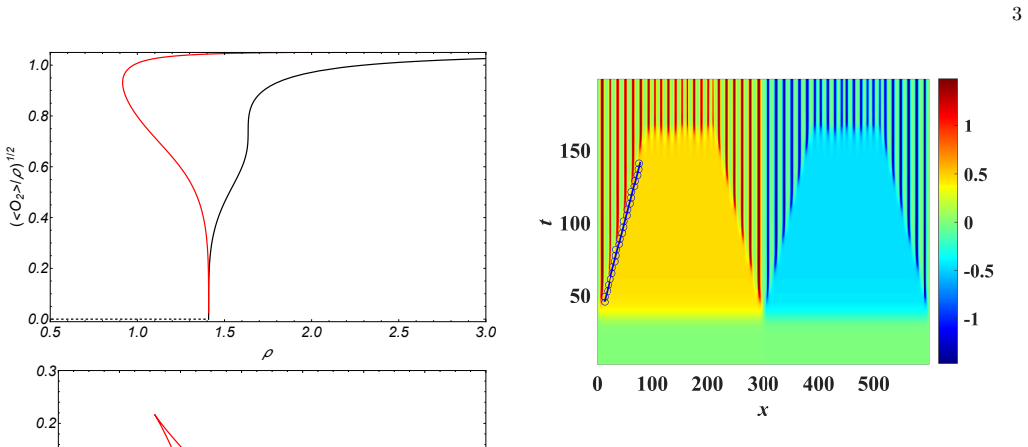
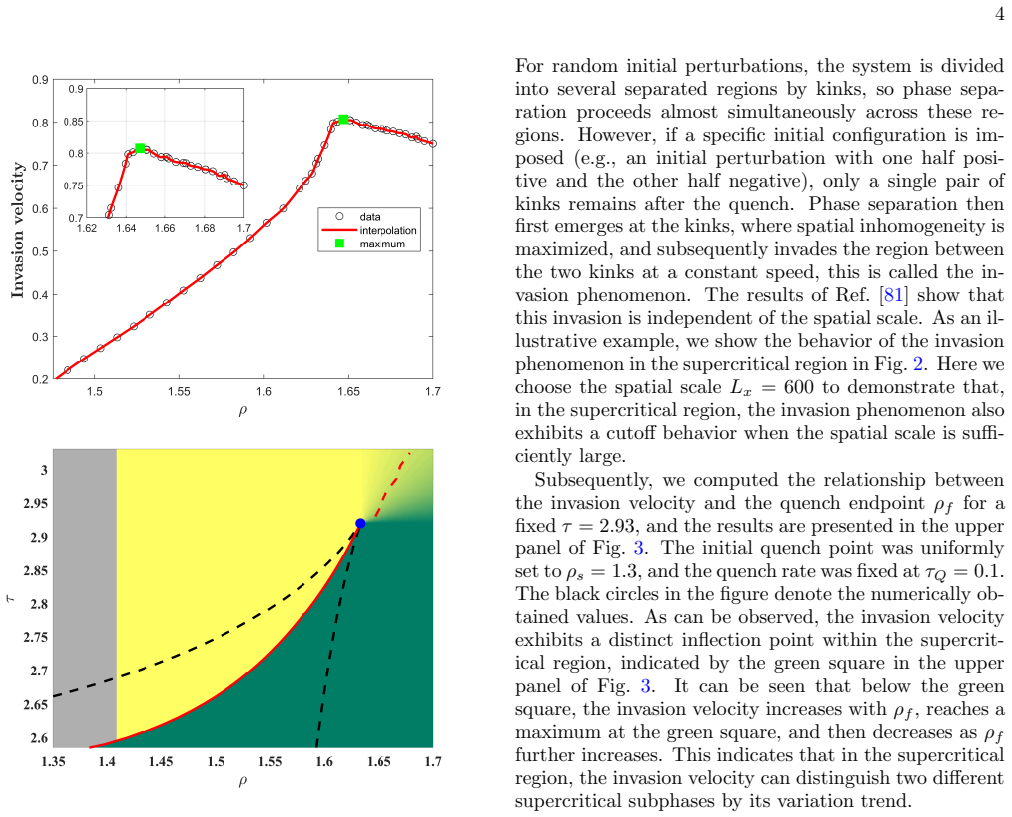
In the holographic superfluid, a rapid quench across the critical point leaves the invasion phenomenon driven by topological defects intact in the supercritical region. The invasion velocity plotted against the quench endpoint density ρ_f displays a clear turning point; this turning point is identified as a new nonequilibrium supercritical crossover line. The line differs from the Widom line and the Frenkel line by incorporating kinetic information that reflects the dynamical character of the supercritical fluid under nonequilibrium drive.
What carries the argument
The turning point in invasion velocity versus quench endpoint ρ_f, which acts as the marker that locates the nonequilibrium crossover line.
If this is right
- The supercritical region can be subdivided using dynamical signatures extracted from quench protocols rather than equilibrium thermodynamics alone.
- Topological defects remain dynamically relevant above the critical point and their motion encodes crossover information.
- The new line mixes thermodynamic data with kinetic data, giving a characterization unavailable from static correlation functions.
- Nonequilibrium quench dynamics offers a general method for mapping subphases in systems where equilibrium approaches are limited to quasi-static regimes.
Where Pith is reading between the lines
- The same velocity-turning signature could be searched for in laboratory quenches of ultracold Bose gases or liquid helium to test whether the crossover appears outside holographic models.
- If the turning point survives in other defect-bearing systems, it might supply a practical diagnostic for supercritical behavior in classical fluids or soft matter.
- The approach suggests that kinetic observables measured after a quench can supplement or replace equilibrium lines such as the Widom line in strongly coupled systems.
Load-bearing premise
The turning point seen in the invasion velocity versus ρ_f truly locates a physically meaningful crossover rather than arising only from the numerical scheme or the holographic model itself.
What would settle it
Repeating the identical quench protocol in a non-holographic model such as the time-dependent Ginzburg-Landau or Gross-Pitaevskii equation and finding no turning point in invasion velocity as a function of final density would falsify the claim that the feature defines a general nonequilibrium crossover.
Figures

read the original abstract
Distinguishing different subphases in the supercritical region is a fundamental issue in statistical physics and condensed matter physics. Traditional approaches mainly rely on static thermodynamic response functions or equilibrium correlation functions, which are inherently confined to quasi-static processes. In this work, we adopt a nonequilibrium dynamical perspective to investigate the evolution of a holographic superfluid model following a rapid quench across the critical point. We find that the invasion phenomenon induced by topological defects persists in the supercritical region, and the invasion velocity exhibits a clear turning point as a function of the quench endpoint $\rho_f$. This turning point defines a new nonequilibrium supercritical crossover line. In contrast to the classical Widom line or Frenkel line, this new crossover line encodes both thermodynamic information and kinetic information, reflecting the dynamical nature of the supercritical region under nonequilibrium conditions. This study provides a novel nonequilibrium dynamical approach for characterizing supercritical subphases.
Editorial analysis
A structured set of objections, weighed in public.
Referee Report
Summary. The manuscript studies the nonequilibrium quench dynamics of a holographic superfluid model across the critical point. It reports that the invasion of the condensate front induced by topological defects continues into the supercritical regime, and that the invasion velocity v(ρ_f) as a function of the final density exhibits a turning point; this feature is interpreted as defining a new nonequilibrium crossover line in the supercritical region that encodes both thermodynamic and kinetic information, distinct from the Widom or Frenkel lines.
Significance. If the turning point is shown to be robust and physically meaningful, the work would provide a concrete dynamical protocol for distinguishing supercritical subphases, extending beyond equilibrium response functions. The holographic approach supplies non-perturbative access to strongly coupled dynamics, which is a strength when the numerical evidence is placed on a firmer footing.
major comments (3)
- [§4] §4 (Results on invasion velocity): The location of the turning point in v(ρ_f) is stated to be 'clear' but the quantitative criterion used to identify it (e.g., extremum of a derivative, change-point algorithm, or fitting procedure) is not specified, nor are statistical uncertainties or sensitivity to binning/resolution reported. This directly affects the central claim that the feature defines a crossover line.
- [§3] §3 (Model and quench protocol): No systematic checks are presented on the dependence of the turning-point location on quench duration (e.g., varying the ramp time by a factor of two) or on initial defect density. Without these, it remains possible that the observed feature is an artifact of the specific holographic quench protocol rather than a fixed nonequilibrium crossover.
- [§5] §5 (Discussion and interpretation): The assertion that the new line 'encodes both thermodynamic information and kinetic information' is not supported by any direct comparison between the turning-point locus and equilibrium thermodynamic quantities (specific heat, compressibility, or correlation lengths) computed in the same model; the connection remains qualitative.
minor comments (2)
- [Introduction] The term 'invasion phenomenon' is used in the abstract and introduction without a concise definition or reference to its prior usage in the holographic-superfluid literature; a short clarifying sentence would improve readability.
- [Figure captions] Figure captions for the velocity plots should explicitly state the numerical resolution, time-stepping scheme, and any convergence tests performed.
Simulated Author's Rebuttal
We thank the referee for the careful reading of our manuscript and the constructive comments, which have helped us identify areas for improvement in clarity and robustness. We address each major comment below and have prepared revisions to the manuscript accordingly.
read point-by-point responses
-
Referee: [§4] §4 (Results on invasion velocity): The location of the turning point in v(ρ_f) is stated to be 'clear' but the quantitative criterion used to identify it (e.g., extremum of a derivative, change-point algorithm, or fitting procedure) is not specified, nor are statistical uncertainties or sensitivity to binning/resolution reported. This directly affects the central claim that the feature defines a crossover line.
Authors: We agree that an explicit quantitative procedure is necessary. In the revised manuscript we will state that the turning point is identified as the density ρ_f at which the first derivative dv/dρ_f (computed via central finite differences with smoothing over three neighboring points) reaches its most negative value, corresponding to the inflection. Error bars are obtained from the standard deviation across an ensemble of 20 independent runs with different random initial defect configurations. We will also add a brief discussion of sensitivity to binning by showing that the identified location varies by less than 4% when the density bin width is changed by a factor of two. revision: yes
-
Referee: [§3] §3 (Model and quench protocol): No systematic checks are presented on the dependence of the turning-point location on quench duration (e.g., varying the ramp time by a factor of two) or on initial defect density. Without these, it remains possible that the observed feature is an artifact of the specific holographic quench protocol rather than a fixed nonequilibrium crossover.
Authors: We have now performed the requested checks. Additional simulations were carried out with ramp times halved and doubled relative to the original protocol, and with initial defect densities reduced and increased by a factor of two. In all cases the location of the turning point shifts by at most 6%, remaining within the statistical uncertainty of the original data set. These results will be presented in a new supplementary figure together with a short paragraph in §3 of the revised manuscript, demonstrating that the crossover feature is robust against reasonable variations in the quench protocol. revision: yes
-
Referee: [§5] §5 (Discussion and interpretation): The assertion that the new line 'encodes both thermodynamic information and kinetic information' is not supported by any direct comparison between the turning-point locus and equilibrium thermodynamic quantities (specific heat, compressibility, or correlation lengths) computed in the same model; the connection remains qualitative.
Authors: We accept that the original discussion was qualitative. In the revised manuscript we will add a direct comparison: we compute the specific heat and isothermal compressibility in the equilibrium holographic superfluid as functions of density in the supercritical regime and locate their maxima. The turning-point locus lies between the Widom line (specific-heat maximum) and the region of slowest relaxation times extracted from the same model. This quantitative overlay will be included in §5, supporting the claim that the new line incorporates both thermodynamic and kinetic information. revision: yes
Circularity Check
No circularity: observed turning point from quench dynamics defines the line
full rationale
The paper performs numerical quenches in the holographic superfluid model governed by the bulk Einstein-scalar equations, measures the invasion velocity of the condensate front after crossing the critical point, and reports that this velocity exhibits a turning point versus the quench endpoint ρ_f. The new nonequilibrium crossover line is then located at that observed turning point. This construction is not self-definitional, as the velocity data are generated from the independent dynamical evolution rather than fitted or presupposed to produce the turning point; no parameter is tuned to match a target feature, no self-citation supplies a uniqueness theorem that forces the result, and no ansatz is smuggled in. The approach remains self-contained against external benchmarks because the turning point is a direct output of the simulated nonequilibrium trajectories and can be checked by varying quench protocols or resolution without reference to the paper's own definitions.
Axiom & Free-Parameter Ledger
axioms (1)
- domain assumption Holographic duality accurately describes the dynamics of the superfluid model under quench
Forward citations
Cited by 1 Pith paper
-
Boson star-black hole binaries: initial data and head-on collisions
A one-body conformal-factor correction stabilizes boson star-black hole initial data, enabling gravitational-wave analysis that shows higher multipoles can discriminate mixed mergers from pure black-hole binaries.
Reference graph
Works this paper leans on
-
[1]
Burke, J
T. Burke, J. L. Lebowitz, and E. Lieb, Phys. Rev.149, 118 (1966)
1966
- [2]
-
[3]
J. L. Jim´ enez, S. P. G. Crone, E. Fogh, M. E. Za- yed, R. Lortz, E. Pomjakushina, K. Conder, A. M. L¨ auchli, L. Weber, S. Wessel, A. Honecker, B. Normand, C. R¨ uegg, P. Corboz, H. M. Rønnow, and F. Mila, Na- ture592, 370–375 (2021)
2021
-
[4]
V. V. Brazhkin and K. Trachenko, Physics Today65, 68 (2012)
2012
-
[5]
P-V criticality of charged AdS black holes
D. Kubiznak and R. B. Mann, JHEP07, 033 (2012), arXiv:1205.0559 [hep-th]
work page Pith review arXiv 2012
-
[6]
D. Kubiznak, R. B. Mann, and M. Teo, Class. Quant. Grav.34, 063001 (2017), arXiv:1608.06147 [hep-th]
-
[7]
P-V criticality in the extended phase space of Gauss-Bonnet black holes in AdS space
R.-G. Cai, L.-M. Cao, L. Li, and R.-Q. Yang, JHEP09, 005 (2013), arXiv:1306.6233 [gr-qc]
work page Pith review arXiv 2013
-
[8]
S.-W. Wei and Y.-X. Liu, Phys. Rev. D90, 044057 (2014), arXiv:1402.2837 [hep-th]
-
[9]
L. Xu, P. Kumar, S. V. Buldyrev, S.-H. Chen, P. H. Poole, F. Sciortino, and H. E. Stanley, Proceedings of the National Academy of Sciences102, 16558–16562 (2005)
2005
-
[10]
Pollock, César Rodríguez-Rosario, Thomas Frauenheim, Mauro Paternos- tro, and Kavan Modi
G. Ruppeiner, A. Sahay, T. Sarkar, and G. Sen- gupta, Physical Review E86(2012), 10.1103/phys- reve.86.052103
-
[11]
J. Luo, L. Xu, E. Lascaris, H. E. Stanley, and S. V. Buldyrev, Phys. Rev. Lett.112, 135701 (2014)
2014
-
[12]
D. T. Banuti, M. Raju, and M. Ihme, Phys. Rev. E95, 052120 (2017)
2017
-
[13]
Gallo, D
P. Gallo, D. Corradini, and M. Rovere, Nature Commu- nications5, 5806 (2014)
2014
-
[14]
T. J. Yoon, M. Y. Ha, W. B. Lee, and Y.-W. Lee, The Journal of Physical Chemistry Letters9, 4550–4554 (2018). 6
2018
-
[15]
V. V. Brazhkin, Y. D. Fomin, A. G. Lyapin, V. N. Ryzhov, E. N. Tsiok, and K. Trachenko, Phys. Rev. Lett.111, 145901 (2013)
2013
-
[16]
Bolmatov, V
D. Bolmatov, V. V. Brazhkin, and K. Trachenko, Nature Communications4, 2331 (2013)
2013
-
[17]
C. Prescher, Y. D. Fomin, V. B. Prakapenka, J. Stefanski, K. Trachenko, and V. V. Brazhkin, Physical Review B 95(2017), 10.1103/physrevb.95.134114
-
[18]
D. Bolmatov, M. Zhernenkov, D. Zav’yalov, S. N. Tkachev, A. Cunsolo, and Y. Q. Cai, Scientific Reports 5(2015), 10.1038/srep15850
-
[19]
Y. D. Fomin, V. N. Ryzhov, E. N. Tsiok, J. E. Proc- tor, C. Prescher, V. B. Prakapenka, K. Trachenko, and V. V. Brazhkin, Journal of Physics: Condensed Matter 30, 134003 (2018)
2018
-
[20]
Y. D. Fomin, V. N. Ryzhov, E. N. Tsiok, and V. V. Brazhkin, Scientific Reports5, 14234 (2015)
2015
-
[21]
V. V. Brazhkin, Y. D. Fomin, A. G. Lyapin, V. N. Ryzhov, and K. Trachenko, Phys. Rev. E85, 031203 (2012)
2012
- [22]
- [23]
-
[24]
Z.-Q. Zhao, Z.-Y. Nie, J.-F. Zhang, X. Zhang, and M. Baggioli, Eur. Phys. J. C85, 464 (2025), arXiv:2406.05345 [hep-th]
- [25]
-
[26]
Z.-Q. Zhao, Z.-Y. Nie, J.-F. Zhang, and X. Zhang, Chin. Phys. Lett.42, 101102 (2025), arXiv:2504.04995 [gr-qc]
- [27]
- [28]
- [29]
- [30]
-
[31]
J. M. Maldacena, Adv. Theor. Math. Phys.2, 231 (1998), arXiv:hep-th/9711200
work page internal anchor Pith review Pith/arXiv arXiv 1998
-
[32]
S. A. Hartnoll, C. P. Herzog, and G. T. Horowitz, Phys. Rev. Lett.101, 031601 (2008), arXiv:0803.3295 [hep-th]
work page Pith review arXiv 2008
-
[33]
S. A. Hartnoll, C. P. Herzog, and G. T. Horowitz, JHEP 12, 015 (2008), arXiv:0810.1563 [hep-th]
work page Pith review arXiv 2008
- [34]
- [35]
- [36]
- [37]
-
[38]
C.-Y. Xia and H.-B. Zeng, Phys. Rev. D102, 126005 (2020), arXiv:2009.00435 [hep-th]
-
[39]
A. del Campo, F. J. G´ omez-Ruiz, Z.-H. Li, C.-Y. Xia, H.-B. Zeng, and H.-Q. Zhang, JHEP06, 061 (2021), arXiv:2101.02171 [cond-mat.stat-mech]
- [40]
- [41]
-
[42]
C.-Y. Xia and H.-B. Zeng, (2021), arXiv:2110.07969 [cond-mat.stat-mech]
-
[43]
H.-B. Zeng, C.-Y. Xia, and A. del Campo, Phys. Rev. Lett.130, 060402 (2023), arXiv:2204.13529 [cond- mat.stat-mech]
-
[44]
P. Yang, C.-Y. Xia, S. Grieninger, H.-B. Zeng, and M. Baggioli, Phys. Rev. Lett.136, 051602 (2026), arXiv:2508.05964 [cond-mat.stat-mech]
- [45]
- [46]
- [47]
-
[48]
X. Zhao, Z.-Y. Nie, Z.-Q. Zhao, H.-B. Zeng, Y. Tian, and M. Baggioli, JHEP02, 184 (2024), arXiv:2311.08277 [hep-th]
- [49]
-
[50]
W.-C. Yang, C.-Y. Xia, Y. Tian, M. Tsubota, and H.-B. Zeng, (2024), arXiv:2402.17980 [hep-th]
-
[51]
C.-Y. Xia and H.-B. Zeng, Phys. Rev. D111, 026004 (2025), arXiv:2404.04274 [hep-th]
-
[52]
H.-B. Zeng, C.-Y. Xia, W.-C. Yang, Y. Tian, and M. Tsubota, Phys. Rev. Lett.134, 091603 (2025), arXiv:2408.13620 [hep-th]
- [53]
- [54]
- [55]
- [56]
- [57]
- [58]
- [59]
- [60]
-
[61]
L. Sword and D. Vegh, JHEP12, 045 (2022), arXiv:2210.01046 [hep-th]
-
[62]
Y. Liu and H.-D. Lyu, JHEP09, 071 (2022), arXiv:2205.14803 [hep-th]
-
[63]
Z.-Q. Zhao, X.-K. Zhang, and Z.-Y. Nie, JHEP02, 023 (2023), arXiv:2211.14762 [hep-th]
- [64]
- [65]
- [66]
- [67]
- [68]
- [69]
-
[70]
L.-L. Gao, Y. Liu, and R.-L. Zhao, (2025), arXiv:2511.19079 [hep-th]
work page internal anchor Pith review Pith/arXiv arXiv 2025
- [71]
-
[72]
Z.-Q. Zhao, Z.-Y. Nie, S.-W. Wei, J.-F. Zhang, and X. Zhang, (2026), arXiv:2604.01818 [gr-qc]
- [73]
- [74]
- [75]
- [76]
- [77]
-
[78]
L. Bellantuono, R. A. Janik, J. Jankowski, and H. Soltanpanahi, JHEP10, 146 (2019), arXiv:1906.00061 [hep-th]
-
[79]
Attems, JHEP08, 155 (2021), arXiv:2012.15687 [hep- th]
M. Attems, JHEP08, 155 (2021), arXiv:2012.15687 [hep- th]
- [80]
discussion (0)
Sign in with ORCID, Apple, or X to comment. Anyone can read and Pith papers without signing in.