Recognition: unknown
Depth-Resolved Coral Reef Thermal Fields from Satellite SST and Sparse In-Situ Loggers Using Physics-Informed Neural Networks
Pith reviewed 2026-05-10 16:06 UTC · model grok-4.3
The pith
A physics-informed neural network reconstructs accurate depth-resolved temperatures in coral reefs by fusing satellite SST with sparse in-situ loggers via the vertical heat equation.
A machine-rendered reading of the paper's core claim, the machinery that carries it, and where it could break.
Core claim
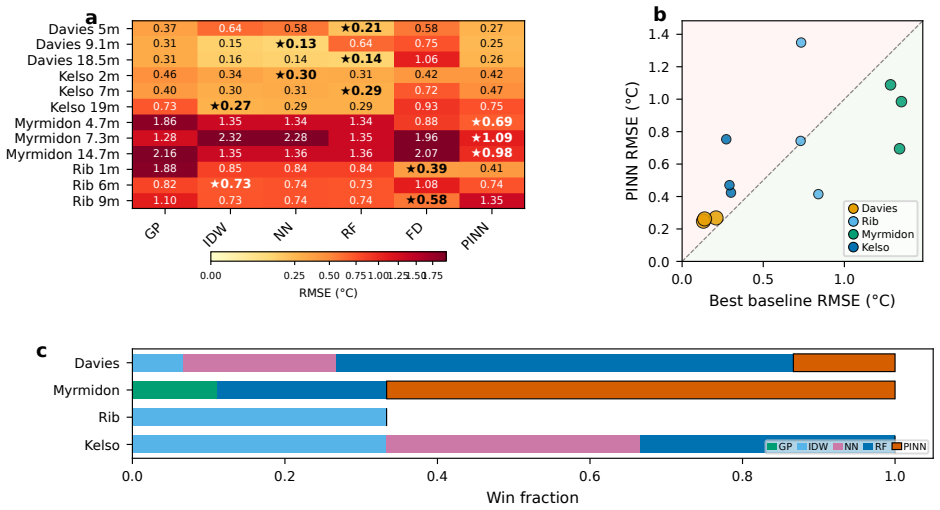
By embedding the one-dimensional vertical heat equation into a neural network and enforcing satellite SST as a hard boundary condition while learning effective thermal diffusivity and light attenuation, the PINN can predict temperatures at unseen depths with 0.25-1.38°C RMSE across four sites, outperforming baselines especially under sparse data conditions, and produces depth profiles of thermal stress that attenuate with depth.
What carries the argument
The physics-informed neural network that solves the 1D vertical heat equation with satellite SST as a hard surface boundary condition and jointly learns constant thermal diffusivity kappa and light attenuation Kd from sparse logger data.
If this is right
- Depth-resolved temperature and thermal stress assessments become feasible using only existing satellite products and a minimal set of in-situ loggers.
- Coral bleaching monitoring can account for reduced stress at depth rather than assuming uniform conditions from the surface.
- The method remains effective with as few as three training depths, enabling application in regions with limited observational data.
- PINN-based Degree Heating Day estimates serve as conservative lower bounds on actual thermal stress due to smoothing of temperature peaks.
Where Pith is reading between the lines
- Applying this model globally could improve coral reef management by providing depth-specific risk maps without requiring dense sensor networks.
- Extensions incorporating horizontal flows or variable coefficients might address sites where the constant-parameter assumption breaks down.
- Comparing PINN outputs with high-resolution 3D hydrodynamic models could test the validity of the 1D approximation.
- The conservative DHD values suggest the need for ensemble methods or peak-capturing adjustments for more complete stress quantification.
Load-bearing premise
The vertical temperature dynamics at these coral reef sites are adequately captured by the one-dimensional heat equation using constant effective thermal diffusivity and light attenuation coefficients.
What would settle it
A direct comparison of PINN-predicted temperatures against new in-situ logger data at previously unseen depths and sites, where an RMSE exceeding 1.5°C or failure to show depth-attenuation in DHD would indicate the model does not generalize as claimed.
Figures

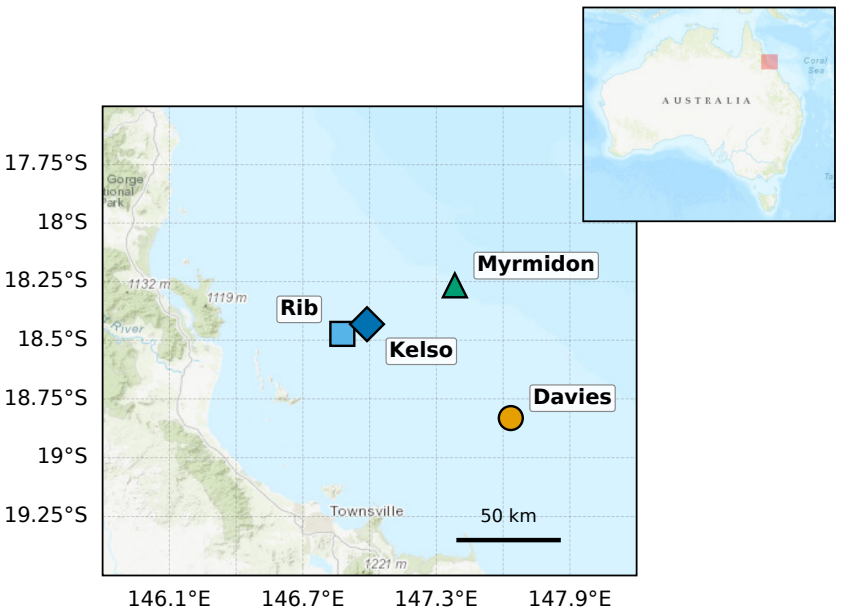


read the original abstract
Satellite sea surface temperature (SST) products underpin global coral bleaching monitoring, yet they measure only the ocean skin. Corals inhabit depths from the shallows to beyond 20 metres, where temperatures can be 1-3{\deg}C cooler than the surface; applying satellite SST uniformly to all depths therefore overestimates subsurface thermal stress. We present a physics-informed neural network (PINN) that fuses NOAA Coral Reef Watch SST with sparse in-situ temperature loggers within the one-dimensional vertical heat equation, enforcing SST as a hard surface boundary condition and jointly learning effective thermal diffusivity (\k{appa}) and light attenuation (Kd). Validated across four Great Barrier Reef sites (30 holdout experiments), the PINN achieves 0.25-1.38{\deg}C RMSE at unseen depths. Under extreme sparsity (three training depths), the PINN maintains 0.27{\deg}C RMSE at the 5 metre holdout and 0.32{\deg}C at the 9.1 metre holdout, where statistical baselines collapse to >1.8{\deg}C; it outperforms a physics-only finite-difference baseline in 90% of experiments. Depth-resolved Degree Heating Day (DHD) profiles show that thermal stress attenuates with depth: at Davies Reef, DHD drops from 0.29 at the surface to zero by 10.7 metres, consistent with logger observations, while satellite DHD remains constant at 0.31 across all depths. However, the PINN underestimates absolute DHD at shallow depths because its smooth predictions attenuate the short-duration peaks that drive threshold exceedances; PINN DHD values should be interpreted as conservative lower bounds on depth-resolved stress. These results demonstrate that physics-constrained fusion of satellite SST with sparse loggers can extend bleaching assessment to the depth dimension using existing observational infrastructure.
Editorial analysis
A structured set of objections, weighed in public.
Referee Report
Summary. The paper claims that a physics-informed neural network (PINN) fusing NOAA Coral Reef Watch satellite SST with sparse in-situ temperature loggers, while enforcing the one-dimensional vertical heat equation as a hard constraint and jointly learning effective thermal diffusivity (kappa) and light attenuation (Kd), can accurately extrapolate temperatures to unseen depths. Validated on four Great Barrier Reef sites via 30 holdout experiments, it reports RMSE of 0.25-1.38°C at unseen depths; under extreme sparsity (three training depths) it achieves 0.27°C RMSE at the 5 m holdout and 0.32°C at 9.1 m (versus >1.8°C for statistical baselines) and outperforms a physics-only finite-difference baseline in 90% of cases. Depth-resolved Degree Heating Day (DHD) profiles are derived showing attenuation of thermal stress with depth, though the PINN underestimates absolute DHD at shallow depths due to smoothing of short-duration peaks and should be treated as conservative lower bounds.
Significance. If the results hold, the work provides a practical, data-efficient method to extend satellite SST-based coral bleaching monitoring into the subsurface using existing sparse logger infrastructure and physics constraints, addressing a key limitation in current global assessments. Notable strengths include the quantitative multi-site holdout validation across sparsity regimes, direct comparison to both statistical and physics-only baselines, and explicit acknowledgment of limitations for threshold-based metrics.
major comments (1)
- [Abstract] Abstract: The reported outperformance versus the physics-only finite-difference baseline (in 90% of experiments) employs the identical 1D vertical heat equation with constant effective kappa and Kd; this comparison therefore does not test the sufficiency of the model form itself for reef dynamics. Omitted processes (horizontal advection, tidal mixing, vertical velocity, depth/time-varying properties) could affect generalizability, consistent with the acknowledged underestimation of short-duration DHD peaks that drive bleaching thresholds.
minor comments (2)
- [Abstract] Abstract: The thermal diffusivity is denoted as (k{appa}); adopt standard mathematical notation (kappa) for clarity and consistency with the heat equation.
- [Abstract] Abstract: Temperature differences are written as 1-3{deg}C; ensure uniform degree-symbol formatting and check for similar LaTeX artifacts elsewhere.
Simulated Author's Rebuttal
We thank the referee for their constructive comments. We address the major comment below and have revised the manuscript to clarify the scope of the baseline comparison and the limitations of the 1D model.
read point-by-point responses
-
Referee: The reported outperformance versus the physics-only finite-difference baseline (in 90% of experiments) employs the identical 1D vertical heat equation with constant effective kappa and Kd; this comparison therefore does not test the sufficiency of the model form itself for reef dynamics. Omitted processes (horizontal advection, tidal mixing, vertical velocity, depth/time-varying properties) could affect generalizability, consistent with the acknowledged underestimation of short-duration DHD peaks that drive bleaching thresholds.
Authors: We agree that the comparison to the finite-difference baseline does not test the sufficiency of the 1D heat equation model itself, as both approaches use the same governing equation (with the baseline employing constant kappa and Kd). The PINN's outperformance in 90% of experiments stems from its ability to jointly learn effective, potentially varying kappa and Kd values from the sparse data while enforcing the physics constraint. We acknowledge that omitted processes such as horizontal advection, tidal mixing, vertical velocity, and depth/time-varying properties could affect generalizability, consistent with the underestimation of short-duration DHD peaks. This limitation is already noted in the manuscript, where PINN DHD values are described as conservative lower bounds. We have revised the abstract to explicitly state that the baseline comparison evaluates the benefit of data-informed parameter learning within the physics model rather than validating the model form. We have also expanded the discussion to highlight the potential impact of unmodeled processes on generalizability. revision: yes
Circularity Check
No significant circularity in the PINN derivation or predictions
full rationale
The paper's central derivation enforces the 1D vertical heat equation as a hard constraint in the PINN loss while learning effective constant parameters κ and Kd from the combination of satellite SST (hard surface BC) and sparse in-situ logger data at a subset of depths. Predictions at holdout depths are obtained by solving the PDE forward with the learned parameters, not by direct regression on the target temperatures. This is confirmed by the 30 holdout experiments, extreme sparsity tests (three training depths), and outperformance versus both statistical baselines and a physics-only finite-difference solver using the identical equation. No quoted step reduces a claimed prediction to a fitted input by construction, no self-citation chain is load-bearing for the extrapolation result, and the method remains self-contained against the external holdout benchmarks.
Axiom & Free-Parameter Ledger
free parameters (2)
- effective thermal diffusivity kappa
- light attenuation coefficient Kd
axioms (1)
- domain assumption Temperature evolution obeys the one-dimensional vertical heat equation with constant effective diffusivity and attenuation.
Reference graph
Works this paper leans on
-
[1]
T. P. Hughes, J. T. Kerry, M. Álvarez-Noriega, J. G. Álvarez-Romero, K. D. Anderson, A. H. Baird, R. C. Babcock, M. Beger, D. R. Bellwood, R. Berkelmans, et al., Global warming and recurrent mass bleaching of corals, Nature 543 (7645) (2017) 373–377.doi:10.1038/ nature21707
2017
-
[2]
T. P. Hughes, K. D. Anderson, S. R. Connolly, S. F. Heron, J. T. Kerry, J. M. Lough, A. H. Baird, J. K. Baum, M. L. Berumen, T. C. Bridge, et al., Spatial and temporal patterns of mass bleaching of corals in the Anthropocene, Science 359 (6371) (2018) 80–83.doi: 10.1126/science.aan8048
-
[3]
URLhttps://www.aims.gov.au/monitoring-great-barrier-reef/ gbr-condition-summary-2024-25 21
Australian Institute of Marine Science, Annual summary report of coral reef condition 2024/25, accessed 2026-03-16 (2025). URLhttps://www.aims.gov.au/monitoring-great-barrier-reef/ gbr-condition-summary-2024-25 21
2024
-
[4]
G. Liu, S. F. Heron, C. M. Eakin, F. E. Muller-Karger, M. Vega-Rodriguez, L. S. Guild, J. L. De La Cour, E. F. Geiger, W. J. Skirving, T. F. D. Burgess, et al., Reef-scale thermal stress monitoring of coral ecosystems: New 5-km global products from NOAA Coral Reef Watch, Remote Sensing 6 (11) (2014) 11579–11606.doi:10.3390/rs61111579
-
[5]
W. J. Skirving, S. F. Heron, B. L. Marsh, G. Liu, J. L. De La Cour, E. F. Geiger, C. M. Eakin, The relentless march of mass coral bleaching: a global perspective of changing heat stress, Coral Reefs 38 (3) (2019) 547–557.doi:10.1007/s00338-019-01799-4
-
[6]
J. J. Leichter, B. Helmuth, A. M. Fischer, Variation beneath the surface: Quantifying complex thermal environments on coral reefs in the Caribbean, Bahamas and Florida, Journal of Marine Research 64 (4) (2006) 563–588.doi:10.1357/002224006778715711
-
[7]
A. H. Baird, J. S. Madin, M. Álvarez-Noriega, L. Fontoura, J. T. Kerry, C.-Y. Kuo, K. Precoda, D. Torres-Pulliza, R. M. Woods, K. J. A. Zawada, T. P. Hughes, A decline in bleaching suggests that depth can provide a refuge from global warming in most coral taxa, Marine Ecology Progress Series 603 (2018) 257–264.doi:10.3354/meps12732
-
[8]
T. C. L. Bridge, A. S. Hoey, S. J. Campbell, E. Muttaqin, R. M. Bonaldo, A. H. Baird, Depth- dependent mortality of reef corals following a severe bleaching event: implications for thermal refuges and population recovery, F1000Research 2 (2013) 187.doi:10.12688/f1000research. 2-187.v3
-
[9]
P. R. Frade, P. Bongaerts, N. Englebert, A. Rogers, M. Gonzalez-Rivero, O. Hoegh-Guldberg, Deep reefs of the Great Barrier Reef offer limited thermal refuge during mass coral bleaching, Nature Communications 9 (1) (2018) 3447.doi:10.1038/s41467-018-05741-0
-
[10]
deep reef refugia
P. Bongaerts, T. Ridgway, E. M. Sampayo, O. Hoegh-Guldberg, Assessing the “deep reef refugia” hypothesis: focus on Caribbean reefs, Coral Reefs 29 (2) (2010) 309–327.doi:10. 1007/s00338-009-0581-x
2010
-
[11]
S. J. Bainbridge, Temperature and light patterns at four reefs along the Great Barrier Reef during the 2015–2016 austral summer: Understanding patterns of observed coral bleaching, Journal of Operational Oceanography 10 (1) (2017) 16–29.doi:10.1080/1755876X.2017. 1290863
-
[12]
M. Raissi, P. Perdikaris, G. E. Karniadakis, Physics-informed neural networks: A deep learning framework for solving forward and inverse problems involving nonlinear partial differential equations, Journal of Computational Physics 378 (2019) 686–707.doi:10.1016/j.jcp.2018. 10.045
-
[13]
G. E. Karniadakis, I. G. Kevrekidis, L. Lu, P. Perdikaris, S. Wang, L. Yang, Physics- informed machine learning, Nature Reviews Physics 3 (6) (2021) 422–440.doi:10.1038/ s42254-021-00314-5
2021
-
[14]
K. Kashinath, M. Mustafa, A. Albert, J. Wu, C. Jiang, S. Esmaeilzadeh, K. Azizzadenesheli, R. Wang, A. Chattopadhyay, A. Singh, et al., Physics-informed machine learning: case stud- ies for weather and climate modelling, Philosophical Transactions of the Royal Society A 379 (2194) (2021) 20200093.doi:10.1098/rsta.2020.0093. 22
-
[15]
J. D. Willard, X. Jia, S. Xu, M. Steinbach, V. Kumar, Integrating scientific knowledge with machine learning for engineering and environmental systems, ACM Computing Surveys 55 (4) (2023) 1–37.doi:10.1145/3514228
-
[16]
Y. Xiao, Y. Tang, Y. Li, Observation-guided physics-informed neural network (OG-PINN): Application to subsurface ocean temperature and salinity structure reconstructionPreprint, submitted to Climate Dynamics (2026).doi:10.21203/rs.3.rs-8879567/v1
-
[17]
L. Han, C. Dong, Y. Liu, H. Xie, H. Zhang, W. Zhu, Application of physics-informed neural networks in solving temperature diffusion equation of seawater, Journal of Oceanology and Limnology 44 (2026) 1–18.doi:10.1007/s00343-025-4348-1
-
[18]
S. G. Monismith, Hydrodynamics of coral reefs, Annual Review of Fluid Mechanics 39 (2007) 37–55.doi:10.1146/annurev.fluid.38.050304.092125
-
[19]
R. J. Lowe, J. L. Falter, Oceanic forcing of coral reefs, Annual Review of Marine Science 7 (2015) 43–66.doi:10.1146/annurev-marine-010814-015834
-
[20]
S. Wang, Y. Teng, P. Perdikaris, Understanding and mitigating gradient flow pathologies in physics-informed neural networks, SIAM Journal on Scientific Computing 43 (5) (2021) A3055– A3081.doi:10.1137/20M1318043
-
[21]
Bradbury, R
J. Bradbury, R. Frostig, P. Hawkins, M. J. Johnson, C. Leary, D. Maclaurin, G. Necula, A. Paszke, J. VanderPlas, S. Wanderman-Milne, Q. Zhang, JAX: Composable transformations of Python+NumPy programs (2018). URLhttp://github.com/jax-ml/jax
2018
-
[22]
G. Liu, A. E. Strong, W. J. Skirving, F. Arzayus, Overview of NOAA Coral Reef Watch program’s near-real-time satellite global coral bleaching monitoring activities, in: Proceedings of the 10th International Coral Reef Symposium, 2006, pp. 1783–1793
2006
-
[23]
J. T. O. Kirk, Light and Photosynthesis in Aquatic Ecosystems, 3rd Edition, Cambridge University Press, Cambridge, 2011.doi:10.1017/CBO9781139168212
-
[24]
C. Donlon, B. Berruti, A. Buongiorno, M.-H. Ferreira, P. Féménias, J. Frerick, P. Goryl, U. Klein, H. Laur, C. Mavrocordatos, et al., The Global Monitoring for Environment and Security (GMES) Sentinel-3 mission, Remote Sensing of Environment 120 (2012) 37–57.doi: 10.1016/j.rse.2011.07.024. 23
discussion (0)
Sign in with ORCID, Apple, or X to comment. Anyone can read and Pith papers without signing in.