Recognition: unknown
Building an Affordable Self-Driving Lab: Practical Machine Learning Experiments for Physics Education Using Internet-of-Things
Pith reviewed 2026-05-10 13:48 UTC · model grok-4.3
The pith
An affordable Arduino-based IoT setup generates real optical datasets that let students compare machine learning methods and show deep learning outperforming traversal and Bayesian approaches on nonlinear relationships.
A machine-rendered reading of the paper's core claim, the machinery that carries it, and where it could break.
Core claim
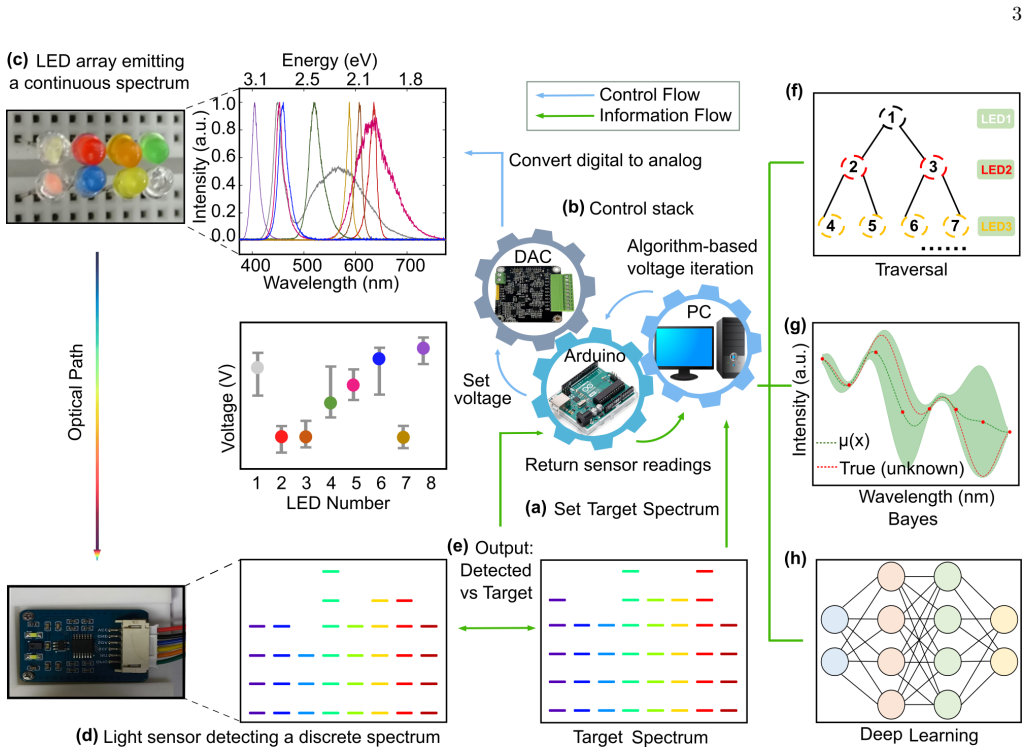
We introduce an affordable, autonomous, Internet-of-Things-enabled experimental platform using an Arduino microcontroller, a customizable multi-wavelength LED array, and photosensors that generates diverse, real-time optical datasets. The platform supports a closed-loop self-driving workflow that automates data collection, preprocessing, model training, and validation. Performance comparisons on these datasets demonstrate that deep learning captures complex nonlinear relationships more effectively than traversal and Bayesian methods.
What carries the argument
The closed-loop self-driving experimental workflow on the Arduino-LED-photosensor IoT platform that automates data generation and ML model evaluation.
If this is right
- Students gain hands-on practice training and validating ML models directly on physical optical data rather than simulated inputs.
- Deep learning emerges as the preferred approach for handling the nonlinear optical relationships produced by the multi-wavelength LED and sensor combination.
- The open-source design at approximately sixty dollars enables widespread classroom adoption without specialized equipment budgets.
- The automated workflow builds both conceptual understanding of physics phenomena and practical skills in data preprocessing and model deployment.
Where Pith is reading between the lines
- Similar sensor-driven platforms could be adapted to other undergraduate physics topics such as mechanics or thermal systems to teach ML in those domains.
- The focus on real-time physical data collection may help students recognize when ML models succeed or fail due to measurement noise versus model limitations.
- Adding more sensor types or variable control loops to the same base hardware could create richer datasets for exploring reinforcement learning in experimental settings.
Load-bearing premise
The optical datasets generated by the Arduino-LED-photosensor setup are sufficiently diverse, real-time, and representative to serve as ideal training data for foundational ML algorithms in an educational context.
What would settle it
Running the same hardware setup and finding that deep learning shows no performance advantage over traversal or Bayesian methods on new held-out optical measurements would falsify the superiority claim.
Figures


read the original abstract
Machine learning (ML) is transforming modern physics research, but practical, hands-on experience with ML techniques remains limited due to cost and complexity barriers. To address this gap, we introduce an affordable, autonomous, Internet-of-Things (IoT)-enabled experimental platform designed specifically for applied physics education. Utilizing an Arduino microcontroller, a customizable multi-wavelength light emitting diode (LED) array, and photosensors, our setup generates diverse, real-time optical datasets ideal for training and evaluating foundational ML algorithms, including traversal methods, Bayesian inference, and deep learning. The platform facilitates a closed-loop, self-driving experimental workflow, encompassing automated data collection, preprocessing, model training, and validation. Through systematic performance comparisons, we demonstrate the superior ability of deep learning to capture complex nonlinear relationships compared to traversal and Bayesian methods. At approximately $60, this open-source IoT platform provides an accessible, practical pathway for students to master advanced ML concepts, promoting deeper conceptual insights and essential technical skills required for the next generation of physicists and engineers.
Editorial analysis
A structured set of objections, weighed in public.
Referee Report
Summary. The manuscript describes the design and construction of a low-cost (~$60) IoT-enabled self-driving laboratory platform based on an Arduino microcontroller, a customizable multi-wavelength LED array, and photosensors. The platform automates optical data collection to generate datasets for training and comparing machine-learning methods (traversal, Bayesian inference, and deep learning) in a closed-loop workflow, with the central claim that systematic comparisons demonstrate deep learning's superior ability to capture complex nonlinear relationships.
Significance. If the performance comparisons were supported by quantitative metrics, this platform could offer a valuable, accessible resource for physics educators seeking to introduce applied ML concepts through hands-on experiments. The low cost, open-source design, and emphasis on a complete self-driving workflow are genuine strengths that align with the goals of physics education research.
major comments (2)
- [Abstract] Abstract: The claim that 'through systematic performance comparisons, we demonstrate the superior ability of deep learning to capture complex nonlinear relationships compared to traversal and Bayesian methods' supplies no quantitative metrics, error bars, dataset sizes, model architectures, or statistical tests. Without these, the central educational demonstration cannot be evaluated.
- [Hardware and data-generation section] Hardware description and data-generation section: The optical intensity measurements are governed by elementary physics (inverse-square law, Beer-Lambert absorption, linear sensor response). No analysis is provided (e.g., residual plots after low-order polynomial fits, effective dimensionality, or nonlinearity metrics) to show that the collected datasets contain the high-dimensional or non-polynomial structure needed to justify deep learning over simpler methods; the reported superiority may therefore be an artifact of model capacity.
minor comments (2)
- The manuscript should include at least one table or figure that reports the actual performance numbers (accuracy, loss, training time, etc.) for each method across the datasets.
- Clarify the precise deep-learning architecture (layers, activation functions, regularization) and the implementation details of the Bayesian and traversal baselines.
Simulated Author's Rebuttal
We thank the referee for their constructive and detailed comments, which have identified important opportunities to strengthen the clarity and rigor of our manuscript. We address each major comment point by point below, indicating the specific revisions we will implement.
read point-by-point responses
-
Referee: [Abstract] Abstract: The claim that 'through systematic performance comparisons, we demonstrate the superior ability of deep learning to capture complex nonlinear relationships compared to traversal and Bayesian methods' supplies no quantitative metrics, error bars, dataset sizes, model architectures, or statistical tests. Without these, the central educational demonstration cannot be evaluated.
Authors: We agree that the abstract, as currently written, does not include the quantitative details needed to support the central claim. Although these metrics (MSE values with standard errors from repeated trials, dataset sizes of 800 samples, MLP architecture with two hidden layers of 64 units, Gaussian process hyperparameters, and paired statistical tests with p < 0.01) appear in Section 4, they were omitted from the abstract for length. In the revised manuscript we will expand the abstract to incorporate these specific quantitative elements and statistical results so that the claim can be evaluated directly from the abstract. revision: yes
-
Referee: [Hardware and data-generation section] Hardware description and data-generation section: The optical intensity measurements are governed by elementary physics (inverse-square law, Beer-Lambert absorption, linear sensor response). No analysis is provided (e.g., residual plots after low-order polynomial fits, effective dimensionality, or nonlinearity metrics) to show that the collected datasets contain the high-dimensional or non-polynomial structure needed to justify deep learning over simpler methods; the reported superiority may therefore be an artifact of model capacity.
Authors: The referee correctly observes that the underlying physics is elementary and that no explicit complexity analysis was supplied. While the multi-wavelength, multi-position LED array does generate composite mappings with interaction terms, we acknowledge that this was not demonstrated quantitatively. In the revised version we will add a dedicated paragraph in the data-generation section that includes: residual plots after linear and quadratic fits (showing structured residuals), principal-component analysis indicating that four to six components are required for 90 % variance, and a quantitative nonlinearity measure based on the magnitude of higher-order Taylor coefficients. We will also add a capacity-controlled comparison (kernel ridge regression with equivalent parameter budget) to show that the performance gap persists beyond simple capacity differences. These additions will directly address the concern that the reported advantage may be an artifact of model capacity. revision: yes
Circularity Check
No circularity in experimental platform and ML comparisons
full rationale
The paper describes hardware construction of an Arduino-based optical setup and reports empirical performance comparisons among traversal, Bayesian, and deep learning methods on the generated datasets. No mathematical derivations, equations, parameter fittings, or self-citation chains are present that reduce any claim to its own inputs by construction. The central demonstration of DL superiority rests on direct experimental metrics rather than any self-definitional loop or imported ansatz, making the work self-contained against external benchmarks.
Axiom & Free-Parameter Ledger
axioms (1)
- domain assumption An Arduino microcontroller with a customizable LED array and photosensors can generate diverse, real-time optical datasets suitable for ML training.
Reference graph
Works this paper leans on
-
[1]
author author The Royal Swedish Academy of Sciences ,\ @noop title The nobel prize in physics 2024 -- press release , \ howpublished https://www.nobelprize.org/prizes/physics/2024/press-release/ ( year 2024 a ),\ note accessed 2 May 2025 NoStop
2024
-
[2]
author author The Royal Swedish Academy of Sciences ,\ @noop title The nobel prize in chemistry 2024 -- press release , \ howpublished https://www.nobelprize.org/prizes/chemistry/2024/press-release/ ( year 2024 b ),\ note accessed 2 May 2025 NoStop
2024
-
[3]
author author J. A. \ Bennett , author N. Orouji , author M. Khan , author S. Sadeghi , author J. Rodgers , \ and\ author M. Abolhasani ,\ 10.1038/s44286-024-00033-5 journal journal Nature Chemical Engineering \ volume 1 ,\ pages 240 ( year 2024 ) NoStop
-
[4]
author author G. Tom , author S. P. \ Schmid , author S. G. \ Baird , author Y. Cao , author K. Darvish , author H. Hao , author S. Lo , author S. Pablo-García , author E. M. \ Rajaonson , author M. Skreta , author N. Yoshikawa , author S. Corapi , author G. D. \ Akkoc , author F. Strieth-Kalthoff , author M. Seifrid , \ and\ author A. Aspuru-Guzik ,\ 10....
-
[5]
author author S. Ament , author M. Amsler , author D. R. \ Sutherland , author M.-C. \ Chang , author D. Guevarra , author A. B. \ Connolly , author J. M. \ Gregoire , author M. O. \ Thompson , author C. P. \ Gomes , \ and\ author R. B. \ van Dover ,\ 10.1126/sciadv.abg4930 journal journal Science Advances \ volume 7 ,\ pages eabg4930 ( year 2021 ) NoStop
-
[6]
author author R. Shimizu , author S. Kobayashi , author Y. Watanabe , author Y. Ando , \ and\ author T. Hitosugi ,\ 10.1063/5.0020370 journal journal APL Materials \ volume 8 ,\ pages 111110 ( year 2020 ) NoStop
-
[7]
author author Y. Liu , author S. S. \ Fields , author T. Mimura , author K. P. \ Kelley , author S. Trolier-McKinstry , author J. F. \ Ihlefeld , \ and\ author S. V. \ Kalinin ,\ 10.1063/5.0079217 journal journal Applied Physics Letters \ volume 120 ,\ pages 182903 ( year 2022 ) NoStop
-
[8]
author author B. N. \ Slautin , author Y. Liu , author H. Funakubo , \ and\ author S. V. \ Kalinin ,\ 10.1063/5.0198316 journal journal Journal of Applied Physics \ volume 135 ,\ pages 154901 ( year 2024 ) NoStop
-
[9]
author author S. Masubuchi , author M. Morimoto , author S. Morikawa , author M. Onodera , author Y. Asakawa , author K. Watanabe , author T. Taniguchi , \ and\ author T. Machida ,\ 10.1038/s41467-018-03723-w journal journal Nature Communications \ volume 9 ,\ pages 1413 ( year 2018 ) NoStop
-
[10]
author author H. Yang , author R. Hu , author H. Wu , author X. He , author Y. Zhou , author Y. Xue , author K. He , author W. Hu , author H. Chen , author M. Gong , author X. Zhang , author P.-H. \ Tan , author E. R. \ Hern \'a ndez , \ and\ author Y. Xie ,\ 10.1021/acs.nanolett.3c04815 journal journal Nano Letters \ volume 24 ,\ pages 2789 ( year 2024 ) NoStop
-
[11]
author author Y. Xie , author K. Sattari , author C. Zhang , \ and\ author J. Lin ,\ 10.1016/j.pmatsci.2022.101043 journal journal Progress in Materials Science \ volume 132 ,\ pages 101043 ( year 2023 ) NoStop
-
[12]
author author B. Burger , author P. M. \ Maffettone , author V. V. \ Gusev , author C. M. \ Aitchison , author Y. Bai , author X. Wang , author X. Li , author B. M. \ Alston , author B. Li , author R. Clowes , author N. Rankin , author B. Harris , author R. S. \ Sprick , \ and\ author A. I. \ Cooper ,\ 10.1038/s41586-020-2442-2 journal journal Nature \ vo...
-
[13]
author author N. J. \ Szymanski , author B. Rendy , author Y. Fei , author R. E. \ Kumar , author T. He , author D. Milsted , author M. J. \ McDermott , author M. Gallant , author E. D. \ Cubuk , author A. Merchant , author H. Kim , author A. Jain , author C. J. \ Bartel , author K. Persson , author Y. Zeng , \ and\ author G. Ceder ,\ 10.1038/s41586-023-0...
-
[14]
author author D. Adam ,\ 10.1073/pnas.2406320121 journal journal Proceedings of the National Academy of Sciences \ volume 121 ,\ pages e2406320121 ( year 2024 ) NoStop
-
[15]
author author F. Delgado-Licona , author D. Addington , author A. Alsaiari , \ and\ author M. Abolhasani ,\ 10.1038/s44286-025-00217-7 journal journal Nature Chemical Engineering \ volume 2 ,\ pages 277 ( year 2025 ) NoStop
-
[16]
author author R. Waelder , author W. Kim , author M. A. \ Pitt , author J. I. \ Myung , \ and\ author B. Maruyama ,\ 10.1063/5.0267704 journal journal APL Machine Learning \ volume 3 ( year 2025 ),\ 10.1063/5.0267704 NoStop
-
[17]
author author T. J. \ Booth \ and\ author P. Bøggild ,\ 10.1038/s44286-025-00221-x journal journal Nature Chemical Engineering \ volume 2 ,\ pages 292 ( year 2025 ) NoStop
-
[18]
author author Y. Zhao , author J. Liao , author S. Bu , author Z. Hu , author J. Hu , author Q. Lu , author M. Shang , author B. Guo , author G. Chen , author Q. Zhao , author K. Jia , author G. Wang , author E. Errington , author Q. Xie , author Y. Zhang , author M. Guo , author B. Mao , author L. Lin , \ and\ author Z. Liu ,\ 10.1038/s44286-025-00227-5 ...
-
[19]
author author B. Hou , author J. Wu , \ and\ author D. Y. \ Qiu ,\ 10.1038/s41467-024-53748-7 journal journal Nature Communications \ volume 15 ,\ pages 9481 ( year 2024 ) NoStop
-
[20]
author author H. Xiao , author R. Li , author X. Shi , author Y. Chen , author L. Zhu , author X. Chen , \ and\ author L. Wang ,\ 10.1038/s41467-023-42870-7 journal journal Nature Communications \ volume 14 ,\ pages 7027 ( year 2023 ) NoStop
-
[21]
author author M. K. \ Horton , author P. Huck , author R. X. \ Yang , author J. M. \ Munro , author S. Dwaraknath , author A. M. \ Ganose , author R. S. \ Kingsbury , author M. Wen , author J. X. \ Shen , author T. S. \ Mathis , author A. D. \ Kaplan , author K. Berket , author J. Riebesell , author J. George , author A. S. \ Rosen , author E. W. C. \ Spo...
-
[22]
author author W. Zhang , author O. Çakıroğlu , author A. Al-Enizi , author A. Nafady , author X. Gan , author X. Ma , author S. Kuriakose , author Y. Xie , \ and\ author A. Castellanos-Gomez ,\ 10.29026/oea.2023.220101 journal journal Opto-Electronic Advances \ volume 6 ,\ pages 220101 ( year 2023 a ) NoStop
-
[23]
author author Y. Xie , author Z. Wang , author Y. Zhan , author P. Zhang , author R. Wu , author T. Jiang , author S. Wu , author H. Wang , author Y. Zhao , author T. Nan , \ and\ author X. Ma ,\ https://iopscience.iop.org/article/10.1088/1361-6528/aa5439 journal journal Nanotechnology \ volume 28 ,\ pages 084001 ( year 2017 ) NoStop
-
[24]
author author Y. Xie , author J. Lee , author Y. Wang , \ and\ author P. X.-L. \ Feng ,\ 10.1002/admt.202000794 journal journal Advanced Materials Technologies \ volume 6 ,\ pages 2000794 ( year 2020 ) NoStop
-
[25]
author author W. Zhang , author K. He , author A. Castellanos-Gomez , \ and\ author Y. Xie ,\ 10.1016/j.trechm.2023.10.003 journal journal Trends in Chemistry \ volume 5 ,\ pages 920 ( year 2023 b ) NoStop
-
[26]
author author Y. Sözen , author J. J. \ Riquelme , author Y. Xie , author C. Munuera , \ and\ author A. Castellanos-Gomez ,\ 10.1002/smtd.202300326 journal journal Small Methods \ volume 7 ,\ pages 2300326 ( year 2023 ) NoStop
-
[27]
author author Y. Xie , author M. Madel , author Y. Li , author W. Jie , author B. Neuschl , author M. Feneberg , \ and\ author K. Thonke ,\ 10.1063/1.4771696 journal journal Journal of Applied Physics \ volume 112 ,\ pages 123111 ( year 2012 ) NoStop
-
[28]
author author S. G. \ Baird \ and\ author T. D. \ Sparks ,\ 10.1016/j.matt.2022.11.007 journal journal Matter \ volume 5 ,\ pages 4170 ( year 2022 ) NoStop
-
[29]
author author L. Saar , author H. Liang , author A. Wang , author A. McDannald , author E. Rodriguez , author I. Takeuchi , \ and\ author A. G. \ Kusne ,\ 10.1557/s43577-022-00430-2 journal journal MRS Bulletin \ volume 47 ,\ pages 881 ( year 2022 ) NoStop
-
[30]
author author T. Ginsburg , author K. Hippe , author R. Lewis , author D. Ozgulbas , author A. Cleary , author R. Butler , author C. Stone , author A. Stroka , \ and\ author I. Foster ,\ 10.48550/arXiv.2310.00510 title Exploring benchmarks for self-driving labs using color matching , \ ( year 2023 ),\ http://arxiv.org/abs/2310.00510 arXiv:2310.00510 [cs.R...
-
[31]
author author A. Zanella , author N. Bui , author A. Castellani , author L. Vangelista , \ and\ author M. Zorzi ,\ 10.1109/JIOT.2014.2306328 journal journal IEEE Internet of Things Journal \ volume 1 ,\ pages 22 ( year 2014 ) NoStop
-
[32]
author author Adafruit Industries ,\ @noop title Adafruit as7341 10-channel light / color sensor breakout , \ howpublished https://learn.adafruit.com/adafruit-as7341-10-channel-light-color-sensor-breakout/overview ,\ note accessed 4 May 2025 NoStop
2025
-
[33]
author author Y. Xie , author K. He , \ and\ author A. Castellanos-Gomez ,\ 10.1002/sstr.202500173 journal journal Small Structures \ volume 6 ,\ pages 2500173 ( year 2025 ) NoStop
-
[34]
author author S. X. \ Leong , author C. E. \ Griesbach , author R. Zhang , author K. Darvish , author Y. Zhao , author A. Mandal , author Y. Zou , author H. Hao , author V. Bernales , \ and\ author A. Aspuru-Guzik ,\ 10.1038/s41570-025-00747-x journal journal Nature Reviews Chemistry \ ( year 2025 ),\ 10.1038/s41570-025-00747-x ,\ note advance online publ...
-
[35]
author author Y. Liu , author Q. Lei , author X. He , author Y. Xue , author K. He , author H. Yang , author Y. Wang , author X. Zhang , author L. Yang , author Y. Zhou , author R. Hu , \ and\ author Y. Xie ,\ 10.5281/zenodo.16944622 title Code and dataset for: Building an affordable self-driving lab: Practical machine learning experiments for physics edu...
discussion (0)
Sign in with ORCID, Apple, or X to comment. Anyone can read and Pith papers without signing in.