Recognition: unknown
Black holes in general relativity coupled with NEDs surrounded by PFDM: thermodynamics, epicyclic oscillations, QPOs, and shadow
Pith reviewed 2026-05-10 15:18 UTC · model grok-4.3
The pith
Quasiperiodic oscillation data from four X-ray sources constrains the mass, magnetic charge, and dark matter parameters of regular black holes in general relativity coupled to nonlinear electrodynamics and perfect fluid dark matter.
A machine-rendered reading of the paper's core claim, the machinery that carries it, and where it could break.
Core claim
The spacetime metric of a regular black hole in general relativity coupled with nonlinear electrodynamics and surrounded by perfect fluid dark matter yields epicyclic frequencies for neutral test particles whose values can be matched to observed quasiperiodic oscillations, permitting a Markov Chain Monte Carlo analysis that constrains the black hole mass, magnetic charge parameter, perfect fluid dark matter parameter, and characteristic orbital radius for the sources XTE J1550-564, GRO J1655-40, GRS 1915+105, and M82 X-1.
What carries the argument
Epicyclic frequencies obtained from the effective potential of neutral test particles in the equatorial plane, inserted into a Markov Chain Monte Carlo fit against observed QPO frequencies.
Load-bearing premise
The observed quasiperiodic oscillations in the listed sources arise from the epicyclic motion of neutral test particles orbiting in the equatorial plane of this regular black hole spacetime.
What would settle it
A set of QPO frequency measurements from any one of the four sources whose values lie outside the range reproducible by the epicyclic frequency expressions for all physically allowed combinations of mass, magnetic charge, perfect fluid dark matter parameter, and radius.
Figures






read the original abstract
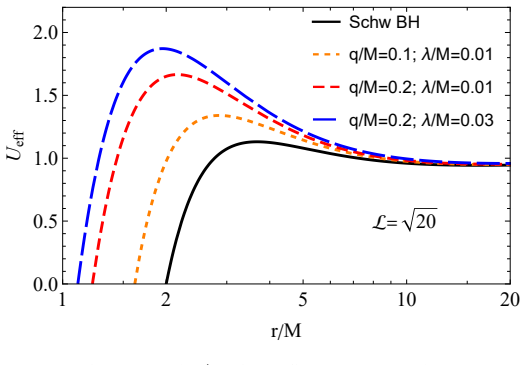
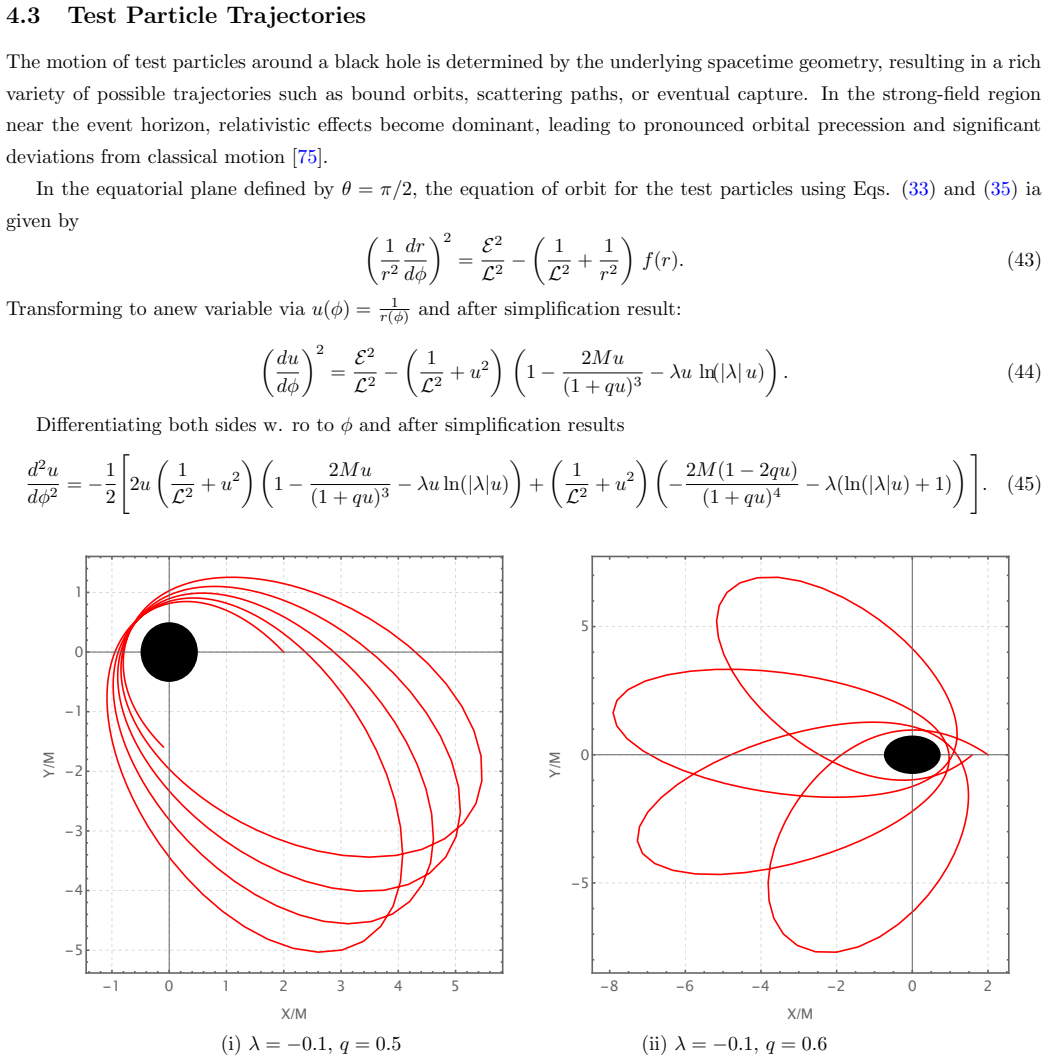
In this work, we investigate the thermodynamics and motion of neutral test particles around a regular black hole immersed in a perfect fluid dark matter environment. We begin by examining the horizon structure and key thermodynamic properties, with particular emphasis on quantities such as the Hawking temperature and the specific heat capacity. These aspects provide important insight into the stability and physical behavior of the black hole system. We then proceed to analyze the dynamics of neutral test particles using the Hamiltonian formalism, through which we derive the effective potential governing particle motion. Using the effective potential, we further study quasiperiodic oscillations by determining the associated epicyclic frequencies and comparing them with available observational data. Using the observed QPO data of XTE J1550-564, GRO J1655-40, GRS 1915+105, and M82 X-1, we perform a Markov Chain Monte Carlo analysis to constrain the black hole mass, the magnetic charge parameter, the PFDM parameter, and the characteristic orbital radius. Finally, we investigate the black hole shadow and demonstrate how various geometric parameters influence its optical appearance. This analysis highlights the potential observational signatures of such black holes and their surrounding dark matter environment.
Editorial analysis
A structured set of objections, weighed in public.
Referee Report
Summary. The manuscript examines the thermodynamic properties and geodesic motion of neutral test particles around a regular black hole in general relativity coupled with nonlinear electrodynamics (NED) and surrounded by perfect fluid dark matter (PFDM). It derives the Hawking temperature and specific heat, computes the effective potential using the Hamiltonian formalism, calculates epicyclic frequencies for QPOs, performs MCMC analysis to fit parameters (mass, magnetic charge, PFDM parameter, orbital radius) to observational QPO data from XTE J1550-564, GRO J1655-40, GRS 1915+105, and M82 X-1, and studies the black hole shadow.
Significance. If the central assumption that the observed QPOs correspond to epicyclic frequencies holds, the work provides new constraints on the model parameters and illustrates the impact of NED and PFDM on black hole observables such as QPOs and shadows. This contributes to the growing literature on testing modified gravity and dark matter models with astrophysical data. The inclusion of MCMC fitting and shadow analysis adds quantitative and visual elements to the study.
major comments (1)
- [QPO and MCMC analysis section] The MCMC constraints on the black hole mass, magnetic charge parameter, PFDM parameter, and characteristic orbital radius are obtained by directly equating the observed upper and lower QPO frequencies to the radial (ν_r) and vertical (ν_θ) epicyclic frequencies derived from the effective potential. This identification is load-bearing for the central claim but lacks justification against alternative QPO models (e.g., disk precession or resonance mechanisms), and the uncertainty in the frequency assignment is not propagated into the posterior distributions. A sensitivity analysis or comparison with other models would strengthen the results.
minor comments (2)
- [Thermodynamics section] The discussion of specific heat capacity could benefit from clearer plots or additional analysis of phase transitions.
- [Shadow section] The figures showing the shadow could include more quantitative measures, such as the shadow radius as a function of parameters.
Simulated Author's Rebuttal
We thank the referee for their careful reading of the manuscript and for the constructive comment on the QPO and MCMC analysis. We address the point below and indicate the revisions we will make.
read point-by-point responses
-
Referee: The MCMC constraints on the black hole mass, magnetic charge parameter, PFDM parameter, and characteristic orbital radius are obtained by directly equating the observed upper and lower QPO frequencies to the radial (ν_r) and vertical (ν_θ) epicyclic frequencies derived from the effective potential. This identification is load-bearing for the central claim but lacks justification against alternative QPO models (e.g., disk precession or resonance mechanisms), and the uncertainty in the frequency assignment is not propagated into the posterior distributions. A sensitivity analysis or comparison with other models would strengthen the results.
Authors: We agree that the direct identification of the observed upper and lower QPO frequencies with the vertical and radial epicyclic frequencies is a central assumption of the MCMC analysis. This choice follows the standard relativistic precession model commonly employed in the literature for twin-peak QPOs in black-hole X-ray binaries. While alternative mechanisms such as disk precession or resonance models exist, our work is focused on the implications of the NED+PFDM spacetime within the epicyclic framework. To address the referee's concern, we will revise the manuscript by (i) adding an explicit discussion of the adopted identification together with references to both supporting and alternative QPO models, and (ii) performing a limited sensitivity analysis in which the frequency assignment is swapped and the resulting shifts in the posterior distributions are reported. The MCMC already incorporates the reported observational uncertainties on the QPO frequencies; the revised text will clarify this point and note the additional model-choice uncertainty. These changes will be presented as an expanded subsection without altering the numerical results or conclusions of the original analysis. revision: partial
Circularity Check
No significant circularity: model derivation independent of QPO fitting
full rationale
The paper constructs the NED+PFDM metric from the Einstein equations, derives the effective potential and epicyclic frequencies (ν_r, ν_θ) from the geodesic Hamiltonian, and computes thermodynamic quantities directly from the metric functions. It then performs MCMC fitting of the four parameters to external QPO frequency data from four named sources by matching those derived frequencies to observations. This is standard parameter estimation against independent data; the fitted values are outputs of the likelihood, not inputs that force the frequency expressions by construction. No self-definitional equations, renamed predictions, or load-bearing self-citations that reduce the central results to tautology are exhibited in the abstract or described chain. The derivation remains self-contained against external benchmarks.
Axiom & Free-Parameter Ledger
free parameters (3)
- magnetic charge parameter
- PFDM parameter
- characteristic orbital radius
axioms (2)
- domain assumption The background spacetime is a regular black hole solution of GR coupled to NEDs and immersed in PFDM.
- domain assumption Quasi-periodic oscillations in the listed X-ray sources are produced by epicyclic motion of neutral test particles.
Reference graph
Works this paper leans on
-
[1]
S. W. Hawking and G. F. R. Ellis,The Large Scale Structure of Space-Time(Cambridge University Press, Cambridge, 1973)
1973
-
[2]
S. W. Hawking and R. Penrose,The Nature of Space and Time(Princeton University Press, Princeton, 1996)
1996
-
[3]
J. M. Bardeen, inProceedings of the International Conference GR5(Tbilisi, USSR, 1968) p. 174
1968
-
[4]
Ay´ on-Beato and A
E. Ay´ on-Beato and A. Garc´ ıa, Physical Review Letters80, 5056 (1998)
1998
-
[5]
Ay´ on-Beato and A
E. Ay´ on-Beato and A. Garc´ ıa, Physics Letters B464, 25 (1999)
1999
-
[6]
Ay´ on-Beato and A
E. Ay´ on-Beato and A. Garc´ ıa, Physics Letters B493, 149 (2000)
2000
-
[7]
K. A. Bronnikov, Physical Review D63, 044005 (2001)
2001
-
[8]
Dymnikova, Classical and Quantum Gravity21, 4417 (2004)
I. Dymnikova, Classical and Quantum Gravity21, 4417 (2004)
2004
-
[9]
Berej, J
W. Berej, J. Matyjasek, and D. Tryniecki, General Relativity and Gravitation38, 885 (2006)
2006
-
[10]
Formation and evaporation of non-singular black holes
S. A. Hayward, “Formation and evaporation of non-singular black holes,” (2006), arXiv preprint, arXiv:gr-qc/0506126 [gr-qc]
work page Pith review arXiv 2006
-
[11]
Born and L
M. Born and L. Infeld, Proceedings of the Royal Society A144, 425 (1934)
1934
-
[12]
H. A. Gonz´ alez, M. Hassa¨ ıne, and C. Mart´ ınez, Physical Review D80, 104008 (2009)
2009
-
[13]
P. Wang, H. Wu, and H. Yang, Journal of High Energy Physics2019, 002 (2019)
2019
-
[14]
Balart and E
L. Balart and E. C. Vagenas, Physical Review D90, 124045 (2014)
2014
-
[15]
Tharanath, J
R. Tharanath, J. Suresh, and V. C. Kuriakose, General Relativity and Gravitation47, 46 (2015)
2015
-
[16]
Q.-S. Gan, J. Chen, and Y. Wang, Chinese Physics B25, 120401 (2016)
2016
-
[17]
Wei, Entropy20, 192 (2018)
Y.-H. Wei, Entropy20, 192 (2018)
2018
-
[18]
Toshmatov, Z
B. Toshmatov, Z. Stuchl´ ık, and B. Ahmedov, Physical Review D95, 084037 (2017)
2017
-
[19]
Rahaman, K
F. Rahaman, K. K. Nandi, A. Bhadra, M. Kalam, and K. Chakraborty, Physics Letters B694, 10 (2010)
2010
-
[20]
X. T. Hou, Z. Xu, and J. Wang, Journal of Cosmology and Astroparticle Physics2018, 040 (2018)
2018
-
[21]
Haroon, M
S. Haroon, M. Jamil, and K. Jusufi, Physical Review D99, 044015 (2019)
2019
-
[22]
Z. Xu, X. T. Hou, and J. Wang, Advances in High Energy Physics2019, 2434390 (2019)
2019
-
[23]
S. H. Hendi, A. Nemati, and K. Lin, The European Physical Journal C80, 296 (2020)
2020
-
[24]
Charged Black Holes in KR-gravity Surrounded by Perfect Fluid Dark Matter
F. Ahmed, M. Fathi, and E. O. Silva, (2026), arXiv:2604.11357 [gr-qc]
work page internal anchor Pith review Pith/arXiv arXiv 2026
- [25]
- [26]
- [27]
-
[28]
A. Al-Badawi, F. Ahmed, and I. Sakalli, (2026), arXiv:2603.02276 [gr-qc]
-
[29]
A. Das, A. Saha, and S. Gangopadhyay, Classical and Quantum Gravity38, 065015 (2021)
2021
-
[30]
Rayimbaev, S
J. Rayimbaev, S. Shaymatov, and M. Jamil, The European Physical Journal C81, 699 (2021)
2021
-
[31]
Zhang, C
H.-X. Zhang, C. Yuan, and T.-C. Ma, Chinese Physics C45, 055103 (2021)
2021
-
[32]
Narzilloev, J
B. Narzilloev, J. Rayimbaev, S. Shaymatov, A. Abdujabbarov, and B. Ahmedov, Physical Review D102, 104062 (2020)
2020
-
[33]
Stuchl´ ık and J
Z. Stuchl´ ık and J. Schee, International Journal of Modern Physics D24, 1550020 (2015)
2015
-
[34]
Toshmatov, A
B. Toshmatov, A. Abdujabbarov, Z. Stuchl´ ık, and B. Ahmedov, Physical Review D91, 083008 (2015)
2015
-
[35]
J. Tang, Y. Liu, and W.-L. Qian, Chinese Physics C47, 025105 (2023)
2023
-
[36]
J. Sun, Y. Liu, and W.-L. Qian, Chinese Physics C47, 025104 (2023)
2023
-
[37]
Koloˇ s, Z
M. Koloˇ s, Z. Stuchl´ ık, and A. Tursunov, Classical and Quantum Gravity32, 165009 (2015). 27
2015
-
[38]
Tursunov, Z
A. Tursunov, Z. Stuchl´ ık, and M. Koloˇ s, Physical Review D93, 084012 (2016)
2016
-
[39]
Stuchl´ ık and M
Z. Stuchl´ ık and M. Koloˇ s, European Physical Journal C76, 32 (2016)
2016
-
[40]
Stuchl´ ık and J
Z. Stuchl´ ık and J. Vrba, Universe7, 279 (2021)
2021
-
[41]
Stuchl´ ık and J
Z. Stuchl´ ık and J. Vrba, Journal of Cosmology and Astroparticle Physics2021, 059 (2021)
2021
-
[43]
Rezzolla, inAIP Conference Proceedings, Vol
L. Rezzolla, inAIP Conference Proceedings, Vol. 714 (2004) pp. 36–39
2004
-
[44]
ˇSr´ amkov´ a, G
E. ˇSr´ amkov´ a, G. T¨ or¨ ok, and A. Kotrlov´ a, Astronomy & Astrophysics578, A90 (2015)
2015
-
[45]
Koloˇ s, A
M. Koloˇ s, A. Tursunov, and Z. Stuchl´ ık, The European Physical Journal C77, 860 (2017)
2017
-
[46]
Jiang, P
X. Jiang, P. Wang, and H. Wu, The European Physical Journal C81, 1045 (2021)
2021
-
[47]
Z. Wang, S. Chen, and J. Jing, The European Physical Journal C82, 528 (2022)
2022
-
[48]
C. Liu, H. Siew, and T. Zhu, Journal of Cosmology and Astroparticle Physics2023, 096 (2023)
2023
-
[49]
Al-Badawi, F
A. Al-Badawi, F. Ahmed, O. D¨ onmez, F. Do˘ gan, B. Pourhassan, ˙Izzet Sakallı, and Y. Sekhmani, Physics of the Dark Universe51, 102206 (2026)
2026
- [50]
- [51]
-
[52]
Rahmatov, M
B. Rahmatov, M. Zahid, and J. Rayimbaev, Chinese Journal of Physics92, 143 (2024)
2024
- [53]
-
[54]
S. Murodov, A. H. Bokhari, and J. Rayimbaev, The European Physical Journal C85(2025), 10.1140/epjc/s10052-025-14298-4
-
[55]
Rahmatov, S
B. Rahmatov, S. Murodov, and J. Rayimbaev, Physics of the Dark Universe50, 102102 (2025)
2025
-
[56]
Donmez, S
O. Donmez, S. Murodov, and J. Rayimbaev, Annals of Physics486, 170350 (2026)
2026
-
[57]
Akiyama and others (Event Horizon Telescope Collaboration), Astrophysical Journal Letters875, L1 (2019)
K. Akiyama and others (Event Horizon Telescope Collaboration), Astrophysical Journal Letters875, L1 (2019)
2019
-
[58]
Akiyama and others (Event Horizon Telescope Collaboration), Astrophysical Journal Letters875, L4 (2019)
K. Akiyama and others (Event Horizon Telescope Collaboration), Astrophysical Journal Letters875, L4 (2019)
2019
-
[59]
Akiyama and others (Event Horizon Telescope Collaboration), Astrophysical Journal Letters875, L6 (2019)
K. Akiyama and others (Event Horizon Telescope Collaboration), Astrophysical Journal Letters875, L6 (2019)
2019
-
[60]
Akiyama and others (Event Horizon Telescope Collaboration), Astrophysical Journal Letters930, L12 (2022)
K. Akiyama and others (Event Horizon Telescope Collaboration), Astrophysical Journal Letters930, L12 (2022)
2022
-
[61]
Akiyama and others (Event Horizon Telescope Collaboration), Astrophysical Journal Letters930, L16 (2022)
K. Akiyama and others (Event Horizon Telescope Collaboration), Astrophysical Journal Letters930, L16 (2022)
2022
-
[62]
Akiyama and others (Event Horizon Telescope Collaboration), Astrophysical Journal Letters930, L17 (2022)
K. Akiyama and others (Event Horizon Telescope Collaboration), Astrophysical Journal Letters930, L17 (2022)
2022
-
[63]
Rayimbaev, B
J. Rayimbaev, B. Rahmatov, and M. Zahid, Chinese Physics C49, 075105 (2025)
2025
-
[64]
Rahmatov, S
B. Rahmatov, S. Saydullayev, and I. Nishonov, The European Physical Journal C85, 1081 (2025)
2025
-
[65]
Rahmatov, I
B. Rahmatov, I. Egamberdiev, and S. Murodov, Physics of the Dark Universe50, 102152 (2025)
2025
-
[66]
Simovic and I
F. Simovic and I. Soranidis, Physical Review D109, 044029 (2024)
2024
-
[67]
Cadoni, A
M. Cadoni, A. P. Sanna, M. Pitzalis, B. Banerjee, R. Murgia, N. Hazra, and M. Branchesi, Journal of Cosmology and Astroparticle Physics 2023, 007 (2023)
2023
-
[68]
Rehan, S
M. Rehan, S. Ul Islam, and S. G. Ghosh, Scientific Reports14, 13875 (2024)
2024
-
[69]
M. H. Li and K. C. Yang, Physical Review D86, 123015 (2012)
2012
-
[70]
Rahmatov, M
B. Rahmatov, M. Zahid, S. U. Khan, J. Rayimbaev, I. Ibragimov, Z. Yuldoshev, A. Dauletov, and S. Muminov, Chinese Physics C49, 075105 (2025)
2025
-
[71]
S. W. Hawking, Nature248, 30 (1974)
1974
-
[72]
S. W. Hawking, Communications in Mathematical Physics43, 199 (1975)
1975
-
[73]
J. M. Bardeen, inBlack Holes (Les Astres Occlus), Les Houches Summer School Proceedings, edited by C. DeWitt and B. S. DeWitt (Gordon and Breach, New York, 1973) pp. 215–240
1973
-
[74]
J. D. Bekenstein, Physical Review D7, 2333 (1973)
1973
-
[75]
Chandrasekhar,The Mathematical Theory of Black Holes(Oxford University Press, New York, 1983)
S. Chandrasekhar,The Mathematical Theory of Black Holes(Oxford University Press, New York, 1983)
1983
-
[76]
van der Klis, inCompact Stellar X-ray Sources, edited by W
M. van der Klis, inCompact Stellar X-ray Sources, edited by W. H. G. Lewin and M. van der Klis (Cambridge University Press, Cambridge,
-
[77]
T. M. Belloni, A. Sanna, and M. M´ endez, Monthly Notices of the Royal Astronomical Society426, 1701 (2012)
2012
-
[78]
Stella and M
L. Stella and M. Vietri, Astrophysical Journal Letters492, L59 (1998)
1998
-
[79]
Stella and M
L. Stella and M. Vietri, Physical Review Letters82, 17 (1999)
1999
-
[80]
R. A. Remillard and J. E. McClintock, Annual Review of Astronomy and Astrophysics44, 49 (2006)
2006
-
[81]
T. E. Strohmayer, The Astrophysical Journal Letters552, L49 (2001)
2001
discussion (0)
Sign in with ORCID, Apple, or X to comment. Anyone can read and Pith papers without signing in.