Recognition: unknown
Charged Black Holes in KR-gravity Surrounded by Perfect Fluid Dark Matter
Pith reviewed 2026-05-10 16:18 UTC · model grok-4.3
The pith
Charged black holes in KR-gravity with perfect fluid dark matter have their photon spheres, shadows, orbits, and thermodynamics modified by Lorentz violation.
A machine-rendered reading of the paper's core claim, the machinery that carries it, and where it could break.
Core claim
The paper establishes that the spacetime metric for charged black holes in KR-gravity surrounded by perfect fluid dark matter yields explicit dependencies of the photon sphere radius, shadow radius, ISCO location, epicyclic frequencies, QPO frequencies, thermodynamic temperature and heat capacity, and Hawking radiation sparsity on the electric charge, the Kalb-Ramond parameter inducing Lorentz violation, and the dark matter density parameter.
What carries the argument
The charged black hole metric ansatz that incorporates the Kalb-Ramond field for Lorentz violation together with the perfect fluid dark matter distribution, which provides the geometry for all geodesic and thermodynamic calculations.
If this is right
- Photon sphere and shadow sizes increase or decrease with the Kalb-Ramond and dark matter parameters relative to the Reissner-Nordström case.
- The ISCO radius shifts outward or inward, altering the inner edge of accretion disks and orbital stability.
- Epicyclic frequencies determine characteristic QPO peaks that depend on charge and the two additional parameters.
- Thermodynamic quantities such as temperature and specific heat exhibit modified stability regions.
- Hawking radiation sparsity changes with the model parameters, affecting the evaporation timescale.
Where Pith is reading between the lines
- Shadow observations could place joint bounds on the Lorentz violation parameter and dark matter density once mass and charge are fixed.
- Predicted QPO frequencies offer a testable signature for X-ray timing data around candidate black holes.
- The thermodynamic and sparsity results may connect to how information is preserved during evaporation in Lorentz-violating spacetimes.
Load-bearing premise
The specific metric form for the charged black hole in KR-gravity with the chosen Kalb-Ramond field and perfect fluid dark matter distribution is assumed to be the correct spacetime solution.
What would settle it
A measured black hole shadow diameter for a known mass that deviates from the model's prediction after fixing charge and dark matter parameters would falsify the central results.
Figures





read the original abstract
In this work, we systematically investigate the null geodesics of electrically charged black holes in a gravitational framework that incorporates Lorentz violation induced by a background Kalb-Ramond (KR) field, in the presence of perfect-fluid dark matter. The properties of the photon sphere, black hole shadow, and photon trajectories are analyzed in detail. Furthermore, to explore the combined effects of Lorentz violation and dark matter on the motion of neutral test particles, we examine the innermost stable circular orbit (ISCO) in this spacetime. In addition, the epicyclic frequencies of test particles are studied to gain further insight into the dynamical behavior of particle motion around these black holes. The main analytical results are complemented by a phenomenological QPO analysis, a thermodynamic investigation, and a discussion of the sparsity of Hawking radiation, allowing us to connect optical, dynamical, and thermodynamic signatures within a single framework.
Editorial analysis
A structured set of objections, weighed in public.
Referee Report
Summary. The paper investigates the null geodesics, photon sphere, black hole shadow, photon trajectories, innermost stable circular orbit (ISCO), epicyclic frequencies, quasi-periodic oscillations (QPOs), thermodynamics, and Hawking radiation sparsity for charged black holes in Kalb-Ramond (KR) gravity surrounded by perfect fluid dark matter (PFDM). It adopts a static spherically symmetric metric ansatz incorporating the KR coupling parameter, electric charge Q, and PFDM density, then computes observable quantities analytically and numerically from this line element.
Significance. If the metric ansatz is consistent with the KR-gravity field equations plus PFDM stress-energy, the work offers a unified phenomenological framework linking Lorentz violation and dark matter effects across optical, dynamical, and thermodynamic black hole signatures. The breadth of analyses (geodesics through QPOs and radiation sparsity) could aid in connecting modified-gravity predictions to observations, provided the underlying spacetime is rigorously justified.
major comments (1)
- [Section 2] Section 2 (Metric and field equations): The line element ds² = −f(r)dt² + dr²/f(r) + r²dΩ² with f(r) encoding the KR parameter, charge Q, and PFDM density is introduced as an ansatz without explicit derivation from the KR-gravity action or verification that it solves the modified Einstein equations for the chosen Kalb-Ramond field strength and perfect-fluid equation of state. All reported results (photon-sphere radius, shadow size, ISCO, epicyclic frequencies, thermodynamic quantities, and Hawking sparsity) are computed directly from this f(r); if the ansatz is not a solution, the entire analysis applies to a spacetime outside the claimed theory.
minor comments (2)
- [Abstract] The abstract and introduction could more explicitly state the range of free parameters (KR coupling, Q, DM density) and their physical bounds to clarify the scope of the parameter scans.
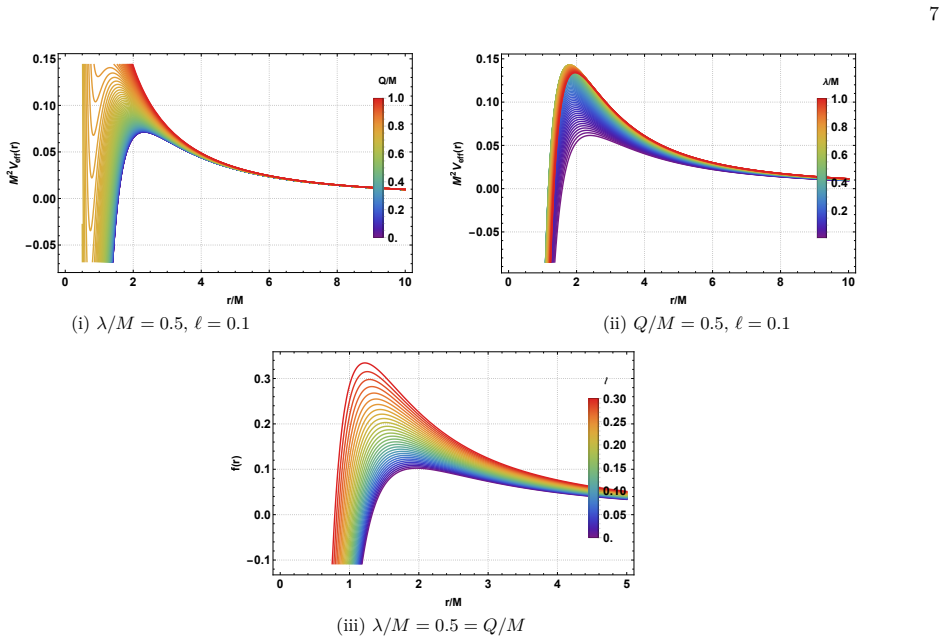
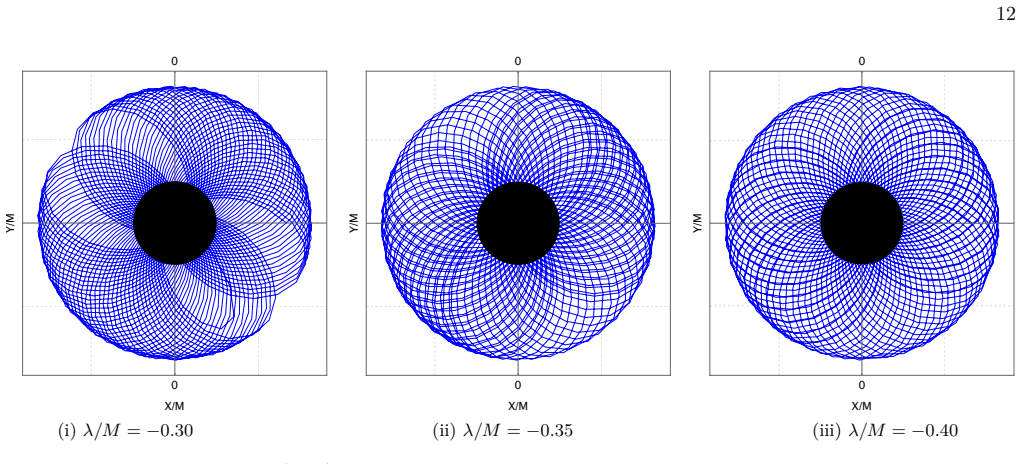
- [Figures] Figure captions for shadow and photon trajectories should specify the exact parameter values used for each curve to aid reproducibility.
Simulated Author's Rebuttal
We thank the referee for the careful reading of our manuscript and for identifying this important point about the metric derivation. We respond to the major comment below and will incorporate the requested clarification in the revised version.
read point-by-point responses
-
Referee: [Section 2] Section 2 (Metric and field equations): The line element ds² = −f(r)dt² + dr²/f(r) + r²dΩ² with f(r) encoding the KR parameter, charge Q, and PFDM density is introduced as an ansatz without explicit derivation from the KR-gravity action or verification that it solves the modified Einstein equations for the chosen Kalb-Ramond field strength and perfect-fluid equation of state. All reported results (photon-sphere radius, shadow size, ISCO, epicyclic frequencies, thermodynamic quantities, and Hawking sparsity) are computed directly from this f(r); if the ansatz is not a solution, the entire analysis applies to a spacetime outside the claimed theory.
Authors: We agree that the original manuscript introduced the metric as an ansatz without a complete, self-contained derivation from the KR-gravity action. To address this, the revised version will include an explicit verification in Section 2: we will solve the modified Einstein equations with the Kalb-Ramond field strength and the perfect-fluid dark matter stress-energy tensor, showing step-by-step that the given f(r) satisfies the field equations under the stated assumptions. This addition will confirm that the spacetime is a solution within the theory and will not alter any of the subsequent calculations, which depend only on the metric coefficients. We thank the referee for this suggestion, which improves the rigor of the presentation. revision: yes
Circularity Check
No significant circularity; analyses derive from assumed metric without reduction to inputs
full rationale
The paper takes a static spherically symmetric metric ansatz incorporating KR parameter, charge, and PFDM density as its starting point, then computes standard GR observables (photon sphere radius, shadow, ISCO, epicyclic frequencies, QPOs, thermodynamics, Hawking sparsity) via geodesic equations, effective potentials, and thermodynamic identities. These steps are direct applications of the line element and do not loop back to redefine or refit the input parameters or ansatz itself. No self-citations are invoked as load-bearing uniqueness theorems, no fitted subsets are relabeled as predictions, and no ansatz is smuggled via prior work by the same authors. The derivation chain remains self-contained against external benchmarks once the metric form is granted.
Axiom & Free-Parameter Ledger
free parameters (3)
- Kalb-Ramond coupling parameter
- Electric charge Q
- Dark matter density parameter
axioms (1)
- domain assumption The line element for charged black holes in KR-gravity with perfect fluid dark matter
Forward citations
Cited by 3 Pith papers
-
Thermodynamic and Radiative Properties of Euler-Heisenberg AdS Black Holes Surrounded by Quintessence and Dark Matter with a Cloud of Strings
Euler-Heisenberg coupling and surrounding matter fields modify the temperature profile, stability structure, and critical point location of AdS black holes, while changing Hawking radiation sparsity, photon sphere, an...
-
Black holes in general relativity coupled with NEDs surrounded by PFDM: thermodynamics, epicyclic oscillations, QPOs, and shadow
The authors calculate horizons, Hawking temperature, heat capacity, effective potentials, epicyclic frequencies, and shadows for a GR+NED+PFDM black hole, then constrain mass, magnetic charge, PFDM parameter, and orbi...
-
Shadow, Quasinormal Modes, Sparsity, and Energy Emission Rate of Euler-Heisenberg Black Hole Surrounded by Perfect Fluid Dark Matter
The perfect fluid dark matter parameter dominates the effects on shadow size, quasinormal frequencies, and energy emission rates, while the Euler-Heisenberg correction remains subleading in the explored regime.
Reference graph
Works this paper leans on
-
[1]
J. L. Synge, MNRAS131, 463 (1966)
1966
-
[2]
J. P. Luminet, A. A75, 228 (1979)
1979
-
[3]
J. M. Bardeen, inLes Astres Occlus(1973)
1973
-
[4]
Chandrasekhar,The Mathematical Theory of Black Holes(Oxford University Press, New York, 1992)
S. Chandrasekhar,The Mathematical Theory of Black Holes(Oxford University Press, New York, 1992)
1992
-
[5]
P. V. P. Cunha and C. A. R. Herdeiro, Gen. Rel. Grav.50, 42 (2018)
2018
-
[6]
Perlick and O
V. Perlick and O. Y. Tsupko, Phys. Rept.947, 1 (2022)
2022
-
[7]
S. Chen, J. Jing, W.-L. Qian, and B. Wang, Sci. China Phys. Mech. Astron.66, 260401 (2023)
2023
-
[8]
Akiyama and others (Event Horizon Telescope), Astrophys
K. Akiyama and others (Event Horizon Telescope), Astrophys. J. Lett.875, L1 (2019)
2019
-
[9]
Akiyama and others (Event Horizon Telescope), Astrophys
K. Akiyama and others (Event Horizon Telescope), Astrophys. J. Lett.875, L4 (2019)
2019
-
[10]
Akiyama and others (Event Horizon Telescope), Astrophys
K. Akiyama and others (Event Horizon Telescope), Astrophys. J. Lett.875, L6 (2019)
2019
-
[11]
Akiyama and others (Event Horizon Telescope), Astrophys
K. Akiyama and others (Event Horizon Telescope), Astrophys. J. Lett.930, L12 (2022)
2022
-
[12]
Akiyama and others (Event Horizon Telescope), Astrophys
K. Akiyama and others (Event Horizon Telescope), Astrophys. J. Lett.930, L14 (2022)
2022
-
[13]
Akiyama and others (Event Horizon Telescope), Astrophys
K. Akiyama and others (Event Horizon Telescope), Astrophys. J. Lett.930, L16 (2022)
2022
-
[14]
Akiyama and others (Event Horizon Telescope), Astrophys
K. Akiyama and others (Event Horizon Telescope), Astrophys. J. Lett.930, L17 (2022)
2022
-
[15]
S. E. Gralla, D. E. Holz, and R. M. Wald, Phys. Rev. D100, 024018 (2019)
2019
-
[16]
Zeng, C.-Y
X.-X. Zeng, C.-Y. Yang, M. I. Aslam, R. Saleem, and S. Aslam, JCAP2025(08), 066
-
[17]
Kalb and P
M. Kalb and P. Ramond, Phys. Rev. D9, 2273 (1974)
1974
-
[18]
D. J. Gross, J. A. Harvey, E. J. Martinec, and R. Rohm, Phys. Rev. Lett.54, 502 (1985). 32
1985
-
[19]
Altschul, Q
B. Altschul, Q. G. Bailey, and V. A. Kostelecký, Phys. Rev. D81, 065028 (2010)
2010
-
[20]
Atamurotov, D
F. Atamurotov, D. Ortiqboev, A. Abdujabbarov,et al., Eur. Phys. J C82, 659 (2022)
2022
-
[21]
F. Ahmed, İ. Sakallı, and A. Al-Badawi, Int. J Geom. Meth. Mod. Phys. 10.1142/S0219887826501823 (2026)
-
[22]
Yang, Y.-Z
K. Yang, Y.-Z. Chen, Z.-Q. Duan, and J.-Y. Zhao, Phys. Rev. D108, 124004 (2023)
2023
-
[23]
W. Liu, D. Wu, and J. Wang, JCAP2024(09), 017
-
[24]
Z. Q. Duan, J. Y. Zhao, and K. Yang, Eur. Phys. J C84, 798 (2024)
2024
-
[25]
Ahmed, A
F. Ahmed, A. Al-Badawi, and ızzet Sakallı, Mod. Phys. Lett. A41, 2650061 (2026)
2026
-
[26]
Al-Badawi, F
A. Al-Badawi, F. Ahmed, and ızzet Sakallı, Phys. Dark Univ.50, 102076 (2025)
2025
- [27]
- [28]
-
[29]
L. A. Lessa, J. E. G. Silva, R. V. Maluf,et al., Eur. Phys. J C80, 335 (2020)
2020
-
[30]
Sucu and İ
E. Sucu and İ. Sakallı, Nucl. Phys. B1018, 117081 (2025)
2025
-
[31]
Baruah, Y
A. Baruah, Y. Sekhmani, S. K. Maurya, A. Deshamukhya, and M. K. Jasim, JCAP2025(08), 023
-
[32]
F. M. Belchior, R. V. Maluf, A. Y. Petrov,et al., Eur. Phys. J C85, 658 (2025)
2025
-
[33]
Fathi and A
M. Fathi and A. Øvgün, Eur. Phys. J Plus140, 280 (2025)
2025
- [34]
- [35]
-
[36]
S. K. Jha, JCAP2025(09), 069
-
[37]
Jumaniyozov, S
S. Jumaniyozov, S. Murodov, J. Rayimbaev, I. Ibragimov, B. Madaminov, S. Urinbaev, and A. Abdujabbarov, Eur. Phys. J. C85, 797 (2025)
2025
-
[38]
V. C. Rubin, W. K. Ford, and N. Thonnard, Astrophys. J238, 471 (1980)
1980
-
[39]
P. J. E. Peebles, Astrophys. J. Lett.263, L1 (1982)
1982
-
[40]
Persic, P
M. Persic, P. Salucci, and F. Stel, MNRAS281, 27 (1996)
1996
-
[41]
Sofue, inPlanets, Stars and Stellar Systems
Y. Sofue, inPlanets, Stars and Stellar Systems. Volume 5: Galactic Structure and Stellar Populations, Vol. 5, edited by T. D. Oswalt and G. Gilmore (Springer, 2013) pp. 985–1037
2013
-
[42]
Boshkayev and D
K. Boshkayev and D. Malafarina, MNRAS484, 3325 (2019)
2019
-
[43]
R. A. Konoplya and A. Zhidenko, Astrophys. J933, 166 (2022)
2022
-
[44]
V. V. Kiselev, (2003), arXiv:gr-qc/0303031 [gr-qc]
work page internal anchor Pith review arXiv 2003
-
[45]
S. H. Hendi, A. Nemati, K. Lin, and M. Jamil, Eur. Phys. J C80, 296 (2020)
2020
-
[46]
Liang, Y.-P
X. Liang, Y.-P. Hu, C.-H. Wu, and Y.-S. An, Eur. Phys. J C83, 1009 (2023)
2023
-
[47]
Angelini, L
L. Angelini, L. Stella, and A. N. Parmar, Astrophys. J.346, 906 (1989)
1989
-
[48]
Verbunt, Ann
F. Verbunt, Ann. Rev. Astron. Astrophys.31, 93 (1993)
1993
-
[49]
T. M. Belloni, A. Sanna, and M. Méndez, MNRAS426, 1701 (2012)
2012
-
[50]
Rayimbaev, A
J. Rayimbaev, A. Abdujabbarov, F. Abdulkhamidov, V. Khamidov, S. Djumanov, J. Toshov, and S. Inoyatov, Eur. Phys. J C82, 1110 (2022)
2022
-
[51]
Rayimbaev, A
J. Rayimbaev, A. H. Bokhari, and B. Ahmedov, Class. Quantum Grav.39, 075021 (2022)
2022
-
[52]
M. Qi, J. Rayimbaev, and B. Ahmedov, Eur. Phys. J C83, 730 (2023)
2023
-
[53]
Rayimbaev, K
J. Rayimbaev, K. F. Dialektopoulos, F. Sarikulov, and A. Abdujabbarov, Eur. Phys. J C83, 572 (2023)
2023
-
[54]
Rayimbaev, B
J. Rayimbaev, B. Majeed, M. Jamil, K. Jusufi, and A. Wang, Phys. Dark Univ.35, 100930 (2022)
2022
-
[55]
Rayimbaev, F
J. Rayimbaev, F. Abdulxamidov, S. Tojiev, A. Abdujabbarov, and F. Holmurodov, Galaxies11, 95 (2023)
2023
-
[56]
Rayimbaev, A
J. Rayimbaev, A. Abdujabbarov, and H. Wen-Biao, Phys. Rev. D103, 104070 (2021)
2021
-
[57]
Rayimbaev, B
J. Rayimbaev, B. Ahmedov, and A. H. Bokhari, Int. J Mod. Phys. D31, 2240004 (2022)
2022
-
[58]
Murodov, J
S. Murodov, J. Rayimbaev, B. Ahmedov, and E. Karimbaev, Universe9, 391 (2023)
2023
-
[59]
Rayimbaev, R
J. Rayimbaev, R. C. Pantig, A. Övgün, A. Abdujabbarov, and D. Demir, Ann. Phys. (NY)454, 169335 (2023)
2023
-
[60]
Rayimbaev, S
J. Rayimbaev, S. Murodov, A. Shermatov, and A. Yusupov, Eur. Phys. J C84, 1114 (2024)
2024
-
[61]
Shermatov, J
A. Shermatov, J. Rayimbaev, B. C. Lütfüoğlu,et al., Eur. Phys. J C85, 1017 (2025)
2025
-
[62]
Gao and X.-M
B. Gao and X.-M. Deng, Eur. Phys. J C81, 983 (2021)
2021
-
[63]
J. D. Bekenstein, Phys. Rev. D7, 2333 (1973)
1973
-
[64]
S. W. Hawking, Commun. Math. Phys.43, 199 (1975), erratum: Commun. Math. Phys. 46, 206 (1976)
1975
-
[65]
J. M. Bardeen, B. Carter, and S. W. Hawking, Commun. Math. Phys.31, 161 (1973)
1973
-
[66]
D. W. Sciama, Vistas in Astronomy19, 385 (1976)
1976
-
[67]
P. C. W. Davies, Rep. Prog. Phys.41, 1313 (1978)
1978
-
[68]
P. T. Landsberg, inBlack Hole Physics, NATO ASI Series, Vol. 364, edited by V. De Sabbata and Z. Zhang (Springer, Dordrecht, 1992)
1992
-
[69]
S. A. Hayward, Phys. Rev. D49, 6467 (1994)
1994
-
[70]
Ashtekar and B
A. Ashtekar and B. Krishnan, Living Rev. Rel.7, 10 (2004)
2004
-
[71]
Duan, J.-Y
Z.-Q. Duan, J.-Y. Zhao, and K. Yang, Eur. Phys. J C84, 798 (2024)
2024
-
[72]
M. H. Li and K. C. Yang, Phys. Rev. D86, 123015 (2012)
2012
-
[73]
Sadeghi and S
J. Sadeghi and S. N. Gashti, Phys. Lett. B853, 138651 (2024)
2024
-
[74]
Török and Z
G. Török and Z. Stuchlík, Astron. Astrophys.437, 775 (2005)
2005
-
[75]
Stuchlík, A
Z. Stuchlík, A. Kotrlová, and G. Török, Astron. Astrophys.552, A10 (2013)
2013
-
[76]
Kološ, Z
M. Kološ, Z. Stuchlík, and A. Tursunov, Class. Quantum Grav.32, 165009 (2015)
2015
-
[77]
Tursunov, Z
A. Tursunov, Z. Stuchlík, and M. Kološ, Phys. Rev. D93, 084012 (2016)
2016
-
[78]
Stuchlík and M
Z. Stuchlík and M. Kološ, Eur. Phys. J. C76, 32 (2016). 33
2016
-
[80]
Stuchlík and J
Z. Stuchlík and J. Vrba, JCAP2021(11), 059
-
[81]
Stuchlík and J
Z. Stuchlík and J. Vrba, Universe7, 279 (2021)
2021
discussion (0)
Sign in with ORCID, Apple, or X to comment. Anyone can read and Pith papers without signing in.