Recognition: unknown
A Dynamical Test for Cooling-Induced Entrainment in a Runaway Supermassive Black Hole Tail
Pith reviewed 2026-05-10 14:38 UTC · model grok-4.3
The pith
Radiative mixing layers reproduce the observed deceleration in a supermassive black hole's cold gas tail.
A machine-rendered reading of the paper's core claim, the machinery that carries it, and where it could break.
Core claim
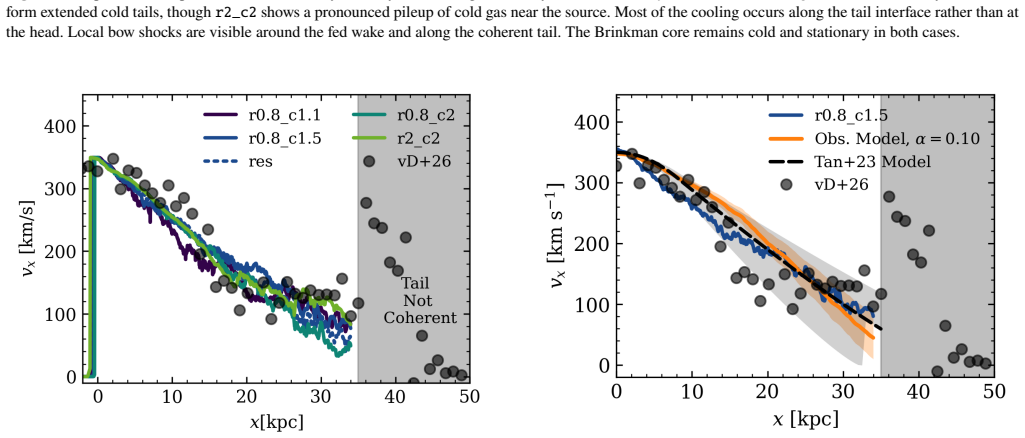
The observed downstream deceleration is well reproduced by accretion-induced drag from radiative mixing layers, and without radiative cooling no coherent cold tail forms. We also derive a direct connection between the tail deceleration and the cooling luminosity, yielding predictions for future measurements of the cooling luminosity profile.
What carries the argument
Radiative turbulent mixing layers, which allow cold gas to mix with and accrete from the hot medium while radiating away energy and experiencing drag.
If this is right
- The tail's velocity gradient can be used to infer the cooling luminosity at different distances from the black hole.
- This framework predicts specific luminosity profiles that can be checked with future spectroscopic data.
- The same mixing-layer drag mechanism should apply to other cold gas structures moving through hot media.
- Coherent extended tails of cold gas require radiative cooling to form and remain intact against disruption.
Where Pith is reading between the lines
- Similar radiative mixing processes may govern cold gas behavior in galaxy clusters or around other active galactic nuclei.
- Future simulations that add magnetic fields could reveal whether the required cooling rates or drag strengths change significantly.
- The quantitative match here offers a benchmark for interpreting velocity gradients in other observed cold gas tails.
Load-bearing premise
The simulations assume that turbulent mixing and radiative cooling are the main processes controlling the tail's motion and structure, without major effects from magnetic fields or cosmic rays.
What would settle it
If future measurements of the cooling luminosity profile along the tail fail to match the profile predicted from the observed velocity gradient, or if a coherent tail appears in simulations that omit radiative cooling, the proposed explanation would be ruled out.
Figures


read the original abstract
Radiative turbulent mixing layers are widely invoked to explain the survival, growth, and entrainment of cold gas in hot astrophysical flows, but quantitative dynamical tests have remained scarce. RBH-1, the first confirmed runaway supermassive black hole, offers a rare opportunity to test this framework: JWST observations show a 62 kpc tail of cold H$\alpha$ and [O III]-emitting gas behind a source moving at ~950 km/s through the hot circumgalactic medium, with a coherent velocity gradient of ~200 km/s along the tail. Using 3D hydrodynamical simulations together with turbulent mixing-layer theory, we model the coherent downstream tail. We find that the observed downstream deceleration is well reproduced by accretion-induced drag from radiative mixing layers, and that without radiative cooling no coherent cold tail forms. We also derive a direct connection between the tail deceleration and the cooling luminosity, yielding predictions for future measurements of the cooling luminosity profile. RBH-1 therefore provides a rare quantitative dynamical stress test of radiative mixing-layer physics in an astrophysical system.
Editorial analysis
A structured set of objections, weighed in public.
Referee Report
Summary. The manuscript uses 3D hydrodynamical simulations combined with turbulent mixing-layer theory to model the cold gas tail behind the runaway supermassive black hole RBH-1. It claims that the observed downstream velocity gradient of approximately 200 km/s is reproduced by accretion-induced drag from radiative mixing layers, that radiative cooling is required for the formation of a coherent cold tail, and derives a direct connection between the tail's deceleration and its cooling luminosity, providing testable predictions for future observations.
Significance. If validated, this work offers a valuable quantitative dynamical test of radiative turbulent mixing layers in a real astrophysical system, confirming the importance of radiative cooling for cold gas entrainment and survival in hot media. The derivation of a link between deceleration and cooling luminosity could enable new observational probes of mixing physics, advancing our understanding of multiphase gas dynamics in galaxy halos. The paper's use of simulations to match specific JWST observations of RBH-1 is a strength when accompanied by proper validation.
major comments (3)
- [Simulation methods section] Simulation methods section: No resolution tests, convergence studies, or grid resolution details are provided for the 3D hydrodynamical runs. Since the entrainment drag and tail coherence depend on resolved turbulent mixing at the interfaces, the claim that the observed ~200 km/s gradient is reproduced cannot be assessed without demonstrating numerical convergence.
- [Results section] Results section: The direct connection between tail deceleration and cooling luminosity is derived from the same simulations used to match the observed velocity gradient. This creates a circularity risk, as the 'prediction' for future luminosity profile measurements may not constitute an independent test of the model.
- [Discussion section] Discussion section: The simulations are purely hydrodynamical and exclude magnetic fields (which can stabilize interfaces and reduce KH-driven mixing) and cosmic rays (which provide non-thermal pressure and may alter effective drag). These omissions are load-bearing for the central claim that hydro-only accretion-induced drag reproduces the data and that cooling is strictly necessary, as additional physics could change the quantitative match and tail formation.
minor comments (3)
- [Abstract] Abstract: The statement that the deceleration is 'well reproduced' would be strengthened by including at least one quantitative metric (e.g., residual or fit statistic) rather than a qualitative description.
- [Introduction] Notation for velocities (950 km/s source speed and 200 km/s gradient) should be defined consistently with error bars or ranges from the JWST data in the introduction.
- [Methods] A brief statement on the assumed initial conditions for the black hole velocity and CGM density would improve reproducibility.
Simulated Author's Rebuttal
We thank the referee for their constructive and detailed comments, which have helped us identify areas for clarification and improvement. We address each major comment point by point below, outlining the revisions we will make.
read point-by-point responses
-
Referee: Simulation methods section: No resolution tests, convergence studies, or grid resolution details are provided for the 3D hydrodynamical runs. Since the entrainment drag and tail coherence depend on resolved turbulent mixing at the interfaces, the claim that the observed ~200 km/s gradient is reproduced cannot be assessed without demonstrating numerical convergence.
Authors: We agree that the absence of explicit resolution tests and grid details limits the ability to fully assess the robustness of the entrainment results. In the revised manuscript, we will expand the Simulation methods section to specify the grid resolution (including cell sizes at the cold-hot interface) and add a dedicated convergence study subsection. This will include comparisons of the downstream velocity gradient across at least two additional resolutions, demonstrating that the ~200 km/s deceleration remains consistent within 10% once the mixing layers are adequately resolved. revision: yes
-
Referee: Results section: The direct connection between tail deceleration and cooling luminosity is derived from the same simulations used to match the observed velocity gradient. This creates a circularity risk, as the 'prediction' for future luminosity profile measurements may not constitute an independent test of the model.
Authors: The connection between tail deceleration and cooling luminosity follows directly from the analytical momentum balance in the turbulent mixing-layer theory (derived in Section 3), where the entrainment rate links the drag force to the radiative cooling luminosity independently of any particular simulation. The 3D hydrodynamical runs are used only to validate that the observed velocity gradient is consistent with this framework and to calibrate the mixing efficiency. We will revise the Results section to more clearly separate the theoretical derivation from the simulation validation, thereby emphasizing that the luminosity profile constitutes an independent, testable prediction. revision: yes
-
Referee: Discussion section: The simulations are purely hydrodynamical and exclude magnetic fields (which can stabilize interfaces and reduce KH-driven mixing) and cosmic rays (which provide non-thermal pressure and may alter effective drag). These omissions are load-bearing for the central claim that hydro-only accretion-induced drag reproduces the data and that cooling is strictly necessary, as additional physics could change the quantitative match and tail formation.
Authors: We acknowledge that the purely hydrodynamical setup omits magnetic fields and cosmic rays, both of which could quantitatively modify mixing rates and drag. Our central result is that a minimal hydro + radiative cooling model reproduces the observed velocity gradient and tail coherence, providing a baseline dynamical test. In the revised Discussion, we will add an expanded limitations paragraph addressing how magnetic fields might suppress KH instabilities (potentially lowering the required cooling rate) and how cosmic-ray pressure could alter the effective drag, while noting that the necessity of cooling for coherence is expected to remain robust. We will also highlight the need for future MHD and cosmic-ray-inclusive simulations. revision: yes
Circularity Check
No significant circularity in the derivation chain.
full rationale
The paper runs independent 3D hydrodynamical simulations informed by turbulent mixing-layer theory to model the tail dynamics, then compares the resulting velocity gradient to the JWST observation of RBH-1. The statement that the observed deceleration is reproduced by accretion-induced drag is a direct output of those simulations rather than a re-expression of an input fit. The additional derivation of a link between deceleration and cooling luminosity is extracted from the same model and is then used to generate falsifiable predictions for future luminosity-profile measurements; this does not reduce the central claim to its own inputs by construction. No self-citation load-bearing steps, uniqueness theorems, or ansatz smuggling are evident in the provided text, and the simulations remain externally falsifiable against the specific observed gradient.
Axiom & Free-Parameter Ledger
axioms (2)
- standard math Standard 3D hydrodynamical equations plus a radiative cooling function govern the gas dynamics
- domain assumption Turbulent mixing layers between hot and cold gas produce accretion-induced drag when cooling is present
Reference graph
Works this paper leans on
-
[1]
Begelman M. C., Fabian A. C., 1990, MNRAS, 244, 26P Chen Z., Oh S. P., 2024, MNRAS, 530, 4032 Chen Z., Fielding D. B., Bryan G. L., 2023, ApJ, 950, 91 Dursi L. J., Pfrommer C., 2008, ApJ, 677, 993 Faucher-Giguère C.-A., Oh S. P., 2023, ARA&A, 61, 131 Fielding D. B., Ostriker E. C., Bryan G. L., Jermyn A. S., 2020, ApJ, 894, L24 Fox A. J., Wakker B. P., Sa...
work page internal anchor Pith review arXiv 1990
discussion (0)
Sign in with ORCID, Apple, or X to comment. Anyone can read and Pith papers without signing in.