Recognition: 2 theorem links
· Lean TheoremInvestigating the Circumgalactic Medium through Mg II absorption coincidence
Pith reviewed 2026-05-11 01:49 UTC · model grok-4.3
The pith
Mg II absorption coincidence in quasar pairs shows a sharp transition at 100 kpc from halo gas to galaxy clustering.
A machine-rendered reading of the paper's core claim, the machinery that carries it, and where it could break.
Core claim
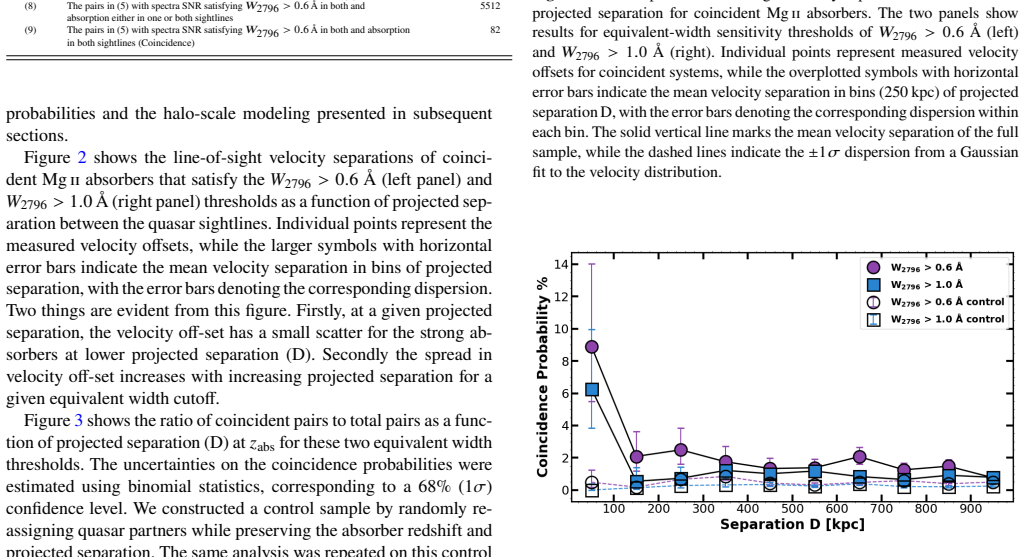
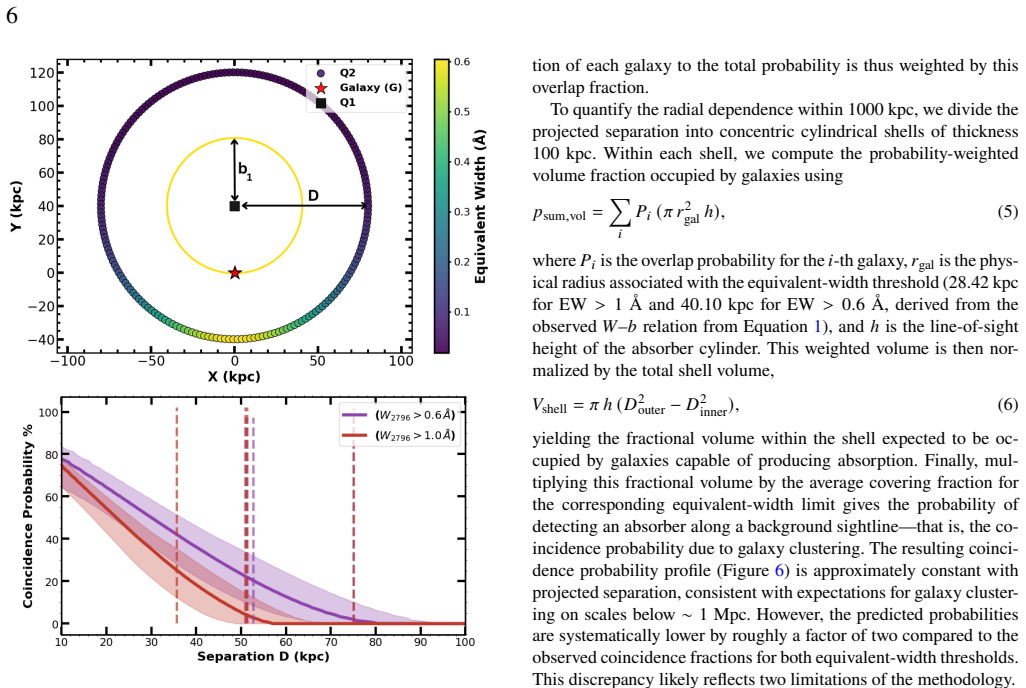
Using a sample of 9204 absorber-centric quasar sightline pairs from the Sloan Digital Sky Survey, the coincidence probability of Mg II absorbers rises steeply to 5-8% at projected separations below 100 kpc, declines rapidly beyond this scale, and settles into a 1-2% plateau out to 1 Mpc. A simple geometrical single-halo model reproduces the small-scale enhancement while galaxy clustering, confirmed via photometric counts and the two-point correlation function, explains the large-scale plateau. Complementary stacking of paired sightlines lacking individual detections reveals a significant excess in Mg II equivalent width, implying a coherence scale of 100-200 kpc for the cool, metal-enriched
What carries the argument
the coincidence probability of Mg II absorbers as a function of projected separation between quasar sightlines
If this is right
- The cool circumgalactic medium maintains coherent Mg II absorption on scales of 100-200 kpc.
- Small separations are dominated by single-halo gas while separations beyond 100 kpc reflect galaxy clustering.
- Stacking analysis can reveal weak CGM signals even in sightlines without individual absorber detections.
- These statistical measurements connect small-scale lensing constraints to megaparsec-scale absorber clustering studies.
Where Pith is reading between the lines
- The same coincidence method could be applied to other absorption lines to compare coherence scales across different CGM phases.
- Larger samples from future surveys could pinpoint the exact transition radius between the halo and clustering regimes.
- Statistical detection via stacking may allow CGM studies even in regions where individual absorbers fall below the detection threshold.
Load-bearing premise
The Mg II absorbers are physically associated with the circumgalactic medium of individual galaxies rather than unrelated structures or selection effects.
What would settle it
An independent measurement showing no rise in coincidence probability above 2% at separations below 100 kpc, or no excess equivalent width in stacked non-detections at 150 kpc, would falsify the claimed two-regime structure and 100-200 kpc coherence scale.
Figures




read the original abstract
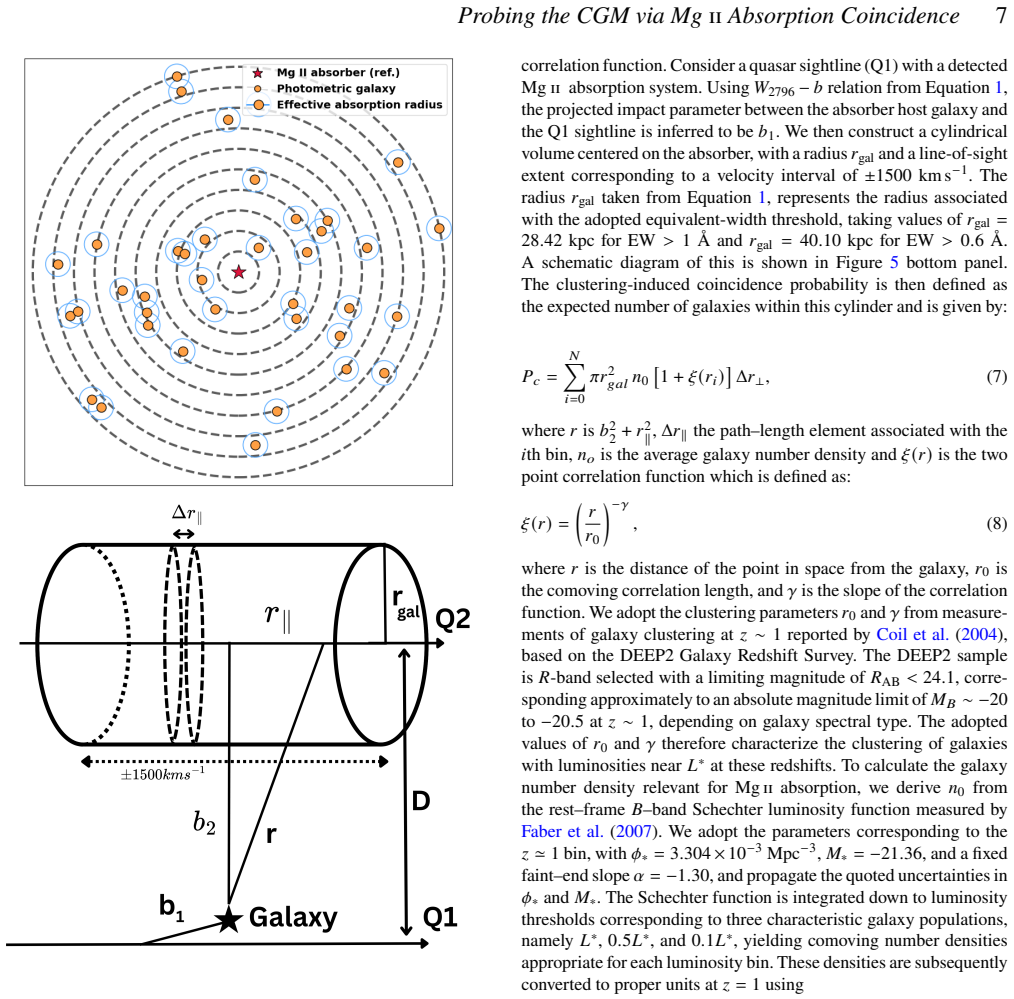
We present a statistical measurement of the transverse coherence of Mg II $\lambda\lambda2796,2803$ absorption using a large sample of 9204 absorber-centric quasar sightline pairs from the Sloan Digital Sky Survey. We quantify the probability that an Mg II absorber detected along one sightline is also present along a nearby sightline, and measure how this coincidence probability varies with projected separation from $\sim$50 kpc to $\sim$1 Mpc. The resulting coincidence curve exhibits a clear two-regime structure: the coincidence probability rises steeply to $\sim$5-8% at separations below $\sim$100 kpc, but declines rapidly beyond this scale and settles into a low plateau of $\sim$1--2% out to $\sim$1 Mpc. A simple geometrical single-halo model reproduces the enhanced probability at $\lesssim$100 kpc, while the large-scale plateau is well explained by the expected contribution from galaxy clustering, confirmed using both photometric galaxy counts and the two-point correlation function. A complementary stacking analysis reveals a significant excess in Mg II equivalent width in paired sightlines lacking individual detections, implying a coherence scale of $\sim$100-200 kpc for the cool, metal-enriched CGM. Together, these results identify the transition from a halo-dominated coherence regime at small separations to a clustering-dominated regime at large scales, bridging the gap between small-scale lensing constraints and megaparsec-scale absorber clustering studies.
Editorial analysis
A structured set of objections, weighed in public.
Referee Report
Summary. The manuscript reports a statistical measurement of Mg II absorber coincidence probability using 9204 absorber-centric quasar sightline pairs from SDSS, as a function of projected separation from ~50 kpc to ~1 Mpc. It identifies a two-regime structure with a steep rise to 5-8% below ~100 kpc (reproduced by a geometrical single-halo model) and a 1-2% plateau at larger scales (attributed to galaxy clustering, validated via photometric counts and the two-point correlation function). A stacking analysis of non-detections shows excess equivalent width, implying a ~100-200 kpc coherence scale for the cool, metal-enriched CGM.
Significance. If the results hold, this provides a useful empirical bridge between small-scale CGM constraints and large-scale absorber clustering, leveraging a large sample and complementary coincidence plus stacking approaches. The independent checks on the large-scale plateau using galaxy correlation functions and counts are a strength, as is the identification of a clear transition scale.
major comments (2)
- [Geometrical single-halo model and results on coincidence curve] The central claim that the geometrical single-halo model cleanly reproduces the small-scale (≲100 kpc) coincidence rise while the plateau is purely from clustering requires explicit validation that the model excludes or accounts for absorber-galaxy cross-correlation and filamentary contributions at the 50-200 kpc transition. Without this, the stacking excess in non-detections could be contaminated, undermining the inferred 100-200 kpc coherence scale.
- [Methods and data description] The abstract and summary provide no details on pair selection criteria for the 9204 sightlines, error budgets on the coincidence probabilities, or the precise implementation of the stacking analysis on non-detections. These are load-bearing for confirming the two-regime structure is not driven by post-hoc choices or unaccounted systematics.
minor comments (2)
- [Abstract] The abstract refers to the model as 'simple' and 'geometrical' without outlining its key assumptions (e.g., halo radius, covering fraction); adding a one-sentence summary or pointer to the methods would aid readability.
- [Figures] Figures showing the coincidence curve should explicitly overlay the model prediction, clustering expectation, and data points with uncertainties for direct visual comparison.
Simulated Author's Rebuttal
We thank the referee for their constructive comments, which have prompted us to strengthen the validation of our model and clarify our methods. We respond to each major comment below and have revised the manuscript accordingly where appropriate.
read point-by-point responses
-
Referee: The central claim that the geometrical single-halo model cleanly reproduces the small-scale (≲100 kpc) coincidence rise while the plateau is purely from clustering requires explicit validation that the model excludes or accounts for absorber-galaxy cross-correlation and filamentary contributions at the 50-200 kpc transition. Without this, the stacking excess in non-detections could be contaminated, undermining the inferred 100-200 kpc coherence scale.
Authors: Our geometrical single-halo model is constructed purely from the radial distribution of absorbers within individual halos and contains no terms for inter-halo absorber-galaxy cross-correlations or filaments; those contributions are instead modeled separately via the observed galaxy two-point correlation function and photometric counts that reproduce the large-scale plateau. We have added explicit text and a supplementary comparison in the revised manuscript demonstrating that the single-halo prediction matches the data to within uncertainties at 50-100 kpc without requiring additional cross terms, while any filamentary contribution would produce a smoother transition inconsistent with the sharp break we observe. For the stacking analysis, the non-detections are drawn from pairs spanning the full range but the excess equivalent width remains significant even when restricted to >150 kpc pairs, supporting the reported coherence scale. We therefore make a partial revision by adding this validation discussion and a brief robustness test. revision: partial
-
Referee: The abstract and summary provide no details on pair selection criteria for the 9204 sightlines, error budgets on the coincidence probabilities, or the precise implementation of the stacking analysis on non-detections. These are load-bearing for confirming the two-regime structure is not driven by post-hoc choices or unaccounted systematics.
Authors: The full methods section of the manuscript details the absorber-centric pair selection (Mg II systems from SDSS DR7/DR12 with velocity and redshift cuts, quasar sightlines within 1 Mpc projected separation), the coincidence probability calculation with Poisson and bootstrap error estimates, and the stacking procedure (continuum-normalized spectra shifted to the absorber redshift, averaged in the Mg II rest frame for non-detections with propagated uncertainties). To improve accessibility we have expanded the abstract with a brief methods clause and added a summary table of selection criteria and error methods. This constitutes a yes revision. revision: yes
Circularity Check
No significant circularity; derivation relies on direct observations and external cross-checks
full rationale
The paper measures coincidence probability directly from 9204 SDSS absorber-centric quasar pairs as a function of projected separation, yielding an observed two-regime curve. The small-scale rise is reproduced by a simple geometrical single-halo model whose construction is not shown to be fitted to the coincidence data itself. The large-scale plateau is compared to independent galaxy two-point correlation functions and photometric counts rather than being derived from the absorber sample. The stacking analysis on non-detections is presented as complementary and does not reduce to the same inputs. No self-citations, self-definitional steps, or fitted inputs renamed as predictions appear in the provided text. The chain is therefore self-contained against external benchmarks.
Axiom & Free-Parameter Ledger
axioms (2)
- domain assumption Mg II absorbers trace cool, metal-enriched gas physically associated with galaxy circumgalactic media
- domain assumption Quasar sightlines are otherwise independent except for the projected separation geometry
Lean theorems connected to this paper
-
IndisputableMonolith/Cost/FunctionalEquation.leanwashburn_uniqueness_aczel unclear?
unclearRelation between the paper passage and the cited Recognition theorem.
A simple geometrical single-halo model reproduces the enhanced probability at ≲100 kpc, while the large-scale plateau is well explained by the expected contribution from galaxy clustering, confirmed using both photometric galaxy counts and the two-point correlation function.
-
IndisputableMonolith/Foundation/AlexanderDuality.leanalexander_duality_circle_linking unclear?
unclearRelation between the paper passage and the cited Recognition theorem.
The coincidence probability rises steeply to ~5–8% at separations below ~100 kpc, but declines rapidly beyond this scale and settles into a low plateau of ~1–2% out to ~1 Mpc.
What do these tags mean?
- matches
- The paper's claim is directly supported by a theorem in the formal canon.
- supports
- The theorem supports part of the paper's argument, but the paper may add assumptions or extra steps.
- extends
- The paper goes beyond the formal theorem; the theorem is a base layer rather than the whole result.
- uses
- The paper appears to rely on the theorem as machinery.
- contradicts
- The paper's claim conflicts with a theorem or certificate in the canon.
- unclear
- Pith found a possible connection, but the passage is too broad, indirect, or ambiguous to say the theorem truly supports the claim.
Reference graph
Works this paper leans on
-
[1]
T., Péroux C., 2004, MNRAS, 354, L25 Burbidge E
Afruni A., et al., 2023, A&A, 680, A112 Anand A., Nelson D., Kauffmann G., 2021, MNRAS, 504, 65 Augustin R., Péroux C., Hamanowicz A., Kulkarni V., Rahmani H., Zanella A., 2021, MNRAS, 505, 6195 Bergeron J., Boissé P., 1991, A&A, 243, 344 Bouché N., Murphy M. T., Péroux C., 2004, MNRAS, 354, L25 Burbidge E. M., 1967, ARA&A, 5, 399 Burbidge E. M., Lynds C....
work page internal anchor Pith review doi:10.48550/arxiv.astro-ph/9509098 2023
discussion (0)
Sign in with ORCID, Apple, or X to comment. Anyone can read and Pith papers without signing in.