Euclid: Quick Data Release (Q1) -- Dual AGN in low-mass galaxies
00014 Helsinki, 00044 Frascati, 00078 Monteporzio Catone, 00100 Roma, 00133 Roma, 00146 Rome, 00185 Roma, 0315 Oslo, 077125, 08010 Barcelona, 08028 Barcelona, 08193 Barcelona, 08193 Bellaterra (Barcelona), 08860 Castelldefels, 1), 10), 100, 100), 10025 Pino Torinese (TO), (100) Niels Bohr Institute, 10125 Torino, (101) Universidad Polit\'ecnica de Cartagena, 102), (102) INFN-Bologna, (103) Astronomisches Rechen-Institut, (104) Instituto de F\'isica Te\'orica UAM-CSIC, 105, (105) Universit\'e PSL, 106), (106) Universit\'e Paris-Cit\'e, (107) Univ. Grenoble Alpes, (108) Aurora Technology for European Space Agency (ESA), 109) ((1) Institute of Space Sciences (ICE, (109) ICL, (10) Institut de Ciencies de l'Espai (IEEC-CSIC), 115 South 1400 East, (11) Department of Mathematics, 12), 1200 E. California Blvd., 1290 Versoix, (12) INAF-Osservatorio Astronomico di Roma, 1349-018 Lisboa, (13) School of Physics, 14), 14 Av. Edouard Belin, (14) Leiden Observatory, (15) INAF-Osservatorio Astronomico di Padova, 16), (16) Universit\"ats-Sternwarte M\"unchen, (17) Instituto de F\'isica de Cantabria, 18, 18), 18 avenue Edouard Belin, (18) INAF-Osservatorio di Astrofisica e Scienza dello Spazio di Bologna, (19) Institute of Theoretical Astrophysics, 2, 2), 20122 Milano, 20133 Milano, (20) INAF-Istituto di Astrofisica e Planetologia Spaziali, 21 avenue Pierre de Coubertin 69627 Villeurbanne Cedex, (21) School of Physics \& Astronomy, 2200 Copenhagen, 2201 AZ Noordwijk, (22) Jet Propulsion Laboratory, 2333 CC Leiden, (23) Department of Physics, (24) Department of Physics, 24 quai Ernest-Ansermet, 25, (25) Department of Astronomy, 26), 2680 Woodlawn Drive, (26) ESAC/ESA, (27) INAF-Osservatorio Astronomico di Brera, 2800 Kgs. Lyngby, 28040 Madrid, 28049 Madrid, 28692 Madrid, 28692 Villanueva de la Ca\~nada, (28) Dipartimento di Fisica e Astronomia, 29), (29) INFN-Sezione di Bologna, 2 - c/o Dipartimento di Fisica, (2) Institut d'Estudis Espacials de Catalunya (IEEC), 3), 30), 30202 Cartagena, (30) INAF-Osservatorio Astronomico di Trieste, 31), 31400 Toulouse, 31401 Toulouse Cedex 9, (31) IFPU, (32) Department of Physics "E. Pancini", (33) Dipartimento di Fisica, 34, 34143 Trieste, 34151 Trieste, (34) INFN-Sezione di Torino, 35), 35122 Padova, 35131 Padova, (35) INAF-Osservatorio Astrofisico di Torino, (36) Institute for Astronomy, 37, (37) INAF-IASF Milano, 38), 38000, (38) Centro de Investigaciones Energ\'eticas, 39), 39005 Santander, (39) Port d'Informaci\'o Cient\'ifica, (3) INAF-Osservatorio Astronomico di Capodimonte, 4), 40), 40126 Bologna, 40127 Bologna, 40129 Bologna, (40) INFN section of Naples, (41) Institute for Astronomy, (42) Dipartimento di Fisica e Astronomia "Augusto Righi" - Alma Mater Studiorum Universit\`a di Bologna, (43) Jodrell Bank Centre for Astrophysics, (44) European Space Agency/ESRIN, (45) Universit\'e Claude Bernard Lyon 1, (46) Institut de Ci\`encies del Cosmos (ICCUB), 47, (47) Instituci\'o Catalana de Recerca i Estudis Avan\c{c}ats (ICREA), 4800 Oak Grove Drive, (48) UCB Lyon 1, (49) Mullard Space Science Laboratory, (4) Max Planck Institute for Extraterrestrial Physics, 4 rue Enrico Fermi, 5, 50019 Sesto Fiorentino, 50125, (50) Universit\'e Paris-Saclay, 51), (51) Space Science Data Center, (52) University Observatory, 53, 53121 Bonn, (53) Department of Physics, (54) Felix Hormuth Engineering, (55) Technical University of Denmark, 56), (56) Cosmic Dawn Center (DAWN), (57) Max-Planck-Institut f\"ur Astronomie, (58) NASA Goddard Space Flight Center, 59000 Lille, (59) Aix-Marseille Universit\'e, (5) Dipartimento di Fisica e Astronomia, 5 Rue Thomas Mann, 6, (60) Universit\'e de Gen\`eve, (61) Department of Physics, 62), (62) Helsinki Institute of Physics, (63) Laboratoire d'etude de l'Univers et des phenomenes eXtremes, (64) SKAO, (65) Centre de Calcul de l'IN2P3/CNRS, (66) Dipartimento di Fisica "Aldo Pontremoli", 67), (67) INFN-Sezione di Milano, (68) Universit\"at Bonn, 69), 69117 Heidelberg, 69120 Heidelberg, 69181 Leimen, 69622 Villeurbanne, (69) INFN-Sezione di Roma, (6) University of Trento, 7), (70) Aix-Marseille Universit\'e, (71) Dipartimento di Fisica e Astronomia "Augusto Righi" - Alma Mater Studiorum Universit\`a di Bologna, (72) Department of Physics, (73) Universit\'e Paris Cit\'e, 74), (74) CNRS-UCB International Research Laboratory, 75013, 75013 Paris, 75014, 75014 Paris, (75) Institut d'Astrophysique de Paris, 76), (76) Institut d'Astrophysique de Paris, (77) Institute of Physics, (78) Telespazio UK S.L. for European Space Agency (ESA), (79) Institut de F\'isica d'Altes Energies (IFAE), (7) INAF-Osservatorio Astrofisico di Arcetri, 8, 80126, 80131 Napoli, (80) School of Mathematics, 81679 M\"unchen, 81679 Munich, (81) European Space Agency/ESTEC, (82) DARK, (83) Waterloo Centre for Astrophysics, 84, (84) Department of Physics, 85), 85748 Garching, (85) Perimeter Institute for Theoretical Physics, (86) Universit\'e Paris-Saclay, (87) Centre National d'Etudes Spatiales -- Centre spatial de Toulouse, (88) Institute of Space Science, (89) Dipartimento di Fisica e Astronomia "G. Galilei", (8) Instituto de Astrof\'isica de Canarias, 9), 90), (90) INFN-Padova, 91109, 91191, 91405, (91) Caltech/IPAC, 92190 Meudon, (92) Institut f\"ur Theoretische Physik, 93, 93), (93) Institut de Recherche en Astrophysique et Plan\'etologie (IRAP), 94), (94) Universit\'e St Joseph, (95) Departamento de F\'isica, 96, (96) Satlantis, (97) Departamento de F\'isica, 98), 98 bis boulevard Arago, 98bis Boulevard Arago, (98) Instituto de Astrof\'isica e Ci\^encias do Espa\c{c}o, (99) Cosmic Dawn Center (DAWN), (9) Universidad de La Laguna, A. Biviano (30, A. Cimatti (42), A. Er\'ostegui (10), A. Feltre (7), A. Grazian (15), A. Hornstrup (55, AIM, A. M. C. Le Brun (63), A. Mora (78), A. N. Taylor (36), A. Renzi (89, Argelander-Institut f\"ur Astronomie, A. Secroun (59), Astronomy, Astroparticule et Cosmologie, Auf dem H\"ugel 71, Avenida Complutense 40, Avenida de los Castros, Avenue des Martyrs, A. Viitanen (24, A. Zacchei (30, B. Altieri (26), Barcelona, Beirut, Berkeley, B. Gillis (36), B. Kubik (45), Blackford Hill, B. Laloux (3, Blanco Encalada 2008, Bristol, B. Rusholme (91), BS8 1TL, B. Sartoris (16, CA, CA 91125, C. Albareda s/n, California Institute of Technology, Camino Bajo del Castillo, Campo Grande, Campus de Cantoblanco, Campus UAB, Campus UPC, Canada, Carrer de Can Magrans, C. Carbone (37), C. Colodro-Conde (8), C. Dolding (49), CEA, Centre for Astroparticle Physics, Centre Pierre Bin\'etruy, C. Giocoli (18, CH-1211 Gen\`eve 4, ch. d'Ecogia 16, Chile, C. J. Conselice (43), C. M. Gutierrez (8, C. Neissner (79, CNES, CNRS, CNRS/IN2P3, C. Padilla (79), CPB-IN2P3, CPPM, C. Saulder (4, CSIC), C. Sirignano (89, Denmark, Departamento de Electr\'onica y Tecnolog\'ia de Computadoras, D\'epartement de Physique Th\'eorique, Department of Physics, DH1 3LE, D. Maino (66, Dorking, Dpto. Astrof\'i sica, D. Sapone (95), D. Stern (22), Durham, Durham University, E-38205 La Laguna, E-38206 La Laguna, Ecole Polytechnique F\'ed\'erale de Lausanne (EPFL), Edif\'icio C8, Edificio G. Marconi, Edificio Juan Jord\'a, Edifici RDIT, Edinburgh EH9 3HJ, E. Franceschi (18), Einsteinweg 55, Elektrovej 327, E. Maiorano (18), E. Medinaceli (18), E. Merlin (12), E. Romelli (30), E. Rossetti (28), E. Sihvola (24), E. Zucca (18), F-69100, Faculdade de Ci\^encias, Faculty of Sciences, Fakult\"at f\"ur Physik, FCFM, F. Courbin (46, F. Dubath (25), F. Faustini (12, F. Grupp (4, F. Hormuth (54), Finland, Firenze, F. Marulli (71, F. M. Zerbi (27), F. Pasian (30), F. Raison (4), France, France), F. Ricci (11, F. Shankar (21), F. Torradeflot (39, G. Ca\~nas-Herrera (36, G. Castignani (18), G. Congedo (36), G. De Lucia (30), Germany, Giessenbachstr. 1, Gif-sur-Yvette, G. Mainetti (65), G. Meylan (77), Goethestr. 17, G. Polenta (51), Greenbelt, Grenoble, Grenoble INP, G. Riccio (3), G. Seidel (57), G. Sirri (29), GU2 7XH, Guildford, Gustaf H\"allstr\"omin katu 2, G. Zamorani (18), H. Degaudenzi (25), H. Dole (50), H. Dom\'inguez S\'anchez (17), Helsinki Institute of Physics, H. Hoekstra (14), HH Wills Physics Laboratory, HI 96822, Highfield Campus, H. J. A. Rottgering (14), H. Kurki-Suonio (61, H. M. Courtois (48), Holmbury St Mary, Honolulu, I-38123 Trento, I. A. Zinchenko (103), Ilfov, I. Lloro (64), I. M. Hook (53), Institut d'astrophysique spatiale, Institute for Computational Cosmology, Institute for Fundamental Physics of the Universe, IP2I Lyon, IRL2007, Italian Space Agency, Italy, I. Tereno (97, I. Tutusaus (1, IUF, Jagtvej 128, Jagtvej 155, J. Calhau (3), J. Carretero (38, J. Garc\'ia-Bellido (104), J. Gracia-Carpio (4), J. H. Knapen (8, J. Hoar (26), J. Macias-Perez (107), J. Mart\'in-Fleitas (108), Jodrell Bank, J. Rhodes (22), J. Steinwagner (4), Junia, J. Valiviita (61, J. Weller (16, K. C. Chambers (41), Keplerlaan 1, K. George (52), K. Jahnke (57), K\"onigstuhl 17, K. Pedersen (82), K. Rubinur (19), LA1 4YB, Laboratory of Astrophysics, LAM, Lancaster, Lancaster University, L. A. Popa (88), Largo E. Fermi 5, Largo Galileo Galilei 1, L. Bisigello (15), L. Conversi (44, Lebanon, Leiden University, Leioa-Bilbao, LERMA, LITL, L. Moscardini (71, LMU Faculty of Physics, Lower Withington, L. Pozzetti (18), LPSC-IN2P3, L. Spinoglio (20), L. Stanco (90), Ludwig-Maximilians-Universit\"at M\"unchen, L. Ulivi (6, L. Valenziano (18, Macclesfield SK11 9FT, Madrid, Manchester M13 9PL, Marseille, Mart\'i i Franqu\`es 1, M. Baldi (28, M. Brescia (32, M. Castellano (12), M. Cropper (49), MD 20771, Medioambientales y Tecnol\'ogicas (CIEMAT), M. Farina (20), M. Frailis (30), M. Fumana (37), M. Huertas-Company (8, M. Jhabvala (58), M. K\"ummel (16), M. Kunz (60), M. Martinelli (12, M. Meneghetti (18, M. Mezcua (1, M. Moresco (71, M\"onchhofstr. 12-14, M. Poncet (87), M. Roncarelli (18), M. Sauvage (86), M. Schirmer (57), M. Scialpi (5, M. Siudek (1, Napoli, N. Auricchio (18), Niels Bohr Institute, N. Martinet (70), Norway, nr. 409 M\u{a}gurele, N. Tessore (49), Observatoire de Paris, Observatoire de Sauverny, O. Mansutti (30), O. Marggraf (68), Ontario N2L 2Y5, Ontario N2L 3G1, Orsay, Oxford Road, Paris, Pasadena, Passeig de Llu\'is Companys 23, P. Battaglia (18), P. B. Lilje (19), Philosophenweg 16, Physics, Piazzale Aldo Moro, Plaza del Hospital 1, P.O. Box 1029 Blindern, P.O. Box 64, Portugal, P. Schneider (68), P. Simon (68), PT1749-016 Lisboa, P. Tallada-Cresp\'i (38, R. C. Nichol (80), R. Farinelli (18), R. J. Massey (72), Roma, Romania, Roma Tre University, Royal Observatory, R. Pucha (23), R. Saglia (16, R. Toledo-Moreo (101), Salt Lake City, S. Andreon (27), Santiago, S. Bardelli (18), S. Camera (33, S. Cavuoti (3, Scheinerstr. 1, Sede Bld 48940, S. Ferriol (45), S. Galeotta (30), S. Kermiche (59), S. Ligori (35), S. Mei (73, S.-M. Niemi (81), s/n, s/n., s/n Cerdanyola del Vall\'es, Sorbonne Universit\'e, Southampton SO17 1BJ, South Road, Spain, S. Paltani (25), S. Pires (86), S. Serrano (2, S. Toft (99, Str. Atomistilor, Surrey, Surrey RH5 6NT, S. V. H. Haugan (19), S. Visser (14), Switzerland, Tapada da Ajuda, Technology, Tenerife, The Barcelona Institute of Science, The Netherlands, T. Matamoro Zatarain (13), T. Vassallo (30), Tyndall Avenue, UK, UMR 5822, UMR 7095, Universidad de Chile, Universidade de Lisboa, Universit\`a degli Studi di Milano, Universit\`a degli Studi di Torino, Universit\`a di Bologna, Universit\`a di Firenze, Universit\`a di Padova, Universitat de Barcelona (IEEC-UB), Universit\'e Catholique de Lille, Universit\'e de Toulouse, Universit\'e Paris Cit\'e, Universit\'e PSL, University College London, University Federico II, University of Bristol, University of Copenhagen, University of Edinburgh, University of Geneva, University of Hawaii, University of Heidelberg, University of Helsinki, University of Manchester, University of Oslo, University of Southampton, University of Surrey, University of Utah, University of Waterloo, University Science Park, UPS, Urbanizacion Villafranca del Castillo, Urb. Villafranca del Castillo, USA, UT 84112, V. Capobianco (35), Via Alfonso Corti 12, via Beirut 2, Via Brera 28, Via Celoria 16, Via Cinthia 6, via del Fosso del Cavaliere, Via della Vasca Navale 84, Via dell'Osservatorio 5, via del Politecnico snc, Via Frascati 33, Via G. B. Tiepolo 11, Via Gobetti 93/2, via G. Sansone 1, Via Irnerio 46, Viale Berti Pichat 6/2, Via Marzolo 8, Via Moiariello 16, Via Osservatorio 20, Via P. Giuria 1, via Piero Gobetti 93/2, Via Piero Gobetti 93/3, Via Sommarive 14, Villanueva de la Ca\~nada, Villeurbanne, V. Lindholm (61, V. Pettorino (81), V. Scottez (75, Waterloo, W. Holmes (22), W. J. Percival (83, X. Dupac (26), Y. Copin (45), Y. Mellier (75, Y. Wang (91), Zentrum f\"ur Astronomie der Universit\"at Heidelberg, Z. Sakr (92
Euclid Quick Data Release identifies nine dual AGN candidates in low-mass galaxies below 10^10 solar masses.
A machine-rendered reading of the paper's core claim, the
machinery that carries it, and where it could break.
The paper searches for dual active galactic nuclei using photometry and spectroscopy from Euclid's first quick release combined with DESI, LOFAR, X-ray and mid-infrared data. It reports nine candidates in low-mass galaxies at redshifts below 1 with projected separations of 20 to 51 kpc, plus 49 more in higher-mass systems, yielding a 0.1 percent dual AGN fraction in the low-mass sample. This constitutes the first spectroscopically confirmed sample in the low-mass regime, which hierarchical models require because low-mass galaxies are expected to merge and deliver their central black holes as pairs. If these candidates are genuine, they trace progenitor systems that can tighten into bound binaries and eventually coalesce while emitting gravitational waves in the frequency band accessible to LISA. A reader cares because the low-mass end has remained undetected despite its predicted role in early black hole assembly and in setting the overall merger rate.
Core claim
We used photometry and spectroscopy from the first Euclid Quick Data Release, combined with a collection of multi-wavelength data from DESI, LOFAR, and counterparts in X-ray and mid-infrared catalogues to identify dual AGNs at redshift z less than or equal to 1. Focusing on low-mass galaxies with stellar masses below 10^10 solar masses, we find nine dual AGN candidates with projected separations ranging from about 20 to 51 kpc. We also find 49 dual AGN candidates in more massive galaxies. We derive a dual AGN fraction of 0.1 percent for the low-mass galaxies and estimate that these systems likely trace a population of progenitor black hole pairs that may evolve into bound binaries and emit L
What carries the argument
Multi-wavelength cross-identification that selects pairs of nuclei both showing AGN signatures at projected separations of 20-51 kpc, using Euclid imaging and spectroscopy plus ancillary X-ray, infrared and radio data to confirm activity in both members.
If this is right
A dual AGN fraction of 0.1 percent is measured among low-mass galaxies.
The nine systems represent progenitor pairs that can evolve into bound binaries and produce gravitational waves in the LISA band.
Supermassive black holes can grow by accretion within low-mass galaxies before their eventual merger.
The same selection applied to more massive galaxies yields 49 candidates, consistent with an increasing dual fraction at higher stellar mass.
Where Pith is reading between the lines
These are editorial extensions of the paper, not claims the
author makes directly.
Future high-resolution imaging or velocity mapping could test whether any of the nine pairs are already gravitationally bound.
If the 0.1 percent fraction persists in larger samples, it would tighten constraints on the mass and occupation fraction of seed black holes in dwarf galaxies.
Extending the search with later Euclid data releases at higher redshift would map how the dual fraction evolves during the epoch of peak galaxy assembly.
Load-bearing premise
The combined multi-wavelength criteria correctly flag true dual AGNs rather than single AGNs with misidentified companions or contaminants, even though only projected separations are available without dynamical orbital confirmation.
What would settle it
Follow-up integral-field spectroscopy that shows either nucleus lacks an AGN emission-line signature or that the two nuclei lie at significantly different redshifts would rule out the dual AGN interpretation for those candidates.
Figures
Figures reproduced from
arXiv: 2604.13170
by 00014 Helsinki, 00044 Frascati, 00078 Monteporzio Catone, 00100 Roma, 00133 Roma, 00146 Rome, 00185 Roma, 0315 Oslo, 077125, 08010 Barcelona, 08028 Barcelona, 08193 Barcelona, 08193 Bellaterra (Barcelona), 08860 Castelldefels, 1), 10), 100, 100), 10025 Pino Torinese (TO), (100) Niels Bohr Institute, 10125 Torino, (101) Universidad Polit\'ecnica de Cartagena, 102), (102) INFN-Bologna, (103) Astronomisches Rechen-Institut, (104) Instituto de F\'isica Te\'orica UAM-CSIC, 105, (105) Universit\'e PSL, 106), (106) Universit\'e Paris-Cit\'e, (107) Univ. Grenoble Alpes, (108) Aurora Technology for European Space Agency (ESA), 109) ((1) Institute of Space Sciences (ICE, (109) ICL, (10) Institut de Ciencies de l'Espai (IEEC-CSIC), 115 South 1400 East, (11) Department of Mathematics, 12), 1200 E. California Blvd., 1290 Versoix, (12) INAF-Osservatorio Astronomico di Roma, 1349-018 Lisboa, (13) School of Physics, 14), 14 Av. Edouard Belin, (14) Leiden Observatory, (15) INAF-Osservatorio Astronomico di Padova, 16), (16) Universit\"ats-Sternwarte M\"unchen, (17) Instituto de F\'isica de Cantabria, 18, 18), 18 avenue Edouard Belin, (18) INAF-Osservatorio di Astrofisica e Scienza dello Spazio di Bologna, (19) Institute of Theoretical Astrophysics, 2, 2), 20122 Milano, 20133 Milano, (20) INAF-Istituto di Astrofisica e Planetologia Spaziali, 21 avenue Pierre de Coubertin 69627 Villeurbanne Cedex, (21) School of Physics \& Astronomy, 2200 Copenhagen, 2201 AZ Noordwijk, (22) Jet Propulsion Laboratory, 2333 CC Leiden, (23) Department of Physics, (24) Department of Physics, 24 quai Ernest-Ansermet, 25, (25) Department of Astronomy, 26), 2680 Woodlawn Drive, (26) ESAC/ESA, (27) INAF-Osservatorio Astronomico di Brera, 2800 Kgs. Lyngby, 28040 Madrid, 28049 Madrid, 28692 Madrid, 28692 Villanueva de la Ca\~nada, (28) Dipartimento di Fisica e Astronomia, 29), (29) INFN-Sezione di Bologna, 2 - c/o Dipartimento di Fisica, (2) Institut d'Estudis Espacials de Catalunya (IEEC), 3), 30), 30202 Cartagena, (30) INAF-Osservatorio Astronomico di Trieste, 31), 31400 Toulouse, 31401 Toulouse Cedex 9, (31) IFPU, (32) Department of Physics "E. Pancini", (33) Dipartimento di Fisica, 34, 34143 Trieste, 34151 Trieste, (34) INFN-Sezione di Torino, 35), 35122 Padova, 35131 Padova, (35) INAF-Osservatorio Astrofisico di Torino, (36) Institute for Astronomy, 37, (37) INAF-IASF Milano, 38), 38000, (38) Centro de Investigaciones Energ\'eticas, 39), 39005 Santander, (39) Port d'Informaci\'o Cient\'ifica, (3) INAF-Osservatorio Astronomico di Capodimonte, 4), 40), 40126 Bologna, 40127 Bologna, 40129 Bologna, (40) INFN section of Naples, (41) Institute for Astronomy, (42) Dipartimento di Fisica e Astronomia "Augusto Righi" - Alma Mater Studiorum Universit\`a di Bologna, (43) Jodrell Bank Centre for Astrophysics, (44) European Space Agency/ESRIN, (45) Universit\'e Claude Bernard Lyon 1, (46) Institut de Ci\`encies del Cosmos (ICCUB), 47, (47) Instituci\'o Catalana de Recerca i Estudis Avan\c{c}ats (ICREA), 4800 Oak Grove Drive, (48) UCB Lyon 1, (49) Mullard Space Science Laboratory, (4) Max Planck Institute for Extraterrestrial Physics, 4 rue Enrico Fermi, 5, 50019 Sesto Fiorentino, 50125, (50) Universit\'e Paris-Saclay, 51), (51) Space Science Data Center, (52) University Observatory, 53, 53121 Bonn, (53) Department of Physics, (54) Felix Hormuth Engineering, (55) Technical University of Denmark, 56), (56) Cosmic Dawn Center (DAWN), (57) Max-Planck-Institut f\"ur Astronomie, (58) NASA Goddard Space Flight Center, 59000 Lille, (59) Aix-Marseille Universit\'e, (5) Dipartimento di Fisica e Astronomia, 5 Rue Thomas Mann, 6, (60) Universit\'e de Gen\`eve, (61) Department of Physics, 62), (62) Helsinki Institute of Physics, (63) Laboratoire d'etude de l'Univers et des phenomenes eXtremes, (64) SKAO, (65) Centre de Calcul de l'IN2P3/CNRS, (66) Dipartimento di Fisica "Aldo Pontremoli", 67), (67) INFN-Sezione di Milano, (68) Universit\"at Bonn, 69), 69117 Heidelberg, 69120 Heidelberg, 69181 Leimen, 69622 Villeurbanne, (69) INFN-Sezione di Roma, (6) University of Trento, 7), (70) Aix-Marseille Universit\'e, (71) Dipartimento di Fisica e Astronomia "Augusto Righi" - Alma Mater Studiorum Universit\`a di Bologna, (72) Department of Physics, (73) Universit\'e Paris Cit\'e, 74), (74) CNRS-UCB International Research Laboratory, 75013, 75013 Paris, 75014, 75014 Paris, (75) Institut d'Astrophysique de Paris, 76), (76) Institut d'Astrophysique de Paris, (77) Institute of Physics, (78) Telespazio UK S.L. for European Space Agency (ESA), (79) Institut de F\'isica d'Altes Energies (IFAE), (7) INAF-Osservatorio Astrofisico di Arcetri, 8, 80126, 80131 Napoli, (80) School of Mathematics, 81679 M\"unchen, 81679 Munich, (81) European Space Agency/ESTEC, (82) DARK, (83) Waterloo Centre for Astrophysics, 84, (84) Department of Physics, 85), 85748 Garching, (85) Perimeter Institute for Theoretical Physics, (86) Universit\'e Paris-Saclay, (87) Centre National d'Etudes Spatiales -- Centre spatial de Toulouse, (88) Institute of Space Science, (89) Dipartimento di Fisica e Astronomia "G. Galilei", (8) Instituto de Astrof\'isica de Canarias, 9), 90), (90) INFN-Padova, 91109, 91191, 91405, (91) Caltech/IPAC, 92190 Meudon, (92) Institut f\"ur Theoretische Physik, 93, 93), (93) Institut de Recherche en Astrophysique et Plan\'etologie (IRAP), 94), (94) Universit\'e St Joseph, (95) Departamento de F\'isica, 96, (96) Satlantis, (97) Departamento de F\'isica, 98), 98 bis boulevard Arago, 98bis Boulevard Arago, (98) Instituto de Astrof\'isica e Ci\^encias do Espa\c{c}o, (99) Cosmic Dawn Center (DAWN), (9) Universidad de La Laguna, A. Biviano (30, A. Cimatti (42), A. Er\'ostegui (10), A. Feltre (7), A. Grazian (15), A. Hornstrup (55, AIM, A. M. C. Le Brun (63), A. Mora (78), A. N. Taylor (36), A. Renzi (89, Argelander-Institut f\"ur Astronomie, A. Secroun (59), Astronomy, Astroparticule et Cosmologie, Auf dem H\"ugel 71, Avenida Complutense 40, Avenida de los Castros, Avenue des Martyrs, A. Viitanen (24, A. Zacchei (30, B. Altieri (26), Barcelona, Beirut, Berkeley, B. Gillis (36), B. Kubik (45), Blackford Hill, B. Laloux (3, Blanco Encalada 2008, Bristol, B. Rusholme (91), BS8 1TL, B. Sartoris (16, CA, CA 91125, C. Albareda s/n, California Institute of Technology, Camino Bajo del Castillo, Campo Grande, Campus de Cantoblanco, Campus UAB, Campus UPC, Canada, Carrer de Can Magrans, C. Carbone (37), C. Colodro-Conde (8), C. Dolding (49), CEA, Centre for Astroparticle Physics, Centre Pierre Bin\'etruy, C. Giocoli (18, CH-1211 Gen\`eve 4, ch. d'Ecogia 16, Chile, C. J. Conselice (43), C. M. Gutierrez (8, C. Neissner (79, CNES, CNRS, CNRS/IN2P3, C. Padilla (79), CPB-IN2P3, CPPM, C. Saulder (4, CSIC), C. Sirignano (89, Denmark, Departamento de Electr\'onica y Tecnolog\'ia de Computadoras, D\'epartement de Physique Th\'eorique, Department of Physics, DH1 3LE, D. Maino (66, Dorking, Dpto. Astrof\'i sica, D. Sapone (95), D. Stern (22), Durham, Durham University, E-38205 La Laguna, E-38206 La Laguna, Ecole Polytechnique F\'ed\'erale de Lausanne (EPFL), Edif\'icio C8, Edificio G. Marconi, Edificio Juan Jord\'a, Edifici RDIT, Edinburgh EH9 3HJ, E. Franceschi (18), Einsteinweg 55, Elektrovej 327, E. Maiorano (18), E. Medinaceli (18), E. Merlin (12), E. Romelli (30), E. Rossetti (28), E. Sihvola (24), E. Zucca (18), F-69100, Faculdade de Ci\^encias, Faculty of Sciences, Fakult\"at f\"ur Physik, FCFM, F. Courbin (46, F. Dubath (25), F. Faustini (12, F. Grupp (4, F. Hormuth (54), Finland, Firenze, F. Marulli (71, F. M. Zerbi (27), F. Pasian (30), F. Raison (4), France, France), F. Ricci (11, F. Shankar (21), F. Torradeflot (39, G. Ca\~nas-Herrera (36, G. Castignani (18), G. Congedo (36), G. De Lucia (30), Germany, Giessenbachstr. 1, Gif-sur-Yvette, G. Mainetti (65), G. Meylan (77), Goethestr. 17, G. Polenta (51), Greenbelt, Grenoble, Grenoble INP, G. Riccio (3), G. Seidel (57), G. Sirri (29), GU2 7XH, Guildford, Gustaf H\"allstr\"omin katu 2, G. Zamorani (18), H. Degaudenzi (25), H. Dole (50), H. Dom\'inguez S\'anchez (17), Helsinki Institute of Physics, H. Hoekstra (14), HH Wills Physics Laboratory, HI 96822, Highfield Campus, H. J. A. Rottgering (14), H. Kurki-Suonio (61, H. M. Courtois (48), Holmbury St Mary, Honolulu, I-38123 Trento, I. A. Zinchenko (103), Ilfov, I. Lloro (64), I. M. Hook (53), Institut d'astrophysique spatiale, Institute for Computational Cosmology, Institute for Fundamental Physics of the Universe, IP2I Lyon, IRL2007, Italian Space Agency, Italy, I. Tereno (97, I. Tutusaus (1, IUF, Jagtvej 128, Jagtvej 155, J. Calhau (3), J. Carretero (38, J. Garc\'ia-Bellido (104), J. Gracia-Carpio (4), J. H. Knapen (8, J. Hoar (26), J. Macias-Perez (107), J. Mart\'in-Fleitas (108), Jodrell Bank, J. Rhodes (22), J. Steinwagner (4), Junia, J. Valiviita (61, J. Weller (16, K. C. Chambers (41), Keplerlaan 1, K. George (52), K. Jahnke (57), K\"onigstuhl 17, K. Pedersen (82), K. Rubinur (19), LA1 4YB, Laboratory of Astrophysics, LAM, Lancaster, Lancaster University, L. A. Popa (88), Largo E. Fermi 5, Largo Galileo Galilei 1, L. Bisigello (15), L. Conversi (44, Lebanon, Leiden University, Leioa-Bilbao, LERMA, LITL, L. Moscardini (71, LMU Faculty of Physics, Lower Withington, L. Pozzetti (18), LPSC-IN2P3, L. Spinoglio (20), L. Stanco (90), Ludwig-Maximilians-Universit\"at M\"unchen, L. Ulivi (6, L. Valenziano (18, Macclesfield SK11 9FT, Madrid, Manchester M13 9PL, Marseille, Mart\'i i Franqu\`es 1, M. Baldi (28, M. Brescia (32, M. Castellano (12), M. Cropper (49), MD 20771, Medioambientales y Tecnol\'ogicas (CIEMAT), M. Farina (20), M. Frailis (30), M. Fumana (37), M. Huertas-Company (8, M. Jhabvala (58), M. K\"ummel (16), M. Kunz (60), M. Martinelli (12, M. Meneghetti (18, M. Mezcua (1, M. Moresco (71, M\"onchhofstr. 12-14, M. Poncet (87), M. Roncarelli (18), M. Sauvage (86), M. Schirmer (57), M. Scialpi (5, M. Siudek (1, Napoli, N. Auricchio (18), Niels Bohr Institute, N. Martinet (70), Norway, nr. 409 M\u{a}gurele, N. Tessore (49), Observatoire de Paris, Observatoire de Sauverny, O. Mansutti (30), O. Marggraf (68), Ontario N2L 2Y5, Ontario N2L 3G1, Orsay, Oxford Road, Paris, Pasadena, Passeig de Llu\'is Companys 23, P. Battaglia (18), P. B. Lilje (19), Philosophenweg 16, Physics, Piazzale Aldo Moro, Plaza del Hospital 1, P.O. Box 1029 Blindern, P.O. Box 64, Portugal, P. Schneider (68), P. Simon (68), PT1749-016 Lisboa, P. Tallada-Cresp\'i (38, R. C. Nichol (80), R. Farinelli (18), R. J. Massey (72), Roma, Romania, Roma Tre University, Royal Observatory, R. Pucha (23), R. Saglia (16, R. Toledo-Moreo (101), Salt Lake City, S. Andreon (27), Santiago, S. Bardelli (18), S. Camera (33, S. Cavuoti (3, Scheinerstr. 1, Sede Bld 48940, S. Ferriol (45), S. Galeotta (30), S. Kermiche (59), S. Ligori (35), S. Mei (73, S.-M. Niemi (81), s/n, s/n., s/n Cerdanyola del Vall\'es, Sorbonne Universit\'e, Southampton SO17 1BJ, South Road, Spain, S. Paltani (25), S. Pires (86), S. Serrano (2, S. Toft (99, Str. Atomistilor, Surrey, Surrey RH5 6NT, S. V. H. Haugan (19), S. Visser (14), Switzerland, Tapada da Ajuda, Technology, Tenerife, The Barcelona Institute of Science, The Netherlands, T. Matamoro Zatarain (13), T. Vassallo (30), Tyndall Avenue, UK, UMR 5822, UMR 7095, Universidad de Chile, Universidade de Lisboa, Universit\`a degli Studi di Milano, Universit\`a degli Studi di Torino, Universit\`a di Bologna, Universit\`a di Firenze, Universit\`a di Padova, Universitat de Barcelona (IEEC-UB), Universit\'e Catholique de Lille, Universit\'e de Toulouse, Universit\'e Paris Cit\'e, Universit\'e PSL, University College London, University Federico II, University of Bristol, University of Copenhagen, University of Edinburgh, University of Geneva, University of Hawaii, University of Heidelberg, University of Helsinki, University of Manchester, University of Oslo, University of Southampton, University of Surrey, University of Utah, University of Waterloo, University Science Park, UPS, Urbanizacion Villafranca del Castillo, Urb. Villafranca del Castillo, USA, UT 84112, V. Capobianco (35), Via Alfonso Corti 12, via Beirut 2, Via Brera 28, Via Celoria 16, Via Cinthia 6, via del Fosso del Cavaliere, Via della Vasca Navale 84, Via dell'Osservatorio 5, via del Politecnico snc, Via Frascati 33, Via G. B. Tiepolo 11, Via Gobetti 93/2, via G. Sansone 1, Via Irnerio 46, Viale Berti Pichat 6/2, Via Marzolo 8, Via Moiariello 16, Via Osservatorio 20, Via P. Giuria 1, via Piero Gobetti 93/2, Via Piero Gobetti 93/3, Via Sommarive 14, Villanueva de la Ca\~nada, Villeurbanne, V. Lindholm (61, V. Pettorino (81), V. Scottez (75, Waterloo, W. Holmes (22), W. J. Percival (83, X. Dupac (26), Y. Copin (45), Y. Mellier (75, Y. Wang (91), Zentrum f\"ur Astronomie der Universit\"at Heidelberg, Z. Sakr (92.
Figure 2.Figure 2
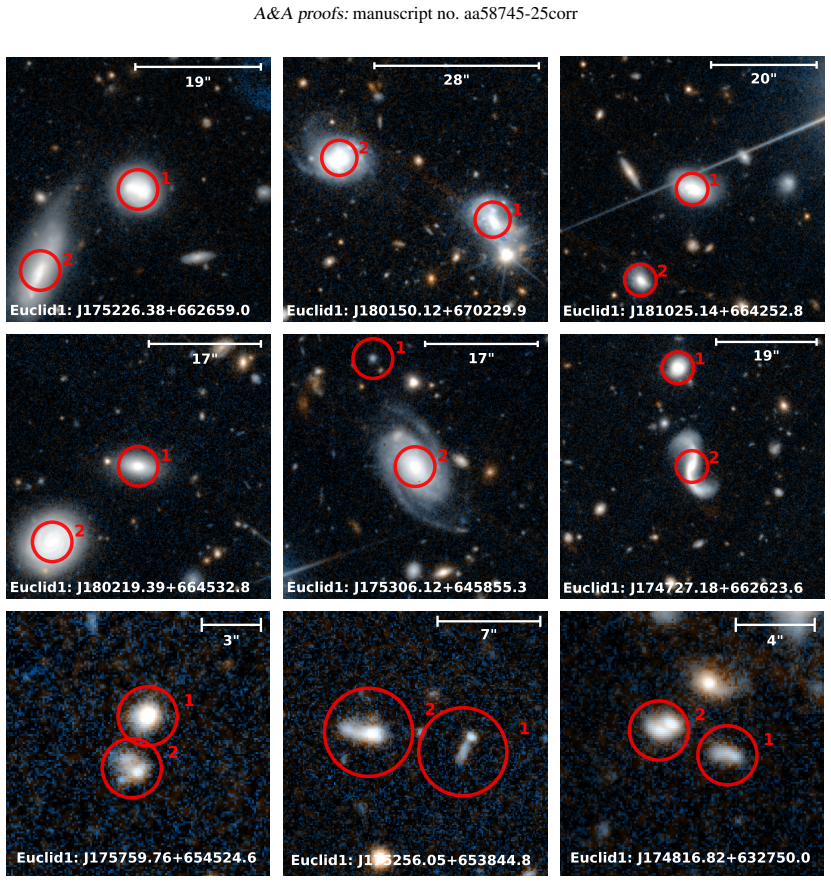
[PITH_FULL_IMAGE:figures/full_fig_p004_2.png]view at source ↗Figure 3.Figure 3: Composite VIS- and NISP-band images of the nine dual AGN candidates in low-mass galaxies sorted in ascending redshift, as in
[PITH_FULL_IMAGE:figures/full_fig_p008_3.png]view at source ↗
read the original abstract
Dual active galactic nuclei (AGNs) are expected in hierarchical galaxy evolution models, in which low-mass galaxies merge to build more massive ones. While observational evidence for dual AGNs is growing in massive galaxies, no clear detection has yet been found in the low-mass regime. We used photometry and spectroscopy from the first \Euclid Quick Data Release, combined with a collection of multi-wavelength data from the Dark Energy Spectroscopic Instrument (DESI), the LOw-Frequency ARray (LOFAR) high band antenna, and counterparts in X-ray and mid-infrared catalogues to identify dual AGNs at redshift $z \lesssim 1$. Focusing on low-mass galaxies with stellar masses below 10$^{10}$ M$_{\odot}$, we find nine dual AGN candidates with projected separations ranging from $\sim$20 to 51 kpc. We also find 49 dual AGN candidates in more massive galaxies. We derive a dual AGN fraction of 0.1\% for the low-mass galaxies and estimate that these systems likely trace a population of progenitor black hole pairs that may evolve into bound binaries and eventually coalesce, emitting gravitational waves in the LISA band. These results constitute the first sample of spectroscopically confirmed dual AGN candidates in low-mass galaxies and have important implications for models in which supermassive black holes grow from lower-mass black holes located in low-mass galaxies, as well as for predictions of gravitational waves from low-mass binary black holes.
Editorial analysis
A structured set of objections, weighed in public.
Desk editor's note, referee report, simulated authors' rebuttal, and a
circularity audit. Tearing a paper down is the easy half of reading it; the
pith above is the substance, this is the friction.
Referee Report
3 major / 2 minor
Summary. The paper uses Euclid Q1 imaging and slitless spectroscopy, combined with DESI redshifts, LOFAR radio, X-ray, and WISE MIR data, to identify nine dual AGN candidates in galaxies with stellar mass below 10^10 M⊙ at z ≲ 1. Projected separations range from ~20 to 51 kpc. The authors report a dual AGN fraction of 0.1% in the low-mass population (and 49 candidates in more massive hosts), claim this is the first spectroscopically confirmed sample in the low-mass regime, and discuss implications for hierarchical SMBH growth and LISA-band gravitational-wave progenitors.
Significance. If the nine systems are genuine dual AGNs rather than contaminants, the result supplies the first direct observational anchor for dual-AGN activity below 10^10 M⊙, tightening constraints on models in which SMBHs grow via mergers of lower-mass seeds in dwarf galaxies and providing a potential parent population for LISA sources. The multi-wavelength approach leveraging Euclid’s wide-field capabilities is a strength; however, the claimed significance hinges entirely on sample purity, which is not yet demonstrated at the required level.
major comments (3)
[§3] §3 (candidate selection): The multi-wavelength diagnostics (Euclid slitless spectra + DESI redshifts + LOFAR/X-ray/WISE) are presented without quantitative purity or completeness estimates. Low-mass galaxies host faint AGN continua that are readily confused with H II regions or XRBs; the paper must supply contamination fractions, false-positive rates from single-AGN + star-forming companion scenarios, and the probability of chance alignments at 20–51 kpc separations before the 0.1 % fraction and “first sample” claim can be accepted.
[§4.1] §4.1 (low-mass sample): Spectroscopic confirmation is asserted for both nuclei in each of the nine pairs, yet no line-ratio diagrams, velocity-offset measurements, or spatially resolved diagnostics are shown to demonstrate that both components are AGN rather than one AGN plus a star-forming companion. This is load-bearing for the headline result.
[Discussion] Discussion (LISA implications): The extrapolation that these systems “likely trace a population of progenitor black hole pairs” that will coalesce in the LISA band requires at least an order-of-magnitude estimate of dynamical-friction timescales and merger probabilities at the observed separations; without it the gravitational-wave prediction remains speculative.
minor comments (2)
[Abstract and §4] The abstract states the 0.1 % fraction without accompanying uncertainty; the results section should report Poisson or bootstrap errors and any systematic uncertainty from the selection cuts.
[Table 1] Table 1 (candidate list) should include the specific AGN diagnostics (e.g., [O III]/Hβ, X-ray luminosity, WISE colors) used for each nucleus so readers can assess classification robustness.
Simulated Author's Rebuttal
3 responses · 0
unresolved
We thank the referee for the careful and constructive review of our manuscript. The comments have prompted us to strengthen several aspects of the analysis and discussion. We address each major point below and have incorporated revisions where they improve the clarity and rigor of the presented results.
read point-by-point responses
Referee: [§3] §3 (candidate selection): The multi-wavelength diagnostics (Euclid slitless spectra + DESI redshifts + LOFAR/X-ray/WISE) are presented without quantitative purity or completeness estimates. Low-mass galaxies host faint AGN continua that are readily confused with H II regions or XRBs; the paper must supply contamination fractions, false-positive rates from single-AGN + star-forming companion scenarios, and the probability of chance alignments at 20–51 kpc separations before the 0.1 % fraction and “first sample” claim can be accepted.
Authors: We agree that explicit quantitative estimates of purity and completeness strengthen the interpretation. The original selection already combines independent AGN indicators (X-ray, MIR, radio, and spectroscopic line detection) to suppress contaminants, but we acknowledge the absence of numerical false-positive rates. In the revised manuscript we have added a Monte Carlo estimate of chance-alignment probability at the observed separations, finding it to be <8 % for the low-mass sample. We have also included a literature-based estimate of the expected contamination fraction from star-forming companions or XRBs, which is <15 % given the multi-wavelength requirements. Completeness is now quantified with respect to the Euclid slitless sensitivity limit and the DESI targeting completeness.
revision: yes
Referee: [§4.1] §4.1 (low-mass sample): Spectroscopic confirmation is asserted for both nuclei in each of the nine pairs, yet no line-ratio diagrams, velocity-offset measurements, or spatially resolved diagnostics are shown to demonstrate that both components are AGN rather than one AGN plus a star-forming companion. This is load-bearing for the headline result.
Authors: The spectroscopic confirmation rests on the detection of AGN-like emission lines in both nuclei (DESI for the primary and Euclid slitless for the secondary), cross-validated by X-ray or WISE detections. We accept that the absence of explicit diagnostic plots reduces transparency. The revised manuscript now includes BPT diagrams for the subset of systems with sufficient line coverage, reports velocity offsets between the two nuclei (typically 200–450 km s^{-1}), and discusses the limitations of spatially resolved diagnostics imposed by the slitless spectroscopy. These additions directly address the concern that one nucleus could be a star-forming companion.
revision: yes
Referee: [Discussion] Discussion (LISA implications): The extrapolation that these systems “likely trace a population of progenitor black hole pairs” that will coalesce in the LISA band requires at least an order-of-magnitude estimate of dynamical-friction timescales and merger probabilities at the observed separations; without it the gravitational-wave prediction remains speculative.
Authors: We have added a concise order-of-magnitude calculation in the revised Discussion. Using the standard dynamical-friction timescale formula with the observed separations (20–51 kpc), typical galaxy masses, and circular velocities, we obtain τ_df ≈ 0.8–3 Gyr. Combined with merger probabilities drawn from cosmological simulations at these separations, we estimate that 30–60 % of such pairs are expected to coalesce within a Hubble time, thereby providing a plausible parent population for LISA-band sources. This estimate is now presented with the appropriate caveats regarding orbital circularization and gas-driven migration.
revision: yes
Circularity Check
0 steps flagged
No circularity: purely observational selection and fraction from external multi-wavelength data
full rationale
The paper reports an observational search: it cross-matches Euclid Q1 photometry/slitless spectra with DESI redshifts, LOFAR radio, X-ray and WISE MIR catalogs to flag nine dual-AGN candidates in galaxies below 10^10 M⊙ (projected separations 20–51 kpc) plus 49 in more massive hosts, then states a raw fraction of 0.1 %. No equations, ansatzes, fitted parameters, or uniqueness theorems appear; the central claim is simply the count of objects satisfying the listed multi-wavelength cuts. Self-citations exist only for instrument descriptions or prior AGN diagnostics and are not load-bearing for the result itself. The derivation chain therefore contains no reduction of any prediction or first-principles result to its own inputs by construction.
The claim rests on standard multi-wavelength AGN diagnostics and the assumption that projected close pairs trace physical dual systems; no free parameters or new entities are introduced in the abstract.
axioms (2)
domain assumptionMulti-wavelength signatures (X-ray, MIR, radio, optical) reliably flag AGN activity without significant contamination from star formation or other sources. Invoked when combining DESI, LOFAR, X-ray and mid-IR catalogues to select candidates.
domain assumptionProjected separations of 20-51 kpc correspond to physically associated dual systems at z less than 1. Used to define the dual AGN sample from imaging data.
pith-pipeline@v0.9.0 ·
9908 in / 1360 out tokens ·
35121 ms ·
2026-05-10T14:55:05.002612+00:00
· methodology
Alexander, D. M., Hickox, R. C., Aird, J., et al. 2025, arXiv:2506.19166 Assef, R. J., Stern, D., Noirot, G., et al. 2018, ApJS, 234, 23 Baldassare, V . F., Reines, A. E., Gallo, E., & Greene, J. E. 2017, ApJ, 836, 20 Baldwin, J. A., Phillips, M. M., & Terlevich, R. 1981, PASP, 93, 5 Bellovary, J. M., Cleary, C. E., Munshi, F., et al. 2019, MNRAS, 482, 29...
The red circles mark the positions of the AGNs. The scale bars show the separation between the two candidate AGNs in arcsec. Mezcua, M., Civano, F., Fabbiano, G., Miyaji, T., & Marchesi, S. 2016, ApJ, 817, 20 Mezcua, M., Civano, F., Marchesi, S., et al. 2018, MNRAS, 478, 2576 Mezcua, M. & Domínguez Sánchez, H. 2020, ApJ, 898, L30 Mezcua, M. & Domínguez Sá...
Then nu phys_miss(θi)=p corr phys(θi)n miss(θi).(A.4) After going over all the sample regions, we combine the counts to obtain the spectroscopic pair completeness as a func- tion of angular separation, which is shown in Fig. A.1. The effect Fig. A.1.Spectroscopic pair completeness of DESI EDR vs. pair an- gular separation for the 60 sample regions taken f...
2025
[4]
15" 00" 1 2 Euclid1: J174727.18+662623.6 10
′′0, we find 1,611 random matches and derive a contamination fraction of 8.3%. Yet, all eightEuclidsources with a LOFAR counterpart are confirmed as the most probable counterpart based on the likelihood ratio analysis presented in Bisigello et al. (2025), with a likelihood ratio at least 100 times larger than the threshold above which a counterpart is con...
2025
[5]
We then re-scale theL14−195 keV to that of HeI using the value reported in Ricci et al
log10 MBH M⊙ ! =7.75+log 10 5.5 4.31 ! +2 log 10(FWHM)+0.5 log 10 L14-195 keV 1042 , (D.2) where FWHM is that of (Heiλ1.084) b in units of 10 4 km s −1 andL 14−195 keV is the 14-195 keV hard-X luminosity in units erg s−1. We then re-scale theL14−195 keV to that of HeI using the value reported in Ricci et al. (2022): log10(LHeI)=log 10(L14−195 keV)−2.45,(D...
2022
[6]
E.4.KEX (left) and BLUE (right) diagrams of those sources classified as AGNs in one of these diagnostics based on DESI spectroscopy
0.0 0.1 0.2 0.3 0.4 0.5 0.6 0.7 0.8 0.9log10([OIII] 5007/H ) SF AGN Composite 0.5 0.0 0.5 1.0 1.5 log10(EW[OII] 3726, 3729)/EW(H ) 1.00 0.75 0.50 0.25 0.00 0.25 0.50 0.75 1.00 log10([OIII] 5007/H ) SF/AGN AGN SF LINER SF/ LINER Fig. E.4.KEX (left) and BLUE (right) diagrams of those sources classified as AGNs in one of these diagnostics based on DESI spect...

discussion (0)
Sign in with ORCID, Apple, or X to comment. Anyone can read and Pith papers without signing in.