Recognition: unknown
Simple slow operators and quantum thermalization
Pith reviewed 2026-05-10 14:45 UTC · model grok-4.3
The pith
Typical low-complexity quantum states thermalize unless simple slow operators exist and persist.
A machine-rendered reading of the paper's core claim, the machinery that carries it, and where it could break.
Core claim
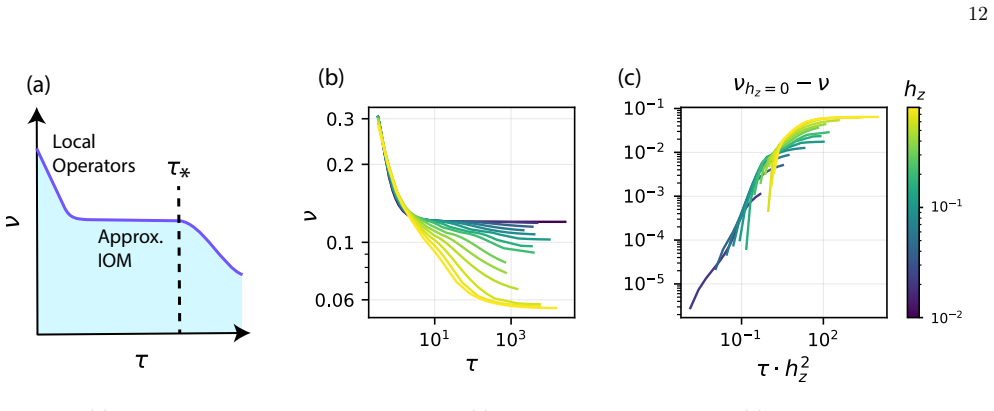
We introduce simple slow operators as those with small commutator with the Hamiltonian and significant projection onto small-size operators. If typical initial states drawn from a low-complexity ensemble fail to thermalize by time t, then SSOs must exist that remain approximately conserved up to t. Equivalently, the absence of SSOs implies that typical initial states thermalize. The proof relies on the ensemble variance norm of an operator, which for low-entanglement ensembles is tied to the size of its small-sized components, thereby connecting operator growth to state thermalization.
What carries the argument
Simple slow operators (SSOs), defined as operators with small [H, O] and large small-size components, connected to state dynamics through the ensemble variance norm.
If this is right
- Systems lacking SSOs exhibit thermalization of all typical low-complexity initial states.
- Operator growth bounds directly control the equilibration timescale for such ensembles.
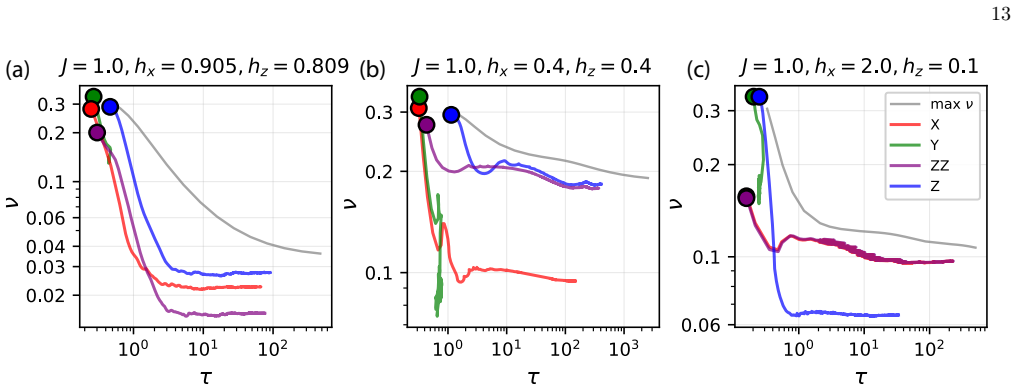
- Prethermal plateaus require the presence of at least one SSO with lifetime matching the plateau duration.
- The criterion applies to any ensemble whose variance norm reduces to operator size, including many product-state families.
Where Pith is reading between the lines
- The same logic may classify when prethermalization occurs in Floquet or driven systems by identifying long-lived SSOs.
- Numerical searches for SSOs could serve as a practical diagnostic for whether a given model thermalizes from typical initial conditions.
- Extensions to higher-entanglement ensembles would require a generalized norm that still isolates small-size components.
Load-bearing premise
The ensemble variance norm of an operator is directly tied to its small-sized components when acting on low-entanglement states.
What would settle it
A concrete counterexample: a Hamiltonian and low-complexity ensemble where typical states remain non-thermalized to time t yet no operator with both small [H, O] and large small-size weight survives to t.
Figures


read the original abstract
We establish a rigorous relation between the thermalization of typical initial states and the dynamics of local operators. We introduce a concept of simple slow operators (SSOs), defined as operators that have a small commutator with the Hamiltonian and have significant small-sized components. We show that if typical initial states (drawn from a low-complexity state ensemble) do not thermalize on timescale $t$, then SSOs must exist that are approximately conserved up to timescale $t$. Equivalently, the absence of SSOs implies that typical initial states thermalize. We establish these results by introducing the concept of an ensemble variance norm of an operator, defined as the typical magnitude of the expectation value of that operator with respect to states in the ensemble. For low-entanglement ensembles, the norm is related to operator sizes, allowing us to establish a direct link between operator growth and thermalization.
Editorial analysis
A structured set of objections, weighed in public.
Referee Report
Summary. The paper claims to establish a rigorous equivalence between the thermalization of typical initial states drawn from low-complexity (low-entanglement) ensembles and the existence of simple slow operators (SSOs). SSOs are defined as operators with small commutators with the Hamiltonian that also possess significant small-sized components. Using an ensemble variance norm (the typical magnitude of expectation values over the ensemble), the authors show that non-thermalization on timescale t implies the existence of SSOs approximately conserved up to t, and conversely that the absence of SSOs implies thermalization of typical states. The key step links the ensemble variance norm to operator sizes specifically for low-entanglement ensembles.
Significance. If the central equivalence holds, the result offers a precise operator-based criterion for thermalization in quantum many-body systems, connecting operator growth, slow modes, and the dynamics of low-complexity states. The ensemble variance norm is a useful auxiliary construct that could apply to other questions in quantum thermalization and scrambling. The paper gives credit to the equivalence as a falsifiable link between non-thermalization and the presence of approximately conserved simple operators.
major comments (2)
- [§3] §3 (Main Theorem) and the paragraph following the definition of the ensemble variance norm: the claim that 'for low-entanglement ensembles, the norm is related to operator sizes' is invoked to conclude that a large norm plus small [H,O] implies significant small-sized components (qualifying the operator as an SSO). The manuscript does not specify the direction or tightness of this relation (upper/lower bound or equality) nor how high-weight terms are controlled so that they cannot dominate the norm while small-weight components remain small. This step is load-bearing for the implication from non-thermalization to existence of SSOs.
- [Proof of main result] Proof of the main equivalence (likely §4 or Theorem 1): the handling of error terms when approximating conservation up to finite timescale t is not fully detailed in the provided abstract and outline. Explicit bounds on the deviation from exact conservation are needed to ensure the resulting operator satisfies the SSO definition without additional restrictions on the ensemble.
minor comments (2)
- [Abstract] Abstract: the phrase 'the norm is related to operator sizes' is vague; a more precise statement of the inequality or equality used would improve clarity before the full proof is presented.
- [§2] Notation: the definition of 'small-sized components' and 'significant' should be given with explicit thresholds or norms in the main text to make the SSO definition unambiguous.
Simulated Author's Rebuttal
We thank the referee for the careful reading and constructive comments. We address the major points below and will revise the manuscript accordingly to improve clarity on the key steps.
read point-by-point responses
-
Referee: [§3] §3 (Main Theorem) and the paragraph following the definition of the ensemble variance norm: the claim that 'for low-entanglement ensembles, the norm is related to operator sizes' is invoked to conclude that a large norm plus small [H,O] implies significant small-sized components (qualifying the operator as an SSO). The manuscript does not specify the direction or tightness of this relation (upper/lower bound or equality) nor how high-weight terms are controlled so that they cannot dominate the norm while small-weight components remain small. This step is load-bearing for the implication from non-thermalization to existence of SSOs.
Authors: We thank the referee for highlighting this point. In §3, after defining the ensemble variance norm, we prove that for low-entanglement ensembles the norm is lower-bounded (up to a factor depending on the ensemble's maximum entanglement) by the sum of squared coefficients of the operator's small-sized components. High-weight terms cannot dominate because their contributions to the expectation values are exponentially suppressed by the low entanglement of states in the ensemble; this suppression is derived from the definition of the ensemble and ensures the norm directly reflects the low-weight support. We will revise the text to state the lower bound explicitly and detail the high-weight control argument. revision: yes
-
Referee: [Proof of main result] Proof of the main equivalence (likely §4 or Theorem 1): the handling of error terms when approximating conservation up to finite timescale t is not fully detailed in the provided abstract and outline. Explicit bounds on the deviation from exact conservation are needed to ensure the resulting operator satisfies the SSO definition without additional restrictions on the ensemble.
Authors: In the proof of the main equivalence (Theorem 1), the approximate conservation up to time t is obtained by integrating the Heisenberg equation, yielding an explicit error bound of t times the ensemble variance norm of [H,O]. This bound is independent of further ensemble details beyond those already used for the norm and ensures the operator meets the SSO definition with a controlled deviation. We will expand the proof section to include the full derivation of this error term and its application to the SSO criteria. revision: yes
Circularity Check
No significant circularity; derivation introduces auxiliary concepts without self-reduction
full rationale
The paper defines SSOs via small [H,O] and significant small-sized components, introduces the ensemble variance norm as the typical |<psi|O|psi>| over the ensemble, and states that for low-entanglement ensembles this norm relates to operator sizes. It then derives the implication that non-thermalization of typical states on timescale t forces existence of approximately conserved SSOs up to t. This chain relies on the stated relation between norm and sizes as an independent property of the ensembles rather than a tautology or redefinition; the central equivalence is obtained by applying the norm to connect operator growth to state thermalization, without any step reducing by construction to a fitted parameter, self-citation chain, or input assumption. The derivation is self-contained against the introduced definitions and the low-entanglement property.
Axiom & Free-Parameter Ledger
axioms (2)
- domain assumption The initial states belong to a low-complexity, low-entanglement ensemble for which the ensemble variance norm of an operator equals its typical size.
- standard math The Hamiltonian is local and time-independent.
Reference graph
Works this paper leans on
-
[1]
Therefore, the projectionPβ would be defined by (Pβ[O])β =P[O β],(I3) andQ β[O] =O− P β[O], accordingly
The expressions ofP β andQ β In Section IVD, we introduced the finite-temperature projectionP β, which shall satisfy ∥P[O β(t)]∥E =∥P β[O(t)]∥Eβ .(I1) Notice that∥A∥ Eβ =∥A β∥E, this is equivalent to P[O β(t)] = (Pβ[O(t)])β .(I2) Since both the projectionPand the dressing·β commute with time evolution, we can drop thetargument. Therefore, the projectionPβ...
-
[2]
physical
Properties of unnormalized Scrooge-like ensembles Scrooge ensembles [92, 100, 110–114, 155] are a generalization of the Haar ensemble in the case where the first moment, or the density matrix, of the ensemble is not a maximally mixed state. Given a density matrix ρ, the Scrooge ensemble takes a Haar random state|ψ⟩ and deform it to√ρ|ψ⟩. There are two ver...
-
[3]
Without loss of generality, assume that the non- differentiable point occurs ata=b= 0
Proof of differentiability of the boundary We will show that the boundary of the joint numerical rangeW(A, B)is non-differentiable if and only ifv θ becomesthesimultaneouseigenvectorofAandBatsome pointθ. Without loss of generality, assume that the non- differentiable point occurs ata=b= 0. A vectorvexists such thatv †Av=v †Bv= 0. Due to the convexity of t...
-
[4]
Orthogonalization in diagonalizing superoperator We now return to the problem of orthogonalization. Recall that our goal is to find the largest eigenvalue of the matrixB−θAsubject to the constraint that the vectorvis orthogonal to certain given vectors, which we will write asU, withU †U=I, and the constraint is U †v= 0. The problem is equivalent to findin...
-
[5]
R. K. Pathria and P. D. Beale,Statistical Mechanics, 3rd ed. (Elsevier/Academic Press, Amsterdam Boston, 2011)
2011
-
[6]
J. P. Sethna,Statistical Mechanics: Entropy, Order Parameters, and Complexity, 2nd ed., Oxford Master Series in Statistical, Computational, and Theoretical Physics (Oxford University press, Oxford, 2021)
2021
-
[7]
Kardar,Statistical Physics of Particles, first published, 7th printing ed
M. Kardar,Statistical Physics of Particles, first published, 7th printing ed. (Cambridge University Press, Cambridge, 2015)
2015
-
[8]
Quantum many-body systems out of equilibrium,
J. Eisert, M. Friesdorf, and C. Gogolin, “Quantum many-body systems out of equilibrium,” Nature Phys 11, 124 (2015)
2015
-
[9]
Equilibration, thermalisation, and the emergence of statistical mechanics in closed quantum systems,
C.GogolinandJ.Eisert,“Equilibration, thermalisation, and the emergence of statistical mechanics in closed quantum systems,” Rep. Prog. Phys.79, 056001 (2016)
2016
-
[10]
From quantum chaos and eigenstate thermalization to statistical mechanics and thermodynamics,
L. D’Alessio, Y. Kafri, A. Polkovnikov, and M. Rigol, “From quantum chaos and eigenstate thermalization to statistical mechanics and thermodynamics,” Advances in Physics65, 239 (2016)
2016
-
[11]
Quantum chaos and thermalization in isolated systems of interacting particles,
F. Borgonovi, F. Izrailev, L. Santos, and V. Zelevinsky, “Quantum chaos and thermalization in isolated systems of interacting particles,” Physics Reports626, 1 (2016)
2016
-
[12]
Thermalization and prethermalization in isolated quantum systems: A theoretical overview,
T. Mori, T. N. Ikeda, E. Kaminishi, and M. Ueda, “Thermalization and prethermalization in isolated quantum systems: A theoretical overview,” J. Phys. B: At. Mol. Opt. Phys.51, 112001 (2018)
2018
-
[13]
Quantum equilibration, thermalization and prethermalization in ultracold atoms,
M. Ueda, “Quantum equilibration, thermalization and prethermalization in ultracold atoms,” Nat Rev Phys2, 669 (2020)
2020
-
[14]
Quantum statistical mechanics in a closed system,
J. M. Deutsch, “Quantum statistical mechanics in a closed system,” Phys. Rev. A43, 2046 (1991)
2046
-
[15]
Chaos and quantum thermalization,
M. Srednicki, “Chaos and quantum thermalization,” Phys. Rev. E50, 888 (1994)
1994
-
[16]
Testing whether all eigenstates obey the eigenstate thermalization hypothesis,
H. Kim, T. N. Ikeda, and D. A. Huse, “Testing whether all eigenstates obey the eigenstate thermalization hypothesis,” Phys. Rev. E90, 052105 (2014)
2014
-
[17]
Eigenstate thermalization hypothesis,
J. M. Deutsch, “Eigenstate thermalization hypothesis,” Rep. Prog. Phys.81, 082001 (2018)
2018
-
[18]
Alternatives to Eigenstate Thermalization,
M. Rigol and M. Srednicki, “Alternatives to Eigenstate Thermalization,” Phys. Rev. Lett.108, 110601 (2012)
2012
-
[19]
Eigenstate Thermalization Hypothesis and Its Deviations from Random-Matrix Theory beyond the Thermalization Time,
J. Wang, M. H. Lamann, J. Richter, R. Steinigeweg, A. Dymarsky, and J. Gemmer, “Eigenstate Thermalization Hypothesis and Its Deviations from Random-Matrix Theory beyond the Thermalization Time,” Phys. Rev. Lett.128, 180601 (2022)
2022
-
[20]
Eigenstate ThermalizationHypothesisandFreeProbability,
S. Pappalardi, L. Foini, and J. Kurchan, “Eigenstate ThermalizationHypothesisandFreeProbability,” Phys. Rev. Lett.129, 170603 (2022)
2022
-
[21]
Eigenstate Correlations, the Eigenstate Thermalization Hypothesis, and Quantum Information Dynamics 29 in Chaotic Many-Body Quantum Systems,
D. Hahn, D. J. Luitz, and J. T. Chalker, “Eigenstate Correlations, the Eigenstate Thermalization Hypothesis, and Quantum Information Dynamics 29 in Chaotic Many-Body Quantum Systems,” Phys. Rev. X14, 031029 (2024)
2024
-
[22]
Typical thermalization of low-entanglement states,
C. Bertoni, C. Wassner, G. Guarnieri, and J. Eisert, “Typical thermalization of low-entanglement states,” Commun Phys8, 301 (2025)
2025
-
[23]
Quantum thermalization must occur in translation-invariant systems at high temperature,
S. Pilatowsky-Cameo and S. Choi, “Quantum thermalization must occur in translation-invariant systems at high temperature,” Nat Commun17, 75 (2025)
2025
-
[24]
Remarks on the notion of quantum integrability
J.-S. Caux and J. Mossel, “Remarks on the notion of quantum integrability,” J. Stat. Mech.2011, P02023 (2011), arXiv:1012.3587 [cond-mat]
-
[25]
Generalized Thermalization in an Integrable Lattice System,
A. C. Cassidy, C. W. Clark, and M. Rigol, “Generalized Thermalization in an Integrable Lattice System,” Phys. Rev. Lett.106, 140405 (2011)
2011
-
[26]
The generalized Gibbs ensemble for Heisenberg spin chains,
B. Pozsgay, “The generalized Gibbs ensemble for Heisenberg spin chains,” J. Stat. Mech.2013, P07003 (2013)
2013
-
[27]
Correlations after Quantum Quenches in the X X Z Spin Chain: Failure of the Generalized Gibbs Ensemble,
B. Pozsgay, M. Mestyán, M. A. Werner, M. Kormos, G. Zaránd, and G. Takács, “Correlations after Quantum Quenches in the X X Z Spin Chain: Failure of the Generalized Gibbs Ensemble,” Phys. Rev. Lett. 113, 117203 (2014)
2014
-
[28]
Quenching the Anisotropic Heisenberg Chain: Exact Solution and Generalized Gibbs Ensemble Predictions,
B. Wouters, J. De Nardis, M. Brockmann, D. Fioretto, M. Rigol, and J.-S. Caux, “Quenching the Anisotropic Heisenberg Chain: Exact Solution and Generalized Gibbs Ensemble Predictions,” Phys. Rev. Lett.113, 117202 (2014)
2014
-
[29]
Many-Body LocalizationandThermalizationinQuantumStatistical Mechanics,
R. Nandkishore and D. A. Huse, “Many-Body LocalizationandThermalizationinQuantumStatistical Mechanics,” Annu. Rev. Condens. Matter Phys.6, 15 (2015)
2015
-
[30]
Colloquium: Many-body localization, thermalization, and entanglement,
D. A. Abanin, E. Altman, I. Bloch, and M. Serbyn, “Colloquium: Many-body localization, thermalization, and entanglement,” Rev. Mod. Phys.91, 021001 (2019)
2019
-
[31]
Many-body localization phase transition,
A. Pal and D. A. Huse, “Many-body localization phase transition,” Phys. Rev. B82, 174411 (2010)
2010
-
[32]
Local Conservation Laws and the Structure of the Many-Body Localized States,
M. Serbyn, Z. Papić, and D. A. Abanin, “Local Conservation Laws and the Structure of the Many-Body Localized States,” Phys. Rev. Lett.111, 127201 (2013)
2013
-
[33]
Phenomenology of fully many-body-localized systems,
D. A. Huse, R. Nandkishore, and V. Oganesyan, “Phenomenology of fully many-body-localized systems,” Phys. Rev. B90, 174202 (2014)
2014
-
[34]
Theory of the Many-Body Localization Transition in One- Dimensional Systems,
R. Vosk, D. A. Huse, and E. Altman, “Theory of the Many-Body Localization Transition in One- Dimensional Systems,” Phys. Rev. X5, 031032 (2015)
2015
-
[35]
Constructing local integrals of motion in the many- body localized phase,
A. Chandran, I. H. Kim, G. Vidal, and D. A. Abanin, “Constructing local integrals of motion in the many- body localized phase,” Phys. Rev. B91, 085425 (2015)
2015
-
[36]
Explicit Local Integrals of Motion for the Many-Body Localized State,
L. Rademaker and M. Ortuño, “Explicit Local Integrals of Motion for the Many-Body Localized State,” Phys. Rev. Lett.116, 010404 (2016)
2016
-
[37]
Weak ergodicity breaking from quantum many-body scars,
C. J. Turner, A. A. Michailidis, D. A. Abanin, M. Serbyn, and Z. Papić, “Weak ergodicity breaking from quantum many-body scars,” Nature Phys14, 745 (2018)
2018
-
[38]
Systematic Construction of Counterexamples to the Eigenstate Thermalization Hypothesis,
N. Shiraishi and T. Mori, “Systematic Construction of Counterexamples to the Eigenstate Thermalization Hypothesis,” Phys. Rev. Lett.119, 030601 (2017)
2017
-
[39]
η- pairing in Hubbard models: From spectrum generating algebras to quantum many-body scars,
S. Moudgalya, N. Regnault, and B. A. Bernevig, “η- pairing in Hubbard models: From spectrum generating algebras to quantum many-body scars,” Phys. Rev. B 102, 085140 (2020)
2020
-
[40]
Quantum many-body scars and weak breaking of ergodicity,
M. Serbyn, D. A. Abanin, and Z. Papić, “Quantum many-body scars and weak breaking of ergodicity,” Nat. Phys.17, 675 (2021)
2021
-
[41]
QuasisymmetryGroups and Many-Body Scar Dynamics,
J.Ren, C.Liang, andC.Fang,“QuasisymmetryGroups and Many-Body Scar Dynamics,” Phys. Rev. Lett.126, 120604 (2021)
2021
-
[42]
Exhaustive Characterization of Quantum Many-Body Scars Using Commutant Algebras,
S. Moudgalya and O. I. Motrunich, “Exhaustive Characterization of Quantum Many-Body Scars Using Commutant Algebras,” Phys. Rev. X14, 041069 (2024)
2024
-
[43]
Quantum many-body scars and Hilbert space fragmentation: A review of exact results,
S. Moudgalya, B. A. Bernevig, and N. Regnault, “Quantum many-body scars and Hilbert space fragmentation: A review of exact results,” Rep. Prog. Phys.85, 086501 (2022)
2022
-
[44]
Ergodicity Breaking Arising from Hilbert Space Fragmentation in Dipole-Conserving Hamiltonians,
P. Sala, T. Rakovszky, R. Verresen, M. Knap, and F. Pollmann, “Ergodicity Breaking Arising from Hilbert Space Fragmentation in Dipole-Conserving Hamiltonians,” Phys. Rev. X10, 011047 (2020)
2020
-
[45]
Hilbert-Space Fragmentation from Strict Confinement,
Z.-C. Yang, F. Liu, A. V. Gorshkov, and T. Iadecola, “Hilbert-Space Fragmentation from Strict Confinement,” Phys. Rev. Lett.124, 207602 (2020)
2020
-
[46]
Hilbert Space Fragmentation and Commutant Algebras,
S. Moudgalya and O. I. Motrunich, “Hilbert Space Fragmentation and Commutant Algebras,” Phys. Rev. X12, 011050 (2022)
2022
-
[47]
Glassy Word Problems: Ultraslow Relaxation, Hilbert Space Jamming, and Computational Complexity,
S. Balasubramanian, S. Gopalakrishnan, A. Khudorozhkov, and E. Lake, “Glassy Word Problems: Ultraslow Relaxation, Hilbert Space Jamming, and Computational Complexity,” Phys. Rev. X14, 021034 (2024)
2024
-
[48]
Quantum fragmentation in the extended quantum breakdown model,
B.-T. Chen, A. Prem, N. Regnault, and B. Lian, “Quantum fragmentation in the extended quantum breakdown model,” Phys. Rev. B110, 165109 (2024)
2024
-
[49]
Quantum Hilbert Space Fragmentation and Entangled Frozen States
Z. Zhou, T.-H. Yang, and B.-T. Chen, “Quantum Hilbert Space Fragmentation and Entangled Frozen States,” (2026), arXiv:2604.05218 [quant-ph]
work page internal anchor Pith review Pith/arXiv arXiv 2026
-
[50]
Prethermalization,
J. Berges, Sz. Borsányi, and C. Wetterich, “Prethermalization,” Phys. Rev. Lett.93, 142002 (2004)
2004
-
[51]
Breakdown of Thermalization in Finite One- Dimensional Systems,
M. Rigol, “Breakdown of Thermalization in Finite One- Dimensional Systems,” Phys. Rev. Lett.103, 100403 (2009)
2009
-
[52]
Onset of quantum chaos in one-dimensional bosonic and fermionic systems and its relation to thermalization,
L. F. Santos and M. Rigol, “Onset of quantum chaos in one-dimensional bosonic and fermionic systems and its relation to thermalization,” Phys. Rev. E81, 036206 (2010)
2010
-
[53]
Typicality of Prethermalization,
P. Reimann and L. Dabelow, “Typicality of Prethermalization,” Phys. Rev. Lett.122, 080603 (2019)
2019
-
[54]
A Rigorous Theory of Many-Body Prethermalization for Periodically Driven and Closed Quantum Systems,
D. Abanin, W. De Roeck, W. W. Ho, and F. Huveneers, “A Rigorous Theory of Many-Body Prethermalization for Periodically Driven and Closed Quantum Systems,” Commun. Math. Phys.354, 809 (2017)
2017
-
[55]
Effective Hamiltonians, prethermalization, and slow energy absorption in periodically driven many-body systems,
D. A. Abanin, W. De Roeck, W. W. Ho, and F. Huveneers, “Effective Hamiltonians, prethermalization, and slow energy absorption in periodically driven many-body systems,” Phys. Rev. B 95, 014112 (2017)
2017
-
[56]
Prethermalization and the Local Robustness of Gapped Systems,
C. Yin and A. Lucas, “Prethermalization and the Local Robustness of Gapped Systems,” Phys. Rev. Lett.131, 050402 (2023)
2023
-
[57]
Emergent conservation laws and nonthermal states in the mixed-field Ising model,
J. Wurtz and A. Polkovnikov, “Emergent conservation laws and nonthermal states in the mixed-field Ising model,” Phys. Rev. B101, 195138 (2020)
2020
-
[58]
Finite-size generators for weak integrability breaking perturbations in the Heisenberg chain,
S. Vanovac, F. M. Surace, and O. I. Motrunich, “Finite-size generators for weak integrability breaking perturbations in the Heisenberg chain,” Phys. Rev. B 30 110, 144309 (2024)
2024
-
[59]
Scrambling Dynamics and Out- of-Time-Ordered Correlators in Quantum Many-Body Systems,
S. Xu and B. Swingle, “Scrambling Dynamics and Out- of-Time-Ordered Correlators in Quantum Many-Body Systems,” PRX Quantum5, 010201 (2024)
2024
-
[60]
Operator Spreading and the Emergence of Dissipative Hydrodynamics under Unitary Evolution with Conservation Laws,
V. Khemani, A. Vishwanath, and D. A. Huse, “Operator Spreading and the Emergence of Dissipative Hydrodynamics under Unitary Evolution with Conservation Laws,” Phys. Rev. X8, 031057 (2018)
2018
-
[61]
A Universal Operator Growth Hypothesis,
D. E. Parker, X. Cao, A. Avdoshkin, T. Scaffidi, and E. Altman, “A Universal Operator Growth Hypothesis,” Phys. Rev. X9, 041017 (2019)
2019
-
[62]
Hydrodynamics of operator spreading and quasiparticle diffusion in interacting integrable systems,
S. Gopalakrishnan, D. A. Huse, V. Khemani, and R. Vasseur, “Hydrodynamics of operator spreading and quasiparticle diffusion in interacting integrable systems,” Phys. Rev. B98, 220303 (2018)
2018
-
[63]
Operator Growth in Open Quantum Systems,
T. Schuster and N. Y. Yao, “Operator Growth in Open Quantum Systems,” Phys. Rev. Lett.131, 160402 (2023)
2023
-
[64]
Operator growth in the SYK model,
D.A.Roberts, D.Stanford, andA.Streicher,“Operator growth in the SYK model,” J. High Energ. Phys.2018, 122 (2018)
2018
-
[65]
Unscrambling the physics of out-of-time- order correlators,
B. Swingle, “Unscrambling the physics of out-of-time- order correlators,” Nature Phys14, 988 (2018)
2018
-
[66]
Measuring the scrambling of quantum information,
B. Swingle, G. Bentsen, M. Schleier-Smith, and P. Hayden, “Measuring the scrambling of quantum information,” Phys. Rev. A94, 040302 (2016)
2016
-
[67]
Measuring operator size growth in quantum quench experiments,
X.-L. Qi, E. J. Davis, A. Periwal, and M. Schleier- Smith, “Measuring operator size growth in quantum quench experiments,” (2019), arXiv:1906.00524 [quant- ph]
-
[68]
Predicting many properties of a quantum system from very few measurements,
H.-Y. Huang, R. Kueng, and J. Preskill, “Predicting many properties of a quantum system from very few measurements,” Nat. Phys.16, 1050 (2020)
2020
-
[69]
Symmetries as Ground States of Local Superoperators: Hydrodynamic Implications,
S. Moudgalya and O. I. Motrunich, “Symmetries as Ground States of Local Superoperators: Hydrodynamic Implications,” PRX Quantum5, 040330 (2024)
2024
-
[70]
Quantum mechanical evolution towards thermal equilibrium,
N. Linden, S. Popescu, A. J. Short, and A. Winter, “Quantum mechanical evolution towards thermal equilibrium,” Phys. Rev. E79, 061103 (2009)
2009
-
[71]
Equilibration of quantum systems and subsystems,
A. J. Short, “Equilibration of quantum systems and subsystems,” New J. Phys.13, 053009 (2011)
2011
-
[72]
Quantum equilibration in finite time,
A. J. Short and T. C. Farrelly, “Quantum equilibration in finite time,” New J. Phys.14, 013063 (2012)
2012
-
[73]
Effect of Rare Fluctuations on the Thermalization of Isolated Quantum Systems,
G. Biroli, C. Kollath, and A. M. Läuchli, “Effect of Rare Fluctuations on the Thermalization of Isolated Quantum Systems,” Phys. Rev. Lett.105, 250401 (2010)
2010
-
[74]
Weak eigenstate thermalization with large deviationbound,
T. Mori, “Weak eigenstate thermalization with large deviationbound,” (2016),arXiv:1609.09776[cond-mat]
-
[75]
Unified Theory of Local Quantum Many- Body Dynamics: Eigenoperator Thermalization Theorems,
B. Buča, “Unified Theory of Local Quantum Many- Body Dynamics: Eigenoperator Thermalization Theorems,” Phys. Rev. X13, 031013 (2023)
2023
-
[76]
Eigenstate Thermalization Hypothesis for Wigner Matrices,
G. Cipolloni, L. Erdős, and D. Schröder, “Eigenstate Thermalization Hypothesis for Wigner Matrices,” Commun. Math. Phys.388, 1005 (2021)
2021
-
[77]
Eigenstate Thermalization Hypothesis for Wigner-Type Matrices,
L. Erdős and V. Riabov, “Eigenstate Thermalization Hypothesis for Wigner-Type Matrices,” Commun. Math. Phys.405, 282 (2024)
2024
-
[78]
Random product states at high temperature equilibrate exponentially well,
Y. Huang, “Random product states at high temperature equilibrate exponentially well,” (2024), arXiv:2409.08436 [cond-mat]
-
[79]
Conserved quantities from entanglement Hamiltonian,
B. Lian, “Conserved quantities from entanglement Hamiltonian,” Phys. Rev. B105, 035106 (2022)
2022
-
[80]
Generalized Gibbs Ensemble from Eigenstate Entanglement Hamiltonian,
H. Chen and B. Lian, “Generalized Gibbs Ensemble from Eigenstate Entanglement Hamiltonian,” Phys. Rev. Lett.135, 233402 (2025)
2025
discussion (0)
Sign in with ORCID, Apple, or X to comment. Anyone can read and Pith papers without signing in.