Recognition: 2 theorem links
· Lean TheoremQuantum Hilbert Space Fragmentation and Entangled Frozen States
Pith reviewed 2026-05-10 18:38 UTC · model grok-4.3
The pith
Rank deficiency in the local Hamiltonian of classically fragmented models generates entangled frozen states that split mobile sectors into quantum mobile and frozen parts.
A machine-rendered reading of the paper's core claim, the machinery that carries it, and where it could break.
Core claim
In classically fragmented models the rank deficiency of the local Hamiltonian produces local null directions that generate entangled frozen states embedded in mobile classical Krylov sectors; when the entangled frozen subspace is non-empty the mobile sector splits into a mobile quantum Krylov subspace and an entangled frozen subspace, yielding quantum Hilbert space fragmentation. Closed-form expressions for irreducible Krylov dimensions, degeneracies and sector multiplicities are obtained for the asymmetric qubit and Z2-symmetric GHZ projector models, where the all-mobile-sector entangled frozen states show sub-volume-law bipartite entanglement entropy scaling as S ~ sqrt(L). After removing
What carries the argument
Rank deficiency of the local Hamiltonian, which produces local null directions that generate entangled frozen states within mobile classical Krylov sectors.
If this is right
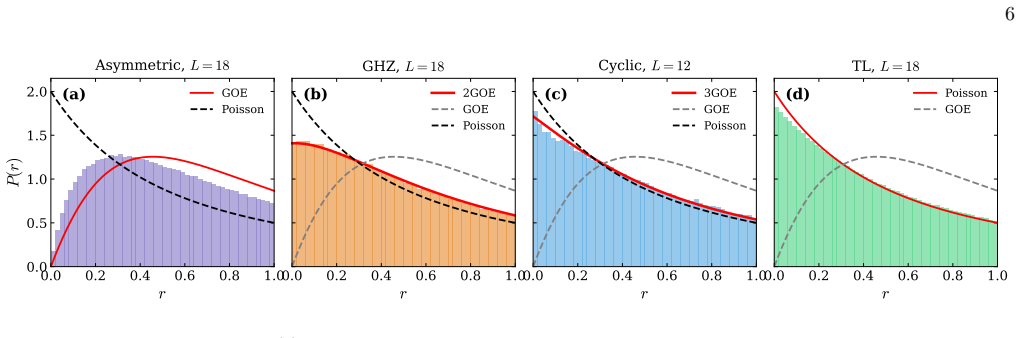
- The mobile quantum Krylov subspace decomposes into irreducible blocks whose statistics distinguish weak fragmentation (O(1) blocks, each GOE ergodic, unresolved spectrum mGOE) from strong fragmentation (block number grows with L, gap ratios approach Poisson).
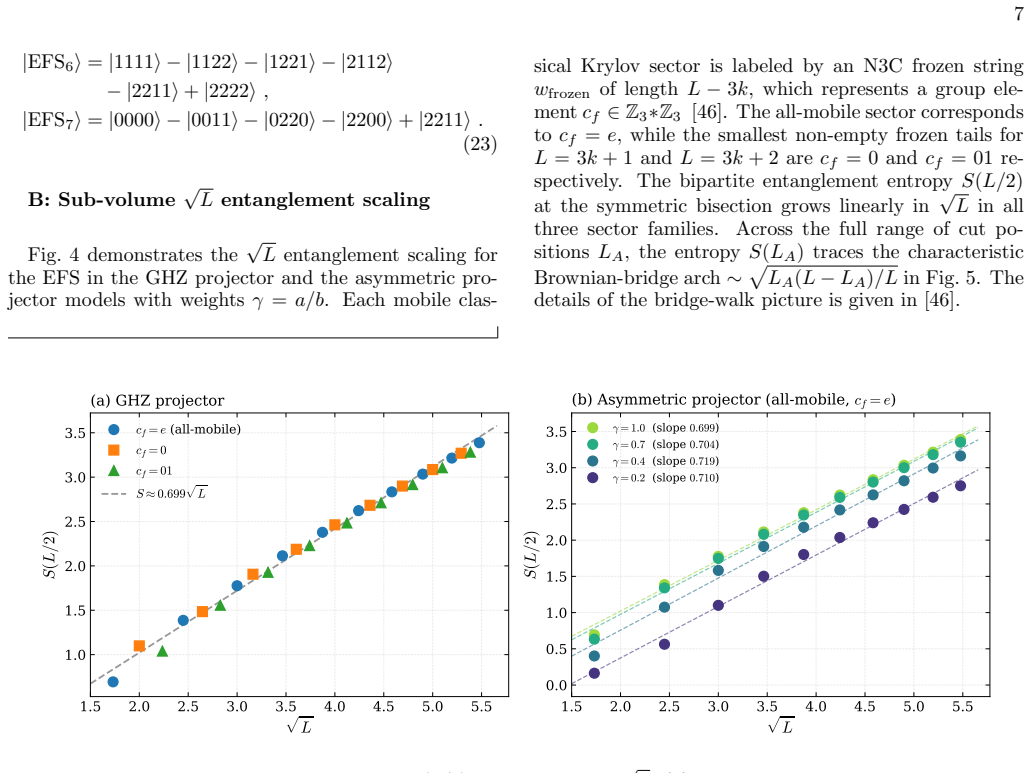
- In the asymmetric qubit and GHZ projector models the all-mobile-sector entangled frozen subspace exhibits bipartite entanglement entropy scaling as S ~ sqrt(L).
- Closed-form expressions exist for the irreducible Krylov dimensions, degeneracies, and sector multiplicities in the asymmetric and GHZ cases.
- The same rank-deficiency mechanism applies across models with no symmetry, Z2 symmetry, Z3 symmetry, and Temperley-Lieb algebra structure.
Where Pith is reading between the lines
- The same local null-direction construction might be used to engineer protected entangled subspaces for quantum information storage inside otherwise mobile many-body systems.
- If the mechanism is generic, then any classical fragmentation arising from projector constraints could be lifted into a quantum version simply by checking the rank of the effective Hamiltonian on each sector.
- The weak-strong distinction introduced here parallels the classical case and suggests that level statistics alone may not diagnose ergodicity once frozen subspaces are present.
Load-bearing premise
Rank deficiency of the local Hamiltonian reliably produces local null directions that generate entangled frozen states in general classically fragmented models, not only in the four projector cases studied.
What would settle it
Constructing or simulating a classically fragmented model whose local Hamiltonian has rank deficiency yet produces no entangled frozen states inside its mobile sectors, or conversely a model with entangled frozen states but no rank deficiency, would falsify the proposed mechanism.
Figures



read the original abstract
We find that rank deficiency of the local Hamiltonian in a classically fragmented model is the key mechanism leading to quantum Hilbert space fragmentation. The rank deficiency produces local null directions that can generate entangled frozen states (EFS): entangled states embedded in mobile classical Krylov sectors that do not evolve under Hamiltonian dynamics. When the entangled frozen subspace is non-empty, the mobile classical sector splits into a mobile quantum Krylov subspace and an entangled frozen subspace, and the model exhibits quantum fragmentation. We establish this mechanism in four models of increasing symmetry structure: an asymmetric qubit projector with no symmetry, the $\mathbb{Z}_2$-symmetric GHZ projector, a $\mathbb{Z}_3$-symmetric cyclic qutrit projector, and the Temperley-Lieb model. For the asymmetric and GHZ projector models, we obtain closed-form expressions for irreducible Krylov dimensions, degeneracies, and sector multiplicities. The all-mobile-sector EFS in these two models exhibits a sub-volume-law bipartite entanglement entropy scaling as $S \sim \sqrt{L}$. Further, we introduce the notion of weak and strong quantum fragmentation, the quantum counterpart of the weak-strong distinction in classical fragmentation. After removing the EFS, the mobile quantum Krylov subspace decomposes into irreducible blocks. In the weak case, the number of irreducible blocks remains $O(1)$, each is individually ergodic with Gaussian Orthogonal Ensemble (GOE) level statistics, and the unresolved spectrum follows an $m$GOE distribution. In the strong case, the number of irreducible blocks grows with system size, and the gap-ratio distribution approaches Poisson as $L\to\infty$.
Editorial analysis
A structured set of objections, weighed in public.
Referee Report
Summary. The manuscript claims that rank deficiency of the local Hamiltonian in classically fragmented models is the key mechanism for quantum Hilbert space fragmentation. This deficiency generates local null directions that produce entangled frozen states (EFS) embedded within mobile classical Krylov sectors; when the EFS subspace is non-empty, the sector splits into a mobile quantum Krylov subspace and a frozen subspace. The mechanism is established via explicit construction in four projector models of increasing symmetry (asymmetric qubit, Z2-symmetric GHZ, Z3 cyclic qutrit, Temperley-Lieb). Closed-form expressions for irreducible Krylov dimensions, degeneracies, and sector multiplicities are obtained for the first two models. The all-mobile EFS exhibit sub-volume-law entanglement S ~ sqrt(L). The paper introduces weak and strong quantum fragmentation: after EFS removal, the weak case has O(1) irreducible blocks that are ergodic (GOE statistics) with the unresolved spectrum following an mGOE distribution, while the strong case has a number of blocks that grows with L and approaches Poisson gap-ratio statistics.
Significance. If the central mechanism holds, the work supplies concrete analytical results (closed forms for Krylov data in two models) and a useful distinction between weak and strong quantum fragmentation, extending classical fragmentation concepts with potential relevance to constrained quantum dynamics. The explicit constructions and entanglement scaling provide falsifiable predictions and reproducible examples that strengthen the contribution.
major comments (2)
- [Abstract] Abstract: the claim that rank deficiency 'is the key mechanism leading to quantum Hilbert space fragmentation' rests on explicit constructions in four specific projector models, but no general argument or theorem is supplied showing that an arbitrary classically fragmented model whose local terms possess a kernel will automatically admit globally consistent, non-trivial EFS; compatibility of local null vectors across overlapping sites may impose additional constraints not implied by rank deficiency alone.
- [Weak and strong quantum fragmentation] The section introducing weak and strong quantum fragmentation: after EFS removal the decomposition into irreducible blocks is asserted to yield GOE statistics (weak) or Poisson (strong), but the manuscript provides no derivation or verification details for how the EFS projection is performed on the Krylov basis or for the resulting level statistics distributions.
minor comments (2)
- [Abstract] The abstract states closed-form expressions for Krylov dimensions and level statistics but does not indicate where the derivations appear or how they were verified (e.g., by direct diagonalization for small L).
- Notation for the four models should be introduced with explicit local projector definitions and symmetry generators in a dedicated section to aid reproducibility.
Simulated Author's Rebuttal
We thank the referee for the positive evaluation of our work and for the detailed comments, which have helped us improve the clarity and completeness of the manuscript. We address each major comment below.
read point-by-point responses
-
Referee: [Abstract] Abstract: the claim that rank deficiency 'is the key mechanism leading to quantum Hilbert space fragmentation' rests on explicit constructions in four specific projector models, but no general argument or theorem is supplied showing that an arbitrary classically fragmented model whose local terms possess a kernel will automatically admit globally consistent, non-trivial EFS; compatibility of local null vectors across overlapping sites may impose additional constraints not implied by rank deficiency alone.
Authors: We agree that the manuscript does not contain a general theorem for arbitrary classically fragmented models. Our central claim is established through explicit constructions in four representative projector models of increasing symmetry, where local rank deficiency is shown to generate globally consistent EFS. In the revised manuscript we have modified the abstract to read that rank deficiency 'is the key mechanism leading to quantum Hilbert space fragmentation in the models we consider.' We have also added a short paragraph in the introduction that explicitly discusses the compatibility of local null vectors on overlapping sites and verifies that the constructions satisfy the necessary consistency conditions for each of the four models. revision: yes
-
Referee: [Weak and strong quantum fragmentation] The section introducing weak and strong quantum fragmentation: after EFS removal the decomposition into irreducible blocks is asserted to yield GOE statistics (weak) or Poisson (strong), but the manuscript provides no derivation or verification details for how the EFS projection is performed on the Krylov basis or for the resulting level statistics distributions.
Authors: The referee is correct that the original text lacked explicit procedural details. In the revised version we have expanded the relevant section to include: (i) a precise algorithmic description of how the EFS subspace is identified within each classical Krylov sector and how the orthogonal projection onto the remaining mobile subspace is performed; (ii) the numerical protocol used to extract the irreducible blocks (including the construction of the effective Hamiltonian matrix in the projected basis); and (iii) the ensemble-averaging procedure and binning details for the gap-ratio distributions. New figures have been added that display the GOE and Poisson statistics explicitly for representative system sizes. revision: yes
Circularity Check
No significant circularity; claims rest on explicit constructions in four models
full rationale
The paper's central claim is established by direct calculation of rank deficiency, local null vectors, and resulting EFS in four concrete projector Hamiltonians (asymmetric qubit, Z2 GHZ, Z3 cyclic qutrit, Temperley-Lieb). Closed-form expressions for Krylov dimensions and sector multiplicities are derived for the first two models, and the weak/strong quantum fragmentation distinction is defined after removing the EFS subspace. No step reduces a prediction to a fitted input by construction, invokes a self-citation as the sole justification for a uniqueness theorem, or renames an input quantity. The mechanism is illustrated rather than asserted as universally proven from rank deficiency alone, but this does not create a circular derivation chain. The work is self-contained with respect to the models and quantities it explicitly computes.
Axiom & Free-Parameter Ledger
axioms (1)
- standard math Quantum dynamics is generated by a local Hamiltonian via unitary evolution on a finite-dimensional Hilbert space.
invented entities (1)
-
Entangled Frozen States (EFS)
no independent evidence
Lean theorems connected to this paper
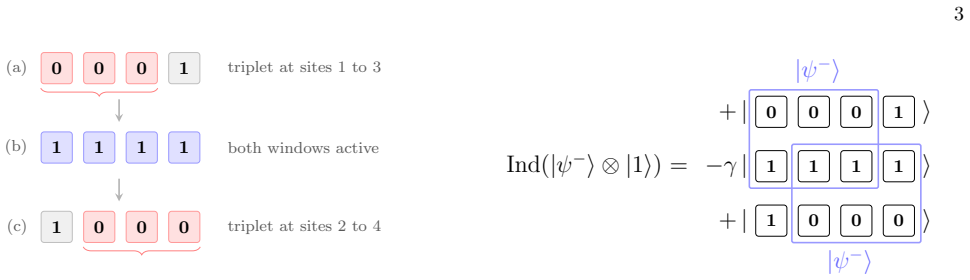
-
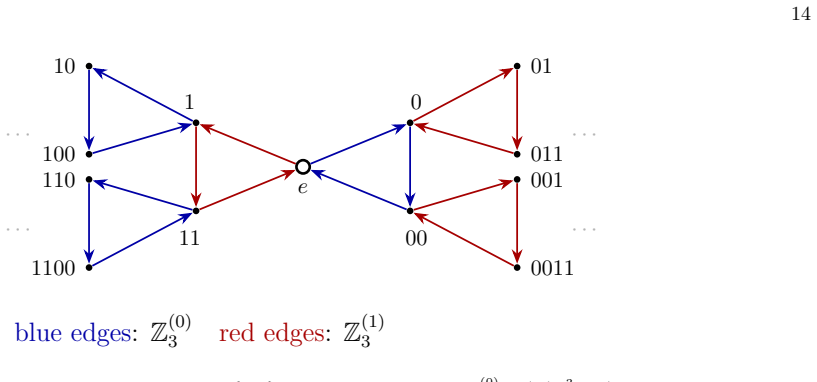
IndisputableMonolith/Cost/FunctionalEquation.leanwashburn_uniqueness_aczel unclear?
unclearRelation between the paper passage and the cited Recognition theorem.
rank deficiency of the local Hamiltonian in a classically fragmented model is the key mechanism leading to quantum Hilbert space fragmentation. The rank deficiency produces local null directions that can generate entangled frozen states (EFS)
-
IndisputableMonolith/Foundation/DimensionForcing.leanalexander_duality_circle_linking unclear?
unclearRelation between the paper passage and the cited Recognition theorem.
weak and strong quantum fragmentation... gap-ratio distribution approaches Poisson as L→∞
What do these tags mean?
- matches
- The paper's claim is directly supported by a theorem in the formal canon.
- supports
- The theorem supports part of the paper's argument, but the paper may add assumptions or extra steps.
- extends
- The paper goes beyond the formal theorem; the theorem is a base layer rather than the whole result.
- uses
- The paper appears to rely on the theorem as machinery.
- contradicts
- The paper's claim conflicts with a theorem or certificate in the canon.
- unclear
- Pith found a possible connection, but the passage is too broad, indirect, or ambiguous to say the theorem truly supports the claim.
Forward citations
Cited by 3 Pith papers
-
Hilbert Space Fragmentation from Generalized Symmetries
Generalized symmetries generate exponentially many Krylov sectors in quantum many-body systems, showing that Hilbert space fragmentation does not by itself imply ergodicity breaking.
-
Quantum Fragmentation
A Rokhsar-Kivelson-type construction turns classical or non-fragmented models into quantum fragmented Hamiltonians whose Krylov sectors require an entangled basis to resolve.
-
Simple slow operators and quantum thermalization
Absence of simple slow operators implies that typical low-complexity states thermalize in quantum systems.
Reference graph
Works this paper leans on
- [1]
-
[2]
S. Moudgalya, S. Rachel, B. A. Bernevig, and N. Reg- nault, Exact excited states of nonintegrable models, Phys. Rev. B98, 235155 (2018), arXiv:1708.05021 [cond- mat.str-el]
-
[3]
Moudgalya, B
S. Moudgalya, B. A. Bernevig, and N. Regnault, Quan- tum many-body scars in a Landau level on a thin torus, Physical Review B102, 195150 (2020)
2020
-
[4]
J. Ren, C. Liang, and C. Fang, Quasisymmetry Groups and Many-Body Scar Dynamics, Physical Review Letters 126, 120604 (2021)
2021
-
[5]
Y. Li, F. Pollmann, N. Read, and P. Sala, Highly en- tangled stationary states from strong symmetries, Phys. Rev. X15, 011068 (2025). 9
2025
-
[6]
Y. Li, P. Sala, and F. Pollmann, Hilbert space fragmenta- tion in open quantum systems, Phys. Rev. Res.5, 043239 (2023)
2023
-
[7]
S. Sahu, Y. Li, and P. Sala, Entanglement-cost hierar- chies in quantum fragmented mixed states, Phys. Rev. A 113, 022406 (2026)
2026
-
[8]
S. Moudgalya and O. I. Motrunich, From symmetries to commutant algebras in standard Hamiltonians, An- nals Phys.455, 169384 (2023), arXiv:2209.03370 [cond- mat.str-el]
-
[9]
S. Moudgalya and O. I. Motrunich, Exhaustive Char- acterization of Quantum Many-Body Scars Using Com- mutant Algebras, Phys. Rev. X14, 041069 (2024), arXiv:2209.03377 [cond-mat.str-el]
-
[10]
H. N. V. Temperley and E. H. Lieb, Relations be- tween the ‘percolation’ and ‘colouring’ problem and other graph-theoretical problems associated with regular pla- nar lattices: some exact results for the ‘percolation’ prob- lem, Proc. Roy. Soc. Lond. A322, 251 (1971)
1971
-
[11]
V. F. R. Jones, Index for subfactors, Invent. Math.72, 1 (1983)
1983
-
[12]
Lian, Quantum breakdown model: From many-body localization to chaos with scars, Phys
B. Lian, Quantum breakdown model: From many-body localization to chaos with scars, Phys. Rev. B107, 115171 (2023), arXiv:2208.10509 [cond-mat.str-el]
-
[13]
Hu and B
Y.-M. Hu and B. Lian, From the quantum breakdown model to the lattice gauge theory, AAPPS Bulletin34 (2024)
2024
-
[14]
Hu and B
Y.-M. Hu and B. Lian, Bosonic quantum breakdown hub- bard model, Physical Review B112(2025)
2025
-
[15]
Liu and B
X. Liu and B. Lian, Two-dimensional quantum break- down model with krylov subspace many-body localiza- tion, Phys. Rev. B111, 054302 (2025)
2025
- [16]
-
[17]
See Supplemental Material for details
-
[18]
Y. Han, O. Hart, A. Khudorozhkov, and R. Nandk- ishore, Quantum fragmentation, arXiv e-prints (2026), arXiv:2604.06461 [quant-ph]
work page internal anchor Pith review Pith/arXiv arXiv 2026
-
[19]
R. Movassagh and P. W. Shor, Supercritical entangle- ment in local systems: Counterexample to the area law for quantum matter, Proc. Nat. Acad. Sci.113, 13278 (2016), arXiv:1408.1657 [quant-ph]
-
[20]
E. P. Wigner,Group Theory and Its Application to the Quantum Mechanics of Atomic Spectra(Academic Press, New York, 1959)
1959
-
[21]
C. J. Bradley and B. L. Davies, Magnetic groups and their corepresentations, Rev. Mod. Phys.40, 359 (1968)
1968
-
[22]
D. Rumynin and J. Taylor, Real representations ofc 2-graded groups: The antilinear theory (2021), arXiv:2006.09765 [math.RT]
-
[23]
Oganesyan and D
V. Oganesyan and D. A. Huse, Localization of interacting fermions at high temperature, Phys. Rev. B75, 155111 (2007)
2007
- [24]
-
[25]
Bohigas, M
O. Bohigas, M. J. Giannoni, and C. Schmit, Character- ization of chaotic quantum spectra and universality of level fluctuation laws, Phys. Rev. Lett.52, 1 (1984)
1984
-
[26]
M. V. Berry and M. Tabor, Level clustering in the regular spectrum, Proc. Roy. Soc. Lond. A356, 375 (1977)
1977
- [27]
-
[28]
Revuz and M
D. Revuz and M. Yor,Continuous martingales and Brow- nian motion(Springer Science & Business Media, 2013)
2013
-
[29]
S. P. Lalley, Finite range random walk on free groups and homogeneous trees, The Annals of Probability , 2087 (1993)
2087
-
[30]
Bj¨ orklund, Central limit theorems for gromov hyper- bolic groups, Journal of theoretical probability23, 871 (2010)
M. Bj¨ orklund, Central limit theorems for gromov hyper- bolic groups, Journal of theoretical probability23, 871 (2010)
2010
-
[31]
Gou¨ ezel, Local limit theorem for symmetric random walks in gromov-hyperbolic groups, Journal of the Amer- ican Mathematical Society27, 893 (2014)
S. Gou¨ ezel, Local limit theorem for symmetric random walks in gromov-hyperbolic groups, Journal of the Amer- ican Mathematical Society27, 893 (2014)
2014
-
[32]
OEIS Foundation, Entry A213028 in The On-Line Ency- clopedia of Integer Sequences (2024)
2024
-
[33]
OEIS Foundation, Entry A047098 in The On-Line Ency- clopedia of Integer Sequences (2024)
2024
-
[34]
C. R. Cornwell and S. P. Humphries, Counting funda- mental paths in certain garside semigroups, Journal of Knot Theory and Its Ramifications17, 191 (2008)
2008
-
[35]
Huet, Confluent Reductions: Abstract Properties and Applications to Term Rewriting Systems, J
G. Huet, Confluent Reductions: Abstract Properties and Applications to Term Rewriting Systems, J. ACM27, 797 (1980)
1980
-
[36]
Quantum Hilbert Space Fragmentation and Entangled Frozen States
R. P. Stanley,Enumerative Combinatorics, Volume 2 (Cambridge University Press, 1999). 10 Supplemental Material for “Quantum Hilbert Space Fragmentation and Entangled Frozen States” Zihan Zhou, Tian-Hua Yang, and Bo-Ting Chen Department of Physics, Princeton University, NJ 08544, USA CONTENTS References 8 A. Quantum Hilbert space fragmentation in the quant...
1999
-
[37]
Setup: the EFS ansatz 13
-
[38]
The groupZ 3 ∗Z 3 and its Cayley graph 13
-
[39]
Schmidt decomposition of EFS 14
-
[40]
Classical Krylov structure of the triplet flip model 18
Extensions 17 D. Classical Krylov structure of the triplet flip model 18
-
[41]
Krylov degeneracy 18
-
[42]
Classical Krylov structure of the cyclic qutrit model 19
Krylov dimension 19 E. Classical Krylov structure of the cyclic qutrit model 19
-
[43]
Conserved quantities and symmetries 20
-
[44]
Triplets and quasi-Krylovs 21
-
[45]
Single-triplet sectors 21
-
[46]
Multi-triplet sectors 22
-
[47]
Mathematical proofs 23
Summary 22 F. Mathematical proofs 23
-
[48]
Triplet flip model: Uniqueness of decomposition 23
-
[49]
Triplet flip model: Size of all-mobile Krylov subspaces 24
-
[50]
Cyclic qutrit model: Connectivity of Single-triplet Krylovs 27
-
[51]
Cyclic qutrit model: Multi-triplet sectors 28
-
[52]
ThemGOE gap-ratio distribution 29
-
[53]
Numerical results 32
Saddle-point derivation of the EFS entanglement scaling 31 G. Numerical results 32
-
[54]
Algorithm for finding classical Krylov subspaces 32
-
[55]
Algorithm for finding quantum Krylov subspaces 33
-
[56]
Krylov subspace structure of the triplet flip model 33
-
[57]
concatenate
Krylov subspace structure of the cyclic qutrit model 35 Appendix A: Quantum Hilbert space fragmentation in the quantum breakdown model The quantum breakdown model is a one-dimensional system that captures particle avalanche dynamics. The model comes in several variants, including fermionic, bosonic, and spin versions, all of which exhibit Hilbert space fr...
-
[58]
Setup: the EFS ansatz In the GHZ projector model, each classical mobile Krylov sector containsk≥1 mobile triplets and an|N3C⟩frozen tail of lengthL−3k. The entangled frozen state (EFS) in such a sector is the signed uniform superposition |EFS⟩= 1p D(L) X w (−1)N1(w)|w⟩,(C1) where the sum runs over all length-Lstringswin the sector,D(L) is the classical Kr...
-
[59]
The generator 0 then has order three (0·0·0 =e) and generates a copy ofZ 3, likewise 1 generates anotherZ 3
The groupZ 3 ∗Z 3 and its Cayley graph The semigroup⟨0,1|000 = 111⟩lifts to a group by declaring both triplets 000 and 111 to equal the identitye. The generator 0 then has order three (0·0·0 =e) and generates a copy ofZ 3, likewise 1 generates anotherZ 3. Since there is no relation mixing the two generators, the resulting group is the free product G=Z 3 ∗...
-
[60]
, L−1}, writingw=w AwB withw A ∈ {0,1} LA andw B ∈ {0,1} LB whereL B =L−L A
Schmidt decomposition of EFS We bisect the chain at any positionL A ∈ {1, . . . , L−1}, writingw=w AwB withw A ∈ {0,1} LA andw B ∈ {0,1} LB whereL B =L−L A. The EFS then takes the form |EFS⟩= 1p D(L) X (wA,wB) (−1)N1(wA)+N1(wB) |wA⟩ ⊗ |wB⟩,(C4) the sum restricted by the conditionf(w AwB) =c f withc f the reduced N3C frozen strings labeling the classical K...
-
[61]
We will show that, for the all-mobile sector cf =eand the bipartitionL A =L/2, this distribution gives a sub-volume entanglement scalingS(L A)∼ √ L
The √ Lscaling The identityS(L A) =H(p) reduces the entanglement calculation to a purely combinatorial question: the distribu- tion ofp cA =D cA(LA)D c−1 A cf (LB)/Dcf (L) over group elementsc A ∈G. We will show that, for the all-mobile sector cf =eand the bipartitionL A =L/2, this distribution gives a sub-volume entanglement scalingS(L A)∼ √ L. The count...
-
[62]
(C8) with the signs replaced by (−γ 1/3)N1
Extensions For the asymmetric projector with coupling ratioγ=a/b, the EFS ansatz generalizes by weighting each string by γN1(w)/3: |EFSγ⟩ ∝ X w (−γ1/3)N1(w)|w⟩.(C22) 18 The Schmidt decomposition takes the same form as Eq. (C8) with the signs replaced by (−γ 1/3)N1. Defining the weighted sector size Dγ c (ℓ) = X |w|=ℓ f(w)=c γ(2/3)N1(w),(C23) the Schmidt w...
-
[63]
It is generated by local Hamiltonian terms of the form|aaa⟩⟨bbb|
Krylov structure The triplet-flip model is a generalization of the pair-flip model. It is generated by local Hamiltonian terms of the form|aaa⟩⟨bbb|. Note that in the literature, the pair-flip model is usually accompanied by on-site potential termsn a i . The presence of such terms lifts the degeneracy of the computational basis, thus kills any quantum fr...
-
[64]
Krylov degeneracy Let the number of N3C strings of lengthLbed L. We can find a recurrence relation ford L by breaking down dL =d xx L +d xy L , whered xx L means N3C strings that end with two identical characters, andd xy L ends with distinct characters (assume thatL≥2). Then, we get two recurrence relations: (1)d xx L+1 =d xy L , since we cannot append a...
-
[65]
Let w=av, whereais its first character, andvis a frozen string of lengthL−3k
Krylov dimension The Krylov dimensionsD k(L) should satisfy the recurrence relation Dk(L+ 1) =D k(L) + (q−1)D k−1(L).(D6) To see this, consider a stringsof lengthL+ 1 that reduces to the normal formX kw, wherewis non-empty. Let w=av, whereais its first character, andvis a frozen string of lengthL−3k. Similarly, lets=bt, wherebis the first character, andti...
-
[66]
Ifa=b, thentreduces to normal formX kv
-
[67]
This can be proven by assuming thatthas normal formX mu, then matchingbt=bX mu=X mbutoX kw
Ifa̸=b, thentreduces to normal formX k−1bbw. This can be proven by assuming thatthas normal formX mu, then matchingbt=bX mu=X mbutoX kw. Eq. (D6) is then a direct consequence of this: the stringsin our subspaceX kwis eitheraplus a string in the subspaceX kv, or anyb̸=a(there areq−1 choices ofb) plus a string in the subspaceX k−1bbw. Based on Eq. (D6), all...
-
[68]
A frozen state would be a string such that no three consecutive characters form a permutation of{0,1,2}
Frozen states We begin the discussion with frozen states, or one-dimensional Krylov subspaces. A frozen state would be a string such that no three consecutive characters form a permutation of{0,1,2}. The number of frozen states can be obtained by a recurrence relation, similar to that in the triplet flip model. Considerd L =d 0 L +d + L +d − L, with strin...
-
[69]
Let us denoten a i as the number ofasymbol on thei-th site; that is,n a i = 1 if thei-th site is ana, andn a i = 0 otherwise
Conserved quantities and symmetries Before discussing the detailed Krylov space structure of the model, we identify some conserved quantities in the system. Let us denoten a i as the number ofasymbol on thei-th site; that is,n a i = 1 if thei-th site is ana, andn a i = 0 otherwise. Then,n 0 i +n 1 i +n 2 i = 1. We can see that the dynamics conserves N a =...
-
[70]
quasi-Krylov
Triplets and quasi-Krylovs We callX=abcanX(even) triplet, andY=acbaY(odd) triplet; explicitly, theXtriplets are 012,120,201 and theYtriplets are 021,102,210. It can be easily shown thatXandYcentralize the semigroup, i.e., they commute with any string. For example,Xa= (abc)a=a(bca) =aX. Notably, if we only apply one pair of the update rules, for example, c...
-
[71]
The single-triplet sector are defined as Krylov subspaces that consist of one or several quasi-Krylovs such that each of them havem X +m Y = 1
Single-triplet sectors We separate non-frozen Krylov subspaces into two broad classes, called the single-triplet sector and multi-triplet sector. The single-triplet sector are defined as Krylov subspaces that consist of one or several quasi-Krylovs such that each of them havem X +m Y = 1. We will soon see that single-triplet Krylov subspaces are qualitati...
-
[72]
However, we find the exact opposite: Krylov subspaces in the multi-triplet sectors are fully characterized by the invariants we identified in Section
Multi-triplet sectors The case where strings can contain more than one triplet appears to be more complex. However, we find the exact opposite: Krylov subspaces in the multi-triplet sectors are fully characterized by the invariants we identified in Section. E 2. Formally, all the strings with the same (N 0, N1, N2, D) that are not frozen or belong to a si...
-
[73]
As a specific example, we show all the Krylov sectors of this model atL= 9 in Table
Summary We summarize the full Krylov subspace structure of the classical cyclic qutrit model in Table III. As a specific example, we show all the Krylov sectors of this model atL= 9 in Table. IV. 23 Type of Krylov Example Number Symmetry Frozen aabbcc ∼( √ 2 + 1)L None Single-triplet, F1 abcabab poly(L) Z2 ifD= 0 andN a =N b Quasi-Krylov (F2,µ= 0) abcaabb...
-
[74]
To prove this, we introduce thecritical pair theorem[64]
Triplet flip model: Uniqueness of decomposition Theorem 1.In the triplet flip model, every string can be uniquely written asX kw, wherewis a frozen string. To prove this, we introduce thecritical pair theorem[64]. The theorem can be summarized as follows: Theorem 2.Consider a string rewriting system(Σ, R), whereΣis a finite alphabet andRis a finite set of...
-
[75]
w 1 is all-mobile
Triplet flip model: Size of all-mobile Krylov subspaces We will offer a proof of Eq. (D7), the formula for the number of all-mobile strings, by giving an explicit constructive characterization of all-mobile strings. We then verify that this implies Eq. (D8). Given a charactera, we definea-encompassed stringsas all-mobile strings such that it does not cont...
-
[76]
Only if” is obvious. To show “if
Cyclic qutrit model: Connectivity of Single-triplet Krylovs Theorem 6.IfN a, N b ≥1andN c = 1, then all the strings that are not frozen with the same(N 0, N1, N2, D)lie in the same orbit. Since we consider non-frozen strings, and thatN c = 1, any such string must be representable asXworY w, where wcontains onlyaandb. Let us consider starting with a string...
-
[77]
Since the rewriting rules preserve (N 0, N1, N2, D), strings with different invariants are certainly disconnected
Cyclic qutrit model: Multi-triplet sectors In this subsection, we argue that all non-frozen, non-single-triplet strings with the same (N 0, N1, N2, D) lie in the same Krylov subspace. Since the rewriting rules preserve (N 0, N1, N2, D), strings with different invariants are certainly disconnected. The non-trivial direction is to show that strings sharing ...
-
[78]
We present the full derivation following Ref
ThemGOE gap-ratio distribution Whenmindependent GOE blocks are superposed without resolving block labels, the gap-ratio distributionP m(r) interpolates between GOE (m= 1) and Poisson (m→ ∞). We present the full derivation following Ref. [56]. Theorem 8.LetX 1, . . . , Xm be independent stationary unfolded spectra onRwith intensitiesµ i >0, Pm i=1 µi = 1. ...
-
[79]
Specializing the Schmidt weights of Eq
Saddle-point derivation of the EFS entanglement scaling This appendix gives an independent rigorous derivation ofS∼ √ Lfor the EFS in the all-mobile sector at the symmetric bisectionL A =L/2. Specializing the Schmidt weights of Eq. (C9) toc f =eandL A =L B =L/2, S=− X c∈G Dc(L/2)D c−1(L/2) D(L) log Dc(L/2)D c−1(L/2) D(L) ,(F26) whereD c(ℓ) counts length-ℓ...
-
[80]
We exemplify this with the cyclic qutrit model
Algorithm for finding classical Krylov subspaces Finding the classical Krylov subspaces of a model is equivalence to finding the orbits of semigroup words under the equivalence relations. We exemplify this with the cyclic qutrit model. Setup. —Let Σ ={0,1,2}and consider the semigroup acting on Σ L generated by local rewrite rules arising from cyclic permu...
discussion (0)
Sign in with ORCID, Apple, or X to comment. Anyone can read and Pith papers without signing in.