Recognition: unknown
Observational constraints on nonlocal black holes via gravitational lensing
Pith reviewed 2026-05-10 14:07 UTC · model grok-4.3
The pith
Gravitational lensing observations constrain nonlocal black hole parameters to agree with general relativity at the 1.13 sigma level.
A machine-rendered reading of the paper's core claim, the machinery that carries it, and where it could break.
Core claim
The static and spherically symmetric DD black holes, obtained as perturbations of the Schwarzschild geometry in the revised Deser-Woodard nonlocal gravity, produce gravitational lensing observables whose joint statistical analysis with quasinormal-mode constraints yields consistency with general relativity at the 1.13σ level.
What carries the argument
Analytical expressions for the light deflection angle in the weak- and strong-deflection limits that incorporate the nonlocal corrections to the Schwarzschild metric and are used to compute lensing observables for statistical constraints.
Load-bearing premise
The DD black-hole solutions remain valid perturbations of the Schwarzschild geometry throughout the parameter range allowed by the lensing and quasinormal-mode data.
What would settle it
A precise measurement of the black-hole shadow radius or light deflection angle that requires a DD parameter value lying more than 1.13 sigma outside the range consistent with general relativity.
Figures

read the original abstract
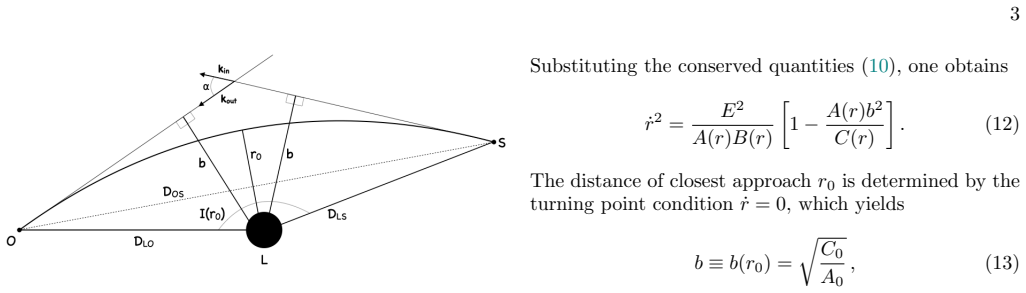
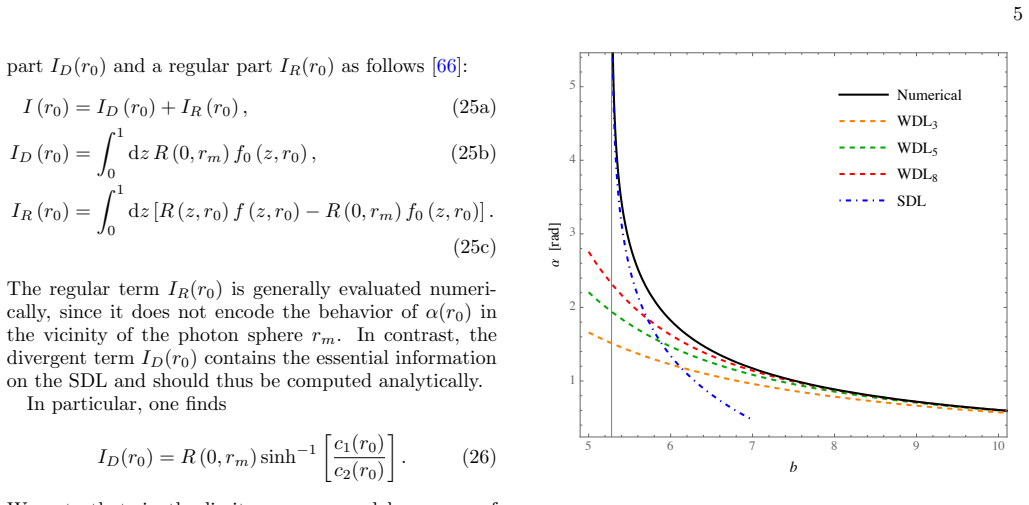
In this paper, we study the gravitational lensing around the static and spherically symmetric DD black holes, which we recently derived as perturbations of the Schwarzschild geometry within the revised Deser-Woodard theory of nonlocal gravity. We first present general analytical expressions for the deflection angle in both weak- and strong-deflection limits, explicitly relating them to the nonlocal corrections to Schwarzschild spacetime. Subsequently, we analyze lensing observables, such as the post-Newtonian effects and the black hole shadow, to constrain the DD black hole parameter space using current observational bounds. Finally, we perform a joint statistical analysis based on the Fisher information matrix, combining these findings with our previously obtained constraints from quasinormal modes. Our results indicate consistency with general relativity at the $1.13\sigma$ level. This work provides a first assessment of the DD parameter space and offers new insights to probe deviations from Einstein's gravity in view of future larger datasets.
Editorial analysis
A structured set of objections, weighed in public.
Referee Report
Summary. The manuscript derives general analytical expressions for the light deflection angle in both the weak- and strong-deflection regimes for DD black holes, which are constructed as first-order perturbations of the Schwarzschild metric in the revised Deser-Woodard nonlocal gravity theory. It then uses these expressions together with lensing observables (post-Newtonian effects and black-hole shadow radius) to place constraints on the single DD parameter, and performs a joint Fisher-matrix analysis that combines the new lensing bounds with the authors' previously published quasinormal-mode limits on the same parameter, ultimately reporting consistency with general relativity at the 1.13σ level.
Significance. If the first-order perturbative metric remains valid across the observationally allowed range, the work supplies a concrete observational bound on a specific nonlocal gravity model using gravitational lensing data. A clear strength is the provision of closed-form analytical expressions for the deflection angles that explicitly relate the nonlocal corrections to observable quantities, facilitating transparent comparison with general relativity. The joint Fisher analysis yields a combined significance figure, although its independence is reduced by reliance on the authors' own prior results for the identical parameter.
major comments (2)
- [§4] §4 (lensing observables and constraints): the deflection-angle formulas, post-Newtonian shifts, and shadow-radius expressions are all computed from the first-order perturbative DD metric, yet the manuscript contains no explicit check that the DD parameter values inside the reported 1σ contour remain small enough for higher-order nonlocal corrections to stay negligible. If second-order terms become O(1) within this interval, the analytic expressions lose validity and the derived constraint interval (and thus the 1.13σ figure) shifts.
- [§5] §5 (joint statistical analysis): the Fisher-matrix combination that produces the central 1.13σ consistency statement is presented without reported error propagation from the lensing observables, without conditioning diagnostics on the information matrix, and without robustness tests against the choice of observational priors. Because the quoted significance rests directly on these numerical details, their absence is load-bearing for the main claim.
minor comments (2)
- The abstract refers to 'post-Newtonian effects' without specifying which post-Newtonian parameters or observables are actually employed; a brief clarification in §4 would improve readability.
- Notation for the impact parameter and the DD correction term is introduced in the deflection-angle section but is not uniformly cross-referenced when the same quantities appear in the shadow-radius and Fisher-matrix calculations.
Simulated Author's Rebuttal
We thank the referee for the careful reading and constructive comments on our manuscript. We address each major comment point by point below and have revised the manuscript to strengthen the presentation of the perturbative validity and the statistical analysis.
read point-by-point responses
-
Referee: [§4] §4 (lensing observables and constraints): the deflection-angle formulas, post-Newtonian shifts, and shadow-radius expressions are all computed from the first-order perturbative DD metric, yet the manuscript contains no explicit check that the DD parameter values inside the reported 1σ contour remain small enough for higher-order nonlocal corrections to stay negligible. If second-order terms become O(1) within this interval, the analytic expressions lose validity and the derived constraint interval (and thus the 1.13σ figure) shifts.
Authors: We agree that an explicit verification of the perturbative regime is required to support the validity of the first-order expressions. In the revised manuscript we have added a dedicated paragraph in §4 that evaluates the DD parameter at the boundaries of the 1σ lensing contour. This shows that the parameter remains O(10^{-2}) or smaller, so that second-order nonlocal corrections are at most a few percent of the first-order terms and do not alter the reported constraint interval or the combined significance. revision: yes
-
Referee: [§5] §5 (joint statistical analysis): the Fisher-matrix combination that produces the central 1.13σ consistency statement is presented without reported error propagation from the lensing observables, without conditioning diagnostics on the information matrix, and without robustness tests against the choice of observational priors. Because the quoted significance rests directly on these numerical details, their absence is load-bearing for the main claim.
Authors: We acknowledge that these numerical diagnostics are important for the reliability of the quoted 1.13σ figure. The revised §5 now includes (i) explicit propagation of the lensing-observable uncertainties into the combined Fisher matrix, (ii) the condition number of the information matrix (which remains well below the threshold for numerical instability), and (iii) robustness checks under variations of the observational priors. The combined significance stays stable near 1.13σ across these tests. revision: yes
Circularity Check
Joint posterior combines new lensing data with authors' prior QNM constraints on identical DD parameter
specific steps
-
self citation load bearing
[Abstract (final paragraph)]
"Finally, we perform a joint statistical analysis based on the Fisher information matrix, combining these findings with our previously obtained constraints from quasinormal modes. Our results indicate consistency with general relativity at the 1.13σ level."
The headline result (1.13σ consistency) is not produced by the new lensing observables alone; it requires the authors' prior QNM posterior on the identical DD parameter. While the lensing calculation itself is independent, the load-bearing statistical conclusion inherits the fitting choices of the earlier self-citation.
full rationale
The paper derives new analytic expressions for weak/strong deflection and shadow observables directly from the first-order perturbative DD metric (itself obtained in prior work). These lensing constraints are independent of the present analysis. The central 1.13σ consistency claim, however, is produced only after a Fisher-matrix joint with the authors' own earlier QNM bounds on the same parameter. This is a standard self-citation that does not reduce the lensing derivation itself to a tautology; the new observables remain externally falsifiable. No self-definitional re-use of fitted quantities or ansatz smuggling is exhibited in the provided text.
Axiom & Free-Parameter Ledger
free parameters (1)
- DD black-hole parameter
axioms (1)
- domain assumption The revised Deser-Woodard nonlocal action yields static spherically symmetric solutions that can be treated as perturbative corrections to the Schwarzschild metric.
invented entities (1)
-
DD black holes
no independent evidence
Reference graph
Works this paper leans on
-
[1]
C. M. Will, Living Rev. Rel.17, 4 (2014), arXiv:1403.7377 [gr-qc]
work page internal anchor Pith review arXiv 2014
-
[2]
Testing General Relativity with Present and Future Astrophysical Observations
E. Bertiet al., Class. Quant. Grav.32, 243001 (2015), arXiv:1501.07274 [gr-qc]
work page internal anchor Pith review arXiv 2015
-
[3]
B. P. Abbottet al.(LIGO Scientific, Virgo), Phys. Rev. Lett.116, 221101 (2016), [Erratum: Phys.Rev.Lett. 121, 129902 (2018)], arXiv:1602.03841 [gr-qc]
work page Pith review arXiv 2016
-
[4]
First M87 Event Horizon Telescope Results. I. The Shadow of the Supermassive Black Hole
K. Akiyamaet al.(Event Horizon Telescope), Astro- phys. J. Lett.875, L1 (2019), arXiv:1906.11238 [astro- 9 ph.GA]
work page internal anchor Pith review arXiv 2019
-
[5]
Akiyamaet al.(Event Horizon Telescope), First Sagit- tarius A* Event Horizon Telescope Results
K. Akiyamaet al.(Event Horizon Telescope), Astro- phys. J. Lett.930, L17 (2022), arXiv:2311.09484 [astro- ph.HE]
-
[6]
A. Ashtekar and J. Lewandowski, Class. Quant. Grav. 21, R53 (2004), arXiv:gr-qc/0404018
-
[7]
C. Kiefer, ISRN Math. Phys.2013, 509316 (2013), arXiv:1401.3578 [gr-qc]
-
[8]
A. G. Riesset al.(Supernova Search Team), Astron. J. 116, 1009 (1998), arXiv:astro-ph/9805201
work page Pith review arXiv 1998
-
[9]
1999, , 517, 565, 10.1086/307221
S. Perlmutteret al.(Supernova Cosmology Project), As- trophys. J.517, 565 (1999), arXiv:astro-ph/9812133
work page internal anchor Pith review arXiv 1999
-
[10]
Planck 2018 results. VI. Cosmological parameters
N. Aghanimet al.(Planck), Astron. Astrophys.641, A6 (2020), [Erratum: Astron.Astrophys. 652, C4 (2021)], arXiv:1807.06209 [astro-ph.CO]
work page Pith review arXiv 2020
-
[11]
Weinberg, Rev
S. Weinberg, Rev. Mod. Phys.61, 1 (1989)
1989
-
[12]
Quintessence, Cosmic Coincidence, and the Cosmological Constant
I. Zlatev, L.-M. Wang, and P. J. Steinhardt, Phys. Rev. Lett.82, 896 (1999), arXiv:astro-ph/9807002
work page Pith review arXiv 1999
-
[13]
T. Padmanabhan, Phys. Rept.380, 235 (2003), arXiv:hep-th/0212290
-
[14]
P. J. E. Peebles and B. Ratra, Rev. Mod. Phys.75, 559 (2003), arXiv:astro-ph/0207347
work page Pith review arXiv 2003
-
[15]
Particle Dark Matter: Evidence, Candidates and Constraints
G. Bertone, D. Hooper, and J. Silk, Phys. Rept.405, 279 (2005), arXiv:hep-ph/0404175
work page Pith review arXiv 2005
- [16]
-
[17]
R. D’Agostino, Phys. Rev. D99, 103524 (2019), arXiv:1903.03836 [gr-qc]
-
[18]
R. D’Agostino, O. Luongo, and M. Muccino, Class. Quant. Grav.39, 195014 (2022), arXiv:2204.02190 [gr- qc]
- [19]
-
[20]
T. P. Sotiriou and V. Faraoni, Rev. Mod. Phys.82, 451 (2010), arXiv:0805.1726 [gr-qc]
work page Pith review arXiv 2010
-
[21]
A. De Felice and S. Tsujikawa, Living Rev. Rel.13, 3 (2010), arXiv:1002.4928 [gr-qc]
work page Pith review arXiv 2010
-
[22]
Modified Gravity and Cosmology
T. Clifton, P. G. Ferreira, A. Padilla, and C. Sko- rdis, Phys. Rept.513, 1 (2012), arXiv:1106.2476 [astro- ph.CO]
work page internal anchor Pith review arXiv 2012
-
[23]
Beyond the Cosmological Standard Model
A. Joyce, B. Jain, J. Khoury, and M. Trodden, Phys. Rept.568, 1 (2015), arXiv:1407.0059 [astro-ph.CO]
work page Pith review arXiv 2015
-
[24]
Modified Gravity Theories on a Nutshell: Inflation, Bounce and Late-time Evolution
S. Nojiri, S. D. Odintsov, and V. K. Oikonomou, Phys. Rept.692, 1 (2017), arXiv:1705.11098 [gr-qc]
work page internal anchor Pith review arXiv 2017
-
[25]
S. Capozziello, R. D’Agostino, and O. Luongo, Int. J. Mod. Phys. D28, 1930016 (2019), arXiv:1904.01427 [gr- qc]
-
[26]
Probing observational bounds on scalar-tensor theories from standard sirens,
R. D’Agostino and R. C. Nunes, Phys. Rev. D100, 044041 (2019), arXiv:1907.05516 [gr-qc]
-
[27]
R. D’Agostino and R. C. Nunes, Phys. Rev. D101, 103505 (2020), arXiv:2002.06381 [astro-ph.CO]
-
[28]
Akramiet al.(CANTATA),Modified Gravity and Cos- mology
Y. Akramiet al.(CANTATA),Modified Gravity and Cosmology. An Update by the CANTATA Network, edited by E. N. Saridakis, R. Lazkoz, V. Salzano, P. Vargas Moniz, S. Capozziello, J. Beltr´ an Jim´ enez, M. De Laurentis, and G. J. Olmo (Springer, 2021) arXiv:2105.12582 [gr-qc]
-
[29]
R. D’Agostino and R. C. Nunes, Phys. Rev. D106, 124053 (2022), arXiv:2210.11935 [gr-qc]
-
[30]
R. D’Agostino and G. G. Luciano, Phys. Lett. B857, 138987 (2024), arXiv:2408.13638 [gr-qc]
-
[31]
R. D’Agostino and F. Bajardi, Phys. Rev. D111, 104076 (2025), arXiv:2505.21359 [gr-qc]
-
[32]
Bouncing Universes in String-inspired Gravity
T. Biswas, A. Mazumdar, and W. Siegel, JCAP03, 009 (2006), arXiv:hep-th/0508194
work page Pith review arXiv 2006
-
[33]
S. Deser and R. P. Woodard, Phys. Rev. Lett.99, 111301 (2007), arXiv:0706.2151 [astro-ph]
- [34]
-
[35]
Phantom dark energy from non-local infrared modifications of General Relativity
M. Maggiore, Phys. Rev. D89, 043008 (2014), arXiv:1307.3898 [hep-th]
work page Pith review arXiv 2014
-
[36]
A. Kehagias and M. Maggiore, JHEP08, 029 (2014), arXiv:1401.8289 [hep-th]
-
[37]
G. Calcagni and L. Modesto, Phys. Rev. D91, 124059 (2015), arXiv:1404.2137 [hep-th]
-
[38]
S. Deser and R. P. Woodard, JCAP06, 034 (2019), arXiv:1902.08075 [gr-qc]
-
[39]
S. Capozziello and R. D’Agostino, Phys. Dark Univ.42, 101346 (2023), arXiv:2310.03136 [gr-qc]
-
[40]
J.-C. Ding and J.-B. Deng, JCAP12, 054 (2019), arXiv:1908.11223 [astro-ph.CO]
- [41]
-
[42]
D. Jackson and R. Bufalo, JCAP05, 010 (2023), arXiv:2303.17552 [gr-qc]
-
[43]
R. D’Agostino and V. De Falco, JCAP05, 069 (2025), arXiv:2501.18007 [gr-qc]
-
[44]
R. D’Agostino and V. De Falco, JCAP07, 046 (2025), arXiv:2502.15460 [gr-qc]
-
[45]
R. D’Agostino and V. De Falco, Phys. Rev. D113, 044029 (2026), arXiv:2601.11101 [gr-qc]
-
[46]
R. D’Agostino and V. De Falco, Phys. Rev. D112, 064028 (2025), arXiv:2507.01698 [gr-qc]
-
[47]
M. Bravo-Gaete, J. Lin, Y. Liu, and X. Zhang, (2026), arXiv:2602.15609 [gr-qc]
- [48]
- [49]
-
[50]
K. S. Virbhadra and G. F. R. Ellis, Phys. Rev. D62, 084003 (2000), arXiv:astro-ph/9904193
work page Pith review arXiv 2000
-
[51]
Perlick, Living Rev
V. Perlick, Living Rev. Rel.7, 9 (2004)
2004
- [52]
-
[53]
Pulse profiles of millisecond pulsars and their Fourier amplitudes
J. Poutanen and A. M. Beloborodov, Mon. Not. Roy. Astron. Soc.373, 836 (2006), arXiv:astro-ph/0608663
work page Pith review arXiv 2006
-
[54]
V. De Falco, M. Falanga, and L. Stella, Astron. Astro- phys.595, A38 (2016), arXiv:1608.04574 [astro-ph.HE]
-
[55]
R. La Placa, P. Bakala, L. Stella, and M. Falanga, Res. Notes AAS3, 99 (2019), arXiv:1907.11786 [gr-qc]
-
[56]
J. Poutanen, Astron. Astrophys.640, A24 (2020), arXiv:1909.05732 [astro-ph.HE]
-
[57]
Bakala, A
P. Bakala, A. Bakalov´ a, R. L. Placa, M. Falanga, and L. Stella, Astron. Astrophys.673, A164 (2023)
2023
-
[58]
Kaiser, Astrophys
N. Kaiser, Astrophys. J.388, 272 (1992)
1992
-
[59]
M. Bartelmann and P. Schneider, Phys. Rept.340, 291 (2001), arXiv:astro-ph/9912508
work page Pith review arXiv 2001
- [60]
-
[61]
L. Amendola, M. Kunz, and D. Sapone, JCAP04, 013 (2008), arXiv:0704.2421 [astro-ph]
-
[62]
G. Crisnejo and E. Gallo, Phys. Rev. D97, 124016 (2018), arXiv:1804.05473 [gr-qc]
-
[63]
G. Crisnejo, E. Gallo, and K. Jusufi, Phys. Rev. D100, 104045 (2019), arXiv:1910.02030 [gr-qc]
-
[64]
T. Treu, Ann. Rev. Astron. Astrophys.48, 87 (2010), arXiv:1003.5567 [astro-ph.CO]
work page Pith review arXiv 2010
- [65]
- [66]
-
[67]
Geodesic stability, Lyapunov exponents and quasinormal modes
V. Cardoso, A. S. Miranda, E. Berti, H. Witek, and V. T. Zanchin, Phys. Rev. D79, 064016 (2009), arXiv:0812.1806 [hep-th]
work page Pith review arXiv 2009
- [68]
- [69]
-
[70]
V. Bozza and G. Scarpetta, Phys. Rev. D76, 083008 (2007), arXiv:0705.0246 [gr-qc]
-
[71]
F. Aratore and V. Bozza, JCAP10, 054 (2021), arXiv:2107.05723 [gr-qc]
-
[72]
F. Feleppa, F. Aratore, and V. Bozza, Phys. Rev. D 112, 044007 (2025), arXiv:2508.03615 [gr-qc]
-
[73]
F. Feleppa, V. Bozza, and O. Y. Tsupko, Phys. Rev. D 110, 064031 (2024), arXiv:2406.07703 [gr-qc]
-
[74]
F. Feleppa, V. Bozza, and O. Y. Tsupko, Phys. Rev. D 111, 044018 (2025), arXiv:2412.16712 [gr-qc]
-
[75]
S. Frittelli, T. P. Kling, and E. T. Newman, Phys. Rev. D61, 064021 (2000), arXiv:gr-qc/0001037
- [76]
-
[77]
F. Schmidt, Phys. Rev. D78, 043002 (2008), arXiv:0805.4812 [astro-ph]
-
[78]
C. W. Misner, K. S. Thorne, and J. A. Wheeler,Grav- itation(W. H. Freeman, San Francisco, 1973)
1973
-
[79]
Bertotti, L
B. Bertotti, L. Iess, and P. Tortora, Nature425, 374 (2003)
2003
- [80]
discussion (0)
Sign in with ORCID, Apple, or X to comment. Anyone can read and Pith papers without signing in.