Recognition: unknown
Out of Context: Reliability in Multimodal Anomaly Detection Requires Contextual Inference
Pith reviewed 2026-05-10 16:06 UTC · model grok-4.3
The pith
Multimodal anomaly detection must separate context from observations to define abnormalities conditionally rather than against a single reference.
A machine-rendered reading of the paper's core claim, the machinery that carries it, and where it could break.
Core claim
The paper establishes that multimodal anomaly detection should be reframed as a cross-modal contextual inference problem. In this view, different modalities assume asymmetric roles: some capture the operating conditions as context, while others provide the observations whose normality is evaluated conditionally on that context. This replaces the assumption of a single global reference model of normality with conditional definitions of abnormality, addressing the structural ambiguity that arises when context and anomaly signals are mixed.
What carries the argument
The central mechanism is the asymmetric separation of modalities into context-inferring and observation-assessing streams to enable conditional abnormality detection.
If this is right
- Models must be designed to infer context from one set of modalities and condition anomaly scores on it.
- Evaluation protocols should test performance across varying contexts rather than averaged.
- Benchmark datasets need to incorporate explicit context labels or variations.
- This approach reduces instability in heterogeneous deployment environments.
Where Pith is reading between the lines
- This reframing may apply to other multimodal tasks like classification or generation where context matters.
- A testable extension would be to create datasets with labeled contexts and compare conditional vs unconditional detectors.
- It connects to ideas in causal machine learning by treating context as a conditioning variable.
Load-bearing premise
The assumption that anomalies are frequently context-dependent, such that failing to separate context from observations creates unavoidable ambiguity in defining normality.
What would settle it
A dataset where context-dependent anomalies are present, and a symmetric multimodal method achieves comparable or better performance than a method that explicitly separates and conditions on context, would challenge the need for this reframing.
Figures

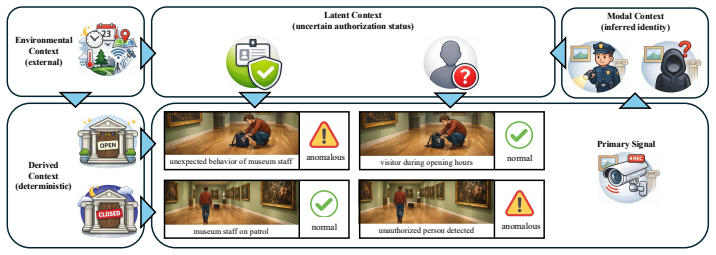
read the original abstract
Anomaly detection aims to identify observations that deviate from expected behavior. Because anomalous events are inherently sparse, most frameworks are trained exclusively on normal data to learn a single reference model of normality. This implicitly assumes that normal behavior can be captured by a single, unconditional reference distribution. In practice, however, anomalies are often context-dependent: A specific observation may be normal under one operating condition, yet anomalous under another. As machine learning systems are deployed in dynamic and heterogeneous environments, these fixed-context assumptions introduce structural ambiguity, i.e., the inability to distinguish contextual variation from genuine abnormality under marginal modeling, leading to unstable performance and unreliable anomaly assessments. While modern sensing systems frequently collect multimodal data capturing complementary aspects of both system behavior and operating conditions, existing methods treat all data streams equally, without distinguishing contextual information from anomaly-relevant signals. As a result, abnormality is often evaluated without explicitly conditioning on operating conditions. We argue that multimodal anomaly detection should be reframed as a cross-modal contextual inference problem, in which modalities play asymmetric roles, separating context from observation, to define abnormality conditionally rather than relative to a single global reference. This perspective has implications for model design, evaluation protocols, and benchmark construction, and outline open research challenges toward robust, context-aware multimodal anomaly detection.
Editorial analysis
A structured set of objections, weighed in public.
Referee Report
Summary. The manuscript is a perspective piece arguing that multimodal anomaly detection suffers from structural ambiguity under marginal modeling because existing methods treat all data streams equally without distinguishing contextual information from anomaly-relevant signals. It proposes reframing the task as a cross-modal contextual inference problem in which modalities play asymmetric roles, separating context from observation to define abnormality conditionally rather than relative to a single global reference, with implications for model design, evaluation, and benchmarks.
Significance. If pursued, the reframing could improve reliability of anomaly detection in dynamic, heterogeneous environments by promoting context-aware conditional modeling. The perspective identifies open research challenges that may usefully guide subsequent work on multimodal systems, though its impact will depend on whether the conceptual distinction leads to concrete methodological advances.
minor comments (1)
- [Abstract] Abstract: the description of structural ambiguity is clear at a high level but would benefit from one brief, concrete example (e.g., a sensor reading that is normal under one operating condition but anomalous under another) to make the practical consequence more immediate for readers.
Simulated Author's Rebuttal
We thank the referee for the positive assessment and the recommendation to accept the manuscript. The summary accurately reflects the central thesis of our perspective piece.
Circularity Check
No significant circularity identified
full rationale
The paper is a perspective piece advancing a conceptual reframing of multimodal anomaly detection as cross-modal contextual inference with asymmetric modality roles. Its central argument rests on stated premises about context-dependent anomalies and the limitations of marginal modeling in existing methods, without any equations, derivations, fitted parameters, or technical results that could reduce to self-referential inputs. No self-citations appear in the provided text, and the reasoning chain is self-contained as a call to reframe the problem rather than a derivation that collapses by construction.
Axiom & Free-Parameter Ledger
axioms (1)
- domain assumption Anomalies are often context-dependent and current multimodal methods do not separate context from anomaly signals
Reference graph
Works this paper leans on
-
[1]
UBnormal: New Benchmark for Supervised Open-Set Video Anomaly Detection
Andra Acsintoae et al. “UBnormal: New Benchmark for Supervised Open-Set Video Anomaly Detection”. In:Proc. CVPR. 2022
2022
-
[2]
Aggarwal.Outlier Analysis
Charu C. Aggarwal.Outlier Analysis. 2nd. Springer, 2017
2017
-
[3]
Unsupervised real-time anomaly detection for streaming data
Subutai Ahmad et al. “Unsupervised real-time anomaly detection for streaming data”. In: Neurocomputing262 (2017)
2017
-
[4]
Flamingo: a Visual Language Model for Few-Shot Learning
Jean-Baptiste Alayrac et al. “Flamingo: a Visual Language Model for Few-Shot Learning”. In: Proc. NeurIPS. 2022
2022
-
[5]
IMAD-DS: A Dataset for Industrial Multi-Sensor Anomaly Detection Under Domain Shift Conditions
Davide Albertini et al. “IMAD-DS: A Dataset for Industrial Multi-Sensor Anomaly Detection Under Domain Shift Conditions”. In:Proc. DCASE. 2024
2024
-
[6]
USAD: UnSupervised Anomaly Detection on Multivariate Time Series
Julien Audibert et al. “USAD: UnSupervised Anomaly Detection on Multivariate Time Series”. In:Proc. KDD. 2020
2020
-
[7]
Multimodal Machine Learning: A Survey and Taxonomy
Tadas Baltrusaitis, Chaitanya Ahuja, and Louis-Philippe Morency. “Multimodal Machine Learning: A Survey and Taxonomy”. In:IEEE Trans. Pattern Anal. Mach. Intell.41.2 (2019)
2019
-
[8]
Towards Open Set Deep Networks
Abhijit Bendale and Terrance E. Boult. “Towards Open Set Deep Networks”. In:Proc. CVPR. 2016
2016
-
[9]
Representation Learning: A Review and New Perspectives
Yoshua Bengio, Aaron C. Courville, and Pascal Vincent. “Representation Learning: A Review and New Perspectives”. In:IEEE Trans. Pattern Anal. Mach. Intell.35.8 (2013)
2013
-
[10]
Beyond Dents and Scratches: Logical Constraints in Unsupervised Anomaly Detection and Localization
Paul Bergmann et al. “Beyond Dents and Scratches: Logical Constraints in Unsupervised Anomaly Detection and Localization”. In:Int. J. Comput. Vis.130.4 (2022)
2022
-
[11]
MVTec AD - A Comprehensive Real-World Dataset for Unsupervised Anomaly Detection
Paul Bergmann et al. “MVTec AD - A Comprehensive Real-World Dataset for Unsupervised Anomaly Detection”. In:Proc. CVPR. 2019
2019
-
[12]
The MVTec 3D-AD Dataset for Unsupervised 3D Anomaly Detection and Localization
Paul Bergmann et al. “The MVTec 3D-AD Dataset for Unsupervised 3D Anomaly Detection and Localization”. In:Proc. VISIGRAPP. 2022
2022
-
[13]
Online Inference of Topics with Latent Dirichlet Allocation
Kevin Robert Canini, Lei Shi, and Thomas L. Griffiths. “Online Inference of Topics with Latent Dirichlet Allocation”. In:Proc. AISTATS. 2009
2009
-
[14]
Anomaly Detection under Distribution Shift
Tri Cao, Jiawen Zhu, and Guansong Pang. “Anomaly Detection under Distribution Shift”. In: Proc. ICCV. 2023
2023
-
[15]
Invariant Anomaly Detection under Distribution Shifts: A Causal Perspective
João B. S. Carvalho et al. “Invariant Anomaly Detection under Distribution Shifts: A Causal Perspective”. In:Proc. NeurIPS. 2023
2023
-
[16]
Anomaly detection: A survey
Varun Chandola, Arindam Banerjee, and Vipin Kumar. “Anomaly detection: A survey”. In: ACM Comput. Surv.41.3 (2009)
2009
-
[17]
Multimodal Industrial Anomaly Detection by Crossmodal Feature Mapping
Alex Costanzino et al. “Multimodal Industrial Anomaly Detection by Crossmodal Feature Mapping”. In:Proc. CVPR. 2024
2024
-
[18]
Description and Discussion on DCASE 2023 Challenge Task 2: First-Shot Unsupervised Anomalous Sound Detection for Machine Condition Monitoring
Kota Dohi et al. “Description and Discussion on DCASE 2023 Challenge Task 2: First-Shot Unsupervised Anomalous Sound Detection for Machine Condition Monitoring”. In:Proc. DCASE. 2023
2023
-
[19]
Description and Discussion on DCASE 2022 Challenge Task 2: Unsuper- vised Anomalous Sound Detection for Machine Condition Monitoring Applying Domain Generalization Techniques
Kota Dohi et al. “Description and Discussion on DCASE 2022 Challenge Task 2: Unsuper- vised Anomalous Sound Detection for Machine Condition Monitoring Applying Domain Generalization Techniques”. In:Proc. DCASE. 2022
2022
-
[20]
Continual learning for anomaly detection in surveillance videos
Keval Doshi and Yasin Yilmaz. “Continual learning for anomaly detection in surveillance videos”. In:Proc. CVPR Workshops. 2020
2020
-
[21]
Towards A Rigorous Science of Interpretable Machine Learning
Finale Doshi-Velez and Been Kim. “Towards a rigorous science of interpretable machine learning”. In:arXiv:1702.08608(2017)
work page internal anchor Pith review arXiv 2017
-
[22]
An introduction to ROC analysis
Tom Fawcett. “An introduction to ROC analysis”. In:Pattern Recognit. Lett.27.8 (2006)
2006
-
[23]
Deep multi-modal object detection and semantic segmentation for autonomous driving: Datasets, methods, and challenges
Di Feng et al. “Deep multi-modal object detection and semantic segmentation for autonomous driving: Datasets, methods, and challenges”. In:IEEE Trans. Intell. Transp. Syst.22.3 (2020)
2020
-
[24]
Recent Advances in Open Set Recognition: A Survey
Chuanxing Geng, Sheng-Jun Huang, and Songcan Chen. “Recent Advances in Open Set Recognition: A Survey”. In:IEEE Trans. Pattern Anal. Mach. Intell.43.10 (2021)
2021
-
[25]
Anomaly Detection in Video via Self-Supervised and Multi-Task Learning
Mariana-Iuliana Georgescu et al. “Anomaly Detection in Video via Self-Supervised and Multi-Task Learning”. In:Proc. CVPR. 2021
2021
-
[26]
A Baseline for Detecting Misclassified and Out-of- Distribution Examples in Neural Networks
Dan Hendrycks and Kevin Gimpel. “A Baseline for Detecting Misclassified and Out-of- Distribution Examples in Neural Networks”. In:Proc. ICLR. 2017. 10
2017
-
[27]
beta-V AE: Learning Basic Visual Concepts with a Constrained Variational Framework
Irina Higgins et al. “beta-V AE: Learning Basic Visual Concepts with a Constrained Variational Framework”. In:Proc. ICLR. 2017
2017
-
[28]
Adaptive Mixtures of Local Experts
Robert A. Jacobs et al. “Adaptive Mixtures of Local Experts”. In:Neural Comput.3.1 (1991)
1991
-
[29]
MMAD: A Comprehensive Benchmark for Multimodal Large Language Models in Industrial Anomaly Detection
Xi Jiang et al. “MMAD: A Comprehensive Benchmark for Multimodal Large Language Models in Industrial Anomaly Detection”. In:Proc. ICLR. 2025
2025
-
[30]
Hierarchical Mixtures of Experts and the EM Algorithm
Michael I. Jordan and Robert A. Jacobs. “Hierarchical Mixtures of Experts and the EM Algorithm”. In:Neural Comput.6.2 (1994)
1994
-
[31]
Description and Discussion on DCASE 2021 Challenge Task 2: Unsupervised Anomalous Detection for Machine Condition Monitoring Under Domain Shifted Conditions
Yohei Kawaguchi et al. “Description and Discussion on DCASE 2021 Challenge Task 2: Unsupervised Anomalous Detection for Machine Condition Monitoring Under Domain Shifted Conditions”. In:Proc. DCASE. 2021
2021
-
[32]
Auto-Encoding Variational Bayes
Diederik P. Kingma and Max Welling. “Auto-Encoding Variational Bayes”. In:Proc. ICLR. 2014
2014
-
[33]
Description and Discussion on DCASE2020 Challenge Task2: Unsu- pervised Anomalous Sound Detection for Machine Condition Monitoring
Yuma Koizumi et al. “Description and Discussion on DCASE2020 Challenge Task2: Unsu- pervised Anomalous Sound Detection for Machine Condition Monitoring”. In:Proc. DCASE. 2020
2020
-
[34]
A Review of Domain Adaptation without Target Labels
Wouter M. Kouw and Marco Loog. “A Review of Domain Adaptation without Target Labels”. In:IEEE Trans. Pattern Anal. Mach. Intell.43.3 (2021)
2021
-
[35]
Review of multimodal machine learning approaches in healthcare
Felix Krones et al. “Review of multimodal machine learning approaches in healthcare”. In:Inf. Fusion114 (2025)
2025
-
[36]
A Continual Learning Survey: Defying Forgetting in Classification Tasks
Matthias De Lange et al. “A Continual Learning Survey: Defying Forgetting in Classification Tasks”. In:IEEE Trans. Pattern Anal. Mach. Intell.44.7 (2022)
2022
-
[37]
Future Frame Prediction for Anomaly Detection - A New Baseline
Wen Liu et al. “Future Frame Prediction for Anomaly Detection - A New Baseline”. In:Proc. CVPR. 2018
2018
-
[38]
Challenging Common Assumptions in the Unsupervised Learning of Disentangled Representations
Francesco Locatello et al. “Challenging Common Assumptions in the Unsupervised Learning of Disentangled Representations”. In:Proc. ICML. 2019
2019
-
[39]
Self-supervised masked convolutional transformer block for anomaly detection
Neelu Madan et al. “Self-supervised masked convolutional transformer block for anomaly detection”. In:IEEE Trans. Pattern Anal. Mach. Intell.46.1 (2023)
2023
-
[40]
Temporal cues from socially unacceptable trajectories for anomaly detection
Neelu Madan et al. “Temporal cues from socially unacceptable trajectories for anomaly detection”. In:Proc. ICCV. 2021
2021
-
[41]
Analyzing a portion of the ROC curve
Donna Katzman McClish. “Analyzing a portion of the ROC curve”. In:Med. Decis. Mak.9.3 (1989)
1989
-
[42]
A unifying view on dataset shift in classification
Jose G. Moreno-Torres et al. “A unifying view on dataset shift in classification”. In:Pattern Recognit.45.1 (2012)
2012
-
[43]
Towards Understanding the Role of Over-Parametrization in Gener- alization of Neural Networks
Behnam Neyshabur et al. “Towards Understanding the Role of Over-Parametrization in Gener- alization of Neural Networks”. In:Proc. ICLR. 2020
2020
-
[44]
Multimodal Deep Learning
Jiquan Ngiam et al. “Multimodal Deep Learning”. In:Proc. ICML. 2011
2011
-
[45]
Description and Discussion on DCASE 2024 Challenge Task 2: First- Shot Unsupervised Anomalous Sound Detection for Machine Condition Monitoring
Tomoya Nishida et al. “Description and Discussion on DCASE 2024 Challenge Task 2: First- Shot Unsupervised Anomalous Sound Detection for Machine Condition Monitoring”. In:Proc. DCASE. 2024
2024
-
[46]
Description and Discussion on DCASE 2025 Challenge Task 2: First- shot Unsupervised Anomalous Sound Detection for Machine Condition Monitoring
Tomoya Nishida et al. “Description and Discussion on DCASE 2025 Challenge Task 2: First- shot Unsupervised Anomalous Sound Detection for Machine Condition Monitoring”. In:Proc. DCASE. 2025
2025
-
[47]
Deep Learning for Anomaly Detection: A Review
Guansong Pang et al. “Deep Learning for Anomaly Detection: A Review”. In:ACM Comput. Surv.54.2 (2022)
2022
-
[48]
Normalizing Flows for Probabilistic Modeling and Inference
George Papamakarios et al. “Normalizing Flows for Probabilistic Modeling and Inference”. In: J. Mach. Learn. Res.22 (2021)
2021
-
[49]
A Multimodal Anomaly Detector for Robot-Assisted Feeding Using an LSTM-Based Variational Autoencoder
Daehyung Park, Yuuna Hoshi, and Charles C. Kemp. “A Multimodal Anomaly Detector for Robot-Assisted Feeding Using an LSTM-Based Variational Autoencoder”. In:IEEE Robotics Autom. Lett.3.2 (2018)
2018
-
[50]
Multimodal execution monitoring for anomaly detection during robot manipulation
Daehyung Park et al. “Multimodal execution monitoring for anomaly detection during robot manipulation”. In:Proc. ICRA. 2016
2016
-
[51]
Learning Transferable Visual Models From Natural Language Supervi- sion
Alec Radford et al. “Learning Transferable Visual Models From Natural Language Supervi- sion”. In:Proc. ICML. 2021
2021
-
[52]
Conditional Generative Models are Sufficient to Sample from Any Causal Effect Estimand
Md Musfiqur Rahman, Matt Jordan, and Murat Kocaoglu. “Conditional Generative Models are Sufficient to Sample from Any Causal Effect Estimand”. In:Proc. NeurIPS. 2024. 11
2024
-
[53]
Deep Multimodal Learning: A Survey on Recent Advances and Trends
Dhanesh Ramachandram and Graham W. Taylor. “Deep Multimodal Learning: A Survey on Recent Advances and Trends”. In:IEEE Signal Process. Mag.34.6 (2017)
2017
-
[54]
Self-supervised predictive convolutional attentive block for anomaly detection
Nicolae-C˘at˘alin Ristea et al. “Self-supervised predictive convolutional attentive block for anomaly detection”. In:Proc. CVPR. 2022
2022
-
[55]
Stop explaining black box machine learning models for high stakes decisions and use interpretable models instead
Cynthia Rudin. “Stop explaining black box machine learning models for high stakes decisions and use interpretable models instead”. In:Nat. Mach. Intell.1.5 (2019)
2019
-
[56]
A Unifying Review of Deep and Shallow Anomaly Detection
Lukas Ruff et al. “A Unifying Review of Deep and Shallow Anomaly Detection”. In:Proc. IEEE109.5 (2021)
2021
-
[57]
A Unified Survey on Anomaly, Novelty, Open-Set, and Out of-Distribution Detection: Solutions and Future Challenges
Mohammadreza Salehi et al. “A Unified Survey on Anomaly, Novelty, Open-Set, and Out of-Distribution Detection: Solutions and Future Challenges”. In:Trans. Mach. Learn. Res. (2022)
2022
-
[58]
Toward Open Set Recognition
Walter J. Scheirer et al. “Toward Open Set Recognition”. In:IEEE Trans. Pattern Anal. Mach. Intell.35.7 (2013)
2013
-
[59]
Toward Causal Representation Learning
Bernhard Schölkopf et al. “Toward Causal Representation Learning”. In:Proc. IEEE109.5 (2021)
2021
-
[60]
An overview of heart rate variability metrics and norms
Fred Shaffer and Jay P Ginsberg. “An overview of heart rate variability metrics and norms”. In:Front. Public Health5 (2017)
2017
-
[61]
Neural graphical models
Harsh Shrivastava and Urszula Chajewska. “Neural graphical models”. In:Proc. ECSQARU. 2023
2023
-
[62]
Eval: Explainable video anomaly localization
Ashish Singh, Michael J Jones, and Erik G Learned-Miller. “Eval: Explainable video anomaly localization”. In:Proc. CVPR. 2023
2023
-
[63]
Interpretable, Multidimensional, Multimodal Anomaly Detection with Negative Sampling for Detection of Device Failure
John Sipple. “Interpretable, Multidimensional, Multimodal Anomaly Detection with Negative Sampling for Detection of Device Failure”. In:Proc. ICML. V ol. 119. 2020
2020
-
[64]
Can you trust your model’s uncertainty? Evaluating predictive uncertainty under dataset shift
Jasper Snoek et al. “Can you trust your model’s uncertainty? Evaluating predictive uncertainty under dataset shift”. In:Proc. NeurIPS. 2019
2019
-
[65]
Learning Structured Output Representation using Deep Conditional Generative Models
Kihyuk Sohn, Honglak Lee, and Xinchen Yan. “Learning Structured Output Representation using Deep Conditional Generative Models”. In:Proc. NeurIPS. 2015
2015
-
[66]
Adaptive computation and machine learn- ing
Masashi Sugiyama and Motoaki Kawanabe.Machine Learning in Non-Stationary Environ- ments - Introduction to Covariate Shift Adaptation. Adaptive computation and machine learn- ing. 2012
2012
-
[67]
Real-world anomaly detection in surveillance videos
Waqas Sultani, Chen Chen, and Mubarak Shah. “Real-world anomaly detection in surveillance videos”. In:Proc. CVPR. 2018
2018
-
[68]
CSI: Novelty Detection via Contrastive Learning on Distributionally Shifted Instances
Jihoon Tack et al. “CSI: Novelty Detection via Contrastive Learning on Distributionally Shifted Instances”. In:Proc. NeurIPS. 2020
2020
-
[69]
On Disentangled Representations Learned from Correlated Data
Frederik Träuble et al. “On Disentangled Representations Learned from Correlated Data”. In: Proc. ICML. V ol. 139. 2021
2021
-
[70]
Multimodal Industrial Anomaly Detection via Hybrid Fusion
Yue Wang et al. “Multimodal Industrial Anomaly Detection via Hybrid Fusion”. In:Proc. CVPR. 2023
2023
-
[71]
How Much Does Machine Identity Matter in Anomalous Sound Detection at Test Time?
Kevin Wilkinghoff, Keisuke Imoto, and Zheng-Hua Tan. “How Much Does Machine Identity Matter in Anomalous Sound Detection at Test Time?” In:arXiv:2602.16253(2026)
work page internal anchor Pith review arXiv 2026
-
[72]
Handling Domain Shifts for Anomalous Sound Detection: A Review of DCASE-Related Work
Kevin Wilkinghoff et al. “Handling Domain Shifts for Anomalous Sound Detection: A Review of DCASE-Related Work”. In:Proc. DCASE. 2025
2025
-
[73]
Local Density-Based Anomaly Score Normalization for Domain Generalization
Kevin Wilkinghoff et al. “Local Density-Based Anomaly Score Normalization for Domain Generalization”. In:IEEE Trans. Audio, Speech, Lang. Process.33 (2025)
2025
-
[74]
Can We Evaluate Domain Adaptation Models Without Target-Domain Labels?
Jianfei Yang et al. “Can We Evaluate Domain Adaptation Models Without Target-Domain Labels?” In:Proc. ICLR. 2024
2024
-
[75]
Deep learning and its applications to machine health monitoring
Rui Zhao et al. “Deep learning and its applications to machine health monitoring”. In:Mech. Syst. Signal Process.115 (2019)
2019
-
[76]
Domain Generalization: A Survey
Kaiyang Zhou et al. “Domain Generalization: A Survey”. In:IEEE Trans. Pattern Anal. Mach. Intell.45.4 (2023). 12
2023
discussion (0)
Sign in with ORCID, Apple, or X to comment. Anyone can read and Pith papers without signing in.