Recognition: unknown
Chaotic Flexural Vibrations in Biomimetic Scale Substrates
Pith reviewed 2026-05-10 13:14 UTC · model grok-4.3
The pith
Biomimetic scale substrates develop chaotic flexural vibrations at modest amplitudes due to unilateral contact, jamming, and asymmetry in texturing.
A machine-rendered reading of the paper's core claim, the machinery that carries it, and where it could break.
Core claim
Biomimetic scale substrates develop chaotic flexural vibrations at modest amplitudes because bending activates unilateral contact and progressive jamming, while built-in asymmetry from unequal texturing biases the restoring response and shifts the onset of chaos. From continuum mechanics, we derive a singular reduced-order model that reduces the scale-covered beam to a nonlinear oscillator whose parameters map directly to overlap, scale inclination, damping, forcing, and substrate stiffness. Finite element simulations validate the model in quasi-static bending and long-time forced response, revealing a period-doubling cascade to chaos. Overlap and inclination set the strength of the post-Eng
What carries the argument
singular reduced-order model (sROM) derived from continuum mechanics, which condenses the scale-covered beam into a nonlinear oscillator governed by contact and jamming
Load-bearing premise
The singular reduced-order model derived from continuum mechanics accurately captures the essential nonlinear contact and jamming effects without significant loss of fidelity for the long-time forced response.
What would settle it
A direct experiment on a fabricated biomimetic scale substrate showing the absence of period-doubling cascade to chaos under forced vibration at the predicted parameter values, or finite-element results diverging from the reduced model's long-term behavior.
Figures





read the original abstract
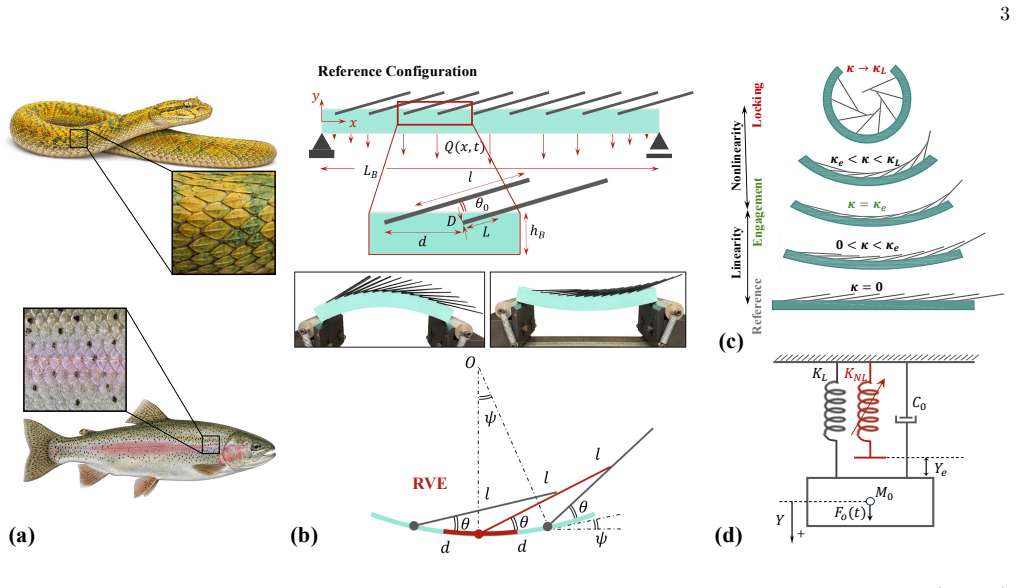
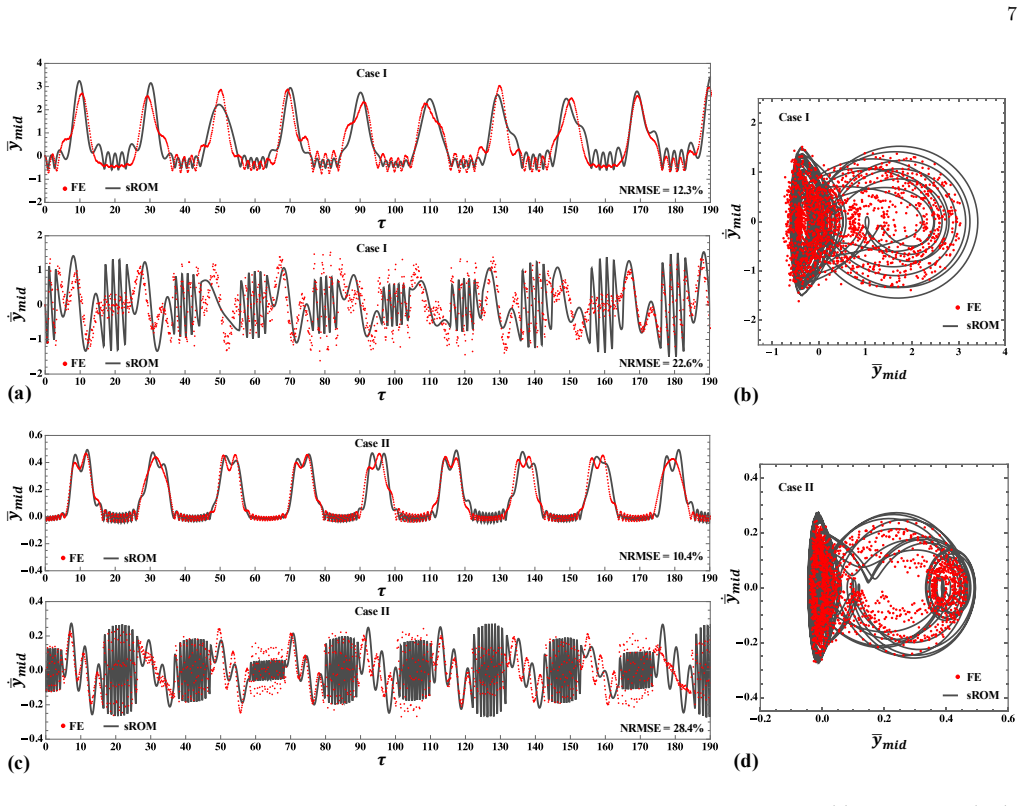
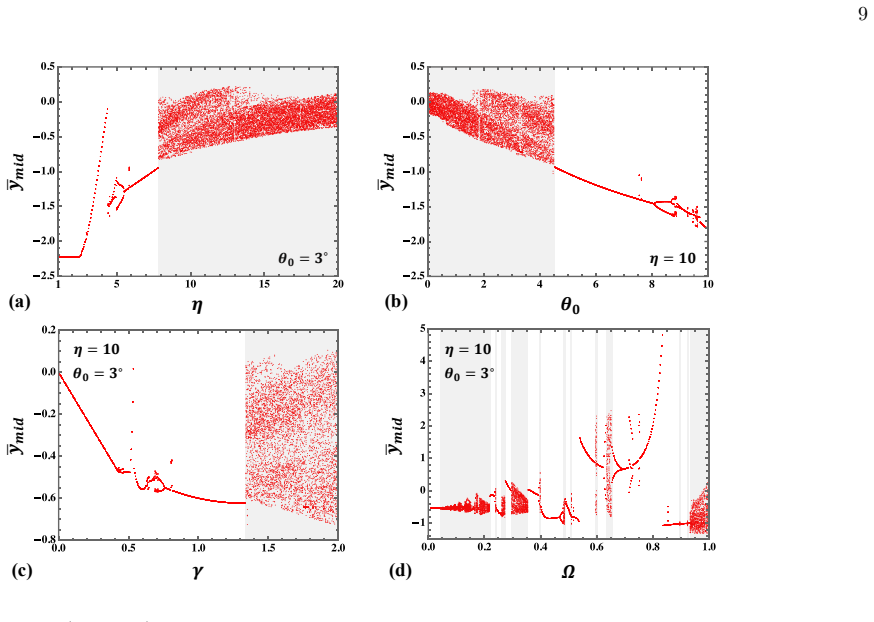
Overlapping fish-scale architectures are among nature's most distinctive surface adaptations, combining protection, contact regulation, hydrodynamics, optical and directional mechanical response within a thin textured integument. Here, we show that their biomimetic structural analogues can host deterministic chaos. Biomimetic scale substrates develop chaotic flexural vibrations at modest amplitudes because bending activates unilateral contact and progressive jamming, while built-in asymmetry from unequal texturing biases the restoring response and shifts the onset of chaos. From continuum mechanics, we derive a singular reduced-order model (sROM) that reduces the scale-covered beam to a nonlinear oscillator whose parameters map directly to overlap, scale inclination, damping, forcing, and substrate stiffness. Finite element (FE) simulations validate the model in quasi-static bending and long-time forced response. Stroboscopic regime maps reveal a period-doubling cascade from period-1 to period-2 and period-4, ultimately chaos. Overlap and inclination determine the strength of post-engagement nonlinearity, whereas damping bounds the chaotic operating window. Unequal top-bottom scale distributions break the antisymmetry of the restoring response, generating offset force-displacement laws. This reduced symmetry does not accelerate instability; instead, it delays the onset of chaos and fragments the response into intermittent periodic windows, whereas restoring symmetry can paradoxically widen the chaotic regime. When the texture is sufficiently sparse or steep on one side, it remains dynamically inactive, and the beam behaves as a fully asymmetric one-sided system. The results identify biomimetic scale substrates as a distinct class of contact-rich architectured metasurfaces in which chaos is programmable through geometry rather than large deflection or constitutive nonlinearity.
Editorial analysis
A structured set of objections, weighed in public.
Referee Report
Summary. The manuscript claims that biomimetic overlapping scale substrates exhibit deterministic chaos in flexural vibrations at modest amplitudes. Bending activates unilateral contact and progressive jamming, while built-in asymmetry from unequal top-bottom texturing biases the restoring force and modulates the onset of chaos. A singular reduced-order model (sROM) is derived from continuum mechanics, reducing the scale-covered beam to a nonlinear oscillator whose parameters map directly to overlap, inclination, damping, forcing, and stiffness. Finite-element simulations validate the sROM for both quasi-static bending and long-time forced response. Stroboscopic regime maps demonstrate a period-doubling cascade to chaos, with overlap and inclination controlling nonlinearity strength, damping bounding the chaotic window, and asymmetry delaying chaos while introducing intermittent periodic windows.
Significance. If the sROM derivation and FE validation hold, the work identifies a distinct class of contact-rich architectured metasurfaces in which chaos is geometrically programmable rather than requiring large deflections or material nonlinearity. The direct mapping of sROM parameters to measurable physical quantities (overlap, inclination) and the use of stroboscopic maps to delineate routes to chaos are notable strengths that could inform design of vibration-tunable surfaces.
major comments (3)
- [sROM derivation and FE validation] The reduction to a single-DOF sROM assumes that distributed unilateral contacts and progressive jamming do not excite higher beam modes or localized waves that carry appreciable energy during long-time forced response. No modal decomposition or energy-partition analysis from the FE simulations is reported in the chaotic regime (see the validation section following the sROM derivation), leaving open whether the observed period-doubling cascade is an artifact of the enforced kinematics.
- [Numerical validation and stroboscopic maps] Quantitative comparison between sROM predictions and FE results is absent for the chaotic regime. The manuscript states that FE simulations validate the long-time response but provides no error norms, Lyapunov-exponent agreement, or overlaid bifurcation diagrams, which are required to confirm that the sROM faithfully reproduces the period-doubling route without fidelity loss.
- [Asymmetry effects and regime maps] The claim that unequal texturing delays chaos onset and fragments the response into intermittent periodic windows (while symmetric texturing widens the chaotic regime) rests on the sROM. If higher-mode coupling is present, this asymmetry effect could be altered; the manuscript should test whether the reported shift in chaos threshold survives when the FE model is allowed additional degrees of freedom.
minor comments (3)
- [Abstract] The abstract introduces 'singular reduced-order model (sROM)' without a brief parenthetical gloss; a short definition on first use would aid readers.
- [Figures] Figure captions for the stroboscopic maps should explicitly state the forcing amplitude and frequency ranges used to generate each panel.
- [Introduction] The manuscript refers to 'modest amplitudes' without a quantitative bound relative to scale thickness or beam length; adding this in the introduction would clarify the operating regime.
Simulated Author's Rebuttal
We thank the referee for the constructive and detailed comments, which help clarify the validation requirements for the sROM. We address each major comment below and will incorporate additional analyses in the revised manuscript to strengthen the evidence that the period-doubling route to chaos is faithfully captured.
read point-by-point responses
-
Referee: The reduction to a single-DOF sROM assumes that distributed unilateral contacts and progressive jamming do not excite higher beam modes or localized waves that carry appreciable energy during long-time forced response. No modal decomposition or energy-partition analysis from the FE simulations is reported in the chaotic regime (see the validation section following the sROM derivation), leaving open whether the observed period-doubling cascade is an artifact of the enforced kinematics.
Authors: We agree that explicit modal decomposition and energy-partition analysis in the chaotic regime would provide stronger confirmation that higher modes remain energetically negligible. The current validation shows close agreement between the full FE model (which includes all possible modes) and the sROM in long-time forced responses and stroboscopic maps. This agreement implies that any higher-mode energy does not alter the observed dynamics. To directly address the concern, we will add an energy-partition analysis in the revised manuscript, quantifying the modal energy distribution during chaotic motion and confirming that the period-doubling cascade originates from the contact nonlinearity rather than kinematic enforcement. revision: yes
-
Referee: Quantitative comparison between sROM predictions and FE results is absent for the chaotic regime. The manuscript states that FE simulations validate the long-time response but provides no error norms, Lyapunov-exponent agreement, or overlaid bifurcation diagrams, which are required to confirm that the sROM faithfully reproduces the period-doubling route without fidelity loss.
Authors: We acknowledge the value of quantitative metrics for the chaotic regime. The manuscript demonstrates validation through direct comparison of time histories and regime maps, but we agree that error norms, Lyapunov exponents, and overlaid bifurcation diagrams would strengthen the case. In the revision, we will include L2 error norms on displacement time series for representative chaotic trajectories, compute and compare Lyapunov exponents from both models, and provide overlaid bifurcation diagrams to quantify the fidelity of the period-doubling cascade. revision: yes
-
Referee: The claim that unequal texturing delays chaos onset and fragments the response into intermittent periodic windows (while symmetric texturing widens the chaotic regime) rests on the sROM. If higher-mode coupling is present, this asymmetry effect could be altered; the manuscript should test whether the reported shift in chaos threshold survives when the FE model is allowed additional degrees of freedom.
Authors: The FE model used for validation is a full continuum discretization of the scale-covered beam and therefore already incorporates all degrees of freedom and any higher-mode coupling. The reported asymmetry effects (delayed chaos onset and intermittent periodic windows) are validated by the agreement between this full FE model and the sROM for both symmetric and asymmetric texturing cases. To make this explicit, we will add direct comparisons of chaos thresholds extracted from FE simulations under symmetric versus asymmetric configurations in the revised manuscript. revision: partial
Circularity Check
No significant circularity in derivation chain
full rationale
The paper derives the sROM from continuum mechanics with parameters stated to map directly to physical quantities (overlap, inclination, damping, forcing, substrate stiffness) rather than being fitted to chaotic behavior. FE simulations are presented as independent validation of both quasi-static and long-time forced responses. No self-citations, uniqueness theorems, or ansatzes are invoked in a load-bearing way that reduces the central claim about chaos from unilateral contact and jamming to its own inputs by construction. The single-DOF reduction is offered as an approximation whose fidelity is tested externally, keeping the derivation self-contained.
Axiom & Free-Parameter Ledger
axioms (2)
- standard math Continuum mechanics of beams with unilateral frictional contact and progressive jamming under bending
- domain assumption Deterministic chaos arises in nonlinear oscillators whose restoring force includes unilateral contact and asymmetry
Reference graph
Works this paper leans on
-
[1]
Hard Contact
¯FN L represents the normalized nonlinear contact force generated by scale engagement and is a function of time and the geometric parameters governing the scale architecture (see SM1 for deriva- tion details). Physically, increasingηor decreasing θ0 promotes stronger contact interactions between neighboring scales. At largerηor smallerθ 0, scale engagemen...
1900
-
[2]
The force-displacement curves in FIG. 9(d) show that increasingθ b 0 progressively delays engagement on the lower side, thereby amplifying the restoring bias and reducing the contribution of the bottom texture to the cycle. The bifurcation plot in FIG. 9(e) again shows that asymmetry does not act as a simple destabilizer. The strongest chaotic response oc...
-
[3]
The equation is projected onto a weighting function chosen to be iden- tical to the fundamental first eigenmode of the beam (ϕ1(¯x) = sin(π¯x))
To simplify the nondimensional nonlinear PDE above and eliminate the second spatial derivative of the bending moment, we employ a Galerkin weak-form approach. The equation is projected onto a weighting function chosen to be iden- tical to the fundamental first eigenmode of the beam (ϕ1(¯x) = sin(π¯x)). This choice inherently satisfies the boundary conditi...
-
[4]
Sfakiotakis, D
M. Sfakiotakis, D. M. Lane, and J. B. C. Davies, IEEE Journal of Oceanic Engineering24, 237 (2002)
2002
-
[5]
M. S. Triantafyllou, F. S. Hover, A. H. Techet, and D. K.- P. Yue, Applied Mechanics Reviews58, 226 (2005)
2005
-
[6]
Ghosh, H
R. Ghosh, H. Ebrahimi, and A. Vaziri, Applied Physics Letters105, 233701 (2014)
2014
-
[7]
M. S. Hossain, H. Ebrahimi, and R. Ghosh, Bioinspira- tion & Biomimetics17, 061001 (2022). 15
2022
-
[8]
P.-Y. Chen, J. Schirer, A. Simpson, R. Nay, Y.-S. Lin, W. Yang, M. I. Lopez, J. Li, E. A. Olevsky, and M. A. Meyers, Journal of Materials Research27, 100 (2012)
2012
-
[9]
D. Zhu, L. Szewciw, F. Vernerey, and F. Barthelat, Jour- nal of the Mechanical Behavior of Biomedical Materials 24, 30 (2013)
2013
-
[10]
A. H. Chang and P. A. Vela, Robotica37, 1302 (2019)
2019
-
[11]
G. V. Lauder, D. K. Wainwright, A. G. Domel, J. C. Weaver, L. Wen, and K. Bertoldi, Physical Review Fluids 1, 060502 (2016)
2016
-
[12]
Browning, C
A. Browning, C. Ortiz, and M. C. Boyce, Journal of the Mechanical Behavior of Biomedical Materials19, 75 (2013)
2013
-
[13]
H. Ali, H. Ebrahimi, and R. Ghosh, International Journal of Solids and Structures166, 22 (2019)
2019
-
[14]
Ebrahimi, H
H. Ebrahimi, H. Ali, J. Stephen, and R. Ghosh, Euro- physics Letters133, 68001 (2021)
2021
-
[15]
Tatari, H
M. Tatari, H. Ebrahimi, R. Ghosh, A. Vaziri, and H. Nayeb-Hashemi, International Journal of Solids and Structures280, 112406 (2023)
2023
-
[16]
Tatari, S
M. Tatari, S. Kamrava, R. Ghosh, H. Nayeb-Hashemi, and A. Vaziri, Scientific Reports10, 17083 (2020)
2020
-
[17]
Ebrahimi, M
H. Ebrahimi, M. Krsmanovic, H. Ali, and R. Ghosh, Ap- plied Physics Letters123, 081701 (2023)
2023
-
[18]
Z. Liu, X. Zhang, Y. Mao, Y. Zhu, Z. Yang, C. Chan, and P. Sheng, Science289, 1734 (2000)
2000
-
[19]
Zhang, Y
H. Zhang, Y. Xiao, and J. Wen, Journal of Physics D: Applied Physics48, 435305 (2015)
2015
-
[20]
Y. Xiao, J. Wen, D. Yu, and X. Wen, Journal of Sound and Vibration332, 867 (2013)
2013
-
[21]
M. Nouh, O. Aldraihem, and A. Baz, Journal of Sound and Vibration341, 53 (2015)
2015
-
[22]
Zhang, T
Z. Zhang, T. Li, Z. Wang, and Y. Tang, Mechanical Sys- tems and Signal Processing131, 364 (2019)
2019
-
[23]
Y. Liu, D. Pei, M. Chen, and Y. Wang, Materials13, 3812 (2020)
2020
-
[24]
Ghosh, H
R. Ghosh, H. Ebrahimi, and A. Vaziri, Europhysics Let- ters113, 34003 (2016)
2016
-
[25]
H. Ali, H. Ebrahimi, and R. Ghosh, Scientific Reports9, 14628 (2019)
2019
-
[26]
Ebrahimi, H
H. Ebrahimi, H. Ali, and R. Ghosh, Bioinspiration & Biomimetics15, 056013 (2020)
2020
-
[27]
H. Sun, X. Du, and P. F. Pai, Journal of Intelligent Ma- terial Systems and Structures21, 1085 (2010)
2010
-
[28]
Findeisen, J
C. Findeisen, J. Hohe, M. Kadic, and P. Gumbsch, Jour- nal of the Mechanics and Physics of Solids102, 151 (2017)
2017
-
[29]
J. Z. Kim, Z. Lu, A. S. Blevins, and D. S. Bassett, Phys- ical Review X12, 011042 (2022)
2022
-
[30]
Krsmanovic, R
M. Krsmanovic, R. Ghosh, and A. K. Dickerson, Journal of the Royal Society Interface20, 20230485 (2023)
2023
-
[31]
P. R. Sarkar, H. Ebrahimi, M. S. Hossain, H. Ali, and R. Ghosh, European Journal of Mechanics - A/Solids 109, 105664 (2025)
2025
-
[32]
Bateniparvar, M
O. Bateniparvar, M. S. Hossain, and R. Ghosh, inBioin- spiration, Biomimetics, and Bioreplication XIV, Vol. 12944 (2024) pp. 17–23
2024
-
[33]
M. S. Hossain, O. Bateniparvar, P. R. Sarkar, and R. Ghosh, inASME Aerospace Structures, Structural Dy- namics, and Materials Conference, Vol. 87745 (2024) p. V001T02A007
2024
-
[34]
X. Fang, W. Lacarbonara, and L. Cheng, Nonlinear Dy- namics112, 1 (2024)
2024
-
[35]
Khandelwal, T
S. Khandelwal, T. Siegmund, R. Cipra, and J. Bolton, Smart Materials and Structures24, 045037 (2015)
2015
-
[36]
S. Shan, S. H. Kang, J. R. Raney, P. Wang, L. Fang, F. Candido, J. A. Lewis, and K. Bertoldi, Advanced Ma- terials27, 4296 (2015)
2015
-
[37]
A. N. Karuriya, J. Simoes, and F. Barthelat, Extreme Mechanics Letters71, 102208 (2024)
2024
-
[38]
Bateniparvar, F
O. Bateniparvar, F. Farahmand, and R. Ghosh, inAIAA SCITECH 2026 Forum(2026) p. 0695
2026
-
[39]
Nakajima, Japanese Journal of Applied Physics59, 060501 (2020)
K. Nakajima, Japanese Journal of Applied Physics59, 060501 (2020)
2020
-
[40]
Bhovad and S
P. Bhovad and S. Li, Scientific Reports11, 13002 (2021)
2021
-
[41]
He and P
S. He and P. F. Musgrave, Neural Networks181, 106766 (2025)
2025
-
[42]
Mandal, S
S. Mandal, S. Sinha, and M. D. Shrimali, Physical Review E105, 054203 (2022)
2022
-
[43]
He and P
S. He and P. F. Musgrave, Neurocomputing652, 131158 (2025)
2025
-
[44]
Zhang and K.-W
Y. Zhang and K.-W. Wang, inAIAA Scitech 2022 Forum (2022) p. 1464
2022
-
[45]
C. He, J. Xing, J. Li, Q. Yang, and R. Wang, Mathemat- ical Problems in Engineering2015, 528656 (2015)
2015
-
[46]
R. D. Blevins, inFormulas for Dynamics, Acoustics, and Vibration(John Wiley & Sons, Hoboken, NJ, 2016) pp. 134–202
2016
-
[47]
X. Chen, J. Duan, Y. Li, and J. Sun, in2018 7th Inter- national Conference on Energy and Environmental Pro- tection (ICEEP 2018)(2018) pp. 747–751
2018
-
[48]
Rocha, E
J. Rocha, E. Pereira, J. Sena-Cruz, L. Valarinho, and J. R. Correia, Engineering Structures234, 111968 (2021)
2021
-
[49]
Ebrahimi, H
H. Ebrahimi, H. Ali, R. Alexander Horton, J. Galvez, A. P. Gordon, and R. Ghosh, Europhysics Letters127, 24002 (2019)
2019
-
[50]
Dharmavaram, H
S. Dharmavaram, H. Ebrahimi, and R. Ghosh, Journal of the Mechanics and Physics of Solids159, 104711 (2022)
2022
discussion (0)
Sign in with ORCID, Apple, or X to comment. Anyone can read and Pith papers without signing in.