Recognition: unknown
SSD-GS: Scattering and Shadow Decomposition for Relightable 3D Gaussian Splatting
Pith reviewed 2026-05-10 15:01 UTC · model grok-4.3
The pith
Decomposing reflectance into diffuse, specular, shadow, and subsurface scattering enables photorealistic relighting of 3D Gaussian Splatting scenes under novel lights.
A machine-rendered reading of the paper's core claim, the machinery that carries it, and where it could break.
Core claim
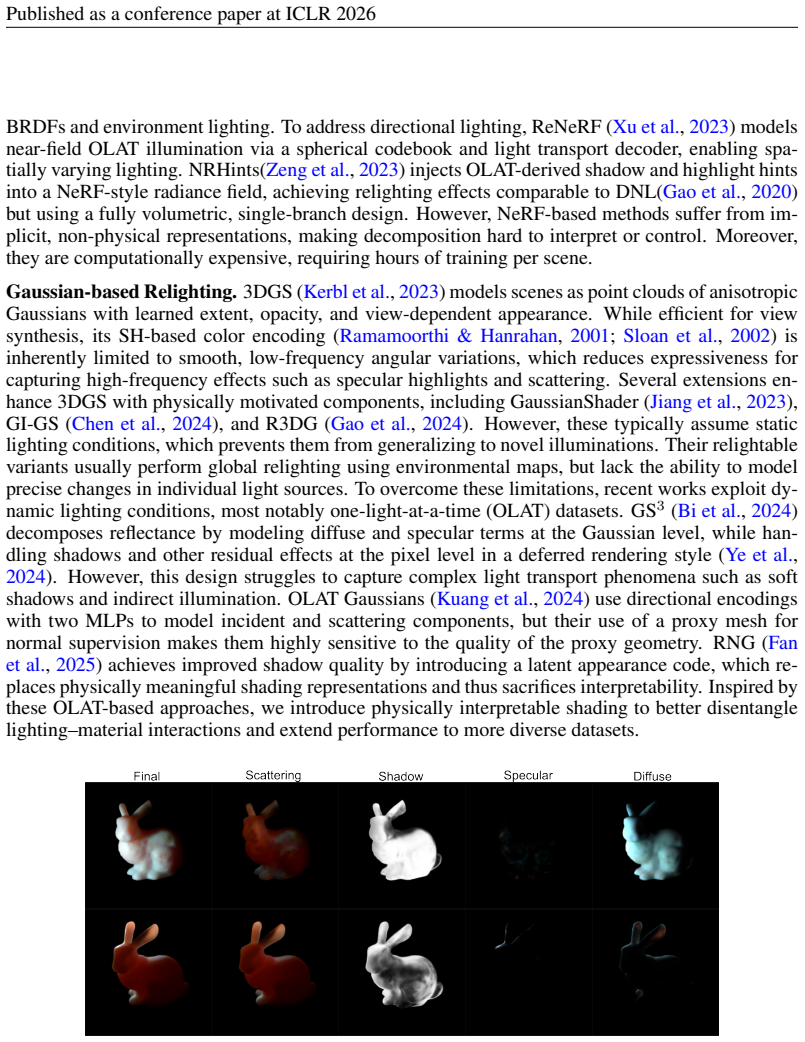
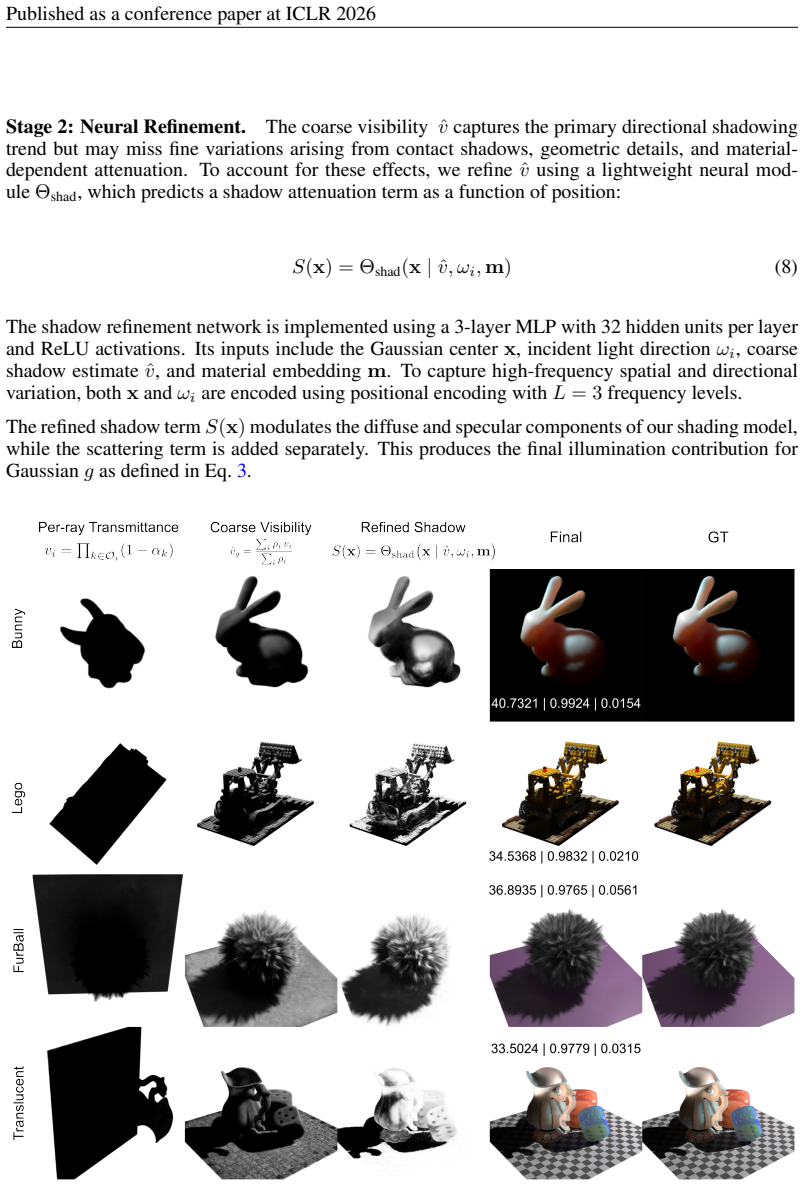
SSD-GS is a physically-based relighting framework built on 3D Gaussian Splatting that decomposes reflectance into diffuse, specular, shadow, and subsurface scattering components. It introduces a learnable dipole-based scattering module for subsurface transport, an occlusion-aware shadow formulation that combines visibility estimates with a refinement network, and an enhanced specular component using an anisotropic Fresnel model. Progressive integration of the components during training disentangles lighting from material properties even under unseen illumination, as shown by improved results on the OLAT dataset.
What carries the argument
The four-component reflectance decomposition (diffuse, specular, shadow, subsurface scattering) realized through a dipole scattering module, occlusion-aware shadow integration, and anisotropic Fresnel specular term inside the 3D Gaussian Splatting representation.
If this is right
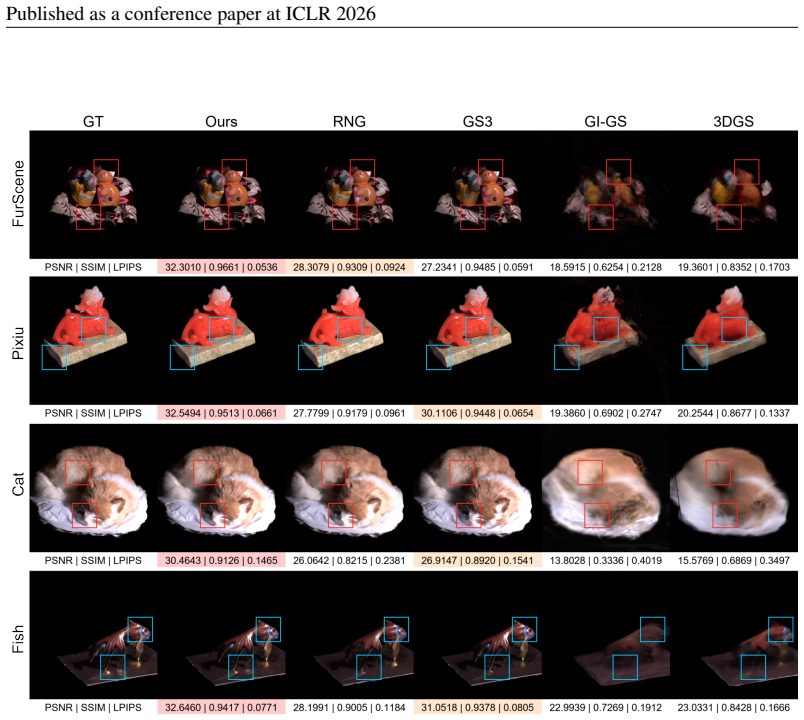
- Superior quantitative and perceptual relighting quality compared with prior 3DGS relighting methods on the OLAT dataset.
- Enables downstream controllable light source editing.
- Supports interactive scene relighting after reconstruction.
- Improves fidelity for anisotropic metals and translucent materials that previous coarse decompositions handled poorly.
Where Pith is reading between the lines
- The same decomposition might support independent editing of material parameters once lighting is factored out.
- Combining the four-component model with dynamic scene representations could extend the relighting capability to moving objects.
- The explicit separation offers a route to inverse problems such as recovering subsurface properties from images alone.
- The method could be tested on outdoor scenes where natural illumination varies continuously rather than the controlled OLAT setup.
Load-bearing premise
That gradually introducing the four components during training will separate lighting effects from intrinsic material properties for lighting setups the model has never encountered.
What would settle it
Train the model on a scene captured under one set of lights, then render the same scene under a single new light direction never seen in training and check whether the output matches a ground-truth photograph taken under that exact new light.
Figures



read the original abstract
We present SSD-GS, a physically-based relighting framework built upon 3D Gaussian Splatting (3DGS) that achieves high-quality reconstruction and photorealistic relighting under novel lighting conditions. In physically-based relighting, accurately modeling light-material interactions is essential for faithful appearance reproduction. However, existing 3DGS-based relighting methods adopt coarse shading decompositions, either modeling only diffuse and specular reflections or relying on neural networks to approximate shadows and scattering. This leads to limited fidelity and poor physical interpretability, particularly for anisotropic metals and translucent materials. To address these limitations, SSD-GS decomposes reflectance into four components: diffuse, specular, shadow, and subsurface scattering. We introduce a learnable dipole-based scattering module for subsurface transport, an occlusion-aware shadow formulation that integrates visibility estimates with a refinement network, and an enhanced specular component with an anisotropic Fresnel-based model. Through progressive integration of all components during training, SSD-GS effectively disentangles lighting and material properties, even for unseen illumination conditions, as demonstrated on the challenging OLAT dataset. Experiments demonstrate superior quantitative and perceptual relighting quality compared to prior methods and pave the way for downstream tasks, including controllable light source editing and interactive scene relighting. The source code is available at: https://github.com/irisfreesiri/SSD-GS.
Editorial analysis
A structured set of objections, weighed in public.
Referee Report
Summary. The manuscript introduces SSD-GS, a relightable 3D Gaussian Splatting framework that decomposes scene reflectance into diffuse, specular, shadow, and subsurface scattering components. Key innovations include a learnable dipole-based scattering module for subsurface transport, an occlusion-aware shadow formulation with a refinement network, and an anisotropic Fresnel model for specular reflections. The method uses progressive component integration during training to disentangle lighting from material properties and demonstrates improved relighting performance on the OLAT dataset for novel lighting conditions.
Significance. If the four-component decomposition and progressive training produce a genuinely lighting-invariant material representation that generalizes to unseen illuminations, the work would advance physically interpretable relighting within 3DGS pipelines. It targets limitations of prior coarse decompositions for anisotropic metals and translucent materials, with potential downstream value for controllable light editing. The public code release supports reproducibility and extension.
major comments (3)
- [Abstract] Abstract: The central claim of superior quantitative and perceptual relighting quality on the OLAT dataset is stated without reference to specific metrics (e.g., PSNR, SSIM, LPIPS), exact baselines, data splits, error bars, or ablation results. This absence prevents verification that the dipole scattering, shadow refinement, and anisotropic Fresnel modules deliver measurable gains over prior 3DGS relighting approaches.
- [Training procedure] Training procedure (progressive integration section): The claim that progressive integration of the four components enforces disentanglement of lighting from material properties for completely novel illuminations is load-bearing for the generalization result. However, the dipole scattering module and shadow refinement network introduce additional learnable parameters without per-component ground truth, explicit physical regularization, or a proof that the schedule prevents lighting leakage into reflectance parameters.
- [Shadow formulation] Shadow formulation: The occlusion-aware shadow model combines visibility estimates with a refinement network, yet no analysis demonstrates that this prevents shadow effects from being absorbed into the diffuse or specular components under lighting conditions absent from training.
minor comments (2)
- [Abstract] The source code link is welcome; the repository should include OLAT preprocessing scripts and full training configurations to enable exact reproduction of the reported results.
- [Method] Notation for the dipole-based scattering module would benefit from explicit equations defining the dipole approximation and its integration with the Gaussian splat rendering equation.
Simulated Author's Rebuttal
We thank the referee for the constructive review of our manuscript on SSD-GS. We address each major comment point by point below, with clear indications of revisions where the manuscript will be updated.
read point-by-point responses
-
Referee: [Abstract] Abstract: The central claim of superior quantitative and perceptual relighting quality on the OLAT dataset is stated without reference to specific metrics (e.g., PSNR, SSIM, LPIPS), exact baselines, data splits, error bars, or ablation results. This absence prevents verification that the dipole scattering, shadow refinement, and anisotropic Fresnel modules deliver measurable gains over prior 3DGS relighting approaches.
Authors: We agree that the abstract would be strengthened by including concrete quantitative details. In the revised version, we will update the abstract to explicitly reference the key metrics (PSNR, SSIM, LPIPS) from our OLAT experiments, name the primary baselines, note the data splits used, and point to the main results table and ablations that quantify the gains from each module. revision: yes
-
Referee: [Training procedure] Training procedure (progressive integration section): The claim that progressive integration of the four components enforces disentanglement of lighting from material properties for completely novel illuminations is load-bearing for the generalization result. However, the dipole scattering module and shadow refinement network introduce additional learnable parameters without per-component ground truth, explicit physical regularization, or a proof that the schedule prevents lighting leakage into reflectance parameters.
Authors: The progressive integration schedule is motivated by the need to stabilize learning of simpler components before adding scattering and shadow effects, which our ablations on novel OLAT illuminations show improves material consistency. While per-component ground truth is unavailable in the dataset and we do not offer a formal mathematical proof of zero leakage, the combination of sequential training and rendering losses empirically reduces lighting absorption into reflectance parameters. We will expand the training section with a clearer schedule description, additional parameter-stability ablations under unseen lights, and any applicable regularization details. revision: partial
-
Referee: [Shadow formulation] Shadow formulation: The occlusion-aware shadow model combines visibility estimates with a refinement network, yet no analysis demonstrates that this prevents shadow effects from being absorbed into the diffuse or specular components under lighting conditions absent from training.
Authors: We will add targeted analysis in the revised manuscript, including qualitative renderings and quantitative comparisons (with and without the refinement network) on held-out OLAT lighting conditions. These will demonstrate that the occlusion-aware formulation isolates shadow contributions rather than allowing them to leak into diffuse or specular terms. revision: yes
Circularity Check
No significant circularity; derivation relies on empirical training and evaluation
full rationale
The paper's claimed result is that a four-component decomposition (diffuse, specular with anisotropic Fresnel, shadow with visibility refinement, dipole subsurface scattering) plus progressive integration during training produces lighting-invariant materials that generalize to unseen illuminations on the OLAT dataset. This is presented as an empirical outcome of the optimization and architecture, not a definitional identity or fitted parameter renamed as prediction. No equations, self-citations, or uniqueness theorems are quoted that reduce the relighting performance to the training inputs by construction. The progressive schedule and component modules are independent design choices whose effectiveness is tested externally via novel-light relighting metrics.
Axiom & Free-Parameter Ledger
free parameters (1)
- learnable parameters of dipole scattering module and shadow refinement network
axioms (1)
- domain assumption Accurate modeling of light-material interactions via diffuse, specular, shadow, and subsurface components is essential for faithful appearance reproduction under novel lighting.
invented entities (2)
-
dipole-based scattering module
no independent evidence
-
occlusion-aware shadow formulation with refinement network
no independent evidence
Reference graph
Works this paper leans on
-
[1]
Multiscale Vision Transformers , isbn =
2021 IEEE/CVF International Conference on Computer Vision (ICCV). ISBN 978-1-6654- 2812-5. doi: 10.1109/ICCV48922.2021.01245. URLhttps://ieeexplore.ieee.org/ document/9710856/. Hongze Chen, Zehong Lin, and Jun Zhang. GI-GS: Global Illumination Decomposition on Gaussian Splatting for Inverse Rendering. ICLR 2025, October 2024. URLhttps://openreview. net/fo...
-
[2]
URLhttp://arxiv.org/abs/2409.19702
doi: 10.48550/arXiv.2409.19702. URLhttp://arxiv.org/abs/2409.19702. arXiv:2409.19702 [cs]. Jeppe Revall Frisvad, Toshiya Hachisuka, and Thomas Kim Kjeldsen. Directional Dipole Model for Subsurface Scattering.ACM Transactions on Graphics, 34(1):1–12, December 2014. ISSN 0730- 0301, 1557-7368. doi: 10.1145/2682629. URLhttps://dl.acm.org/doi/10.1145/ 2682629...
-
[3]
Bernhard Kerbl, Georgios Kopanas, Thomas Leimkuehler, and George Drettakis
URLhttps://openaccess.thecvf.com/content/CVPR2023/html/Jin_ TensoIR_Tensorial_Inverse_Rendering_CVPR_2023_paper.html. Bernhard Kerbl, Georgios Kopanas, Thomas Leimkuehler, and George Drettakis. 3D Gaussian Splatting for Real-Time Radiance Field Rendering.ACM transactions on graphics, 42(4):1–14,
-
[4]
https://doi.org/10.1145/3592433 Xiaonan Kong and Riley G
ISSN 0730-0301. doi: 10.1145/3592433. Place: New York, NY , USA Publisher: ACM. Zhiyi Kuang, Yanchao Yang, Siyan Dong, Jiayue Ma, Hongbo Fu, and Youyi Zheng. OLAT Gaussians for Generic Relightable Appearance Acquisition. InSIGGRAPH Asia 2024 Con- ference Papers, SA ’24, pp. 1–11, New York, NY , USA, December 2024. Association for Computing Machinery. ISBN...
-
[5]
URLhttps://onlinelibrary.wiley.com/doi/abs/ 10.1111/cgf.15158
doi: 10.1111/cgf.15158. URLhttps://onlinelibrary.wiley.com/doi/abs/ 10.1111/cgf.15158. eprint: https://onlinelibrary.wiley.com/doi/pdf/10.1111/cgf.15158. Delio Vicini, Vladlen Koltun, and Wenzel Jakob. A Learned Shape-Adaptive Subsurface Scattering Model.ACM Transactions on Graphics, 38(4):1–15, August 2019. ISSN 0730-0301, 1557-7368. doi: 10.1145/3306346...
-
[6]
URLhttps://dl.acm.org/doi/10.1145/ 2508363.2508386
doi: 10.1145/2508363.2508386. URLhttps://dl.acm.org/doi/10.1145/ 2508363.2508386. Yingyan Xu, Gaspard Zoss, Prashanth Chandran, Markus Gross, Derek Bradley, and Paulo Go- tardo. ReNeRF: Relightable Neural Radiance Fields with Nearfield Lighting. In2023 IEEE/CVF International Conference on Computer Vision (ICCV), pp. 22524–22534, Paris, France, Oc- tober 2...
-
[7]
on the synthetic datasets provided by SSS-GS, trained for 60K iterations. The best and second- best results (based on PSNR) are highlighted in red and orange , respectively. MethodDataset Bunny Candle Dragon Soap Statue AverageTrain Test Train Test Train Test Train Test Train Test Train TestPSNR↑KiloOSF - - - - - - - - - - -25.91±1.88SSS-GS - - - - - - - ...
discussion (0)
Sign in with ORCID, Apple, or X to comment. Anyone can read and Pith papers without signing in.