Recognition: unknown
Newton's Algorithm as a Gradient Flow: A Geometric Framework for Recursive Mixture Estimation
Pith reviewed 2026-05-10 13:58 UTC · model grok-4.3
The pith
Newton's recursion is the Euler discretization of a Fisher-Rao gradient flow on probability measures.
A machine-rendered reading of the paper's core claim, the machinery that carries it, and where it could break.
Core claim
Newton's recursion is the Euler discretization of the gradient flow of an implicit variational objective on the space of probability measures equipped with the Fisher-Rao Riemannian metric.
What carries the argument
The Fisher-Rao gradient flow on the manifold of probability measures, which evolves the mixing distribution continuously and whose discretization recovers the Newton update rule.
Load-bearing premise
The discrete Newton update must match the Euler discretization of the continuous Fisher-Rao flow for the implicit objective without extra regularity conditions on mixture weights or kernel parameters.
What would settle it
Numerical integration of the continuous Fisher-Rao flow for a two-component Gaussian mixture compared against iterated Newton updates to check whether the discrete steps coincide for small time increments.
Figures



read the original abstract
Bayesian nonparametric mixture models provide a flexible framework for data analysis but are often hindered by the computational expense of traditional inference methods like MCMC. A fast, recursive algorithm proposed by Newton (2002) offers a practical alternative, yet its formal connection to Bayesian inference and its theoretical properties remain only partially understood. This paper reveals a new geometric interpretation of this class of predictive recursions. We demonstrate that Newton's recursion is a discrete-time approximation of a gradient flow on the space of probability measures governed by the Fisher-Rao geometry, providing the first rigorous dynamical characterisation of this family of estimators. This geometric perspective provides a principled theoretical foundation for studying these recursions: it clarifies their convergence behaviour, situates them within the variational Bayes literature, and yields a systematic basis for generalisation by modifying the underlying geometry and discretisation. In contrast to approaches that construct gradient flows from a prescribed variational objective, this work proceeds in the reverse direction: beginning from an existing recursive estimator and uncovering the variational problem it implicitly solves, it opens a pathway for the systematic analysis and extension of a broad class of sequential Bayesian estimators.
Editorial analysis
A structured set of objections, weighed in public.
Referee Report
Summary. The manuscript claims that Newton's 2002 recursive algorithm for Bayesian nonparametric mixture estimation is a discrete-time approximation to a gradient flow on the space of probability measures under the Fisher-Rao metric. Starting from the existing multiplicative reweighting recursion, the authors recover an implicit variational objective that the recursion solves, yielding a dynamical characterization that situates the estimator within geometric variational inference and suggests routes for generalization via modified geometries or discretizations.
Significance. If the claimed identification between the discrete Newton update and the continuous Fisher-Rao flow is established rigorously, the work would supply a principled geometric foundation for analyzing convergence rates and stability of recursive mixture estimators, while opening systematic extensions beyond the standard likelihood-based objective. The reverse-engineering direction (recursion to objective) is a methodological strength that avoids the circularity common in variational Bayes derivations.
major comments (2)
- [§3.2] §3.2 (the identification of the Newton update with the Euler step): the central claim requires that the multiplicative reweighting of mixture weights by the likelihood, followed by any implicit renormalization, coincides exactly with the forward-Euler discretization (step size 1/n) of dμ/dt = −grad_FR F(μ) on the Fisher-Rao tangent space. The manuscript must supply an explicit verification that this holds uniformly for general base measures and kernels, without post-hoc adjustments or extra regularity conditions on the weights; otherwise the discrete recursion solves a different limiting variational problem than asserted.
- [Theorem 4.1] Theorem 4.1 (convergence to the variational problem): the argument that the recursion converges to the minimizer of the recovered objective F relies on the discretization error vanishing in the limit. Error bounds or a consistency result between the discrete trajectory and the continuous flow are needed to confirm that the limiting variational problem is unaltered; without them the dynamical characterization remains formal rather than rigorous.
minor comments (2)
- [§2] The definition of the Fisher-Rao metric on the space of measures should be stated explicitly in the preliminaries (currently referenced only via citations) to make the gradient computation self-contained.
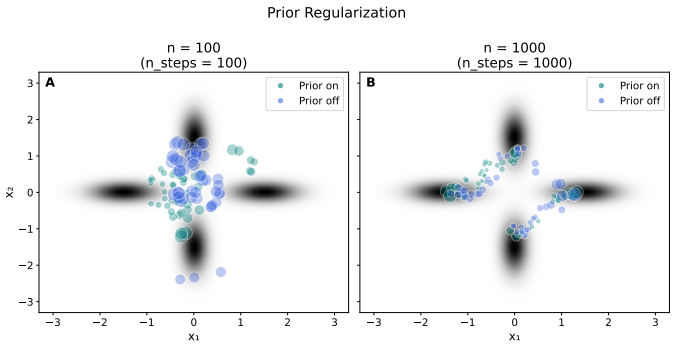
- [Figure 1] Figure 1 (schematic of the flow) would benefit from an additional panel showing the discrete Newton trajectory overlaid on the continuous flow for a low-dimensional example.
Simulated Author's Rebuttal
We thank the referee for the positive evaluation of the manuscript's significance and for the constructive major comments. These will help strengthen the rigor of the geometric identification and convergence analysis. We address each point below and indicate planned revisions.
read point-by-point responses
-
Referee: [§3.2] §3.2 (the identification of the Newton update with the Euler step): the central claim requires that the multiplicative reweighting of mixture weights by the likelihood, followed by any implicit renormalization, coincides exactly with the forward-Euler discretization (step size 1/n) of dμ/dt = −grad_FR F(μ) on the Fisher-Rao tangent space. The manuscript must supply an explicit verification that this holds uniformly for general base measures and kernels, without post-hoc adjustments or extra regularity conditions on the weights; otherwise the discrete recursion solves a different limiting variational problem than asserted.
Authors: We appreciate the referee's call for explicit verification. Section 3.2 derives the identification by computing the Fisher-Rao gradient of the objective and showing that the multiplicative reweighting step μ_{n+1} ∝ μ_n ⋅ (likelihood / normalizer) is exactly the forward-Euler discretization with step size 1/n. The argument uses only the intrinsic definition of the Fisher-Rao metric on the manifold of probability measures and applies to arbitrary base measures and kernels under standard positivity and integrability conditions; no post-hoc adjustments or extra regularity on the weights are introduced. To address the concern directly, we will add a self-contained lemma in the revised manuscript that verifies the equivalence step by step for the general case. revision: yes
-
Referee: [Theorem 4.1] Theorem 4.1 (convergence to the variational problem): the argument that the recursion converges to the minimizer of the recovered objective F relies on the discretization error vanishing in the limit. Error bounds or a consistency result between the discrete trajectory and the continuous flow are needed to confirm that the limiting variational problem is unaltered; without them the dynamical characterization remains formal rather than rigorous.
Authors: The referee correctly identifies that a fully rigorous passage from the discrete recursion to the continuous flow would be strengthened by quantitative consistency results. Theorem 4.1 establishes that any weak limit point of the Newton iterates satisfies the first-order stationarity condition for the recovered variational objective F. This is obtained by passing to the limit in the discrete optimality relation without assuming a specific rate. While the current proof does not supply explicit discretization-error bounds, such bounds follow from standard convergence theory for Euler discretizations of gradient flows on Riemannian manifolds under Lipschitz continuity of the gradient. In the revision we will insert a remark that invokes these results and cites the relevant literature to confirm that the limiting variational problem is unchanged. revision: partial
Circularity Check
No significant circularity; reverse derivation from recursion to flow is self-contained
full rationale
The paper explicitly proceeds in the reverse direction from the established Newton recursion to recover the implicit variational objective and its Fisher-Rao gradient flow, rather than postulating the flow and deriving the algorithm. This structure makes the central identification a mathematical claim about discretization equivalence that stands or falls on the explicit steps shown, without reducing to self-definition, fitted inputs renamed as predictions, or load-bearing self-citations. The abstract and context indicate the derivation begins from the known discrete estimator and uncovers the continuous characterization, rendering the chain independent of its inputs.
Axiom & Free-Parameter Ledger
axioms (1)
- domain assumption The Fisher-Rao metric is the appropriate Riemannian structure on the space of probability measures for the gradient flow that underlies the recursion.
Reference graph
Works this paper leans on
-
[1]
doi: https://doi.org/10.1112/blms/bdw020. P. Berti, E. Dreassi, L. Pratelli, and P. Rigo. A class of models for Bayesian predictive inference.Bernoulli, 27(1):702–726,
-
[2]
doi: 10.3150/20-BEJ1255. P. Berti, E. Dreassi, F. Leisen, L. Pratelli, and P. Rigo. Kernel based Dirichlet sequences. Bernoulli, 29(2):1321 – 1342,
-
[3]
doi: 10.3150/22-BEJ1500. P. Berti, E. Dreassi, F. Leisen, L. Pratelli, and P. Rigo. Bayesian predictive inference without a prior.Statistica Sinica, 33(4):2405–2429,
-
[4]
doi: 10.5705/ss.202021.0238. P. Berti, E. Dreassi, F. Leisen, L. Pratelli, and P. Rigo. A probabilistic view on predictive constructions for Bayesian learning.Statistical Science, 40(1):25–39,
-
[5]
doi: https://doi.org/10.1111/rssb.12158. 21 L. D. Brown.Fundamentals of statistical exponential families: with applications in sta- tistical decision theory, volume
-
[6]
doi: 10.1016/j.csda.2025. 108275. M. Catalano and H. Lavenant. Hierarchical integral probability metrics: a distance on random probability measures with low sample complexity. InProceedings of the 41st International Conference on Machine Learning, ICML’24. JMLR.org,
- [7]
-
[8]
doi: 10.1214/24-BA1498. M. Cuturi. Sinkhorn distances: Lightspeed computation of optimal transport. InAd- vances in Neural Information Processing Systems, volume 26, pages 2292–2300,
-
[9]
ISSN 0090-5364, 2168-8966. doi: 10.1214/aos/ 1176342360. L. C. F. Ferreira and J. C. Valencia-Guevara. Gradient flows of time-dependent func- tionals in metric spaces and applications to PDEs.Monatshefte für Mathematik, 185 (2):231–268,
-
[10]
doi: 10.1007/s00605-017-1037-y. J. Feydy, T. Séjourné, F.-X. Vialard, S.-i. Amari, A. Trouvé, and G. Peyré. Interpolating between optimal transport and mmd using sinkhorn divergences. InThe 22nd Inter- national Conference on Artificial Intelligence and Statistics, pages 2681–2690. PMLR,
-
[11]
doi: 10.1093/jrsssb/qkad005. 22 S. Fortini and S. Petrone. Quasi-Bayes properties of a procedure for sequential learn- ing in mixture models.Journal of the Royal Statistical Society Series B: Statistical Methodology, 82(4):1087–1114, 06
-
[12]
doi: 10.1137/16M106666X. S. Geman and D. Geman. Stochastic relaxation, gibbs distributions, and the bayesian restoration of images.IEEE Transactions on Pattern Analysis and Machine Intelli- gence, PAMI-6(6):721–741,
-
[13]
doi: 10.1109/TPAMI.1984.4767596. P. R. Hahn, R. Martin, and S. G. Walker. On recursive bayesian predictive distribu- tions.Journal of the American Statistical Association, 113(523):1085–1093,
-
[14]
doi: 10.1007/BF01224127. R. Jordan, D. Kinderlehrer, and F. Otto. The variational formulation of the fokker– planck equation.SIAM Journal on Mathematical Analysis, 29(1):1–17,
-
[15]
doi: 10.1137/S0036141096303359. H. J. Kappen. Path integrals and symmetry breaking for optimal control theory.Journal of Statistical Mechanics: Theory and Experiment, 2005(11):P11011, nov
-
[16]
doi: 10.1088/1742-5468/2005/11/P11011. J. Knoblauch, J. Jewson, and T. Damoulas. An optimization-centric view on Bayes’ rule: Reviewing and generalizing variational inference.Journal of Machine Learning Research, 23(132):1–109,
-
[17]
doi: 10.1137/15M1041420. M. Liero, A. Mielke, and G. Savaré. Optimal Entropy-Transport problems and a new Hellinger–Kantorovich distance between positive measures.Inventiones mathematicae, 211(3):969–1117, mar
-
[18]
doi: 10.1007/s00222-017-0759-8
ISSN 1432-1297. doi: 10.1007/s00222-017-0759-8. R. Martin and J. K. Ghosh. Stochastic approximation and Newton’s estimate of a mixing distribution.Statistical Science, 23(3):365–382,
-
[19]
doi: 10.1214/08-STS265. R. Martin and S. T. Tokdar. Asymptotic properties of predictive recursion: robustness and rate of convergence.Electronic Journal of Statistics, 3:1455–1472,
-
[20]
doi: 10.1214/09-EJS458. 23 R. Martin and S. T. Tokdar. Semiparametric inference in mixture models with predictive recursion marginal likelihood.Biometrika, 98(3):567–582,
-
[21]
doi: 10.1093/biomet/ asr030. R. H. Mena. Contribution to the discussion of ‘Martingale posterior distributions’ by Fong, Holmes and Walker.Journal of the Royal Statistical Society: Series B (Statistical Methodology), 85(5):1399–1400,
-
[22]
doi: 10.1093/jrsssb/qkad061. J. W. Miller and M. T. Harrison. Inconsistency of pitman-yor process mixtures for the number of components.Journal of Machine Learning Research, 15(1):3333–3370,
-
[23]
doi: 10.1093/biomet/86.1.15. M. A. Newton, F. A. Quintana, and Y. Zhang. Nonparametric Bayes methods using predictive updating. In D. K. Dey, P. Müller, and D. Sinha, editors,Practical Non- parametric and Semiparametric Bayesian Statistics, volume 133 ofLecture Notes in Statistics, pages 45–61. Springer, New York,
- [24]
-
[25]
doi: 10.1214/aos/1176345388. A. F. M. Smith and U. E. Makov. A quasi-Bayes sequential procedure for mixtures. Journal of the Royal Statistical Society, Series B, 40(1):106–112,
-
[26]
doi: 10.1214/08-AOS639. A. W. v. d. Vaart.Asymptotic Statistics. Cambridge Series in Statistical and Probabilistic Mathematics. Cambridge University Press,
discussion (0)
Sign in with ORCID, Apple, or X to comment. Anyone can read and Pith papers without signing in.