Photoemission and absorption under coherent and entangled-photon-pair illumination
Pith reviewed 2026-05-10 13:53 UTC · model grok-4.3
The pith
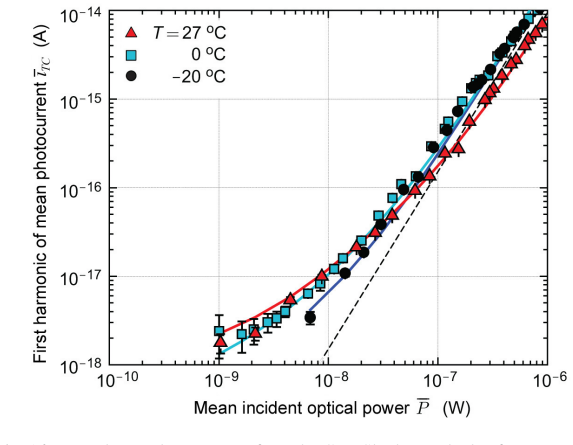
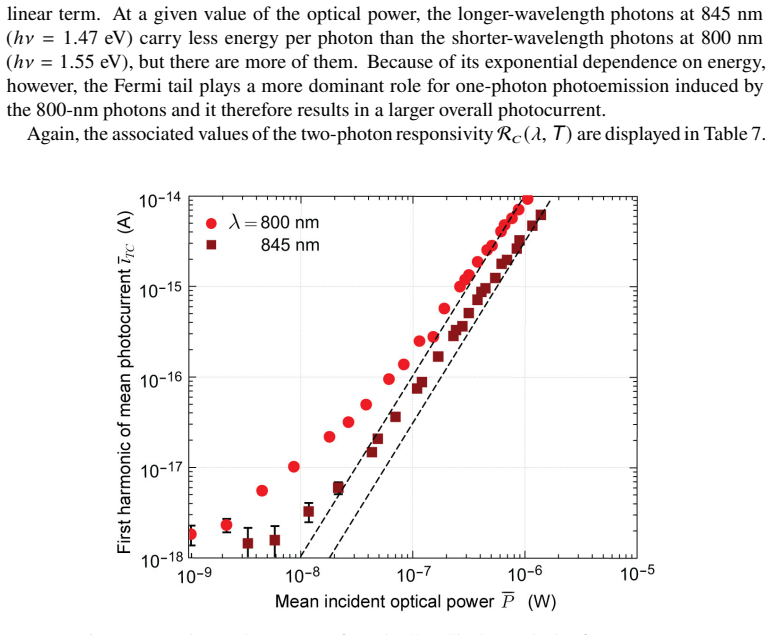
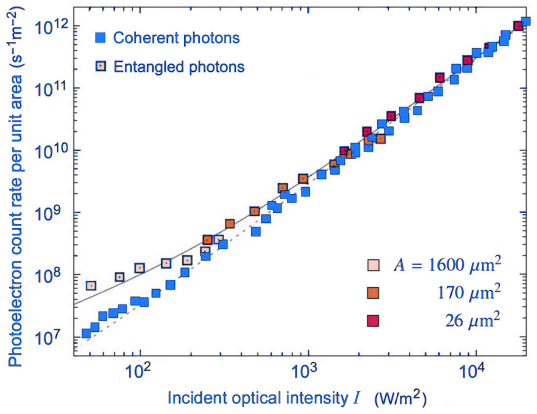
Entangled two-photon photoemission and absorption match quantum models when classical contributions are suppressed by channel photomultipliers and low intensity.
A machine-rendered reading of the paper's core claim, the machinery that carries it, and where it could break.
Core claim
The central claim is that entangled-two-photon photoemission (ETPP) from CsK2Sb in a channel photomultiplier is observable under entangled-pair illumination once one-photon Fermi-tail photoemission is suppressed by the CPM and ordinary two-photon photoemission is minimized by low intensity. Quantum models of two-photon photoemission and ETPP match experimental data. Parallel quantum models describe entangled-two-photon absorption (ETPA), enabling applications in entangled-two-photon fluorescence microscopy and spectroscopy.
What carries the argument
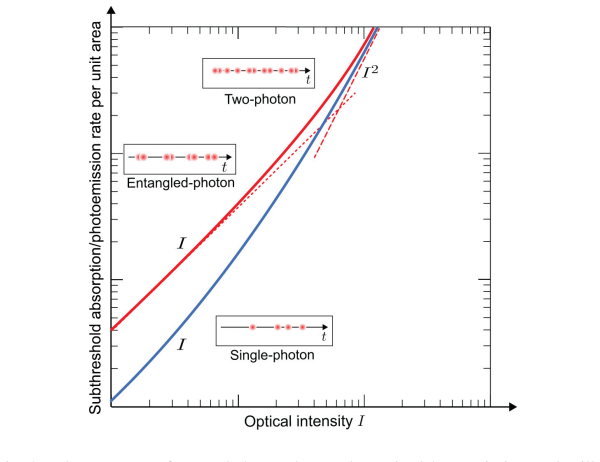
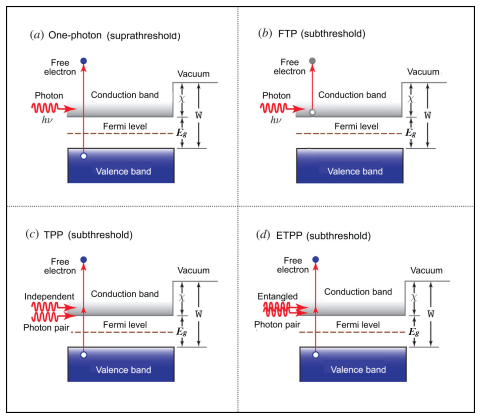
The classification of subthreshold processes into singleton-induced Boltzmann-tail, cousin-induced or pair-induced two-photon, and twin-induced entangled two-photon mechanisms, treated with both heuristic particle models and fully quantum models.
If this is right
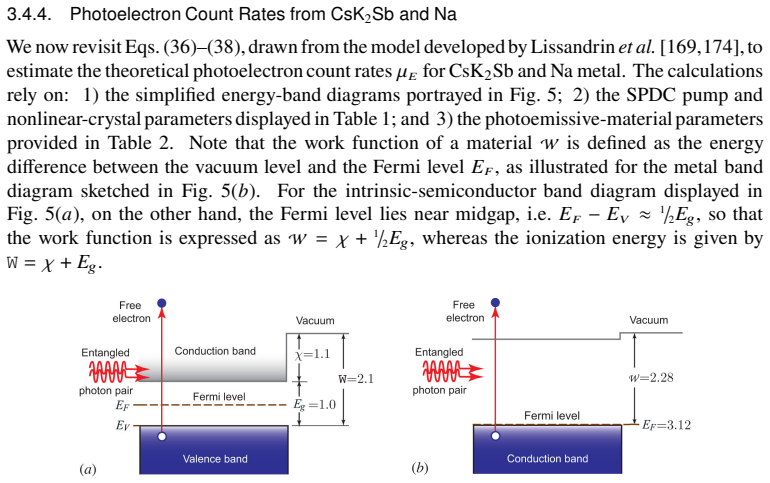
- Quantum models of TPP and ETPP reproduce the observed photocurrents and photoelectron count rates from CsK2Sb and Na photocathodes.
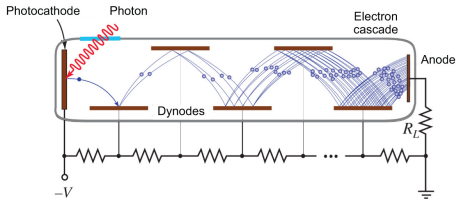
- A channel photomultiplier combined with low-intensity entangled illumination suppresses FTP and TPP enough to reveal ETPP.
- ETPA enables entangled-two-photon fluorescence microscopy and spectroscopy with the same suppression logic.
- The three forms of subthreshold absorption (singleton, cousin-pair, and twin) mirror the photoemission forms exactly.
Where Pith is reading between the lines
- The same suppression strategy could be adapted to other single-photon detectors to test entangled effects in different materials.
- Varying the degree of entanglement while holding intensity fixed would provide a direct test of the twin-induced term.
- These low-intensity quantum processes suggest routes to reduced sample damage in biological imaging compared with classical two-photon methods.
Load-bearing premise
That the measured rates under entangled illumination can be attributed to the entangled-pair mechanism rather than residual classical light or unsuppressed noise.
What would settle it
An experiment that measures photocurrent versus illumination intensity or correlation time under entangled-pair conditions and finds the dependence matches classical two-photon or residual one-photon predictions instead of the quantum entangled-pair model.
Figures











read the original abstract
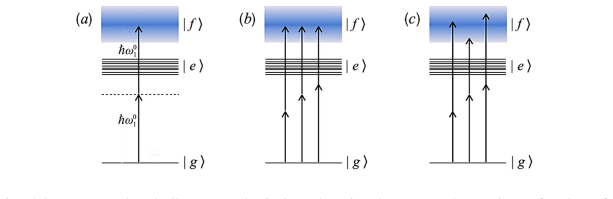
The phenomena of subthreshold photoemission and absorption under coherent and entangled-photon-pair illumination are reviewed, and the generation and properties of entangled-photon pairs are surveyed. Three prominent forms of subthreshold photoemission are examined: one-photon Fermi-tail photoemission (FTP), two-photon photoemission (TPP), and entangled-two-photon photoemission (ETPP). Experimental methods for measuring subthreshold photocurrents and photoelectron count rates are discussed, along with strategies for enhancing selected contributions. Experimental observations of FTP from a CsK$_2$Sb photocathode in a photomultiplier tube (PMT), under both coherent and entangled-photon-pair illumination, are reviewed, and the role of FTP as a noise source in two-photon measurements is elucidated. TPP from Na and CsK$_2$Sb photocathodes in a PMT under classical-light illumination is considered, as are TPP and ETPP from a CsK$_2$Sb photocathode in a channel photomultiplier (CPM) under coherent and entangled-photon-pair illumination. The observation of ETPP is facilitated by the use of a CPM, which suppresses FTP, and by low-intensity illumination, which minimizes TPP. Quantum models of TPP and ETPP accord well with experiment. Entangled-two-photon absorption (ETPA) is analyzed, as are its applications in entangled-two-photon fluorescence microscopy (ETPFM) and entangled-two-photon spectroscopy (ETPS). The three principal forms of subthreshold absorption parallel those of subthreshold photoemission: singleton-induced Boltzmann-tail absorption; cousin-induced/singleton-pair-induced two-photon absorption; and twin-induced ETPA. Heuristic particle and fully quantum models of these processes are compared, and experimental studies of ETPA and ETPFM, together with methods for enhancing their observability, are summarized.
Editorial analysis
A structured set of objections, weighed in public.
Referee Report
Summary. The manuscript reviews subthreshold photoemission and absorption under coherent and entangled-photon-pair illumination. It surveys the generation and properties of entangled photon pairs, examines three forms of subthreshold photoemission (FTP, TPP, and ETPP) from photocathodes such as CsK2Sb and Na in PMT and CPM detectors, discusses experimental methods for measuring photocurrents and strategies to enhance selected contributions, reviews observations under both coherent and entangled illumination, notes that ETPP observation is facilitated by CPM suppression of FTP and low-intensity minimization of TPP, states that quantum models of TPP and ETPP accord well with experiment, and analyzes ETPA along with its applications in ETPFM and ETPS, drawing parallels to the photoemission cases.
Significance. If the reviewed experimental attributions hold, the paper provides a useful synthesis of quantum-optical effects in photoemission and absorption, highlighting conditions for isolating entangled-photon contributions and their potential in microscopy and spectroscopy. The comparison of heuristic particle and fully quantum models, together with summaries of experimental studies, could serve as a reference point for the quantum optics community working on subthreshold processes.
major comments (1)
- The section reviewing experimental observations of ETPP from a CsK2Sb photocathode in a CPM under coherent and entangled illumination: the claim that ETPP is observed thanks to CPM suppression of FTP and low-intensity minimization of TPP is load-bearing for the central assertion that quantum models accord with experiment and that entangled effects are cleanly isolated. The review does not appear to include new quantitative bounds, side-by-side classical-vs-entangled model fits, or explicit error analysis showing that observed signals exceed residual classical two-photon or imperfectly suppressed FTP contributions at the same mean intensity and spectrum; reliance on prior literature leaves the uniqueness of the entangled attribution open to the concern raised in the stress-test note.
minor comments (1)
- The abstract is lengthy and dense in places; consider condensing the descriptions of the three parallel forms of subthreshold absorption to improve readability while retaining key points.
Simulated Author's Rebuttal
We thank the referee for their careful reading and for identifying this key point about the ETPP attribution in the review. We respond to the major comment below.
read point-by-point responses
-
Referee: The section reviewing experimental observations of ETPP from a CsK2Sb photocathode in a CPM under coherent and entangled illumination: the claim that ETPP is observed thanks to CPM suppression of FTP and low-intensity minimization of TPP is load-bearing for the central assertion that quantum models accord with experiment and that entangled effects are cleanly isolated. The review does not appear to include new quantitative bounds, side-by-side classical-vs-entangled model fits, or explicit error analysis showing that observed signals exceed residual classical two-photon or imperfectly suppressed FTP contributions at the same mean intensity and spectrum; reliance on prior literature leaves the uniqueness of the entangled attribution open to the concern raised in the stress-test note.
Authors: We agree that the manuscript is a review and therefore does not contain new experimental data, quantitative bounds, or model fits. The statements on ETPP isolation rest on the experimental conditions and supporting analyses already published in the cited works on CPM-based detection and intensity-dependent measurements. In the revised manuscript we have expanded the relevant section to provide more detailed summaries of those prior error analyses, intensity regimes, suppression factors, and model-to-data comparisons drawn directly from the literature. This makes the evidential basis and the role of the cited studies more explicit. As a review we cannot introduce new fits or bounds, but the added discussion should clarify how the entangled attribution is supported while remaining within the scope of the existing body of work. revision: partial
Circularity Check
Review paper presents no new derivations, predictions, or fitted models; circularity score 0
full rationale
This is a review surveying existing literature on subthreshold photoemission (FTP, TPP, ETPP) and absorption (ETPA) under coherent and entangled illumination. The abstract and structure explicitly state that phenomena are 'reviewed,' experimental observations from prior work are summarized, and 'quantum models of TPP and ETPP accord well with experiment' without introducing original equations, parameter fits, or predictions. No self-definitional steps, fitted inputs renamed as predictions, or load-bearing self-citations that reduce claims to unverified inputs appear. The central attribution of ETPP to entangled pairs via CPM and low intensity is presented as a summary of experimental strategy from the literature, not a new derivation. The paper is self-contained as a review against external benchmarks.
Axiom & Free-Parameter Ledger
Reference graph
Works this paper leans on
-
[1]
Über Elementarakte mit zwei Quantensprüngen [On elementa ry processes with two-quantum transitions],
M. Göppert-Mayer, “Über Elementarakte mit zwei Quantensprüngen [On elementa ry processes with two-quantum transitions],” Ann. Phys. 9, 273–295 (1931). (Göttinger Dissertation.) https://doi. org/10.1002/andp.19314010303
-
[2]
Stimulated optical radiation in ruby,
T. H. Maiman, “Stimulated optical radiation in ruby,” Nat ure 187, 493–494 (1960)
work page 1960
-
[3]
G eneration of optical harmonics,
P . A. Franken, A. E. Hill, C. W. Peters, and G. Weinreich, “G eneration of optical harmonics,” Phys. Rev. Lett. 7, 118–119 (1961)
work page 1961
-
[4]
T wo-photon excitation in C aF2:Eu2+ ,
W. Kaiser and C. G. B. Garrett, “T wo-photon excitation in C aF2:Eu2+ ,” Phys. Rev. Lett. 7, 229–231 (1961)
work page 1961
-
[5]
Interactions between light waves in a nonlinear dielectric,
J. A. Armstrong, N. Bloembergen, J. Ducuing, and P . S. Pers han, “Interactions between light waves in a nonlinear dielectric,” Phys. Rev. 127, 1918–1939 (1962)
work page 1918
-
[6]
Light waves at the bound ary of nonlinear media,
N. Bloembergen and P . S. Pershan, “Light waves at the bound ary of nonlinear media,” Phys. Rev. 128, 606–622 (1962)
work page 1962
-
[7]
Bloembergen, Nonlinear Optics (W
N. Bloembergen, Nonlinear Optics (W. A. Benjamin, New Y ork, 1965). (4th ed., World Scientific, Singapore, 1996)
work page 1965
-
[8]
Double-quant um photoelectric emission from sodium metal,
M. C. Teich, J. M. Schroeer, and G. J. Wolga, “Double-quant um photoelectric emission from sodium metal,” Phys. Rev. Lett. 13, 611–614 (1964)
work page 1964
-
[9]
T wo quantum photoemission and dc photomixin g in sodium,
M. C. Teich, “T wo quantum photoemission and dc photomixin g in sodium,” Ph.D. thesis, Cornell University, Ithaca, NY (1966). https://doi.org/10.5281/zenodo.15858946
-
[10]
T wo-quantum volume photoele ctric effect in sodium,
M. C. Teich and G. J. Wolga, “T wo-quantum volume photoele ctric effect in sodium,” Phys. Rev. 171, 809–814 (1968)
work page 1968
-
[11]
T wo-photon pho toelectric effect in Cs 3Sb,
H. Sonnenberg, H. Heffner, and W. Spicer, “T wo-photon pho toelectric effect in Cs 3Sb,” Appl. Phys. Lett. 5, 95–96 (1964)
work page 1964
-
[12]
B. E. A. Saleh and M. C. Teich, Fundamentals of Photonics (Wiley, Hoboken, 2019), 3rd ed
work page 2019
-
[13]
Multiphoton optical heterodyne detection ,
M. C. Teich, “Multiphoton optical heterodyne detection ,” IEEE J. Quantum Electron. QE-11, 595–602 (1975)
work page 1975
-
[14]
M. C. Teich and B. E. A. Saleh, Photon Bunching and Antibunching (North-Holland/Elsevier, Amsterdam, 1988), vol. 26 of Progress in Optics, chap. 1, pp. 1–104. https://doi.org/10.1016/S0079-6638 (08)70174-4
-
[15]
M. C. Teich and B. E. A. Saleh, “Squeezed states of light,” Quantum Opt. J. Eur. Opt. Soc. Part B 1, 153–191 (1989)
work page 1989
-
[16]
Observation of tunable optical parametric fluorescence,
S. E. Harris, M. K. Oshman, and R. L. Byer, “Observation of tunable optical parametric fluorescence,” Phys. Rev. Lett. 18, 732–735 (1967)
work page 1967
-
[17]
D. Magde and H. Mahr, “Study in ammonium dihydrogen phosp hate of spontaneous parametric interaction tunable from 4400 to 16 000 Å,” Phys. Rev. Lett. 18, 905–907 (1967). 101
work page 1967
-
[18]
Coherent photon decay in a nonlinear medi um,
D. N. Klyshko, “Coherent photon decay in a nonlinear medi um,” Sov. Phys. JETP Lett. 6, 23–25 (1967). Originally published in Zhurnal Eksperimental’noi i Teoreticheskoi Fiziki: Pisma v Redaktsiyu 6, 490–492 (1967)
work page 1967
-
[19]
Quantum theory of spont aneous parametric scattering of intense light,
T. G. Giallorenzi and C. L. Tang, “Quantum theory of spont aneous parametric scattering of intense light,” Phys. Rev. 166, 225–233 (1968)
work page 1968
-
[20]
Scattering of light in a medium with nonli near polarizability,
D. N. Klyshko, “Scattering of light in a medium with nonli near polarizability,” Sov. Phys. JETP 28, 522–526 (1969). Originally published in Zhurnal Eksperimental’noi i Teoreticheskoi Fiziki 55, 1006–1013 (1968)
work page 1969
-
[21]
Observation of simulta neity in parametric production of optical photon pairs,
D. C. Burnham and D. L. Weinberg, “Observation of simulta neity in parametric production of optical photon pairs,” Phys. Rev. Lett. 25, 84–87 (1970)
work page 1970
-
[22]
Antibunching i n the Franck–Hertz experiment,
M. C. Teich, B. E. A. Saleh, and D. Stoler, “ Antibunching i n the Franck–Hertz experiment,” Opt. Commun. 46, 244–248 (1983)
work page 1983
-
[23]
Role of primary excitation statistics in the generation of antibunched and sub-Poisson light,
M. C. Teich, B. E. A. Saleh, and J. Peřina, “Role of primary excitation statistics in the generation of antibunched and sub-Poisson light,” J. Opt. Soc. Am. B 1, 366–389 (1984)
work page 1984
-
[24]
Observation of sub-Poisso n Franck–Hertz light at 253.7 nm,
M. C. Teich and B. E. A. Saleh, “Observation of sub-Poisso n Franck–Hertz light at 253.7 nm,” J. Opt. Soc. Am. B 2, 275–282 (1985)
work page 1985
-
[25]
Observation of squeezed states generated by four-wave mi xing in an optical cavity,
R. E. Slusher, L. W. Hollberg, B. Yurke, et al., “Observation of squeezed states generated by four-wave mi xing in an optical cavity,” Phys. Rev. Lett. 55, 2409–2412 (1985). Erratum: 56, 788 (1986)
work page 1985
-
[26]
D. N. Klyshko, Photons and Nonlinear Optics (Gordon and Breach Science Publishers, New Y ork, 1988). Eng lish translation of the original Russian edition published by Na uka, Moscow, 1980
work page 1988
-
[27]
Transverse photon bunching and two-phot on processes in the field of parametrically scattered light,
D. N. Klyshko, “Transverse photon bunching and two-phot on processes in the field of parametrically scattered light, ” Sov. Phys. JETP 56, 753–759 (1982). Originally published in Zhurnal Eksperimental’noi i Teoreticheskoi Fiziki 83, 1313–1323 (1982)
work page 1982
-
[28]
Squeezed and antibunched l ight,
M. C. Teich and B. E. A. Saleh, “Squeezed and antibunched l ight,” Phys. Today 43 (6), 26–34 (1990). Erratum: 43 (11), 123 (1990)
work page 1990
-
[29]
Entanglement-based quantum information technology: A t utorial,
Z. Zhang, C. Y ou, O. S. Magaña-Loaiza, et al., “Entanglement-based quantum information technology: A t utorial,” Adv. Opt. Photonics 16, 60–162 (2024)
work page 2024
-
[30]
Nonlinear domain engineerin g for quantum technologies,
T. F. Weiss and A. Peruzzo, “Nonlinear domain engineerin g for quantum technologies,” Appl. Phys. Rev. 12, 011318 (2025)
work page 2025
-
[31]
Advances in position–momentum entanglement: A versatil e tool for quantum technologies,
S. Patil, R. Swarnkar, J. L. Moos, et al. , “ Advances in position–momentum entanglement: A versatil e tool for quantum technologies,” Laser & Photonics Rev. p. e01358 (20 26). https://doi.org/10.1002/lpor.202501358
-
[32]
Entanglement-induced two-photon transparency,
H.-B. Fei, B. M. Jost, S. Popescu, et al. , “Entanglement-induced two-photon transparency,” Phys. Rev. Lett. 78, 1679–1682 (1997)
work page 1997
-
[33]
Entangled-photon microsc opy (Mikroskopie s kvantově provázanými fotony),
M. C. Teich and B. E. A. Saleh, “Entangled-photon microsc opy (Mikroskopie s kvantově provázanými fotony),” Československý časopis pro fyziku 47, 3–8 (1997). https://doi.org/10.5281/zenodo.19793959
-
[34]
Superbunched bright squeezed vacuum state,
T. Sh. Iskhakov, A. M. Pérez, K. Yu. Spasibko, et al., “Superbunched bright squeezed vacuum state,” Opt. Lett. 37, 1919–1921 (2012)
work page 1919
-
[35]
Multiphoton effects enhanced due to ultrafast photon- number fluctuations,
K. Yu. Spasibko, D. A. Kopylov, V . L. Krutyanskiy, et al., “Multiphoton effects enhanced due to ultrafast photon- number fluctuations,” Phys. Rev. Lett. 119, 223603 (2017)
work page 2017
-
[36]
Properties of bright squeezed vacuum at increasing brigh tness,
P . R. Sharapova, G. Frascella, M. Riabinin, et al., “Properties of bright squeezed vacuum at increasing brigh tness,” Phys. Rev. Res. 2, 013371 (2020)
work page 2020
-
[37]
Die gegenwärtige Situation in der Quan tenmechanik,
E. Schrödinger, “Die gegenwärtige Situation in der Quan tenmechanik,” Naturwissenschaften 23, 807–812; 823– 828; 844–849 (1935). Translated by J. D. Trimmer, “The prese nt situation in quantum mechanics: A translation of Schrödinger’s ‘cat paradox’ paper,” Proc. Am. Phil. Soc. 124, 323–338 (1980). Reprinted in J. A. Wheeler and W. H. Zurek, eds., Quantum ...
work page 1935
-
[38]
D. Bohm, Quantum Theory (Prentice-Hall, Englewood Cliffs, New Jersey, 1951). Chap. 22: “Quantum Theory of Measurement”
work page 1951
-
[39]
On the Einstein–Podolsky–Rosen paradox,
J. S. Bell, “On the Einstein–Podolsky–Rosen paradox,” P hysics-Physique-Fizika 1, 195–200 (1964)
work page 1964
-
[40]
Pro posed experiment to test local hidden-variable theories,
J. F. Clauser, M. A. Horne, A. Shimony, and R. A. Holt, “Pro posed experiment to test local hidden-variable theories,” Phys. Rev. Lett. 23, 880–884 (1969). Erratum: Phys. Rev. Lett. 24, 549 (1970)
work page 1969
-
[41]
B. E. A. Saleh, Quantum Photonics: Bimodes, Qubits, and Biphotons (Springer, Cham, 2025)
work page 2025
-
[42]
Quantum fluct uations and noise in parametric processes. I
W. H. Louisell, A. Y ariv, and A. E. Siegman, “Quantum fluct uations and noise in parametric processes. I.” Phys. Rev. 124, 1646–1654 (1961)
work page 1961
-
[43]
Field statistics in p arametric luminescence,
B. Y . Zel’dovich and D. N. Klyshko, “Field statistics in p arametric luminescence,” Sov. Phys. JETP Lett. 9, 40–43 (1969). Originally published in Zhurnal Eksperimental’noi i Teoreticheskoi Fiziki: Pisma v Redaktsiyu 9, 69–72 (1969)
work page 1969
-
[44]
Experimental test s of realistic local theories via Bell’s theorem,
A. Aspect, P . Grangier, and G. Roger, “Experimental test s of realistic local theories via Bell’s theorem,” Phys. Rev . Lett. 47, 460–463 (1981)
work page 1981
-
[45]
Experimental test s of Bell’s inequalities using time-varying analyzers,
A. Aspect, J. Dalibard, and G. Roger, “Experimental test s of Bell’s inequalities using time-varying analyzers,” Ph ys. Rev. Lett. 49, 1804–1807 (1982)
work page 1982
-
[46]
Nobel Committee for Physics, “Scientific background on t he Nobel Prize in Physics: For experiments with entangled photons, establishing the violation of Bell inequalities a nd pioneering quantum information science,” Tech. Rep. https://www.nobelprize.org/uploads/2023/10/advanced-physicsprize2022-4.pdf , The Royal Sweedish Academy of Sciences, Stockholm (2022)
work page 2023
-
[47]
Can quantum-mec hanical description of physical reality be considered 102 complete?
A. Einstein, B. Podolsky, and N. Rosen, “Can quantum-mec hanical description of physical reality be considered 102 complete?” Phys. Rev. 47, 777–780 (1935)
work page 1935
-
[48]
Violation of Bell’s inequality with continuous spatial variables,
A. F. Abouraddy, T. Y arnall, B. E. A. Saleh, and M. C. Teich, “Violation of Bell’s inequality with continuous spatial variables,” Phys. Rev. A 75, 052114 (2007)
work page 2007
-
[49]
Experimental violation of Bell’s inequality in spatial-parity space,
T. Y arnall, A. F. Abouraddy, B. E. A. Saleh, and M. C. Teich , “Experimental violation of Bell’s inequality in spatial-parity space,” Phys. Rev. Lett. 99, 170408 (2007)
work page 2007
-
[50]
Spatial-to-spectral mapping in spontaneous parametric down-conversion,
S. Carrasco, J. P . Torres, L. Torner,et al., “Spatial-to-spectral mapping in spontaneous parametric down-conversion,” Phys. Rev. A 70, 043817 (2004)
work page 2004
-
[51]
Spectral engineering of entangled two-photon states,
S. Carrasco, A. V . Sergienko, B. E. A. Saleh, et al., “Spectral engineering of entangled two-photon states,” P hys. Rev. A 73, 063802 (2006)
work page 2006
-
[52]
Broadband light generation by noncollinear parametric d owncon- version,
S. Carrasco, M. B. Nasr, A. V . Sergienko, et al., “Broadband light generation by noncollinear parametric d owncon- version,” Opt. Lett. 31, 253–255 (2006)
work page 2006
-
[53]
Observation of paramet ric luminescence in a lithium niobate crystal excited by an argon laser,
D. N. Klyshko and D. P . Krindach, “Observation of paramet ric luminescence in a lithium niobate crystal excited by an argon laser,” Sov. Phys. JETP 27, 371–373 (1968). Originally published in Zhurnal Eksperimental’noi i Teoreticheskoi Fiziki54, 697–700 (1968)
work page 1968
-
[54]
Quasi -phase-matched second harmonic generation: tuning and tolerances,
M. M. Fejer, G. A. Magel, D. H. Jundt, and R. L. Byer, “Quasi -phase-matched second harmonic generation: tuning and tolerances,” IEEE J. Quantum Electron. 28, 2631–2654 (1992)
work page 1992
-
[55]
Measurement of subpic osecond time intervals between two photons by interference,
C. K. Hong, Z. Y . Ou, and L. Mandel, “Measurement of subpic osecond time intervals between two photons by interference,” Phys. Rev. Lett. 59, 2044–2046 (1987)
work page 2044
-
[56]
T wo-photon interference in a Mach-Zehnder interferomet er,
J. G. Rarity, P . R. Tapster, E. Jakeman, et al., “T wo-photon interference in a Mach-Zehnder interferomet er,” Phys. Rev. Lett. 65, 1348–1351 (1990)
work page 1990
-
[57]
Interfering entangled photons of different colors,
T. S. Larchuk, R. A. Campos, J. G. Rarity, et al., “Interfering entangled photons of different colors,” Phys . Rev. Lett. 70, 1603–1606 (1993)
work page 1993
-
[58]
Statistics of entangled-photon coincidences in parametric down- conversion,
T. S. Larchuk, M. C. Teich, and B. E. A. Saleh, “Statistics of entangled-photon coincidences in parametric down- conversion,” Ann. New Y ork Acad. Sci. 755, 680–686 (1995)
work page 1995
-
[59]
New high-intensity source of polarization-entangled ph oton pairs,
P . G. Kwiat, K. Mattle, H. Weinfurter, et al., “New high-intensity source of polarization-entangled ph oton pairs,” Phys. Rev. Lett. 75, 4337–4341 (1995)
work page 1995
-
[60]
Optical harmonics and nonli near phenomena,
P . A. Franken and J. F. Ward, “Optical harmonics and nonli near phenomena,” Rev. Mod. Phys. 35, 23–39 (1963)
work page 1963
-
[61]
G. Di Giuseppe, M. Atatüre, M. D. Shaw, et al., “Entangled-photon generation from parametric down-conv ersion in media with inhomogeneous nonlinearity,” Phys. Rev. A 66, 013801 (2002)
work page 2002
-
[62]
D. S. Hum and M. M. Fejer, “Quasi-phasematching,” Compte s Rendus Physique8, 180–198 (2007). (Special Journal Issue: Recent advances in crystal optics/Avancées récente s en optique cristalline)
work page 2007
-
[63]
Phase matching by periodic modulation of the nonlinear optical properties,
S. Somekh and A. Y ariv, “Phase matching by periodic modulation of the nonlinear optical properties,” Opt. Commun. 6, 301–304 (1972). https://doi.org/10.1016/0030-4018(72 )90200-3
-
[64]
Quasi-phase-matched optical parametric oscillators in bulk periodically poled LiNbO 3,
L. E. Myers, R. C. Eckardt, M. M. Fejer, et al. , “Quasi-phase-matched optical parametric oscillators in bulk periodically poled LiNbO 3,” J. Opt. Soc. Am. B 12, 2102–2116 (1995)
work page 1995
-
[65]
Engineering entangled-photon states using two- dimensional PPLN crystals,
H. G. de Chatellus, G. Di Giuseppe, A. V . Sergienko, et al. , “Engineering entangled-photon states using two- dimensional PPLN crystals,” in Photon Management, vol. 5456, F. Wyrowski, ed., International Society for Opti cs and Photonics (SPIE, 2004), pp. 75–80
work page 2004
-
[66]
H. Guillet de Chatellus, A. V . Sergienko, B. E. A. Saleh, a nd M. C. Teich, “Non-collinear and non-degenerate polarization-entangled photon generation via concurrent type-I parametric downconversion in PPLN,” Opt. Express 14, 10060–10072 (2006)
work page 2006
-
[67]
Properties of entangled photon pairs generated in periodically poled nonlinear crystals,
J. Svozilík and J. Peřina, Jr., “Properties of entangled photon pairs generated in periodically poled nonlinear crystals,” Phys. Rev. A 80, 023819 (2009)
work page 2009
-
[68]
D. S. Hum, R. K. Route, G. D. Miller, et al., “Optical properties and ferroelectric engineering of vap or-transport- equilibrated, near-stoichiometric lithium tantalate for frequency conversion,” J. Appl. Phys. 101, 093108 (2007)
work page 2007
-
[69]
H. J. Lee, H. Kim, M. Cha, and H. S. Moon, “Generation of bri ght visible photon pairs using a periodically poled stoichiometric lithium tantalate crystal,” Opt. Express 23, 14203–14210 (2015)
work page 2015
-
[70]
C. E. Kuklewicz, M. Fiorentino, G. Messin, et al. , “High-flux source of polarization-entangled photons from a periodically poled KTiOPO 4 parametric down-converter,” Phys. Rev. A 69, 013807 (2004)
work page 2004
-
[71]
Variations on the theme of quantum optical coherence tomography: A review,
M. C. Teich, B. E. A. Saleh, F. N. C. Wong, and J. H. Shapiro,“Variations on the theme of quantum optical coherence tomography: A review,” Quantum Inf. Process. 11, 903–923 (2012)
work page 2012
-
[72]
Demonstration of dispersion-canceled quantum-optical coherence tomography,
M. B. Nasr, B. E. A. Saleh, A. V . Sergienko, and M. C. Teich,“Demonstration of dispersion-canceled quantum-optical coherence tomography,” Phys. Rev. Lett. 91, 083601 (2003)
work page 2003
-
[73]
M. B. Nasr, G. Di Giuseppe, B. E. A. Saleh, et al., “Generation of high-flux ultra-broadband light by bandwid th amplification in spontaneous parametric down conversion,” Opt. Commun. 246, 521–528 (2005)
work page 2005
-
[74]
Ultrabroadband entangled photons on a nanophotonic chip ,
U. A. Javid, J. Ling, J. Staffa, et al., “Ultrabroadband entangled photons on a nanophotonic chip ,” Phys. Rev. Lett. 127, 183601 (2021)
work page 2021
-
[75]
Integrated, bright broadband, two-colour parametric do wn-conversion source,
R. Pollmann, F. Roeder, V . Quiring, et al., “Integrated, bright broadband, two-colour parametric do wn-conversion source,” Opt. Express 32, 23945–23955 (2024)
work page 2024
-
[76]
Ultra-broadband non-degenerate guided-wave bi-photon source in the near and mid-infrared,
F. Roeder, A. Gnanavel, R. Pollmann, et al., “Ultra-broadband non-degenerate guided-wave bi-photon source in the near and mid-infrared,” New J. Phys. 26, 123025 (2024)
work page 2024
-
[77]
S. Carrasco, J. P . Torres, L. Torner,et al., “Enhancing the axial resolution of quantum optical cohere nce tomography by chirped quasi-phase matching,” Opt. Lett. 29, 2429–2431 (2004). 103
work page 2004
-
[78]
M. B. Nasr, S. Carrasco, B. E. A. Saleh,et al., “Ultrabroadband biphotons generated via chirped quasi-p hase-matched optical parametric down-conversion,” Phys. Rev. Lett. 100, 183601 (2008)
work page 2008
-
[79]
M. B. Nasr, O. Minaeva, G. N. Goltsman, et al. , “Submicron axial resolution in an ultrabroadband two-pho ton interferometer using superconducting single-photon dete ctors,” Opt. Express 16, 15104–15108 (2008)
work page 2008
-
[80]
N. Mohan, O. Minaeva, G. N. Goltsman, et al. , “Ultrabroadband coherence-domain imaging using paramet ric downconversion and superconducting single-photon detectors at 1064 nm,” Appl. Opt. 48, 4009–4017 (2009)
work page 2009
discussion (0)
Sign in with ORCID, Apple, or X to comment. Anyone can read and Pith papers without signing in.